Week 3
Rachels reading
distinction between active and passive euthinasia is though tto be crucial for medical ethics. it is thought that in some casses it is permiseble to withold treatment and allow a patient to die but its is never permissible to kill a patient (a strong case can be made against this). for example a patient that is dying of an incurable cancer and who is in terrible pain if the doctor witholds treatment the patient would be in alot of pain and since the patient will die anyway why are we prolonging his suffering. when the dessicion to end suffereing is made active euthanasia is preffered to passive authenasia.
The fact that the idea of the situation is just one of life or death is completly wrong and is another reason why we need to revisit euthinasia. Peope think that there is a moral diff betweenactive and passive euthenasia but is reality they are the same take fore example these two casses:
Smith stands to gain a large inheritance if anything should happen to his six-year-old cousin. One evening while the child is taking his bath, Smith sneaks in-to the bathroom and drowns the child, and then arranges things so that it will look like an accident.
Jones also stands to gain if anything should happen to his six-year-old cousin. Like Smith, Jones sneaks in planning to drown the child in his bath. However, just as he enters the bathroom Jones sees the child slip and hits his head, and falls face down into the water. Jones is delighted; he stands by, ready to push the child's head back under if it is necessary, but it is not necessary. With only a little thrashing about, the child drowns all by himself, "accidentally," as Jones watches and does nothing.
Smith killed the child but jones let the child die. did one behave better from a moral point of view. if letting someone die is less bad then killing then jones should have some weight to his reasoning but he doesent.
Most actually casses of killing are terrible (like murder) and we hear these casses more often then those where people just let something happen and didint do anything about it so we are more conditioned to think that killing is worse because its jammed into our brains more even though killing is not really any worst then letting someone die. and therefore active euthenasia is no different then passive. and even in passive euthenasia the physician still does one thing … letting the person die. we only think active euthenasia is bad since death is regarded as evil. and by the active euthanasia is forbidden when passive euthenasia is permissible.
Dieterle reading
One of the most common forms of arguments of PAS is the possible negative consequences of it. the arguments rely on things that COULD happen in the future / howlikely can it be realised. The netherlands legalized active euthanasia at the same time as PAS. PAS is different as the patient him / herself is the instigator of death when active euthinasia it is the physician that does it. are guments of PAS are based on moral right or wrongness (empirical data). how ever no amount of emperical data could support nor refute the arguments.
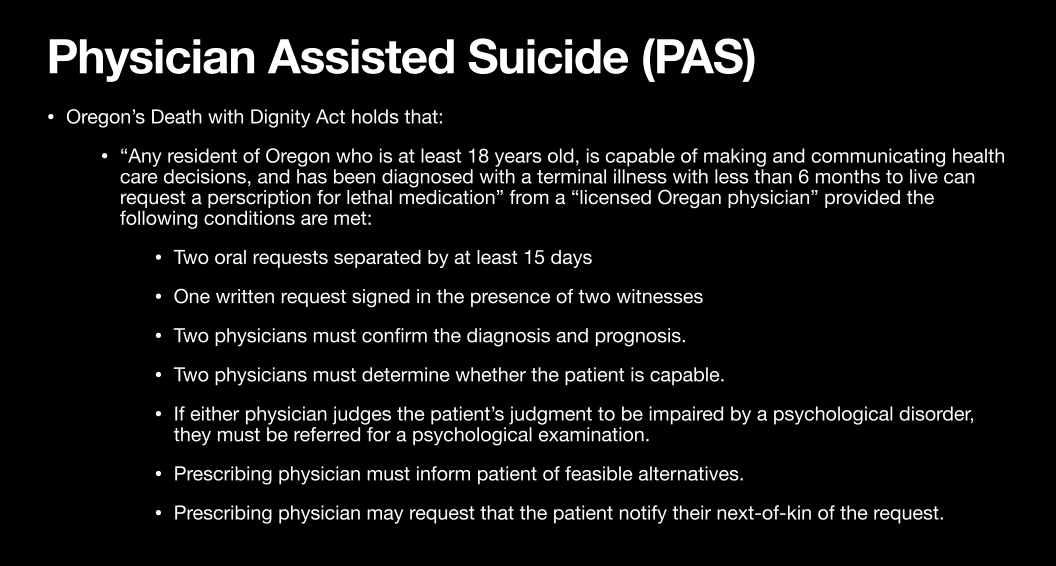
Oregon has a a death with dignity act where people who are 18+, diagnosed with a terminal illness with less then 6 months to live can request a prescription for lethal medication. to get the medication they need to complete these
patient must make two oral requests to his or her physician, separated by at least 15 days.
patient must provide a written request
prescribing physician and a consulting physician must confirm the diagnosis and prognosis.
prescribing physician and a consulting physician must determine whether the patient is capable.
either physician believes the patient’s judgment is impaired by a psychiatric or psychological disorder, the patient must be referred for a psychological examination.
prescribing physician must inform the patient of feasible alternatives
prescribing physician must request, but may not require, the patient to notify his or her next-of-kin of the prescription request
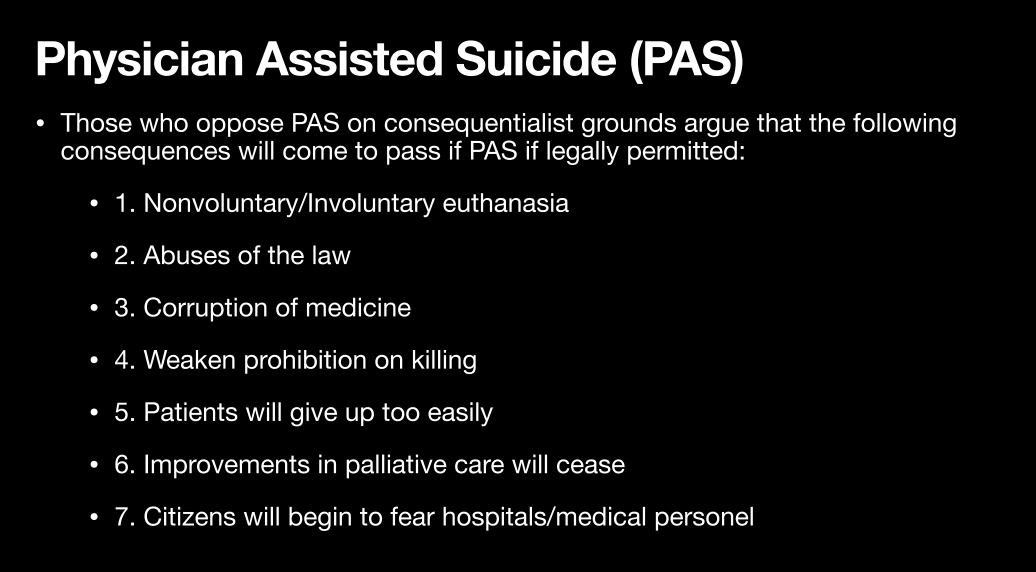
estimated consequences of legalising PAS are
If we legalize PAS, we will start down the slippery slope to nonvoluntary euthanasia and eventually we will end up with a social policy endorsing involuntary euthanasia.
Abuses : patients might be pressured by family members or insurance companies to seek PAS ,vulnerable groups will be more likely to take advantage of PAS, people without insurance will request PAS because they don’t see that they have other options
PAS will corrupt medicine and its practitioners
Acceptance of PAS will weaken the prohibition on killing
Patients will give up too easily
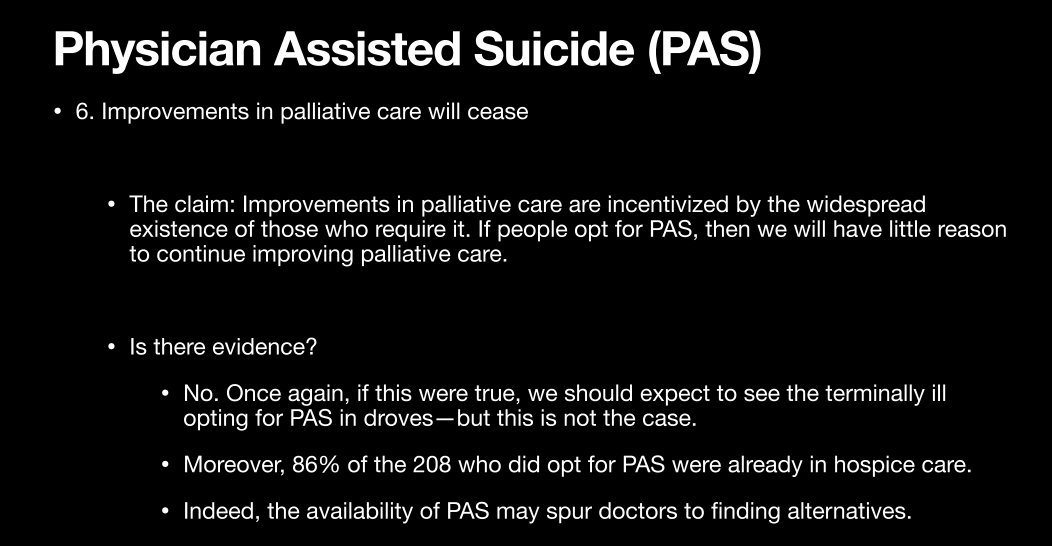
Improvements in palliative and terminal care will cease
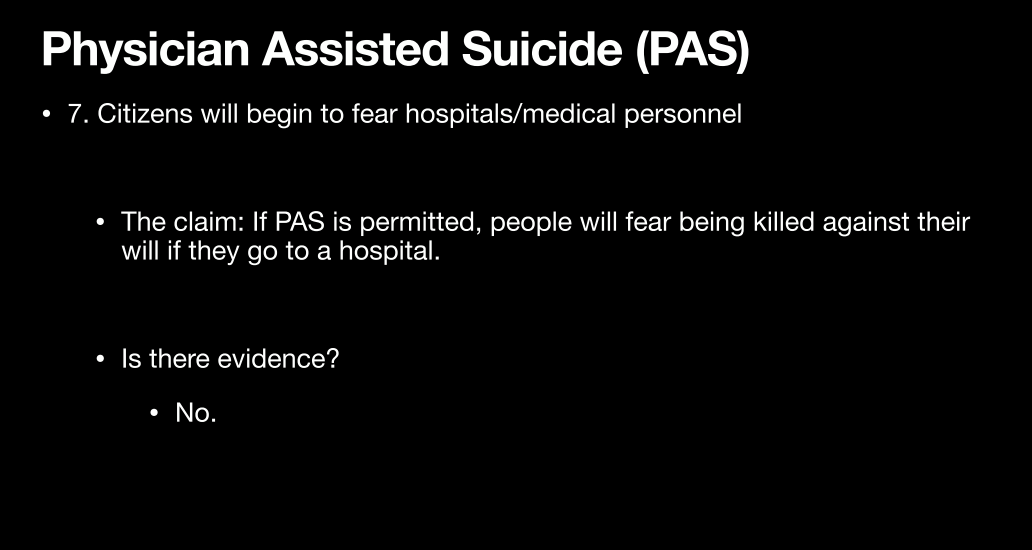
Citizens will begin to fear hospitals and medical personnel
A person that is hopelessly ill may be allowed to take their own life and it is then a short step from voluntary euthanasia or directed euthanasia. oregon will create a law or expand the law so nonvolentary euthenasia is permissible. the overwhelming majority of these cases involve refusal to treatment so basically giving a patient a high dose of morphine for pain knowing that it could hasten death (this is legal outside the netherlands). can we see a slippery slope case in the the netherlands where PAS is legal. no. with the legalisation in the netherlands the wanted of PAS decrease in patients. and because of the legalisation and the rules in place they have acc become more restrictive with euthanasia. if the practice is legal and out in the open it is easier to put safeguards in place and make sure they are followed.
there have been no allagations that insurence compagnies have presured anyone into PAs and there is no real evidence that people are being abused/pushed by their familiy to use it althought it might be more common. most of the time people feel like a burden to the family and or their caregivers and so they ask for PAS. Request for assisted suicide was less likely to be honored if the patient is perceived to be suicidal/ feel like a burden to others. in all 50 states the patient have the right to refuse treatment and are allowed to die (passive euthenasia). trefusing treatment is more likely to be abused by familly members and trying to cororce them not to take the medicine / help to get better.
allowing a patient to die is a negative right
allowing a patient to PAS is a positive right
but what needs to be noted is that every social policy has the potential for abuse. and so we need to try and forsee posible abuses and put controls in place so they happen rarely.
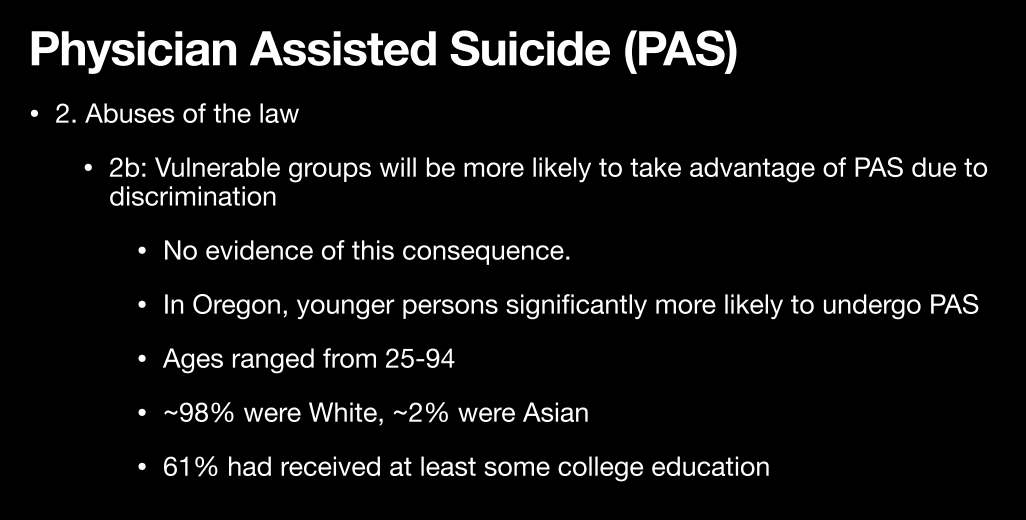
the prediction that vunerable groups like the elderly or poor with abuse the PAS is not true. it was seen that younger adults are more likely to use it. and these patients that ask for PAS are educated.
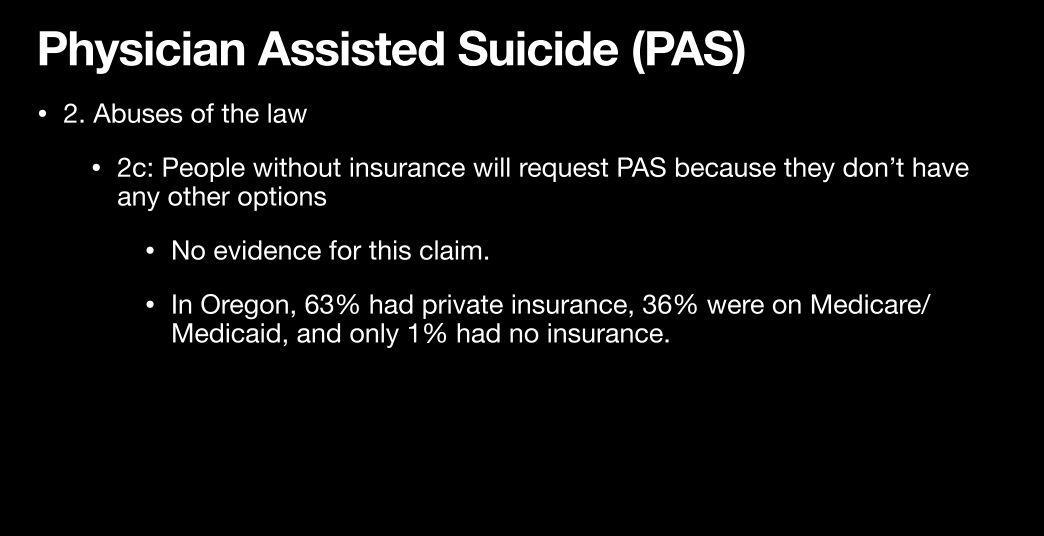
the prediction that people with no insurence will use PAS as an out is also wrong infact terminal care has since improuved
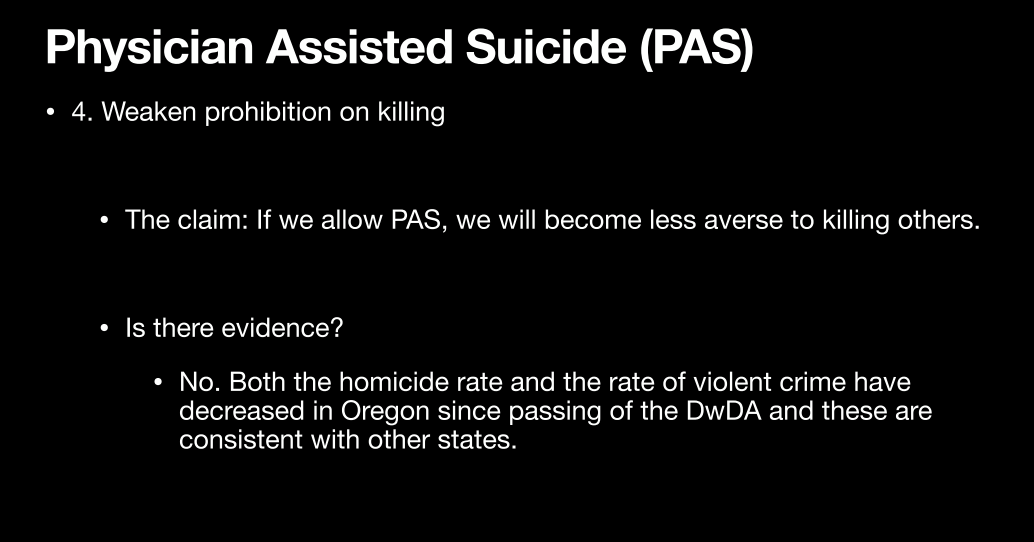
if acceptance of PAS will weaken prohinition killing we would see an increase in homicide rate but we havent seen this increase and acc the homicide rate goes down but we cannot isolate the casual factors involved.
Patients giving up easily because PAS can be a way out also tunred out to be wrong. only terminally ill patients took medication PAS and the people that wanted PAs are not depressed or had no hope. allowing PAs actually gives people more hope because if life were to become unbearable they have a option.
the prediction that palliative and terminal care will go down is also wrong.
the prediction that citizens will fear hospitals and medical personnel is also wrong. this is a slippery slope argument.
Normally there are underground practices in places that dont have PAS legalisation. there has been a significant decrease in the willingness of physicians to end the life of a patient without his or her explicit request.
Wolf (feminist) predicted that women would seek out PAS more often then men as they might have diff reasons to request PAS. historically women are less likely to get adequete pain releif and have hogher rates of depression. women are also seen as more self sacrificing then men and so the womens consent might not be totally autonomous. so we should ensure that physician able to use PAS are aware of gender issues.
in the hippocratic oath it says doctors should not kill as this is prohibited. however words cannot dictate medical ethics or physicians duties when PAS is available and healing / cure is not available why would we allow the patient to suffer. a case counts as passive euthanasia only if there is a cure. also killing is inherently wrong and since the physician is giving the medication they are “killing”. many a times we hear that killing is against gods wills but no one should be bound by another religion. a human does have a natural inclination to continue to live and viloence goes against our natural instincts of survival. but we shouldent just assume that we shouldent have PAs just because its not the way we work in nature.
Bullock Reading
One common argument for the moral permissibility of assisted dying is that it constitutes respect for individual autonomy. Individuals are thought to have a right to shape their own lives through their choices, and this is taken to include the right of patients to choose the manner of their death. The so-called “right to die” is therefore derived from a more general right to direct the course of one’s own life. This idea can be traced to the rise of the doctrine of informed consent and the recognized right to refuse medical treatment. For consent to be valid, the patient must be fully informed of the nature, benefits, and risks of each procedure, and her consent or refusal must be freely chosen.
The concept of autonomy is vague and has different meanings in different contexts. In medical ethics, respect for patient autonomy is commonly understood as respect for self-determination. On this view, autonomy protects the patient’s well-being by allowing her to make choices that shape her life according to her own conception of the good life. When patients are competent and have access to relevant information, they are often considered the best judges of what is in their own interests and of whether the benefits of a proposed treatment outweigh its burdens. As a result, the actions physicians can legitimately take are thought to be determined by the autonomous decisions of their patients. Respect for self-determination is thus defended as the best means of promoting well-being.
Much of the literature challenges this focus on patient self-determination by arguing that patients’ choices are often not genuinely self-determined. Patients are frequently poor decision-makers and rarely make decisions that meaningfully direct their lives. Their decision-making is impaired by numerous cognitive influences, and they are often unable to predict their reactions to future emotional states. As a result, patients often lack the capacities that proponents of self-determination assume they possess. The desirability of making medical decisions may even decrease as illness becomes more severe.
Decision-making is further weakened by the fact that irrelevant suggestions can alter a patient’s assessment of options, and external influences on decisions are unavoidable. This recognition has led to the development of decision-making models such as “nudge” paternalism. These models aim to make it harder for patients to choose options they themselves judge to be detrimental to their best interests, and easier to choose options they judge to be beneficial. Rather than abandoning patients to their decisions, medical practitioners are encouraged to advise and support them on the basis that patients would likely decide differently in the absence of cognitive hindrances.
Given these concerns, there are two possible responses to the argument from autonomy for the moral permissibility of assisted dying. One option is to deny that assisted dying is ever permissible, given patients’ limited decision-making abilities. The other option is to revise the role that autonomy plays in end-of-life decision-making. On this revised view, whether it is in a patient’s best interests to die should be determined objectively, rather than solely by the patient’s self-determining choices.
On this account, patient autonomy functions as a permission or side-constraint on action. Whether assisted dying is permissible depends both on objective facts about the patient’s best interests and on the presence of the patient’s consent. A patient’s best interests should be understood independently of her self-determining choices and grounded in an objective theory of well-being. Such theories identify what contributes to well-being in ways that are not entirely dependent on individual preferences or desires, allowing that something may benefit a patient even if it conflicts with her expressed wishes. As a result, a medical decision that is in a patient’s best interests may not always involve respecting her self-determination.
A central concern about objective list accounts of well-being is that they are too rigid to account for differences in individual values and interests. Critics argue that these accounts fail to capture what truly matters to individuals. The challenge is to allow for variation in individual well-being while still identifying well-being independently of subjective experiences and desires. One response is to adopt a subject-related objective theory of well-being that assesses what is objectively good for a particular individual. Even if self-determination appears on such a list, this does not imply that it should always be respected. Instead, self-determination becomes one good among many, and the ordering of goods can vary depending on the circumstances.
A theory of well-being that determines whether it is objectively good or bad for a patient to die aligns with common intuitions and practices regarding assisted dying. However, determining permissibility cannot rest solely on objective best interests. There are serious concerns about allowing others to act on individuals without regard for their wishes. This is why patient autonomy remains important as a side-constraint, particularly in life-and-death decisions. Justifications for autonomy as a constraint are both legal and moral, including the idea that individuals have ownership over their bodies and that medical practice routinely involves actions that would otherwise violate fundamental rights.
When patient autonomy is understood as a side-constraint, assisted dying may be justified only if the patient has autonomously consented. Thus, two necessary conditions for permissible assisted dying are identified:
(a) assisted dying is in the objective best interests of the patient, and
(b) assisted dying has been consented to by the patient.
Determining whether assisted dying is in the patient’s best interests will still involve communication with the patient and acknowledgment of her self-determination. The consent requirement provides an important restriction and more accurately reflects the legal role of informed consent in medical decision-making.
Lecture 20th
Every time you read an article ask, what is the topic of this article? What is the question they're trying to answer? How do they answer this question? What reasons do they give in support of that answer?What is the thesis I'm giving in response to this question What are the reasons I'm using to support that thesis?
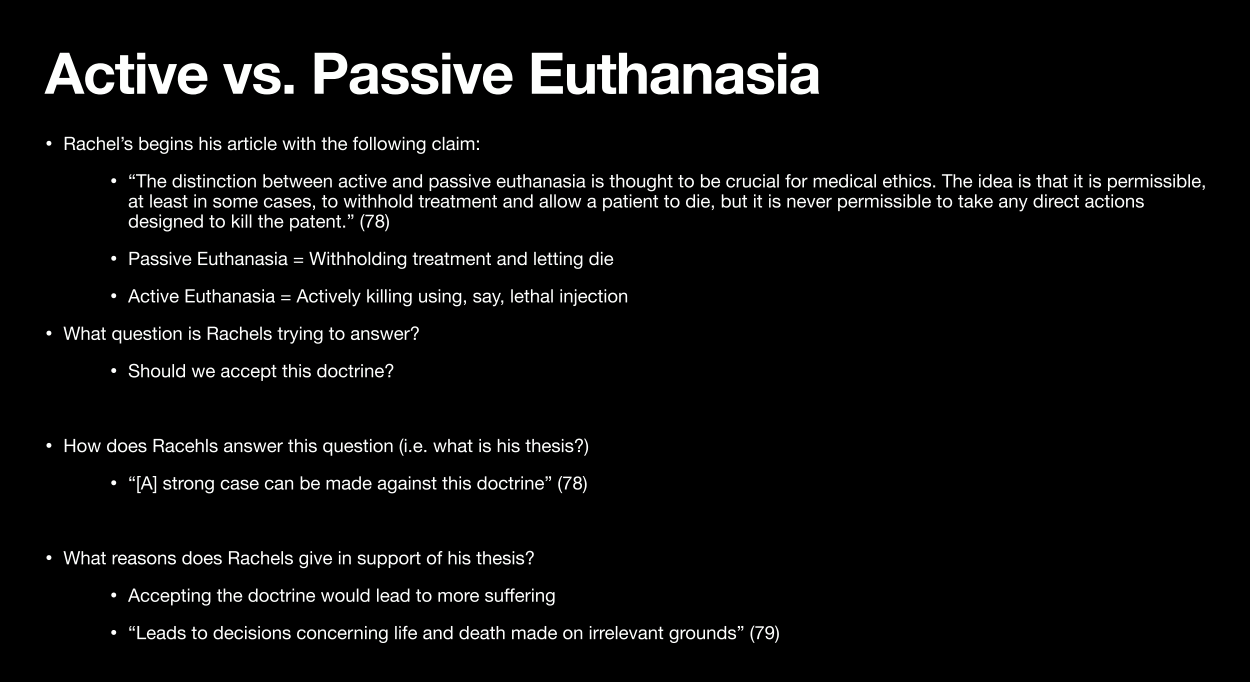
Rachel says the distinction between active and passive euthanasia is thought to be crucial for medical ethics. The idea is that it is permissible, at least in some cases, to withhold treatment and allow a patient to die. But it is never permissible to take direct actions designed to kill the patient.
Passive euthanasia is this idea of withholding and letting somebody die. I am engaging in passive euphanasia if you are suffering from a terminal illness that causes you great pain and rather than prolong your suffering, I withhold treatment from you in a way that hastens your death and allows you to be relieved of that suffering faster. Active euthanasia is going to be taking some active step to try and hasten your debt. So instead of merely withholding treatment, I additionally offer you some injection or some medication that makes it so that you die quicker than you otherwise.
so what question is Rachel's trying to answer? He's trying to answer the question, should we accept this doctrine, this doctrine that draws a distinction, a morally relevant distinction, between active and passive eating that says one of them is permissible? Should we accept this doctrine as a sort of guiding principle for medical ethics or the institution of medicine? How does Rachel answer this thesis?
So the goal of this paper is going to be to show us why we shouldn't accept any sort of morally relevant distinction between these two points of euthanasia.What reasons does he give in support of this? There's two arguments. The first argument is going to say something to the effect of accepting this doctrine would actually lead to more suffering and insofar as we think suffering is, like, definitionally bad, that we should be doing everything we can to prevent suffering. If accepting this doctrine means that more suffering would occur, then we should reject the doctrine. The secondary, I also rejecting the doctrine to say you think it, quote, leads to decisions concerning life and death made on irrelevant ground. So basically, if we accept this doctrine, we actually end up engaging in a lot of sort of, like, implausible or malicious reasoning about when, when and when not to perform certain kinds of treatments on people suffering from homeless.
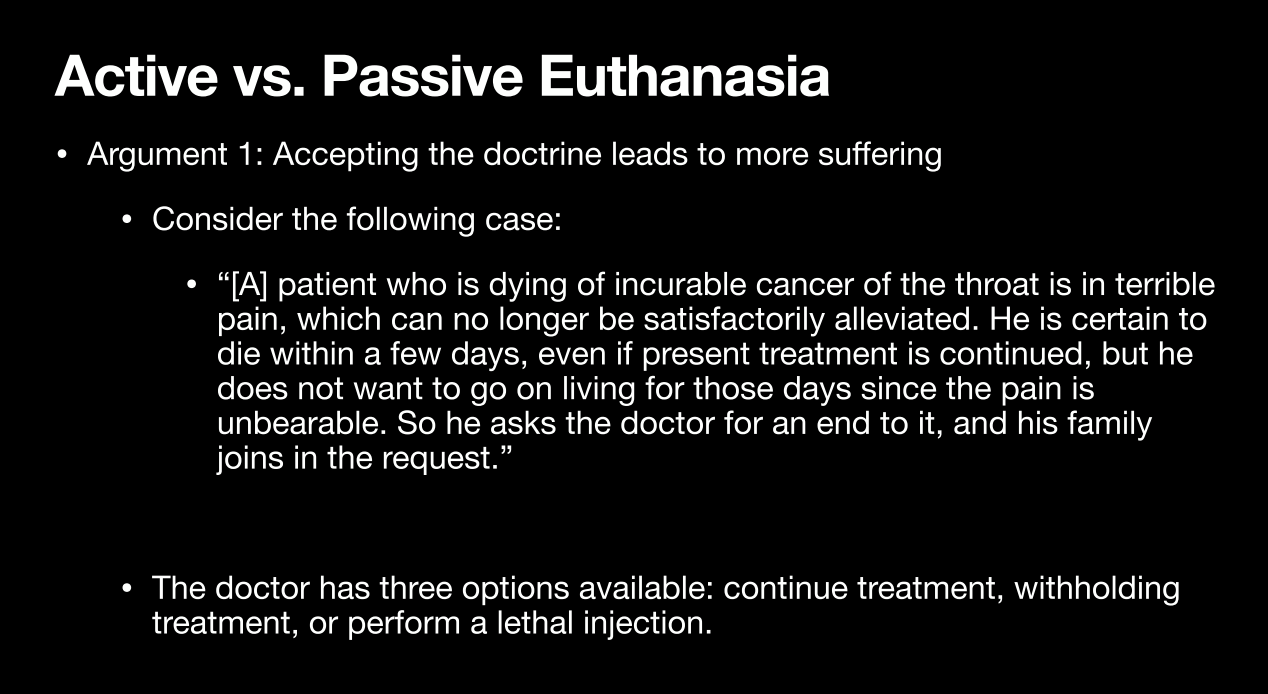
Okay, let's get into it. So the first argument, Rachel's test is that accepting the doctrine that draws a distinction between active capacity euthanasia is going to lead to more suffering. he says, quote, a patient who is dying of incurable cancer throat is in terrible pain which can no longer be satisfactory. He is certain to die within a few days. Even at present, treatment has continued. But he does not want to go on living for those those days since the pain is unbearable. he asked the doctor for an end to it in his family joins the request. this seems like a pretty typical case in which someone was requesting euthanasia.They're suffering from great pain, this pain is terminal, treatment is not going to alleviate it and therefore they ask for put into their pain.Let's say that the doctor has three options available in response to this kind of case.Either the doctor can continue treatments or the doctor can hold treatment, or the doctor can perform a legal gift. These are the three options available and we're trying to figure out what is the sort of morally best option and or which options are morally permissible.
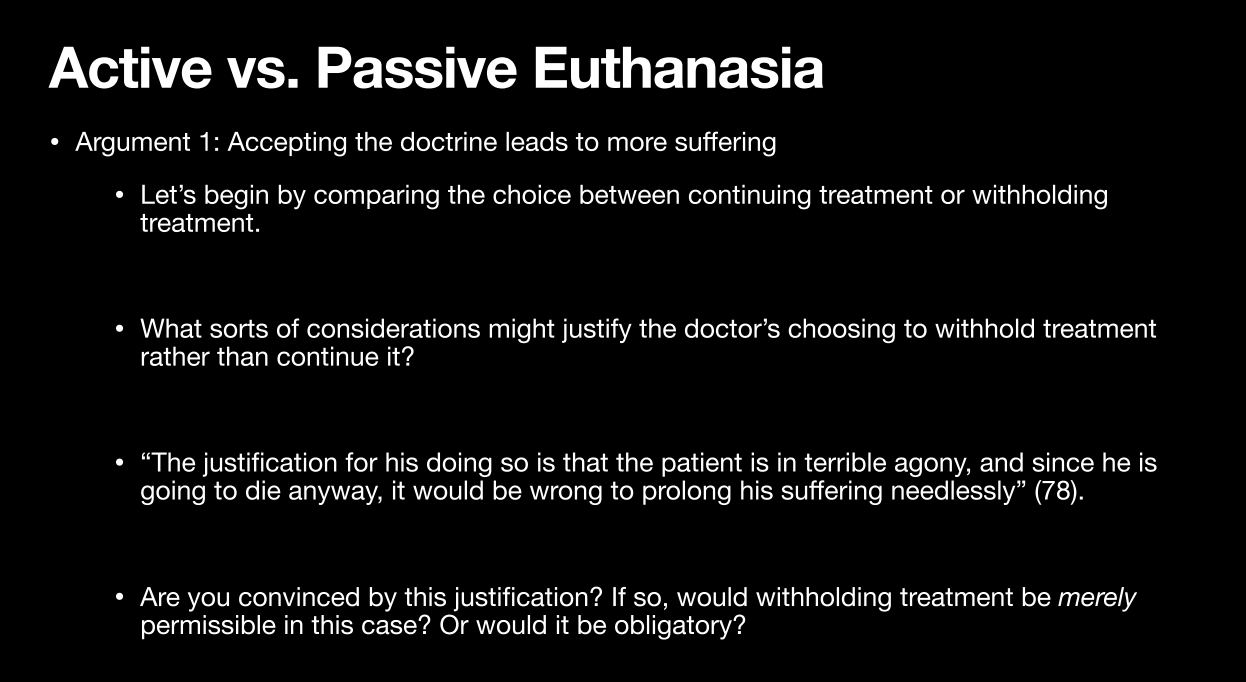
There's three options. Either we can continue treatment on this person suffering from terminal throat cancer or we can do a full treatment from this person you're given a choice between either continuing treatments on this person with terminal throat cancer or withholding treatment. What sorts of considerations do you think might fail on? Like what reasons do you think you have to identify treatment or withhold treatment? one consideration I'll factor between going to be if the treatment doesn't look like it's going to be effective and resources are scarce, there may be a good reason to withhold the treatment because the treatment's not going to do anything good. So it looks like that's the case in this situation. It looks like treatment is not going to be particularly effective. We know for certain that the treatment is not going to be sufficient to heal them from their illness. It's a terminal illness. And it looks like the treatment is not even sufficient in the case of strive for the. So given that, I think that probably constitutes a strong mission not to continue.People have an interest in seeing your desire satisfied and getting what they want. The people patient has communicated their desire to the doctor. Their desire is to no longer seek treatment and to receive euthanasia. therefore it seems like we have at least some reason to respond to this desire by giving them what they want and employing treatment. the patient's quality of life. Good, Perfect. The patient's quality of life. It looks like the patient's quality of life right now is quite poor.They're receiving treatment and yet they're still experiencing uncontrollable amounts of pain and it looks like by continuing treatment we prolong how much time they're going to spend experiencing this pain.If we withhold treatment, then maybe they experience this pain, but presumably they experience it for a longer amount of time because the treatment isn't prolonged at all. If we're trying to look for justification for rehauming treatments rather than continuing treatments, it looks like, quote, the justification for the doctors doing so is that the patient is in terrible agony and since he is going to die anyways, it would be wrong to prolong his suffering means if he's either going to die now or die later, and dying later means that he's going to suffer more, then it looks like we have no reason to prolong his life.All it would mean doing is increasing the amount of suffering he experiences before he dies.Do you think it's possible that because continuing treatment would cause greater suffering, we actually have no reason to continue treatment? Or at least it would be permissible to withdraw, withhold treatment. And then do you think it would be nearly permissible to withhold treatment? So one reaction we could have to a case like this is, look, you're probably justified in withholding treatments because it would relieve the suffering of the patient and therefore, like flip a coin, both are principles. You can either continue treatment or you can withhold treatments. Both would be courses of action. Or you might think, no, actually we have no good reason to continue treatment and therefore withholding treatment isn't nearly permissible in this case. You actually have an obligation to withhold treatment. So I wonder what you think about that. A, do you think it would be permissible to withhold treatment? B, do you think it would be merely permissible? Actually, the doctor has an obligation to withhold treatment for information. If there's no quality of life. But treatment has the potential to extend. Like, even though you're gonna die anyway, but you might die a few days later, you're just prolonging suffering.So would that mean, like, would you think that that means that both options are still permissible or that we just have to avoid. If you're only prolonging the suffering, it would be impermissible. Pursue continue treatment because there would be less suffering if you could help.I don't think it's obligatory because it's at the discretion of the patient.If they would like to continue treatment in the hopes that they may get better or that they would like to prolong their life as long as possible.They are allowed to do that, but not. Okay, good. So fair enough. In this case, the case says that the patient has a desire to cease treatment.But you're completely right that things might be entirely different.If the patient doesn't have that desire, you might think the patient still suffers the exact same amount.Like we can imagine. We can measure suffering using a sort of, like, suffering scale.And in both cases, the patient is suffering an equal amount. But in one case, the patient expresses a desire to cease treatment. In the other case, the patient expresses a desire to continue treatment. Then we might think that we need to respect that desire even if they're suffering, Even if continuing treatment will really prolong their suffering, it behooves us to respect the desire of the patient to continue treatment.
that was the choice between continuing treatment and fullback treatment and in that case, it looked like withholding treatment is at least permissible and in certain cases may in fact, be obligatory. Now let's look at the choice between withholding treatment or performing a lethal objective. What sorts of considerations might bear on the question of whether we should withhold treatment or perform a legal object? What might make it the case that we should do one of those things or the other? What made this sort of difference when you were considering the case of the folding treatment for continuing treatments?What's the amount of suffering that we can expect the patient to experience?Then it looks like we should engage in a similar kind of analysis. When we're choosing between the option of withholding treatment or performing a lethal event.So Rachel observes quotes that if someone simply withholds treatment, it may take the patient longer to die, and so he may suffer more than he would if more direct action is obtained.So when we're choosing between continuing treatment or holding treatment, we ask ourselves, well, which would cause more suffering?Continuing treatment would cause more suffering.Therefore we can either permissively or have an obligation to the whole treatment.And similarly, we might ask, given the choice between withholding treatment and performing a legal injection, if the difference big unique feature is how much suffering the patient is going to experience and the full length treatment needs, the patient's going to live longer and suffer for longer, a more amount of time,
Then we might have reason to, or it might be reminisceable for us and, or obligatory for us to perform a leak.So again, we can apply the exact same reasoning that we applied to the choice between continuing treatment and passive euthanasia to the choice between passive euthanasia and active euthanasia.
that's the first line of argument. He thinks that accepting this doctrine is going to lead to more suffering.Why does he think that? Because there are certain cases in which merely withholding treatment rather than performing a legal judgment means that the patient is going to live for longer, and that means that they're going to settle for longer.And therefore, if we choose only to make past euthanasia permissible and not to make active euthanasia permissible, then it is the case that people are going to suffer for longer than they need to.The second case, or the second argument that Rachels gives us is that accepting this doctrine, accepting this difference between past life and active human nature is going to lead to decisions that are actually made on irrelevant grounds.Like it's going to lead to decisions about whether or not a particular being should live or die that actually have nothing to do with like, fundamental considerations relevant to whether they live or die.It's going to lead to sort of like impossible or religious reasoning.Okay, so here's the sort of line, our thing that he gave us.And he uses the case of, of infants born with down syndrome.So he says, okay, so there are some infants that get born with down syndrome that also possess life threatening congenital defects unrelated to the syndrome.So for instance, he gives the example of intestinal obstruction.This is not related to having down syndrome or this congenital defect.Therefore, it is just the case that some babies are Born with this behavior dental defect.Some babies are born without, some babies are born with down syndrome, some babies are born without.And some babies that are born with down syndrome are also going to have these unrelated congenital defects.Okay, Sometimes when a baby is born with down syndrome and also a life threatening congenital defect, no operations performed in the infant does.In other cases, a baby is born with no congenital defense effect and baby was not.We also know that operations to remove intestinal obstructions are not particularly difficult to perform.That it's not this like really risky procedure. It's not a procedure with the low success rate. It's a pretty routine by procedure that we can expect is going to be successful more often than it's not.Okay, so then the question is, what would be motivating doctors or parents to withhold treatment in these cases?What would be reasons for the doctor or parent not to perform treatment and remove the intestinal obstruction?Or an infinite born with down syndrome and also intestinal obstruction?Will we justify a choice to not perform? So according to Rachel's, the only justification that would make sense here for doctors and parents to withhold treatment treatment for obstructions in intensive down syndrome is the belief that it is, quote, better for the child to death.But notice that we would not think that is the case in the case where congenital defects are un.
So this is kind of a tricky point. So let me see if I can make it clear. The idea is that if a baby is born with down syndrome and intestinal obstruction, that the only reason to withhold treatment and not perform this relatively easy procedure would be the belief that it is better for the child to die.Presumably because they think that being born with this particular, particular manifestation of down syndrome will make the life not. But if you wouldn't have that same thought in cases where no congenital defect is present. So, so we typically don't, when infants are born with down syndrome, engage in the question is it worth it for this child to live a human life when they don't have other life threatening congenital defects? We just take it as given that it is worth it for infants form of dancer to live a life. It is a good thing for them to live. They live rich and rewarding lives. In spite of their age for particular syndrome. And so why do we engage in that question? Why do we start to question whether or not it is worth it for the child to live only in cases where happens to be born with an unrelated congenital defect? We don't think it makes any sense to judgment when they're not born with this why would we then think is a relevant question to ask when they happen to be born with a congenital defect that is entirely unrelated from their from their having been. So this Rachel sphinx reveals an implausible line of reasoning for the doctor or parents who would hold experience from this inf either within the life of an infant or count is worth living, in which case what does it matter if it needs philophy, if it is worth it for all humans to live lives, or at least humans who are more like really really severely debilitating diseases, then what difference does it make if you also need to perform like a simple easy variant at on the child in order to prevent their death? Or we think that the life is not worth living and then this will be true whether or not the child happens to have an unobstructed intestinal and so the status of the child's intestinal tract really shouldn't bear on our decision making in any cases whatsoever. And yet it looks like if we accept this distinction, we the impact of capacity euthanasia. We do, we do posit there being something that the presence of this obstruction in the intestinal tract actually makes a morally relevant difference. But otherwise it's impossible that we should let the question of whether or not this worth living be determined by whether or not they happen to suffer from an unrelated congenital defect. Indeed, there is cerebral uncare for evidence that children with born with down syndrome do live meaningful and work well lives and therefore we have no reason to withhold treatment cases.
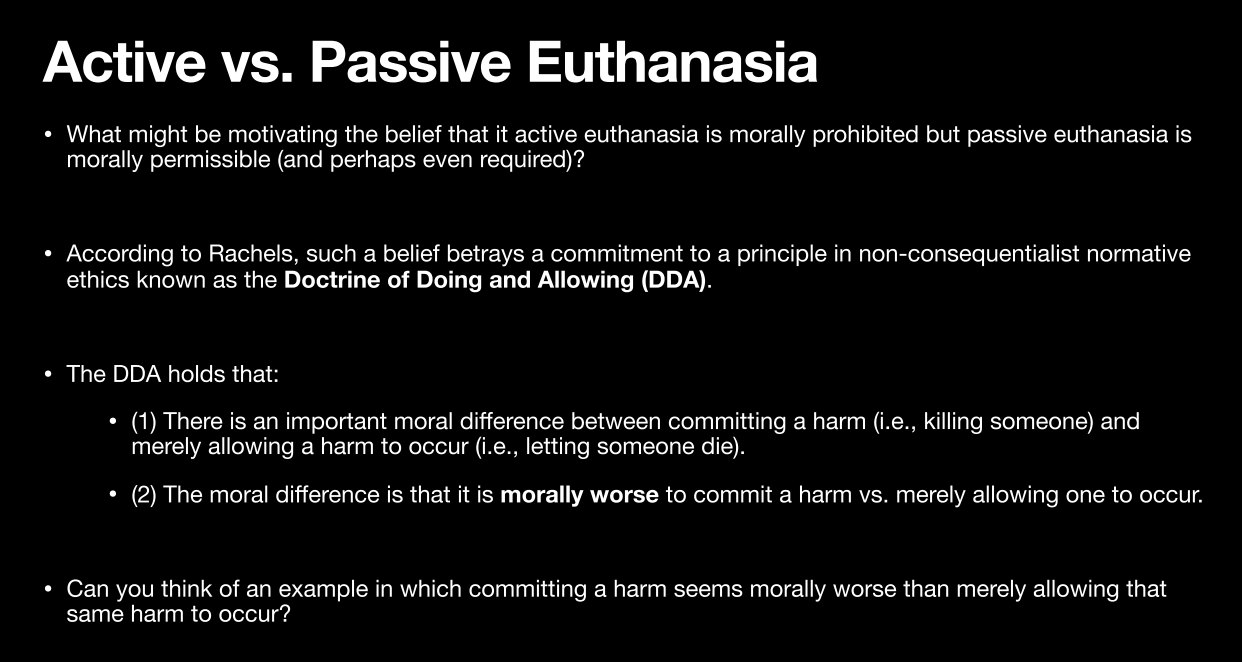
Rachel thinks that this, that this doctrine that posits the existence of a morally relevant difference in Asia is false.And yet like a lot of people seem to have this intuition, indeed so many people have this intuition that it is part of the American Medical Association's policy at the time.Rachel's persuading us to identify active euthanasia as more than impermissible and passive euthanasia as permissible.And so even though Rigels thinks it's false, he's interested in trying to figure out what is motivating our thinking about this issue.What is leading us astray? Why is it that we think there's a morally relevant difference here when there actually isn't?Rituals ultimately deduces that when we say there's a difference between active and passive euthanasia, what we're doing is committing ourselves to a particular principle in non consequentialist form of ethics called the doctrine of doing a laugh.So if you took, if you took Professor Durham Solomon's normative ethics class last term you'll be familiar with this stuff.We talked about the doctrine of double effect. We also talked about the doctrine of doing allowing.The doctrine of doing a lap doing allowing. If a non consequentialist principle that holds.There's sort of two features of it. First, it holds that there's an important moral difference between committing a harm, say killing somebody and merely allowing harm to occur, letting someone know.So in Rachel's paper, Rachel frames it explicitly in these terms.Rachel says people seem to think that there's something morally relevant about.Sorry, morally relevant and different about killing somebody and nearly loving them.And the second part of the doctrine of double fact is that the moral difference here is that it is morally worse to commit a harm versus merely allowing it to occur.It is morally worse to kill someone than to merely let them die.This is what Rachel Sphinx underwrites. His entire intuition that there's a difference between passive and active EU is that it's morally worse to kill somebody than it is to learn better.Quick caveat. If you took Professor Gordon Solomon's normative class last term in which we talked about the doctor doing allowing, we phrased it slightly different in that class.So in that class we said that the doctor doing a lot of poll instead of just harder to justify committing a harm versus merely allowing them to happen.That's not the framing I'm going to use in this class.This is not the framing Rachel's used in his paper.So Rachel says specifically the doctrine holds.The doctrine of killing and letting die holds that it is morally worse to kill versus let die.It is morally worse to commit a harm versus allow.Okay, anyone think of examples which the doctrine of doing allowing successfully tracks our intuitions.Like cases in which we think it would be morally worse for you to commit a harm than to merely allow l to occur.Yeah, I think. I mean, there's 50,000 people who send that I could otherwise be doing because I'm kind of letting people die, I think.But I think most people would think that that's not as bad as me coming up in like 20 years.Good, perfect. So that's like the marquee example that's used to support the doctor doing a lot.I get paid salary by Queen's University that allows me to meet my sal existence needs for food and water and shelter.And indeed my salary allows me to enjoy other goods like shoes and a laptop and this nice water bottle.But of course, I don't need these things, spirit speaking, to survive.There are other people in the world that are suffering from conditions right now that will die for lack of money to buy food or shelter or water.It seems like, given the existence of charitable institutions, I can send all of my excess wealth, all of the wealth that I need, or all of the wealth that I don't need to keep myself alive, to Oxfam or something.And Oxfam could use that money to save the lives of children.So these ones, by not donating to Oxdam right now, by not donating all my excess to all Oxdam right now, I'm letting you shoulder it out, right?If I donated this money, then they don't have enough money to eat food, then they wouldn't die.But because I have chosen not to donate all my excess wealth to Austin, I am letting people die who otherwise wouldn't have died but for my choice not to donate to Austin.Another way that children could die is if I went to some impoverished community and started killing children.In both of these cases, the exact same children died.But in one of these cases, they die as a result of me failing to donate to charity.And in another case, they die because I go to their community and I disappear.Many of us think that there's something morally different going on here.That in fact, it's. It's actually an open question whether I'm doing something morally wrong by not donating.Maturity. You might think that donating to charity is like sort of super erogatory thing, but nobody has an obligation to do so.So it's an open question whether I'm doing something like, morally wrong.Even if I am doing something morally wrong by not donating to charity.If not the worst thing in the world, think someone's like, completely evil just because they don't donate to oxygen.And we probably think that if I just went to this community and started killing children, that I would be doing something very morally wrong, potentially the most morally wrong thing I could be.And so it looks like one way we can explain the difference here, even though the consequences are the same, even though in both cases the exact same children are dying.One way we can explain a difference in our reactions to my either not doing any charity or actually killing children, is that there is nothing morally powerful indifferent about actually doing a harm, killing them in their hands, or merely allowing an arm to occur, not donating charity away to the rest of you.
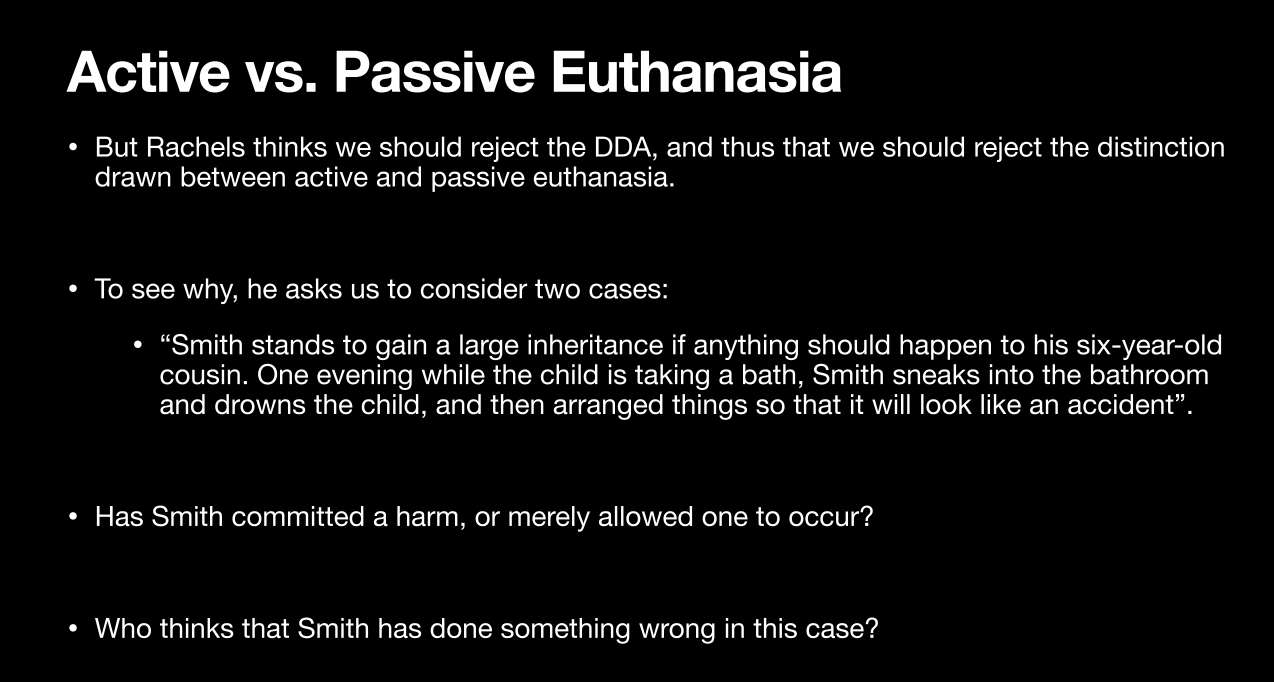
In the case of joining charity versus actively killing. Most selection doctrine does a good job of explaining why we have different intuitions about These cases and yet Rachel's thinks we should reject the dda.And indeed I also think we should reject the DDA but for different reasons and because ranks we should reject the dea.And it looks like the act we pass at this nation is basically just another way of stating the idea.Rachel thinks yeah, we should reject the DEA and because of that we should project this after.So Rachel's just going to try and give us two cases to show why we should not accept the doctrine of doing it aloud.The first case is about a guy named Smith. He says, quote, Smith stands to gain a large inheritance if anything should happen to his six year old cousin.One evening while a child is taking a bath, Smith sneaks into the bathroom and drowns the chug and then a rainfous thing so that it would look like an accident.Okay, has Smith committed a harm in this case or nearly allowed.This one all day? Yes, it looks like Smith has probably committed a harm.He's gone into the bathroom and grabbed tiles. I don't know what would be a clear case may harm in that.Okay, who thinks that Smith has done something wrong in this case, that we would be right to reproach him for acting in this story.Good. I think many of us react to a case in which someone has drowned a child in a bathtub for financial gain with sort of moral indignation.
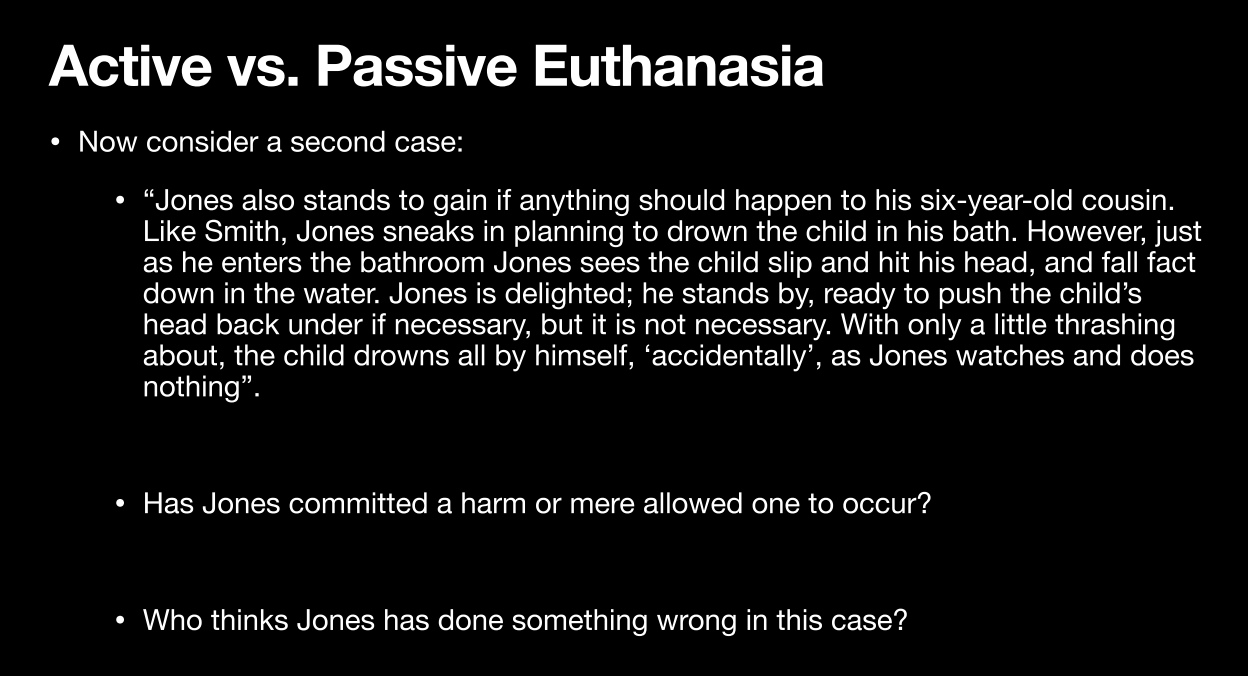
let's consider a second lady case about an I Jones.Jones also stands to gain if anything should happen to his six year old cousin.And indeed, like Smith, Jones is planning to do the exact same thing.Sneak into the bathroom while the child is having a bath to drown him.However, just as Jones enters the room, he sees the child slip into his head and fall face down in the water.Jones is delayed by this because the child is going to drown.And indeed Jones stands at the ready to push the child's head back down should the child manage to get up out of the water with only a little thrashing about.The child drowns all by himself, goes accidentally and Jones watches and does not.Okay, has Jones committed a harm or merely allowed one to occur?Yeah, it looks like in this case Jones has not done it.He just sort of walked into the bathroom and everything that he wanted to happen just sort of fell into place without his actually having to act in anything.So it looks like Jones is merely allowed. Yeah, so I do think there is a sense in which Jones had done something because it showed that he had the intention to torture and push back on your battle would be almost the same Basis as in my opinion and the fact that we had an intent to do it.I think there's an army. If you show up with someone's house with a gun, shoot them and then you show up with someone just dies.An artifact that I think that intensely counts or something even though we haven't particularly done anything.So I think there is a sense in which maybe it's not quite the same, but I still think there that.Okay, fair enough. So the thought is that the intention alone is sufficient to cause.Should have. Good. Yeah, I think both of you are exactly right. And I think. I think you actually are probably having the same sort of thought.So I think Rael does want to say Aar isn't being here as like there is no causal relationship between me and the bad thing that matters to.To the child. If. If I had never showed up, if Jones had never showed up, I don't know why I'm putting myself on this.If Jones had never showed up, the exact same thing would have happened.And so there's no sort of like causal fancy on the arm.And yet I suspect both of you think that something morally change going on in this situation.Yeah, I assume you all think that Jones has probably found something wrong.That if you were to talk to Jones after the fact and Jones was to tell you this story, you'd be like, what the hell?Why didn't you save this kid? Why were you planning to kill him in the first place?Okay, so we think in this case Jones committed a harm and that he felt wrong.
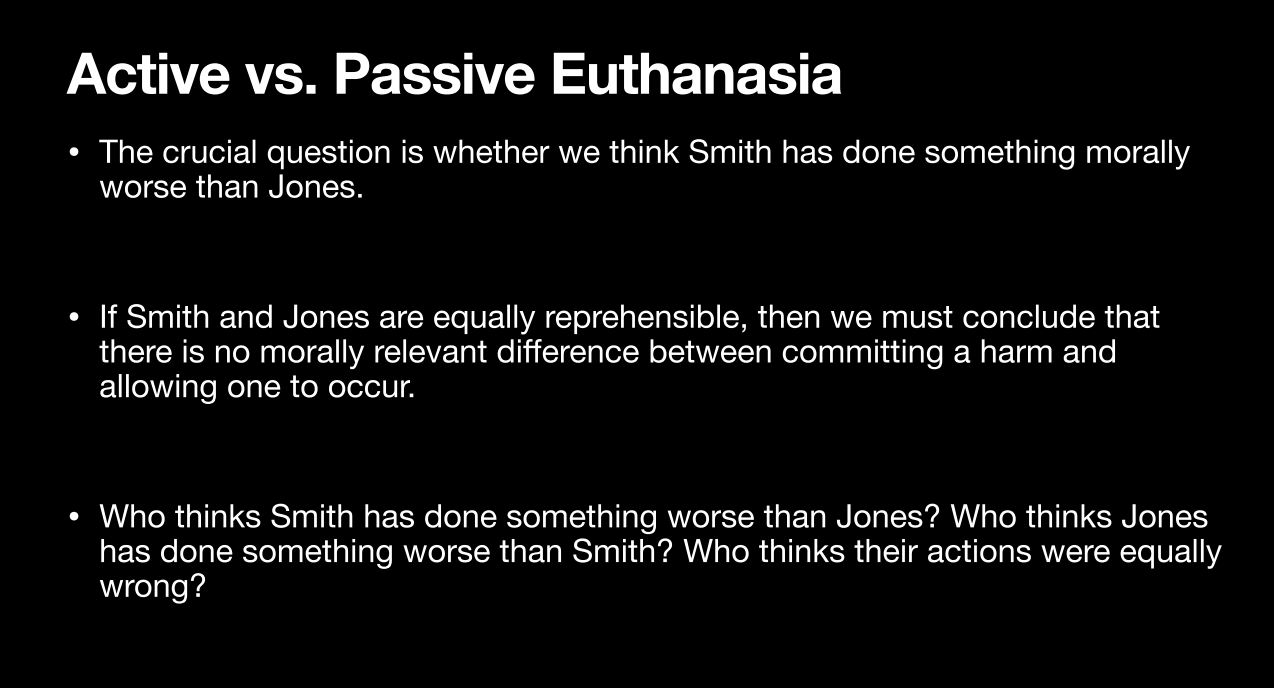
So the crucial question then you think one of them, Smith, committed a harm, the other one, Jones, really allowed a harm to happen and yet both of them did something morally wrong.What we wanted was whether one of them did something morally worse than the other.Yeah, I think there are questions same. What if drones didn't have the. Would that still be. Is that the same as having. To me intuitively I'm. I don't know. I still think there's a scenario with that example.So I'm not saying that I can do something because I feel like that's more like.Yeah. So the question is, what if Jones doesn't have the intention but still allows the child to drown?Am I right? That's the 11th. So Jones doesn't go into the bathroom with the intention of drowning the child, but the events play out the exact same way and Jones just passed.Happens to do nothing. Yeah. So I would think in that case we just might think it's not as morally long as one which Be allowed like fit in with the schools.Yeah, Like I already done this person. I don't know how. It's not even morally bad in both cases. Watch him and die. But you have the intention that going on. Good. Yeah. So I think this is the exact point that Rachel is trying to make.So I think you are. You're perfectly capering the thought that he's kind of needing to.Which is that like. Yeah, there's no difference between these cases.Like, yeah, sure, in one of the cases, Jones got lucky.It didn't actually have to be anything, but we probably still think something equally morally bad happened.The mere fact that Gems got lucky doesn't mean that we would blame any of us.Yeah, Good. Yeah. Okay, this is all great. Guys are all predicting exactly what Rachel was going to say.I mean, so let me just set up the structure of the argument you try to make here.So, okay, we think that the difference here is versus committing versus allowing versus allowing.What we're trying to figure out is whether one's morally worse than the other.If they are. If one mainly what Smith did is morally worse than what Jones did, survives.If we think they're equally bad, then the DBE doesn't survive.Then we need to reject that there is something morally worse about doing a harm versus merely not.Okay, So I take it that at least some people think that these are equally bad.And I'm curious as to whether anyone thinks that these are not equally bad.That actually what Smith is doing is in some way fundamentally morally worse than what Jones is doing, which is like a totally tiny know.Yeah, you want to. Well, I think first of all it's a bit in how the scenario is set up.I think that if you were to make it instead of a child standing uncle, whatever, and if that person knock themselves unconscious themselves with that in a particularly large person in no reasonable way be able to help them out of the bathroom can in the end stay and you were to go for help and in the ensuing time they were to pass away, then there's a bit of a difference there versus if it's a six year old child.Unless you are help suffering from some horribleity that makes you unable to lift even small things, then you have been negligent in something you could have done that could have led to a positive action by just allowing it to happen.Okay, that's a good point. Okay, so the point was about whether I'm going to paraphrase.So hopefully I'm not, I'm not paraphrasing point but Whether our capacity to actually engage in a rescue infection bears on our thing is.So if I, you know, if, if, if the child happens to be, you know, the size of a giant and splits and hits their head and is drowning in this massive pond, let's say that they used to bathe in, and I can't lift giants because I'm a regular human being, then it looks like, okay, yeah, I mean, I might be allowing the giant to die insofar as I thought human being physically capable of lifting giant giants, but we probably don't think that, that I've done anything wrong.Like, if I tried to lift the giant and I just physically couldn't, because again, I'm just a human being, then it looks like I tried to discharge my obligation.I had an intention, let's say, of saving a giant, but I was just fit to be incapable.And so we probably wouldn't think that you're morally responsible or, or culpable or something.Just it wasn't in your mind power to do you also raise the point about like, well, okay, technically what's in our power to do is the result of like, previous intentions we have.So, like, maybe I know that like, baby giants are drowning in ponds all the time around where I live and like, it's just really likely that I'm going to confront a drowning baby giant at some point in my life.Then I might be drinking what makes preparations for the chance that I have to engage in this kind of rescue.Like, maybe I should be working out all the time, like practicing building heavy weights.That way, you know, if I am ever put into this kind of situation, I am, you know, it is within my power.That would be, I mean, we would, we would need to engage in sort of like really complicated and extended moral analysis to figure out whether or not you're actually responsible for like, getting school enough to progress these giants.So, I mean, but the point is supposed to answer, like, we do think that whether or not something is morally wrong, whether you've done something morally wrong is probably dependent on whether or not we have a capacity to do other things.Anybody else that thinks that cemented something morally worse than Jones?Yeah, I think that because Smith acted on desires and like, actually committed crime, I think they're both wrongly wrong.But I think because Jones was almost like a bystander, it's like in a lot of instances in life, they're like.And I think because of. Even though. And I think that like, I don't know if that. Kind of morally, like. Actually committed the Crime and acted on desire versus Jones inherently.Good. Yeah, I think that's, that's totally plausible.I do think I don't exactly buy the the dea, but I think I'm probably in my work.I think most people probably agree that like look, they're from both paths, shouldn't be happy.But there's like a little bit, there's a little moral remainder in the case of Smith too.Like not only did he have these bad intentions and made this repugnant plan, he actually carried it out.He was successful in doing so. And that seems like it adds a little bit more force to our like moral.So tons of people will agree with you. Ultimately it turns out Rachel. Is when you're there. But again it's a natural. Like Jones is sneaking up on a child, taking a child for the first second.When looking at, at the scenario specifically Richard gives the example.He stood by case. He continue strong. So that, that was the way that I know active work because he just didn't have to do it, but he intended to do it.Good. Yeah. So I think that's a really important part of the example.After intentionally walked over this that not only is Jo having the intention around this child, he's like ready just in case like this wasn't successful, he's ready to do the work to make sure that this child's around.And so it's like we, we don't even need to doubt whether or not he had this intention.Like he had the intention and he was ready to act on it if he was told to.He just got lucky and didn't have to.
Okay, I'm going to move on because as always I'm taking this stuff.
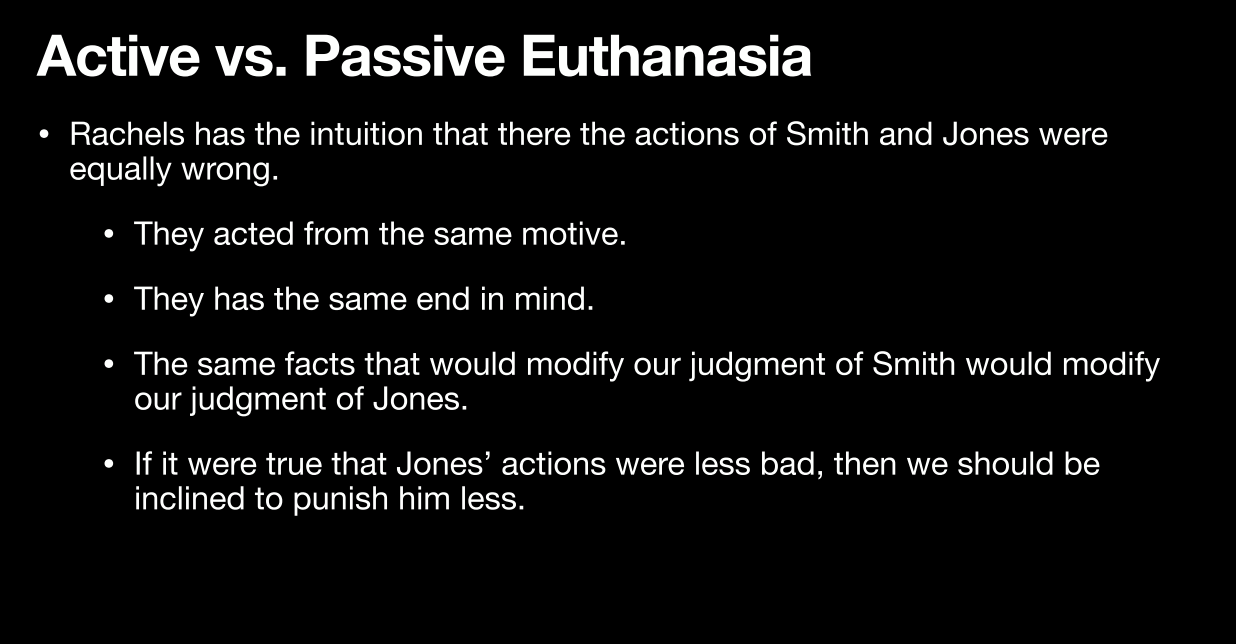
Okay, so Rachels ultimately has the intuition that the actors of Jones are Smith and Jones are equally wrong.
He thinks, look, they acted from the exact same motive.
They had the exact same end in mind drowning the child.
The fact that we modify our judgment of Smith would probably modify our judgment of Jones.
So what he has in mind here is like say we found out that.
That Smith had sustained a severe brain injury two days prior that impacted his ability to engage in sort of like practical reasoning.
We typically think that that might lessen the responsibility we assigned to Smith that this brain injury means that he's not as morally responsible for his behavior as someone who hadn't had this brain injury.
But we probably think that also would be true of Jones.
If Jones had sustained the exact same brain injury, then we would modify our assessment of his character in the exact same way.
Similarly, Rachel Thinks, look, if Jones's actions were less bad, then we would have less cause to punish him.
If we were punishing Smith and Jones, we would have to punish Jones less than we punished Smith.
And Rachel just thinks, I think we should punish these people when equal amount that which of punishment, we should punish Jones for the exact same amount of time, or I mean exact same amount of time.
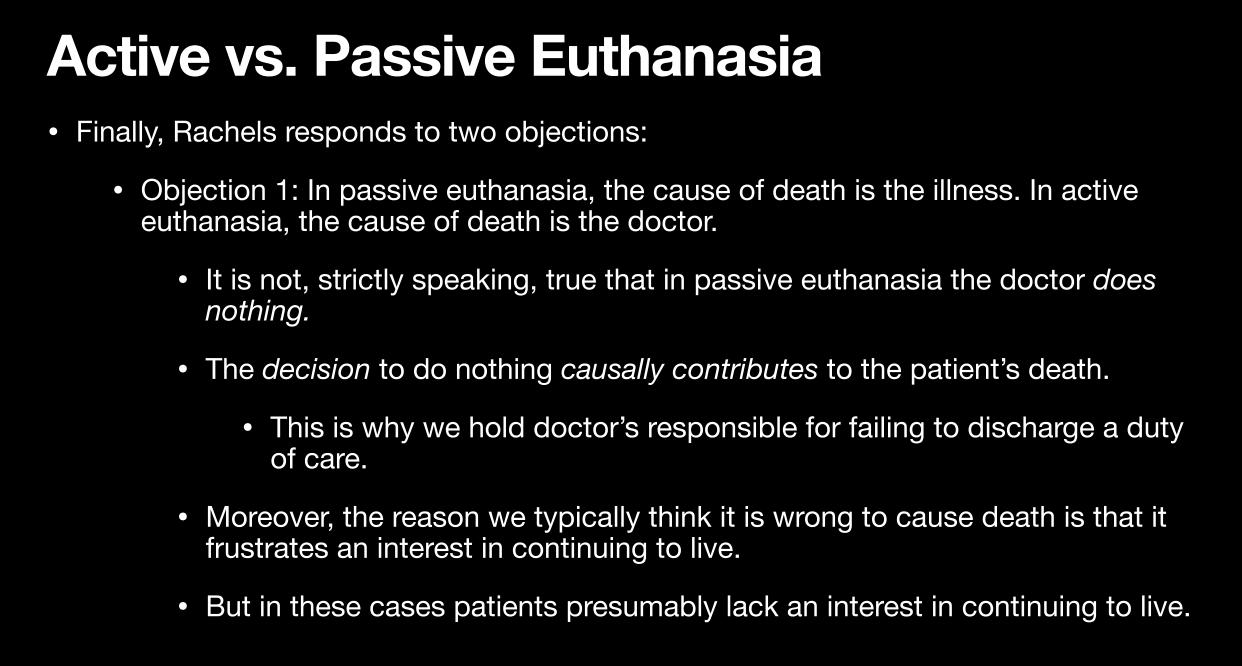
Okay, last thing. Rachel's going to quickly respond to objections.
The first. The objection. First objection says, oh, well, in passive euthanasia, the cause of death is the illness, whereas in active euphemia, the cause of death is.
Okay, we kind of picked up on this before. It's not strictly speaking true that in cases of passive dementia, the doctor does know, the doctor still does something.
They make a decision. In this decision to do nothing seems like it causally contributes to the patient's death.
If I decide to be an ethic, then the patient will die.
If I decide to do something, the patient will live.
Therefore, whether or not the patient lives or dies is causally and counterfactually dependent on my decision of whether or not not to do something.
Indeed, this is why we hold doctors responsible for discharging and duty to care.
Right. If a doctor, if you're suffering from a curable illness, and I do not, we don't think, oh, well, you didn't act on the patient, you didn't commit to harm on the patient, and therefore you're not responsible for anything morally suspect.
We think, look, if the patient is suffering from curable illness and you do nothing, then you've done something, maybe made the choice to withhold treatment, and this is the most impermissible thing to do.
Withholding treatments when you cure a disease is act wrongfully and therefore you should be punished for it.
Okay. Oh, yeah. And the other point we want to make is that we typically think that it's bad to kill somebody.
Like, what makes death bad? Most of us or any of us think death is bad because those of us who are living have an interest in continuing to live.
But that's not the case in the case of patients that are seeking ambulance.
These patients are seeking ambulanceia, presumably because they no longer have interest in continuing to live, and therefore death wouldn't be bad for them in the way death might be bad for us who do have interest in continuing to live.
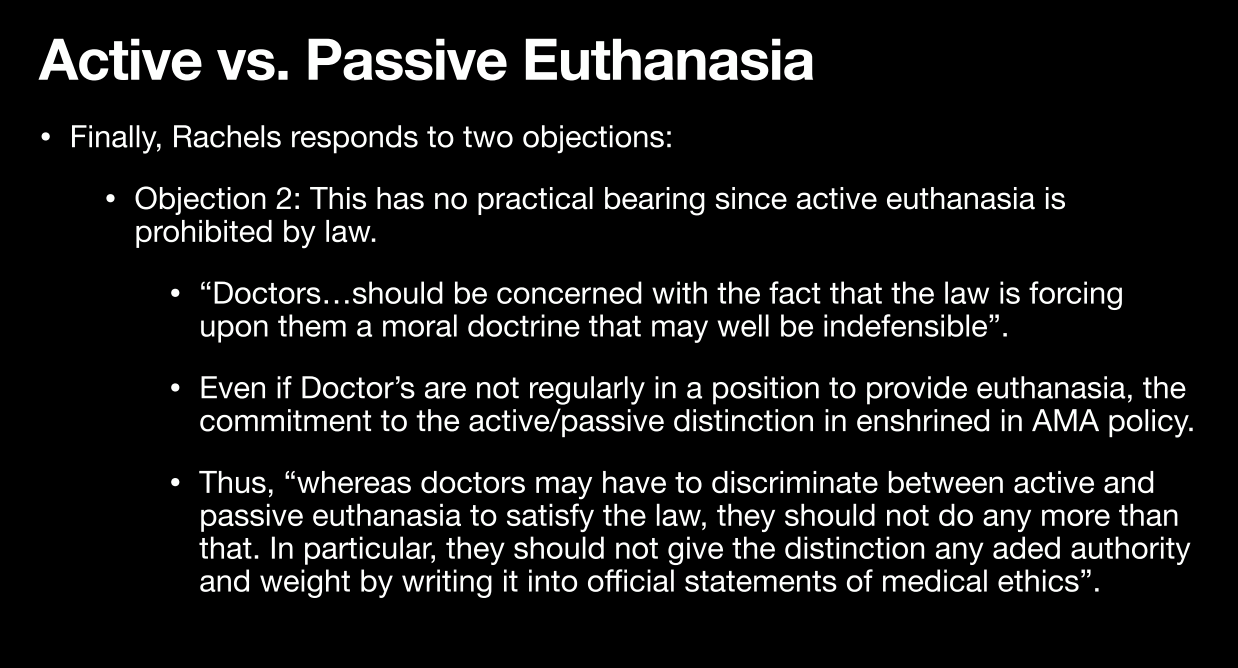
Second objection is that this is an objection you can make for all of moral philosophy.
The doctor is going to say, well, this has no practical difference.
It's active euchanasia is prohibited by law. So you Moral philosophers can do whatever like sort of puzzle solving he wants.
It's going to have no practical significance on that prepared because active nature is managed by law and therefore whether or not it's morally permissible is legally permissible.
Rachel says, well, look, doctors should be concerned about this.
The law as it is is forcing you to accept the moral doctrine that might be impediment, even if you're not in a position to be providing euthanasia.
This commitment to this morally indefensible policy is enshrined in the AMA's public policy.
And so Rachel says, whereas doctors may have to discriminate between act and pass the nature to satisfy the law, they should not do any more than that.
In particular, they should not give the distinction in the added majority by writing it into official statements from.
Okay, that's racial. Racial sense. There's no capacity in Asia that it's okay to engage capacity.
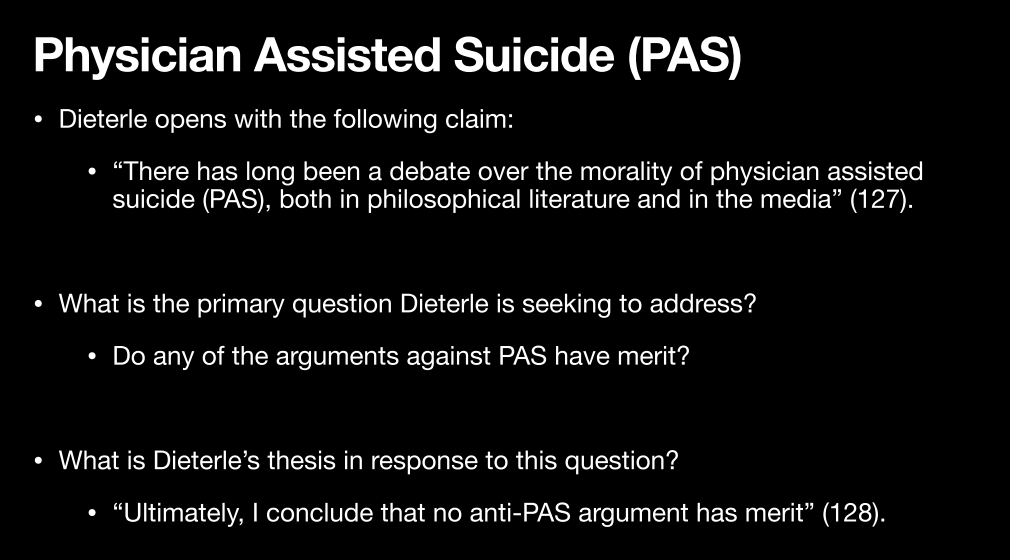
Now we'll get Scheiderly Derly, who opens their paper with this.
There has long been a debate over the morality of physician assisted suicide, both in philosophical literature.
It's obviously true. Okay, so what are the primary question that Diarley is trying to address?
Basically, do any of the arguments against the argument.
So we've been talking about the permissibility of persistent assisted suicide for some time now, countless argument fashions against permitting physician assisted suicide.
I really want to go through these arguments and see whether any of them are actually successful.
What is her thesis and response to this question?
Ultimately, she's going to conclude that no ATPAs are committed to testimony.
Okay, so she's going to break the arguments down into three groups.
The first are like sort of broadly consequentialist arguments.
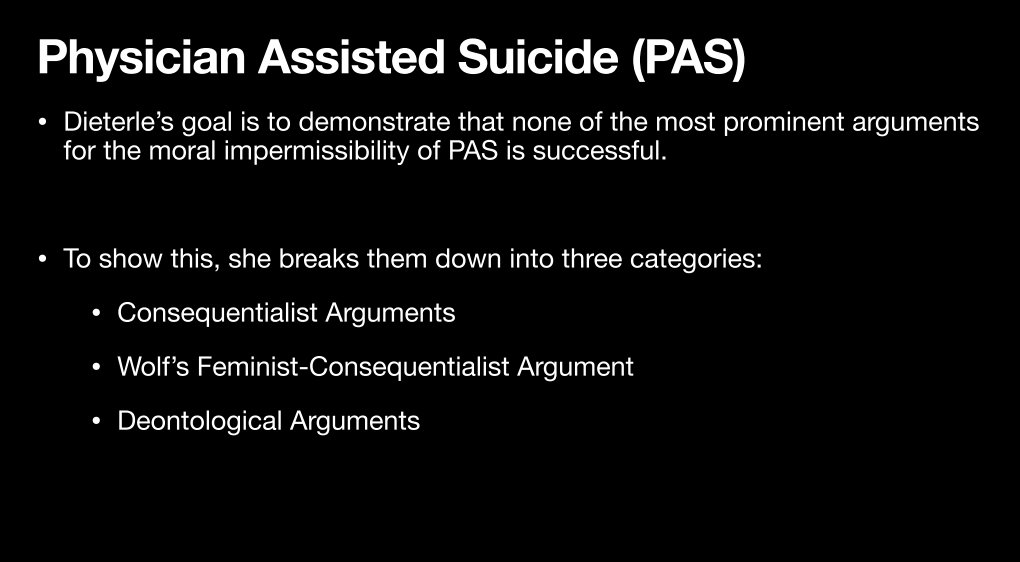
I'll get into what I mean by that in a second. The second is a particular argument from a fantastic healthblosser named Susan Wolf, who gives a sort of like feminist consequentialist arguments against allowing PAs.
And then finally we'll talk about two deonthological arguments for.
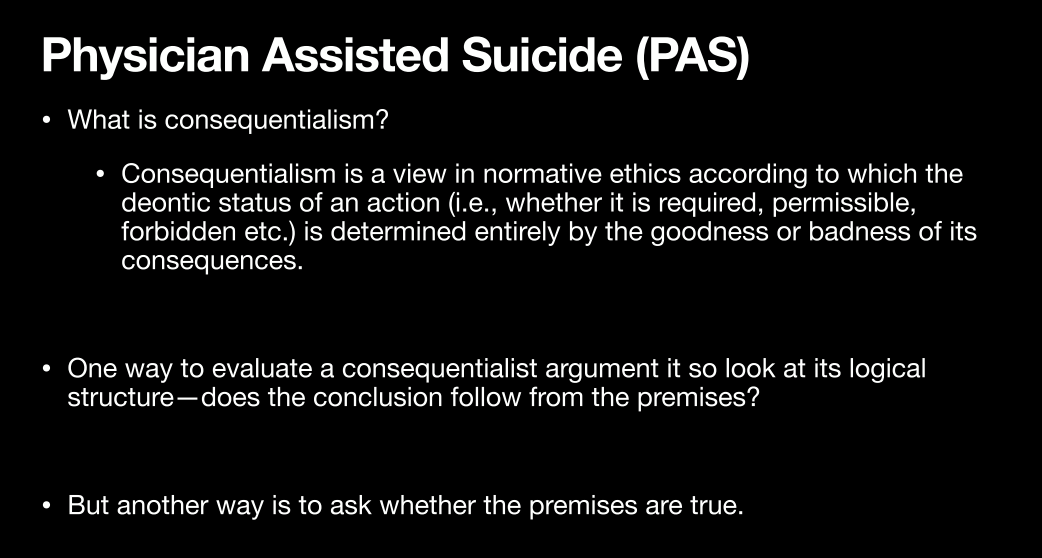
Sorry, for prohibiting PAs. Okay, so what is consequentialism so direly's main focus in this paper is with seven consequentialist arguments against permitting PAs.
So consequentialism is a view in normative ethics according to which the deontic status of an action, so whether or not it's required or permissible or within is determined entirely by the goodness or badness of its consequences.
So you know, so everyone knows the trolley problem.
I consume trolley going downhill. It's out of control. You're standing At a switch, it's going to kill five people.
You can pull a switch and it'll kill one person. The consequentialist is going to say, look, whether or not you should pull the switch and save the 5, 5 killing to 1.
What determines whether or not you should do that is entirely exclusive to its consequences.
In one consequence, five people die. In another consequence, one person dies. We typically think that it's worse for five people to die than one person to die.
Therefore we should pick the choice with the better consequences.
That's pulling the switch in a only killing one person.
So one way to evaluate consequentialist arguments is to look at its logical structure.
And this could evolve philosophical arguments.
There's going to be some logical structure that ties the premises to completion.
We can ask whether the premises guarantee. But another way to think about consequentialist arguments is that they rely on certain predictions, right?
They rely on some prediction about the current consequences that are going to eventually from a particular course of action.
So the consequentialist says don't do P because it will result in X.
And we can ask, okay, would doing P actually result in X?
Because if not, then this does not give us a reason not to do P. Okay, so a consequences might run out.
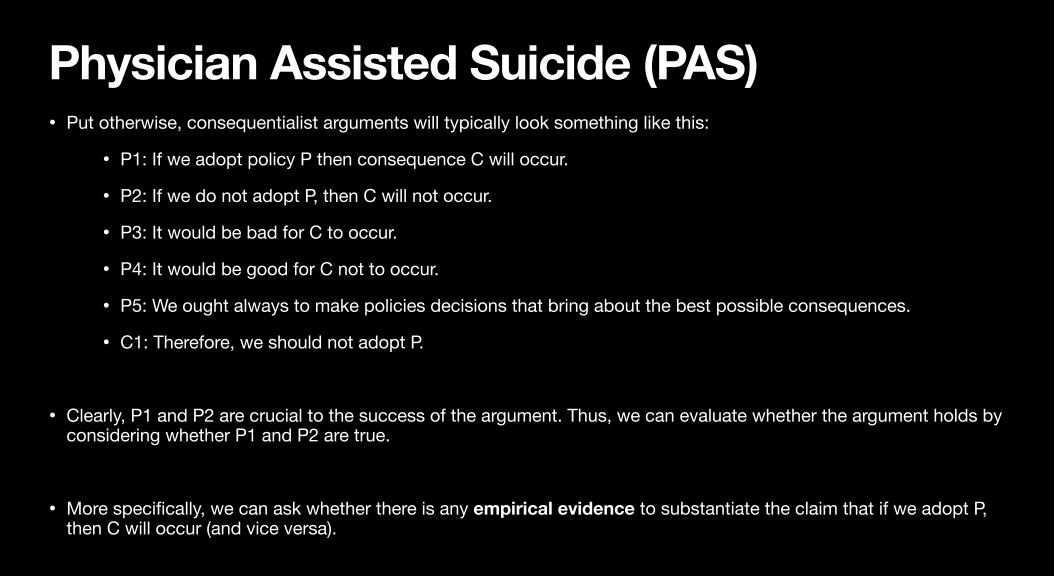
Arguments of the following. Premise 1 if we adopt policy P, then consequent C will occur.
Premise 2 if we do not adopt policy P, then C will not occur.
Premise 3 It would be bad for C to occur. Premise 4 It would be good for C not to occur. Premise 5 We ought always to make policy decisions that bring about the best possible consequences.
Conclusion therefore we should not allow P. Does that make sense?
So the rightness or wrongness of adopting a particular policy is determined entirely by its consequences.
Consequency would be bad. Therefore, we should make a policy decision that does not result in consequence.
So clearly the first two premises that these assertions are right, the first two premises are sort of empirical claims about what will happen to Mitch off particular policies.
It is the effects of this policy that are determining whether or not we should adopt the policy in the first place.
And so we want to know whether it's true that policy will actually have these effects.
Because if the policy doesn't have these bad effects, then there's no reason not to adopt.
The only reason not to adopt a policy would be if it had negative effects or if some other policy had better effects.
And so we can ask, okay, for any given policy and any given consequence that is thought to eventually from this policy is There any empirical evidence to substantiate the claim that if we adopt P C will occur.
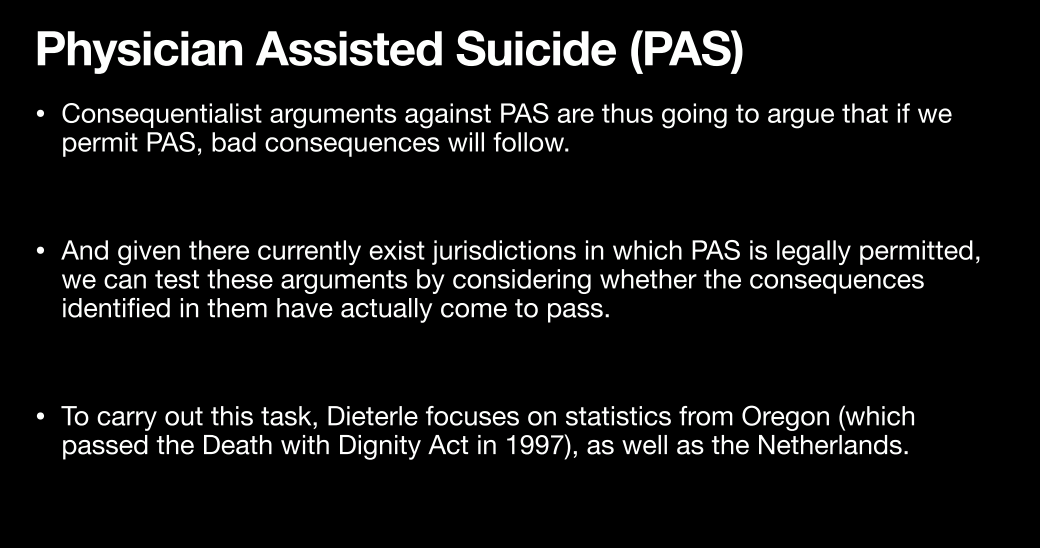
So the consequential argument against PAs are going to say something along the lines of if you permit PAS then and that consequences of false.
But we can actually investigate this in mir we don't have to be policy.
There are jurisdictions in which PAs is permissible.
And so we can look at those jurisdictions and we can ask whether the legalization of PAs in these jurisdictions have resulted in the consequences that these consequentialist arguments allege.
So these are the notions on statistics from Oregon which passed the death of d Act in 1997.
The golden as the Netherlands which has a longer history with consistent suicide.
But they focus kind of really on. These are just the the conditions under the Death with Dignity act under which you can request physician assisted suicide.
It's not that important and it's not philosophical, so I would skip it, but appeals on your own time if you want to.
Okay, so these are the seven arguments that direly is going to take out.
So consequentialists who are opposed to PAs say that if PAs is permitted then the following consequences will come to pass.
First, we'll slide into forming non voluntary or involuntary information.
Various abuses of the law will occur. It will result corruption of the institution of medicine.
It'll weaken the sort of general psychological prohibition on killing that we have.
Patients will begin giving up too easily. We will cease making improvements to palliative care and citizens will begin to fear hospitals in that universal so all of these are arguments that have been provided either philosophical literature or policy discussions for large amounts commit physician.
Let's go through and let's see whether there is sufficient evidence to substantiate charity.
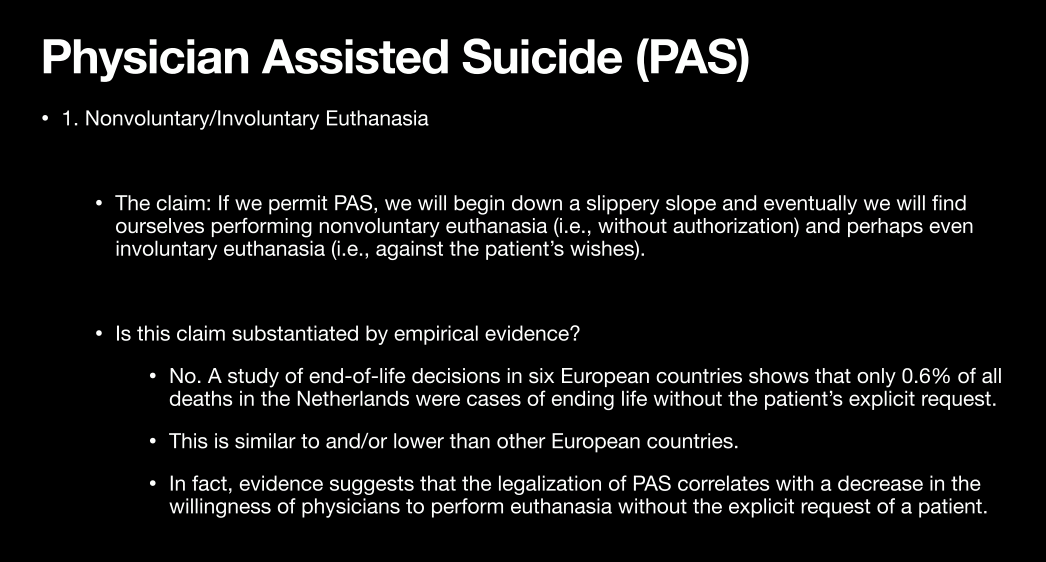
Okay, so the first argument, the claim here is that if we permit PAs, we'll begin down some sort of slippery slope and eventually we'll find ourselves performing non voluntary euthanasia to euthanasia that's done without authorization.
Say you're comatose, you're unable to give any authorization quorum euthanization, euthanasia on you, non voluntary euthanization because you haven't actively authorized the procedure.
And some people worry that once we get there, it's a short step to start performing involuntary euthanasia.
Euthanization, which is euthanization that occurs contrary.
So it's not just they have authorized the treatment is that they are actively post proceeding.
Okay, let's look at Oregon in the Netherlands and ask whether this is actually the case.
PAS is legal there. Have we seen these consequences no, we haven't. Supposedly only 0.6 of all deaths in the Netherlands were caused or cases without the patient's explicit request.
This is similar in the lowers other other European countries which don't have PAS legal and indeed evidence suggests that the legalization of PAS correlates with a decrease in the willingness of physicians to perform legalization.
You then patient. Okay, so you see how this first objection is going to be the same forest doctor doctor that diagnosis going to take on the next six arguments.
The thought is if we allow DAs, then this bad consequence will occur diagonally says, okay, let's look at places where PAS is legal.
Do these bump bumps eventually in this particular case she's going to say, no, they do not.
Okay. The second argument says, okay, well if we allow ks, then the law to allow PAS will be confused in various ways.
And she gives three examples of how this might be the case.
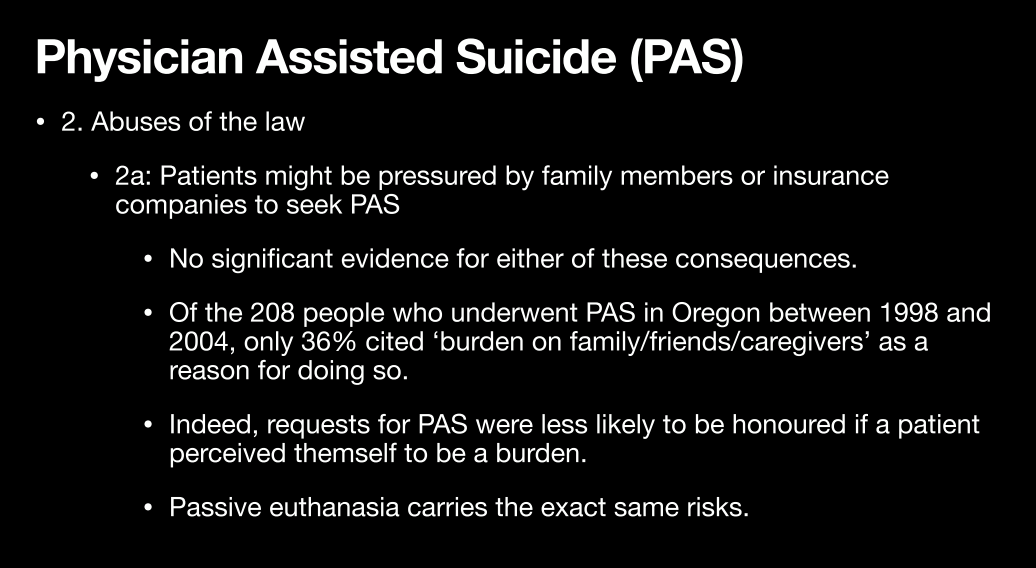
He says, oh, like, you know, if we allow PAs, then maybe patients will be pressured by family members or insurance companies to seek out PAs, that it won't be an authentic choice of theirs.
They'll make this decision because they don't want to be, say, a burden on their family or their families pressuring them to receive PAS to stay the same.
Again, is there any significant evidence that this is the case where PAS is legal?
And ultimately, in terms of not so, 208 people underwent PAs in Oregon between 1998, 2004.
Only 36% cited being a burden on family, friends or caregivers as a reason for doing so.
And of those 36%, we have no knowledge of how many pressured by family counterparts.
All we know is that they felt as though they were a burden.
And indeed we see, at least according that requests of EAs were less likely to be honored by doctors if patients perceive themselves to be a burden.
So it doesn't look like we need to worry about veterinary family members or at least even if we need to be worried about it.
If it doesn't look like the consequence of entry is as much as we might fear.
Okay. The second version of the argument says certain vulnerable groups like poor or the disabled or the elderly are going to be more likely to take advantage of PAs.
Huge discrimination. We might be worried that this sort of disparity in who is availing themselves of PAS is indicative of a certain sort of like unfairness.
He suspects society. But again, it just looks like there's no evidence of this consequence.
In Oregon, it turned out younger people were significantly more likely than their older counterparts to elect for PAs ages of PAs ranged from 25 to 94.
Among those who received PAs, 98% were white, 2% were Asian, and 61% that received at least some quality.
So at least in the samples that we have in Oregon, it doesn't look like PAS is being people are electing to go undergo GAS because they come from disadvantaged groups that are subject to various forms of discrimination, either by socioeconomic structures or by the medical constitution.
Okay. Third version of the startup says, well, maybe people with insurance will be more likely to request PAS because they have no problem, they can't afford treatment, and so the next best thing is to just receive PAS so they don't have long suffering.
Once again, it just looks like there's not sufficient evidence for this claim.
In Oregon, 63% had private insurance. Of this 208, 36% were on some public insurance like Medicare or Medicaid, and only 1% actually had no insurance whatsoever.
So it's unlikely that the people who are getting PAs are doing so because they're in sort of dire circumstances as a result of not having insurance.
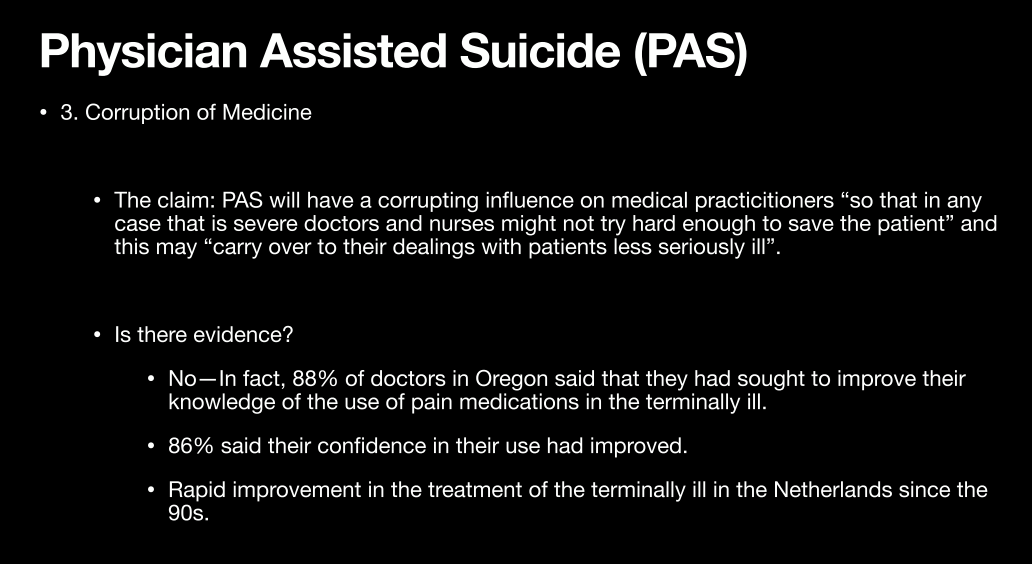
3. Okay, the claim here is that PAS is going to have a corrupting influence on medical practitioners, quote, so that in any case that a severe doctors and nurses might not try hard enough to save the patient and that this may carry over to their dealings with patients.
Seriously. So if we allow gas, if we give doctors the option to just start providing service to their patients, then they might be less inclined to provide the best healthcare possible because they know that the patient always has the option to just sort of like build self, create us and escape.
Is there evidence of this claim? No, there is not. In fact, 88% of doctors in Oregon said that they had sought to improve their knowledge of the pain of the use of pain medications that are terminally ill. After the legalization of PAs, 86% of their confidence in the use had improved.
And we can just see sort of, since PAS has been legalized in the Netherlands in the early 1990s before the communities, there's been rapid improvement to treatment of maternally ill.
So I don't think, or at least diverly doesn't think that we need to worry that allowing this option for certain people in society is going to result in a sort of like wholesale corruption or decrease in the effectiveness of the institution of medicine.
Okay. We typically think in society that something is wrong, that we shouldn't be engaged in acts of homicide against one another.
And I guess the thought here is that, oh well, if we allow petition assisted suicide, if we allow sort of like institutionally recognized and permissible forms of killing, then this sort of general prohibition on killing that we all sort of intuitively accept will be weakened and will be less averse to killing.
Otis, this is a very strange claim. I don't know why you think that there's a connection there, but ultimately we can ask whether the connection is supported by imperial evidence.
And it looks like this is not the case. Again, in the wake of legalized mor, we see decreases, both the homicide rate and the rate of automatic.
And these decreases are consistent with similar decreases that we've seen in other states.
And so it can't be chopped up to factors that are sort of like unique to or okay, another one.
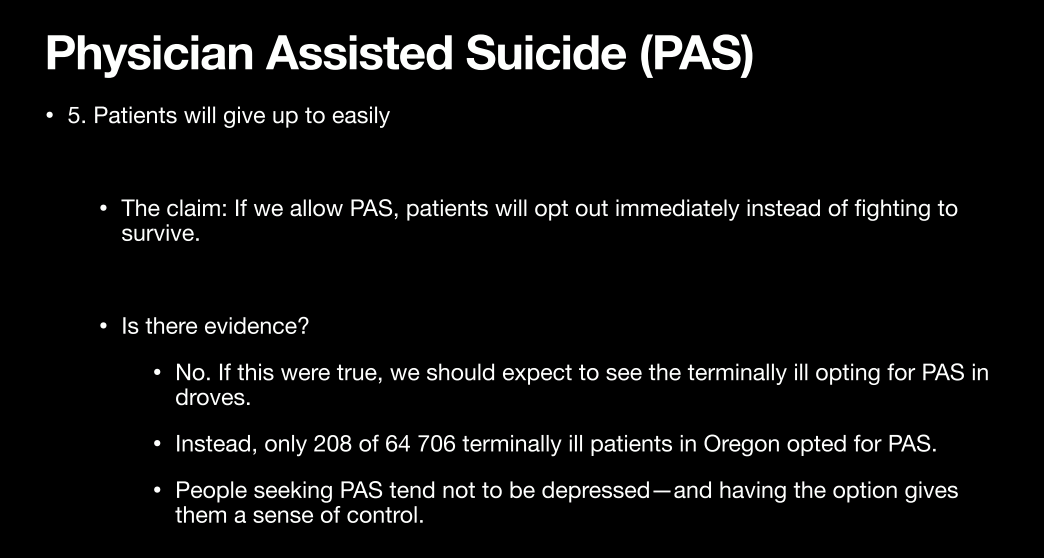
Well, if PAS is an option, maybe patients will give up too easily.
Instead of like trying to, you know, survive the course of their illness or fight to survive their illness, we might see patients opt out earlier than they otherwise might have.
And we might think it's a bad thing for patients to opt out earlier than they otherwise might have.
Again, there's just little evidence that this is the case.
If it were true that patients will begin to give up More easily once VAs is legalized, then we should expect inflatable organization in the Netherlands that people are, you know, beginning to elect for PAS improvements, that the rate at which people are requesting the service increases substantially.
And again, it's just sort of a very small number of people at least.
You know, I actually wonder whether this, this data is how it has changed in the sort of like 20 odd years since this article was written.
I suspect that maybe PAS is now more socially acceptable and therefore might be people might be engaging in it in a greater degree.
But at least at the time this article is being written, of the 64,704 terminal patients in Oregon between 1998 and 2004, only 208 of those patients were eligible for PA. KS actually collected 200.
Yeah, you kind of. I'm curious, like even if you're drinking some of the.
How much does that influence our conviction? That is very wrong. Like let's say that people have started to like update K more often because they're like, they're opting out too quickly.
Maybe we do see a reduction. For example, would that even change our opinion on.
Right, because I think it's like good any component that the evidence doesn't support this.
But more interesting question for me is like, let's say that some of the evidence went other way.
How much would it take to say, no, TS is not, we should not do this or we should, like, maybe concerning one of these arguments, we still want to do it, and then we have half of them if we didn't want to.
Like, that's kind of more good. Yes. The question is, if the evidence, either wholesale or, or even just like some of this evidence, were to be different today than it was when Dealing was reading the writing 20 years ago, would that then provide reason for us to worry about the permission for the permitting PAs?
Like, if the evidence was different and actually did have these bad consequences, would that then give us ground to not permit PAs?
And I guess the answer to that question depends on how much consequentialists are.
If you are a consequentialist and you think that the only thing that matters is the consequences, then if these consequences were different, that would be a very powerful reason for you to say, yeah, we shouldn't commit PAs if it results in patients giving up too easily, if it results in X, if it results in Y, and the consequences the only thing that mattered, then, yeah, this new evidence actually gives us really, really strong reasons to make this clean.
If you're not a consequentialist, then you're going to say, yeah, maybe the consequences matter a little bit, but they're not the only thing that's important.
What's important is things like rights and duties.
I have a right to bodily autonomy, and therefore I have a right to decide whether or not I continue.
So how much these arguments matter is just going to depend on how attractive you find constant.
Okay, 600. I mean, obviously there's a pattern here. It shouldn't be surprising to you what the results of these evaluations are.
So some people worry that, okay, if we allow pads, then improvements in palliative care cease.
So palliative care is care people receive towards the end of their lives.
Improvements in palliative care are incentivized by the fact that most of us will not be receiving and therefore will require some sort of medical attention during our, you know, last months or years.
But the worry is that if people began opting for VAs, then people will be disincentivized from improving colleagues.
Because why sort of, like, waste time, energy, and resources improving care at the end of life when people can just opt out, you know, like wants to become, you know, not worth living anymore.
But again, it looks like if this were true, we would expect to see the general offer PAS groves, which doesn't look like it's the case.
And indeed, 86% of the 208 people who did offer PAs in Oregon over the relative time frame were already in hospice care.
So insofar as they were already in hospice care, that incentivizes us to provide good care, which exemplifies us to provide improvements palliative care.
Which means that really loud PAS doesn't mean that we have to stop you.
How do we make lives better for people at the end of their lives?
Okay, and this is also, this is kind of the start of our client argument.
But the thought is okay, if PAS is permitted, people know that sometimes people go to the doctor to be killed, then they're going to be interfering the medical institution as a whole, medical personnel.
This would be a bad thing because if people are too scared to go to the doctor and see, then we're all going to live less healthy lives.
Jurisdictions for some time now, there's no evidence that people are now too scared to go to the doctor.
That's kind of okay. People of other schools, There's not much of like a variation between that.
That's, that's a true point. This, this linear in particular assumes that like that there is just sort of like a standard relationship between patients and health or like health care practitioner or the institution of medicine that is not at all a function of like importance of using social identity markers like sex or race or gender or whether or not you have a disability.
And indeed in the United States there's 011 set members of certain groups, people of color have been subject to like so like the.
The c. Symbolist trials or or other instances in which like healthcare providers were actively doing like there there was none of the opposite of medical research.
Like there was non medical research being done. That this was just healthcare for practitioners the train to trust of people to whom they owe the community of care and actively harming them.
Under the OSA system medical research. And therefore we might think that like many members of society who are part of groups that have been targeted by medical students in this way actually have very good reasons to be fearful of receiving medical care.
And once medical care begins, including things like killing or providing, you know, medication that allows for life, then we might think that like these fears are raptured up like now this sort of like possibility of death is on the table and it's not clear that like that everyone in society is going to be sort of immune to the sort of like modifying potential of allowing death to serve.
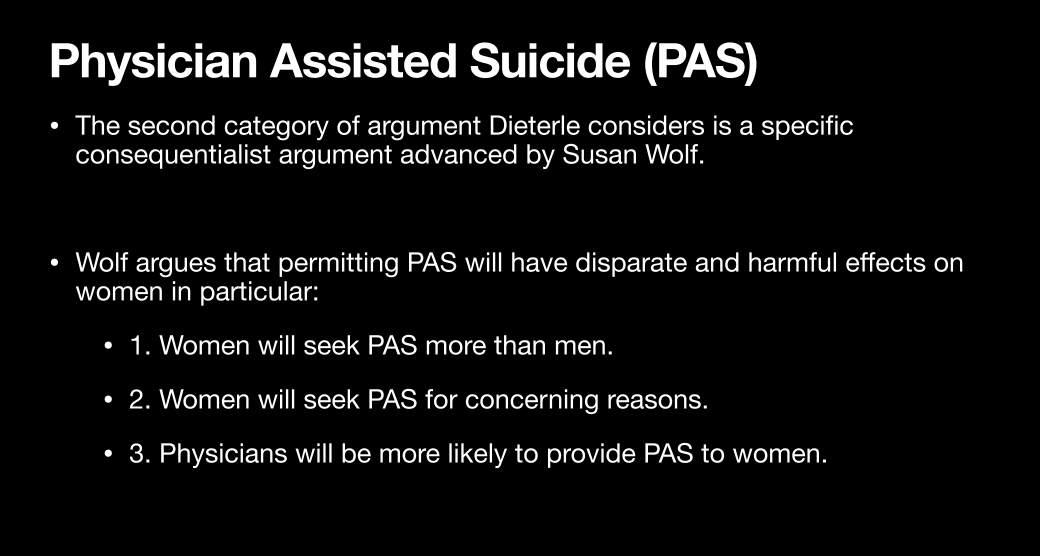
Okay. I mean so this kind of actually Wolf's argument is kind of in line with the point you're just trying to make because Wolf thinks that like actually Permitting PAS is going to have disparate and harmful effects upon different members of society.
Wolf is concerned with women in particular. Who can imagine running a similar type of argument for other advantaged members of society?
Wolf's going to say, like wolverine, three particular consequences that women might be subject to if we permit PAs.
And that might give us cause to at least like worry about permitting it yet not, you know, otherwise make it legally impermissible.
So she says that like we might worry that women are going to seek PAS disproportionately more than that, you might worry that women are going to seek PAS for reasons that are concerning and we might worry that physicians are going to be more likely to provide.
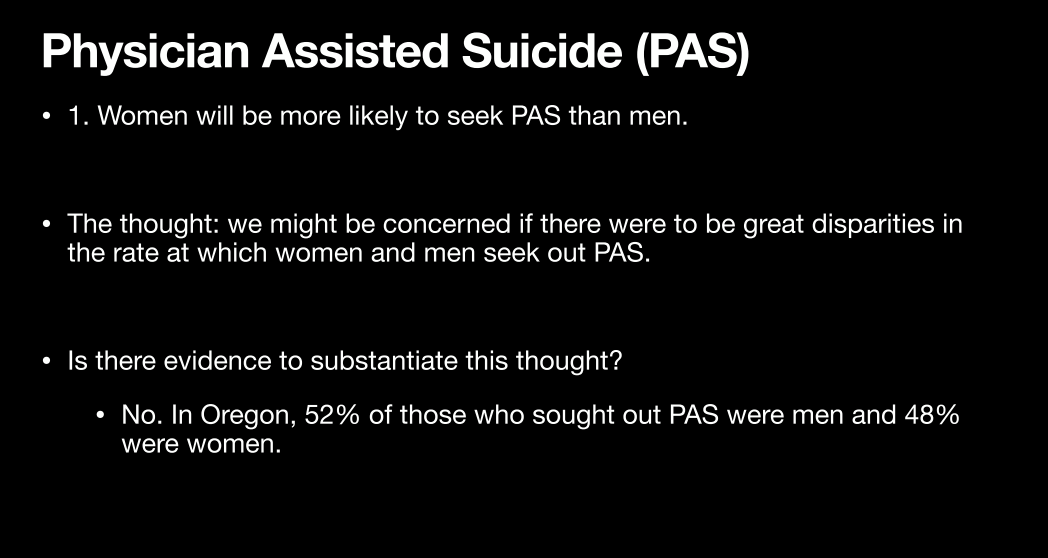
Okay, so what is the thought here? The first thought? First off, we might be concerned if there are great disparities in the rate at which women and men seek FDAs.
If women are seeking FDAs way more than men, then we might agree that there is something specific, there's something, something is unfair that makes it the case that women are finding that they are unable to continue, continue suffering from the terminal illnesses they have and then are strictly happy terminal illnesses they have.
In other words, like a disparity might be evidence of like some form of unfairness that's happened earlier in their history of metal.
But actually diary thinks that there's no other sought that we should be worried about this sort of thing, but there's no evidence that it's actually eventuated.
In Oregon, at least 52% of those who sought a PAS were men, 48% were women.
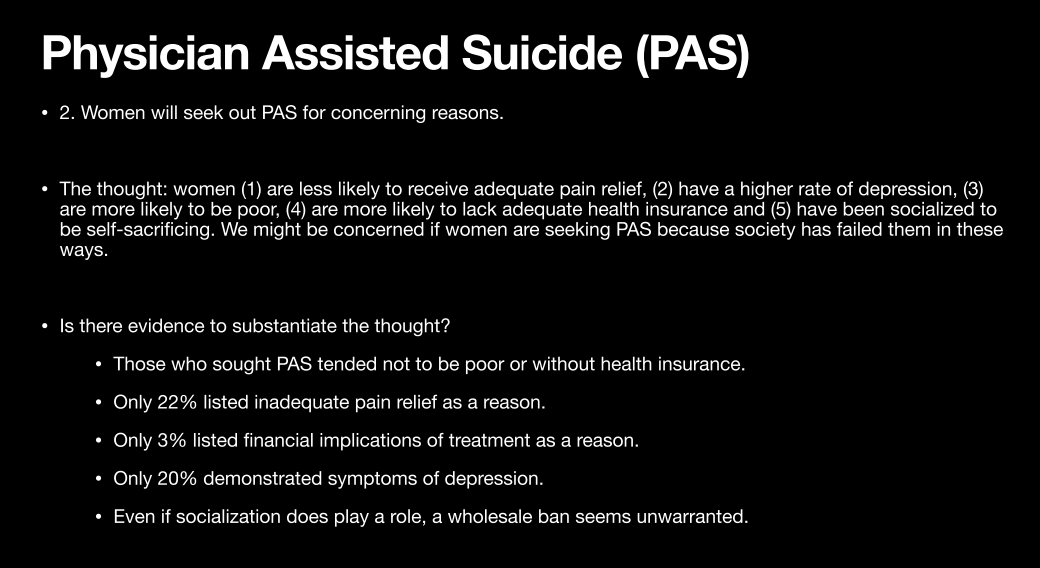
Second one, we might worry that women are going to seek PAS because like society has failed them somewhat earlier along.
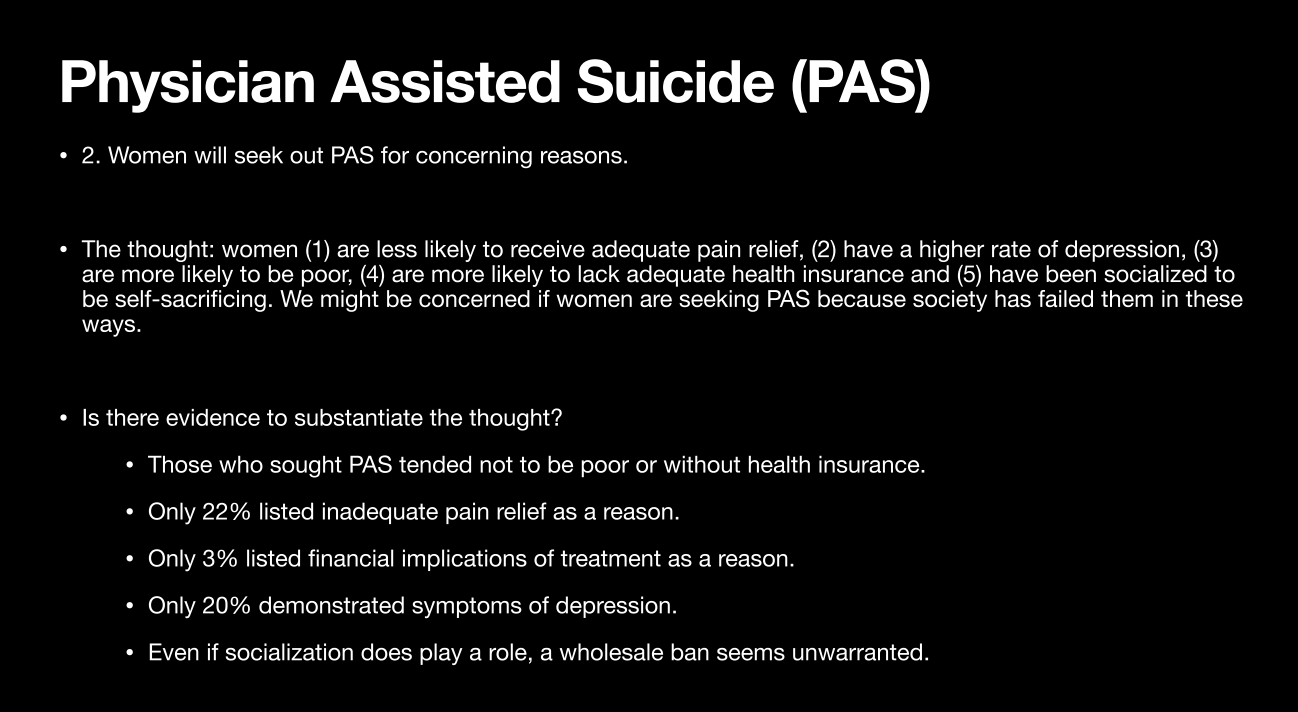
So women are quote, are not quote heroes, are less likely to receive advocate, have higher risk of obstruction, are more likely to be poor, are more likely to lack adequate health insurance and have them socialized to be self sacrificing.
In light of these features, we might be worried if women are seeking PAS because society has failed in service.
So if people are only seeking out a sort of like early end to their lives because they've been failed in all these ways, then we might worry that like we're focusing our attention on the wrong things instead of, I mean, I don't know why we can't do both.
But instead of focusing on permitting PAs, we should be focusing on remeding, remedying the sorts of reasons that are incentivizing them to see pas.
Okay, the Diary thinks that there's not great evidence for the either.
At least that these are the sorts of reasons that are leading women to electric PAs.
Those who saw PAs tended not before health insurance only 22% listed King Relief as a reason.
Only 3% financial implications only 20% symptoms of depression.
And even if socialization does play a role, we might think of like a wholesale ban is on.
Like yes, we should have worried about these things.
We should try to address them causes that incentivizing this.
But we shouldn't then ban access to this sort of treatment just because.
Yeah, yeah, that is a good question. I'm not sure about that. Yeah, there's a part of the article where they say they don't have gender specific recording on these people.
So you're right. That's mass.
Lecture 23
Class, Tuesday's class. I'm going to start today's class. That was running over your resting material. I will handle cover on Tuesday. That'll be pretty quick, hopefully. And then I'll move on to the material that's planned for today.
So recall Tuesday's class, the second article in the book Passion by In that article she's considering like 10 arguments that we might run against the permissibility of the the first step that we consider that all sort of follow the same general structure.
They all said something along the lines of like if we permit physician system suicide then this consequence will happen, this consequences, all things consistent considered bad, therefore we shouldn't commit suicide.
And I really wanted to say like okay, is there a different complaint that you're making in saying if you commit physician assisted suicide then some consequence will happen?
We're making an empirical claim. We can study whether or not that's true. We can look to jurisdictions in which physician assisted suicide has been legalized and ask like okay, do these actual do these circumstances actually merit so we look at seven of those non teams convincingly.
She thinks that all the consequences that are reported to to arise we legalize the suicide have not arisen in the jurisdictions of Oregon and the Netherlands.
So then she moves on to consider two or like a specific kind of suicide.
She attributes this argument to Susan Wolf. I went through a little bit of this on Tuesday, but I'm just going to start at the beginning and go through it all again.
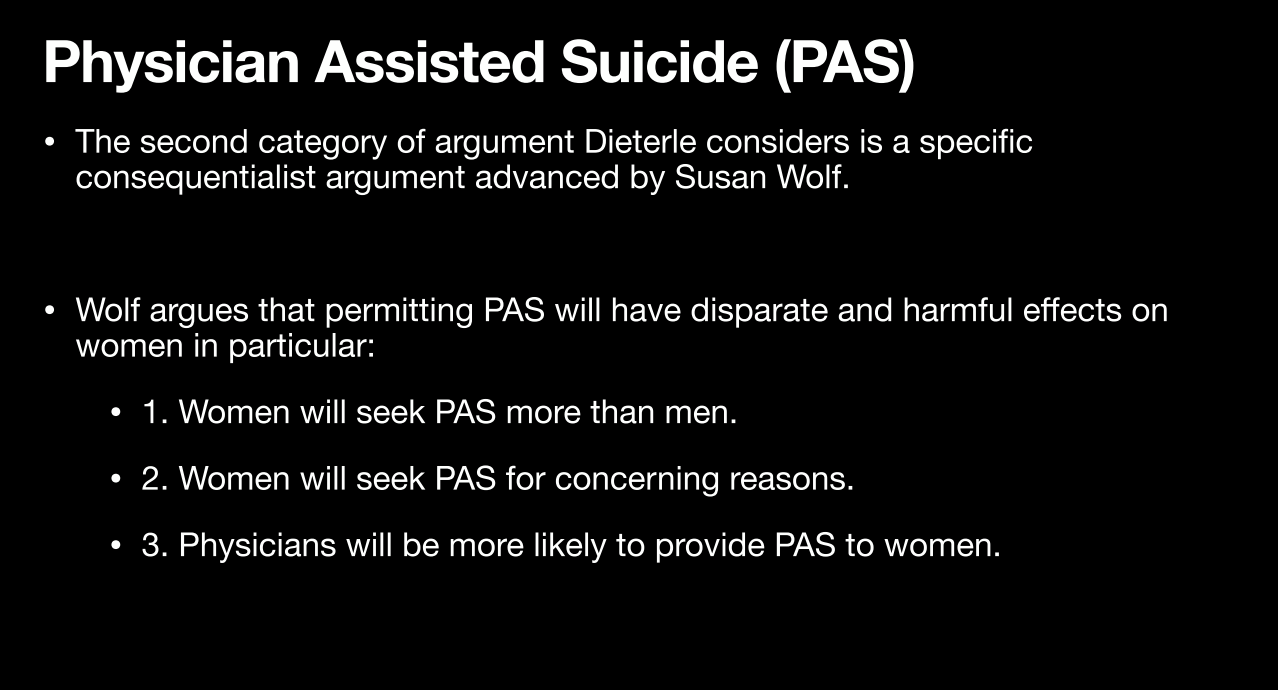
So Susan Wolf argues that permitting DAs we might want to we might have reservations about permitting PAS because of the fact that it's going to or at least she predicts have disparate and harmful effects on women in particular.
So she predicts three sort of particularities or particular sorts of harmful effects that women will uniquely experience.
She thinks first that women are going to seek out PAS 1 and then second she thinks that they're going to seek out PAS for concerning reasons.
And third, she thinks that physicians will be more likely to provide PAs would so will be more likely to respond affirmatively to a race.
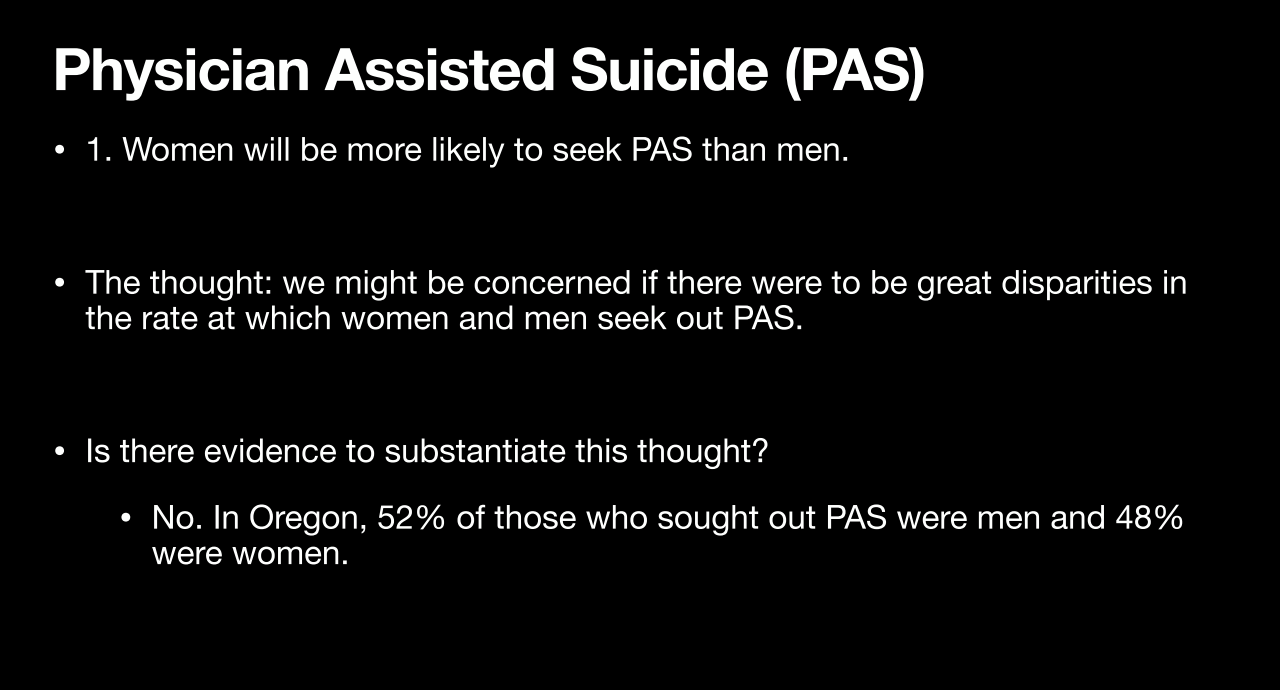
Requests are P.S. okay, so the thought behind this first harmful effect and why we might call into question the permissibility of data as a result that we might be concerned if there are great disparities.
We might be concerned that something morally suspicious is happening.
If women disproportionately are seeking out earlier ends to their lives than men.
Okay, what is their evidences substantiate this thought Diary thinks no.
In Oregon, 52% of those who sought out PAs between 1998 were men and only 48% were women.
This is consistent with the distribution of men and women within Oregon society.
So there's no reason to think that women are just subordinately seeking oas.
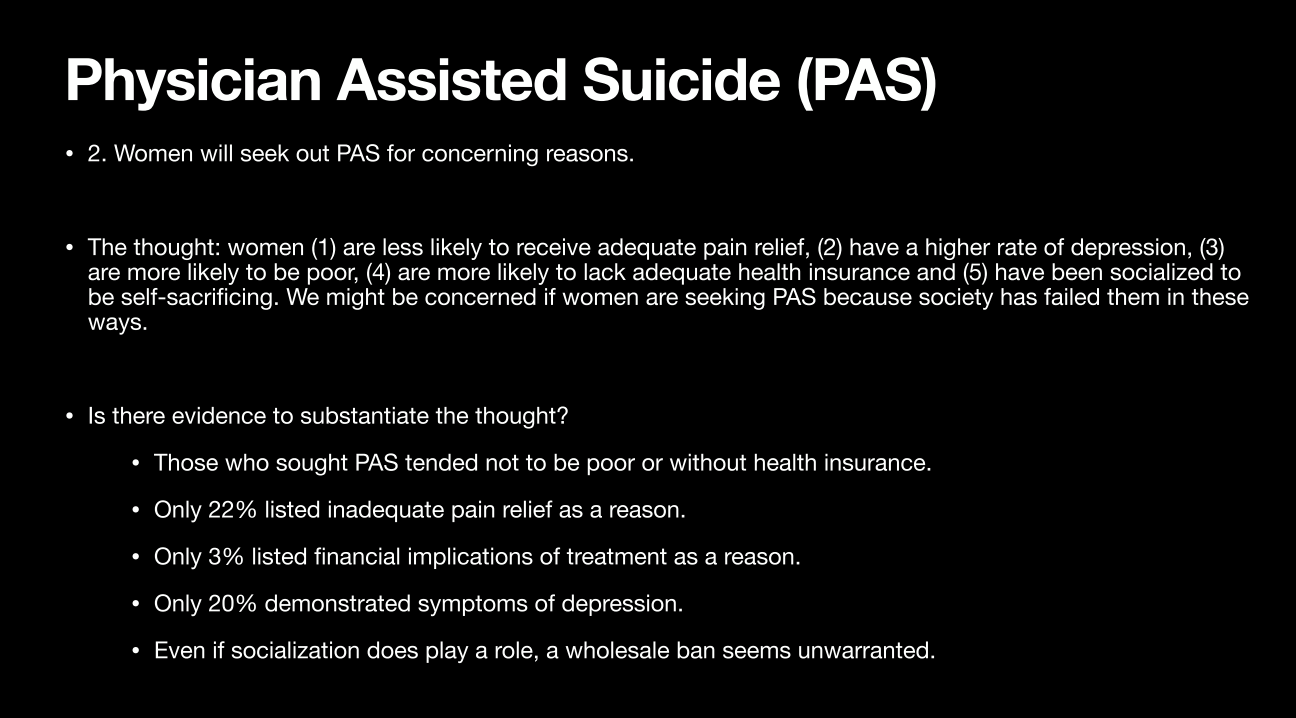
She also worries that women will seek Otis for concerning reasons.
So the thought here is that women are more likely to suffer from like, sort of.
The effects of like poor social conditions. So women are less likely to receive pain relief when they engage in mental institutions.
They have a higher rate of depression, they're more likely to be poor, they're more likely to lack health insurance.
And we might think that women who can socialize in many societies to be self sacrificing.
And so it's like one thing we think women are seeking out PAs because of sort of like genuine autonomous reasons.
You know, they just think that their life will not be as good if they continue living and therefore they should end their lives early.
We might not be concerned if we think those are the sorts of reasons.
And we might be more concerned if the sorts of reasons that are motivating women to see people are because they are sort of like disproportionately likely to suffer these harms in society.
If that's the case, we might think, look, the solution here isn't to just permit women to engage in position.
This has been assisted suicide. The solution here is to deal with the sorts of like disparate social harms that women are experiencing that might lead them to adopt her, to elect to undergo pas.
Weird meth, otherwise. Okay, is there evidence to substantiate this thought?
Direly, again, thanks. Probably not. She notes that those who sought out gas, at least in Oregon, tended not to be poor.
They tended to have health insurance. Only 22% listed inadequate pain relief as a reason.
Only 3% listed financial implications as a reason, and only 20% demonstrated oppression.
And then finally, she notes that like, even if it's true that women are socialized in certain societies to be self sacrificing, even if we do then have cause to worry about whether or not they're making the decision to undergo PAS because they think would be self sacrificial, because, for instance, they don't want to be burdensome on their family members, it's not clear that this by like a wholesale ban on physicians.
It might sort of like prompt us to be more careful about when we provide this sort of treatment.
It might prompt us to reflect on the ways in which women are social, socialized to be self sacrificing.
But it's unclear that it would justify something so severe as like an outright legal ban on indigenous suicide.
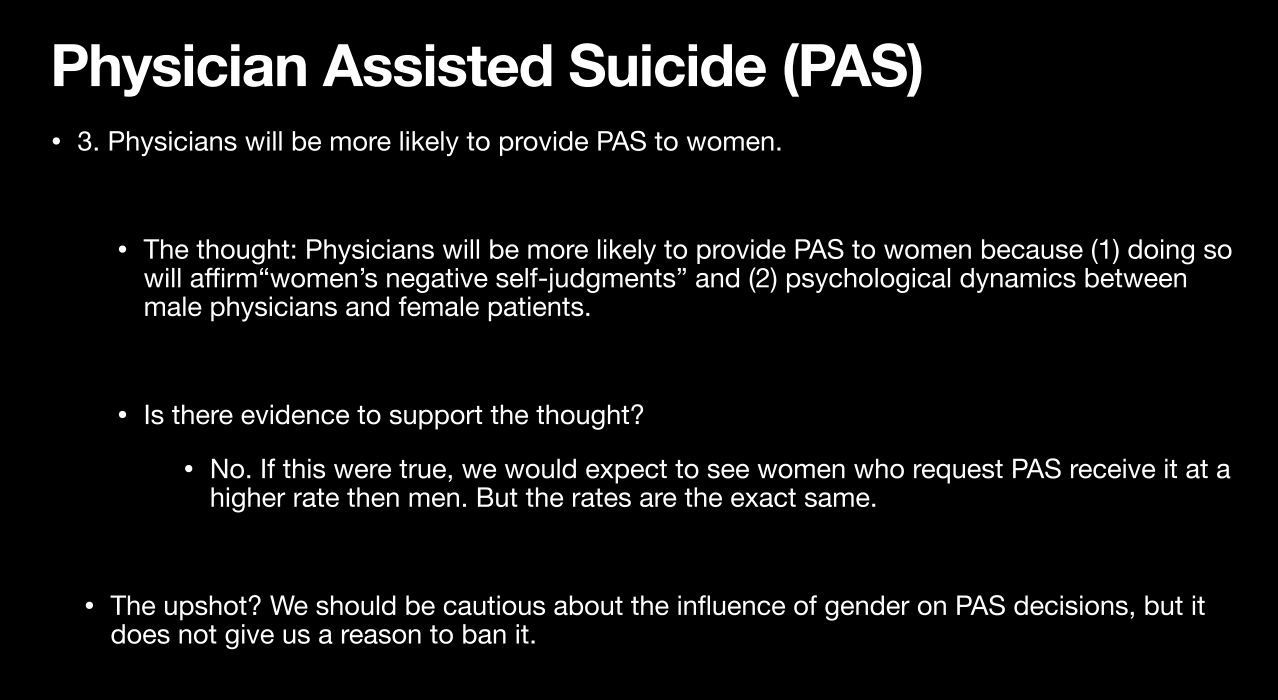
Finally, authorities that like certain social conditions, are going to make it the case that physicians are just more likely to provide BAs to women and maybe in cases where they ought not to.
She thinks this for two reasons. First, doing so will quote confirm women's negative self judgments and second, there are psychological dynamics between, for instance, male physicians and female patients that might make it more likely that physicians are worth provide PAS women.
Okay, but again, Diary thinks there's probably not sufficient evidence to support this thought.
If it were true, we would expect to see women who request PAS receive it at a disproportionately higher rate than men.
But in fact the rates are the exact same 52% of the people who requested PAs were men, 48% of women were women, and 52% of people who successfully received PAs for men and 48%.
So Dyer concludes that like look, Wolf's observations here aren't without marriage.
She's obviously pointing to important social and local factors that might contribute to science decisions, CPAs, and we should be sensitive to those factors when we're thinking about where we're going to provide it.
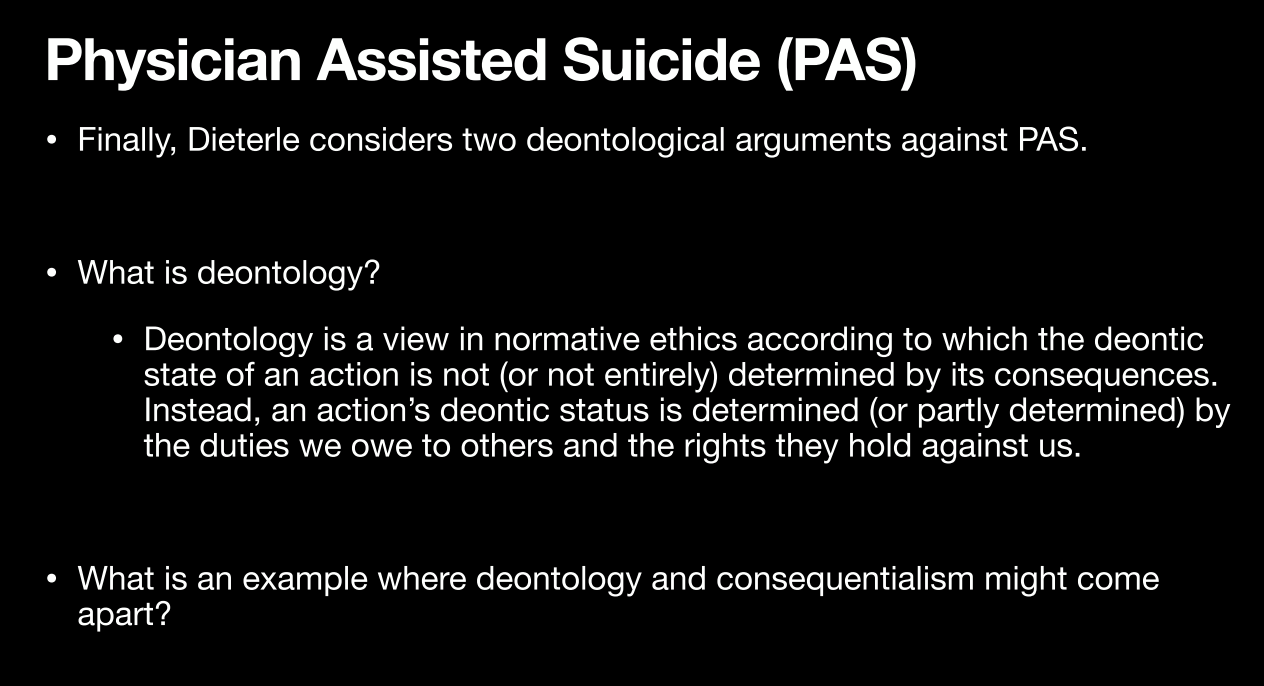
But this does not give us a reason to fail. It gives us a reason to be cautious, but not a reason to outright okay, finally, die to the ontological or non consequentialist arguments against PAs.
So recall from Tuesday's class Consequentialism is a view in Norms of Ethics that says the deontic status of an action, whether or not it's right or wrong or misunderstood or supererogatory or suberogatory, is determined entirely by its consequences.
We don't need to know anything else about the action except whether its consequences were all things considered good, whether they maximize happiness.
Whatever valuation we assign to outcomes, all we need to look at is what the outcomes of an action are, and then we can know whether that action was right or wrong or permissible or bad.
So deontology is sort of like the opposing perspective in normative ethics.
Deontology holds that the deontic status of an action is either not determined by its consequences at all, that the consequences are just entirely irrelevant to the deontic status of an action.
Or I think the more prominent and popular view is that while the consequences matter somewhat like surely the consequences and effects of an action make some difference to whether or not it's this is not a whole story that an action status is at least partly determined by the duties that we owe one another by the Rights that we hold against one another.
So like, I mean, some people will deny this. Consequentialism basically denies the existence of something like a moral right.
So consequentialism would say nobody has the right to bodily autonomy.
Nobody has a right to have their basic needs be met because rights are defeasible if the consequences of violating a right are good enough.
If violating your bodily autonomy means that we maximize happiness, then that's what we should do.
That's what the morally obligated to do in terms of consequences.
So consequentialism can make sense of the concept of rights.
Deontology says no, there's nothing, something important about the notion of a right, the notion of a duty that explains why certain sorts of actions are permissible and certain sorts of actions are incorrect.
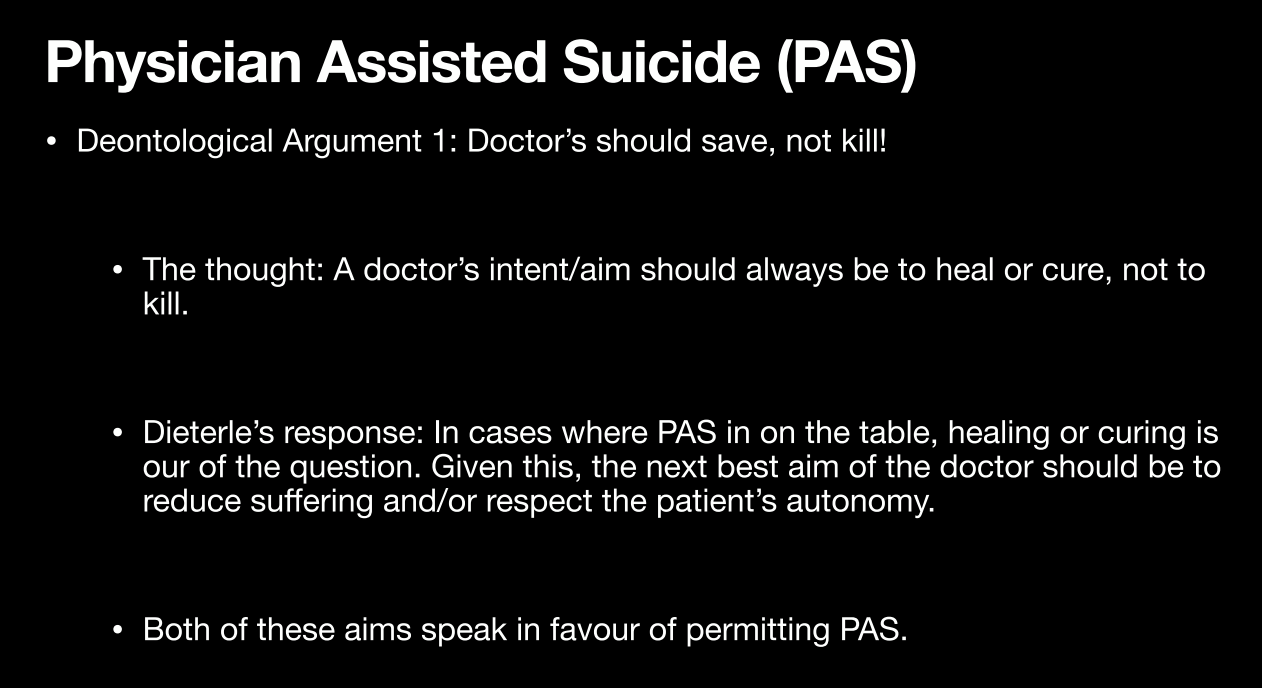
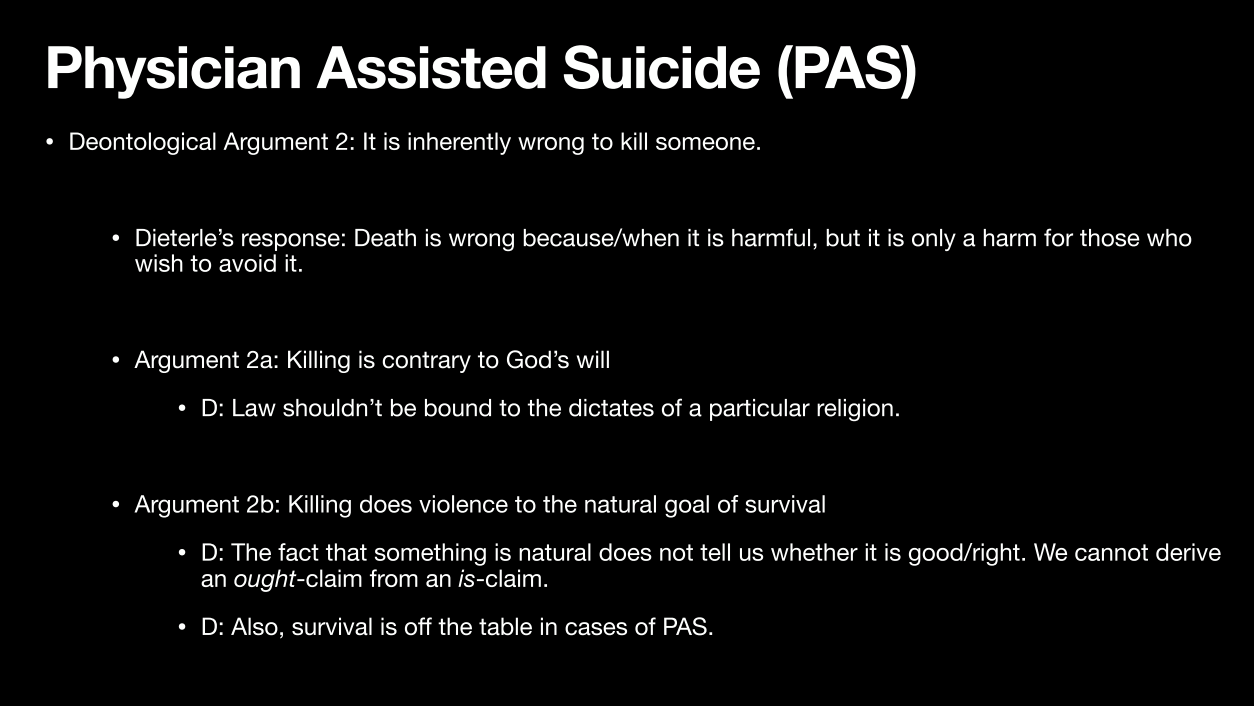
Okay, so one line of the ontological argument we could run against physician assisted suicide is that, well, doctors should save, not kill.
The duty of the doctor or the duty of medical practitioners is, is always to provide healing or rescue.
It is never to kill people. Okay, diary response being like, look, in cases where PDS is on the table, healing is out of the question.
Right? The only reason we're even engaging in the question of whether or not a particular patient should undergo physician assisted suicide is that we've already determined we're not going to be able to heal them from the cells that they're suffering from.
There we're asking, given we cannot heal them, what should our next step be?
And it seems plausible that given healing is off the table, a doctor's next best aim should be to reduce stuff or at least respect the patient's autonomy.
But the basic idea is that like this prescription doctors should say would not kill.
It's just like too broad and strong prescription and doesn't take into account cases in which the doctor can't take and therefore has to engage with their patient some other way.
Okay, the other deonthological argument we might want against PAs is that it's just inherently wrong to kill.
That there it is just fundamentally wrong to kill no matter what.
And Dearly's response is like, okay, well, let's think about why is it wrong to kill?
Like, what explains the fact that it's wrong to kill?
It's wrong to kill people because it harms them. And we need to justify the harms that we impose on people.
But. But it seems plausible to say that death is only harmful for people who want to avoid death.
I would like to go on living, you know, for at least the next like 60 years.
And so insofar as I'm trying to avoid death, death would be very harmful to me.
I have all of these interests and aims that would be frustrated if I were to die, you know, after this class.
In contrast, for those who don't wish to avoid death, for those whose existence is mostly, you know, whose existence consists mostly of suffering, it's not clear that death constitutes a harm anymore.
They don't desire death suffering. And so if the reason we think death is wrong is that it's harmful, then it's not clear that death would be wrong.
In the case of people for whom death wouldn't be okay, she considers sort of sub variant of this argument that killing is contrary to God's will.
That may be true, but she holds that the law shouldn't be bound to the dictates of a particular religion.
Legislation, such as legislation banning the, banning access to suicide should be justifiable on the basis of public reasons, that is reasons we can imagine everybody accepting.
We shouldn't be trying to justify legislation on the basis of some comprehensive doctrine that we're committed to like the Christian Bible.
Okay, the second set here is killing does violence is the natural goal of survival.
We're all sort of like evolutionarily primed to survive.
There's a sort of like natural drive to survive. And killing frustrates this natural drive. And Dyer knows like, okay, but the fact that something is natural doesn't tell us whether or not it's good or bad.
This is like a sort of fundamental precept of moral philosophy is this thing called the is ought distinction.
There are claims about the way the world is. There are claims about the way the world ought to be.
But claims about the way the world is don't tell us anything about the way the world ought to be.
You cannot derive an ought claim. So the mere fact that it is the case that we have a natural drive to survive does not mean that it ought to be the case that we have a natural drive to survive.
More importantly, dynamic notes like, okay, it frustrates the natural goal of survival, but survival is not.
If we're asking whether or not the undergoing physician system suicide, it is because we are not going to be able to survive or be healed of the illness that we're currently suffering.
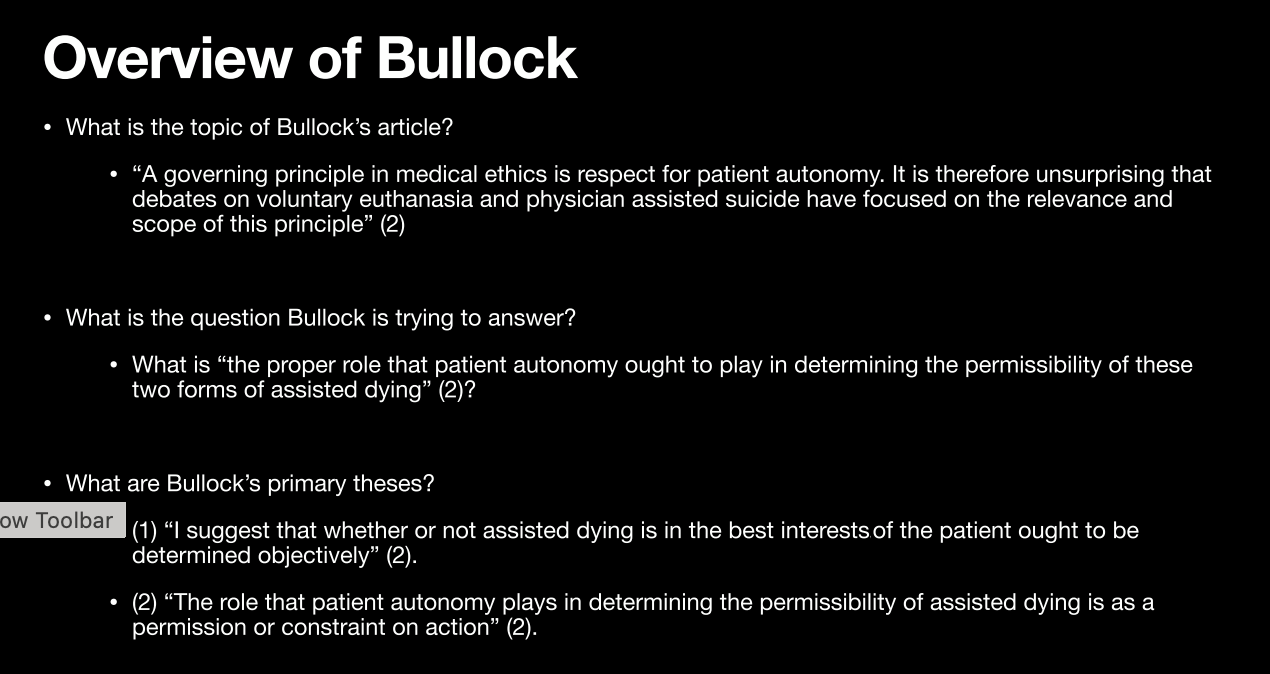
And then I'll talk a little bit about like practical application of review and we'll talk about whether or not we find it.
Okay, so what is the topic of Bullock's article? I identified it as follows. Quote, a governing principle in medical ethics is respect for patient autonomy.
It is therefore unsurprising that debates on voluntary euthanasia position assistant to assist side focus on the relevance and scope of this principle.
Okay, so based on that introduction, we can deduce that the topic of this article is going to be something to do with the relevance and scope of the principle of respect for taking upon.
Okay, what is the question that Bullock is trying to answer in this paper in light of the topic that she's presented?
Speaker 2
Yeah, the relationship between like self autonomy, self determination and how that.
Good.
Speaker 1
I mean, that's more specific than I was looking for, but yes, definitely she's trying to answer the question of what role should thinking about autonomy as self determination play in our thinking about the permissibility you receive?
Suicide, resisted dying. Definitely she's thinking about that. But even more broadly, she's just trying to figure out like what is the role of time?
She says what is the proper role that patient autonomy ought to play in determining the permissibility of these two forms of assisted dying.
She runs voluntary euthanasia position, assisted suicide together.
For the purposes of this article, she's just interested in what role should autonomy play thinking about whether or not it's permissible to engage a system.
Okay, I think Bullock has two primary theses in this article.
One is sort of like a negative thesis. So it's a thesis that tells us what we shouldn't think about something.
And she has a second thesis that's positive thesis that tells what we should think about something.
Can anybody tell me what these two pieces are? What are the two sorts of, of like primary claims that, that Bullock Wants to advance.
Okay, the first that I identified, she says, I suggest that whether or not assistant dying is in the best interest for the patient should be determined objectively.
This is quite a controversial claim. We'll get into why in a second. But she thinks that whether or not it is in my interest to continue living is a matter of objective fact.
It is not dependent on my subjective attitude towards living.
So it might be the case that I really, really like, really, really would like to no longer be continue living.
And Bullock is going to want to say, that doesn't matter.
It might still be in your best interest to continue living, even though it would cause you great psychological distress, Even though your subjective attitude towards living is one of abject indignation.
That doesn't matter, because whether or not it's in your interest to continue living is an objective fact.
It has nothing or not that it has nothing to do. But it is not entirely a matter of how you feel about continuing to live.
The second thesis that she's going to defend is, quote, that the role of patient autonomy, or the role patient autonomy plays in determining the responsibility of the specific dying is that permission or constraint on action.
So there's two theses here, two interesting theses.
I'm sure she has more paper. What we're going to talk about today is whether the best interest of the patient is something that should be determined objectively and whether we should think about autonomy as a mere side constraint when we're thinking about assisted.
Okay, so again, all this paper is what identifies the role spectrum patient economy ought to play in the permissibility of assisted.
Speaker 2
D.
Speaker 1
And so Bullet begins to like, okay, we've thought about this for a long time.
It's not that I'm the first person to consider what the role of autonomy is and what permissibility is.
What is the sort of, like, standard account? What do most people think the relationship between autonomy and permissibility of the sin of the dying is?
She says, quote, the central case to the moral permissibility of the s dying is that it constitutes respect for individual autonomy.
So why should it be permissible for me to ask a doctor to call me suicide?
It should be permissible because it respects my autonomy.
If it is my autonomous will to end my life, then the best way of respecting my autonomy is to provide me with the means to end my life, or at the very least, not to prevent me from ending my life.
Okay, why? How does this respect our autonomy? Well, she says, quote, a person has the right to shape their life through her own choices.
And this right stands to include the right of patients to choose the manner of our death.
So to be autonomous is to give shape to our lives through our own choices.
Then to respect my autonomy means respecting my choice about when and where I should die.
Okay, so this idea that the moral permissibility of assisted dying is grounded in respect for patient autonomy is sort of most clearly revealed in the emphasis that if the medical institution places on informed consent.
We've talked a bunch about informed consent thus far.
I'm not going to go through what it is, but the doctrine of informed consent, what informed consent is supposed to do, the sort of principle in which we think it's relevant, tells us that patients can permissibly refuse medical treatment or consent to certain forms of medical treatment as long as they meet certain conditions.
So we look to one account for what these conditions are.
But generally we just think people need to be like, rational, have options before them being informed about those options.
And we think that insofar as those conditions are met, then patients can permissively refuse or endorse certain forms of medical treatments performed on.
Okay, so the main justification for regarding the permissibility of as the dying contingent on the presence of informed consent is rooted in this sort of more fundamental idea that respecting informed consent is an essential feature of respecting autonomy.
That we cannot respect somebody's autonomy unless we respect their informed consent.
If they consent to something, then we're allowed to do it.
If they do not consent to something, then we're not allowed to do it.
And that's all we need to do to promote their autonomy.
Okay, that should say about it. So Bullock knows that like, okay, so there's this sort of like intuitive standard account that ties to the applicant autonomy to respect her informed consent.
That all we need to know when we're trying to figure out whether or not euthanasia is permissible, is the to ask, well, did the person in question consent to being unionized?
It's like, well, okay, whether or not informed consent and respecting informed consent is the sort of like, be all and end all.
The only thing we need to know about in order to respect patient autonomy, that's going to depend on how we conceive of autonomy.
It might be true on certain conceptions of autonomy that all we need to do is respect informed consent, but on other of autonomy, it's less clear that informed consent is the only necessary condition.
Okay, and the problem is it's like, it's not only that there are many different ways of constern autonomy, but like Autonomy just is a pretty vague concept.
We've been talking about it for the last two weeks, two and a half weeks.
And I don't know about you guys, but like, it's no clear to me what economy means system.
Even after talking about it for the last two and a half weeks, like, autonomy is just this sort of like nebulous improv concept that people are going to disagree with.
It's vague and it's difficult to define. And because of this, we see different accounts associate autonomy with a wide variety of different, you know, sorts of things that we or sorts of circumstances are phenomenal.
So we see autonomy associated with things like privacy, voluntariness, self mastery, choosing freely free in the shoes, choosing one's own moral position, and accepting responsibility in one's choices.
These all seem maybe related, but they are all fundamentally different than others.
And it might be the case that autonomy involves some of them or all of them or none of them.
Similarly, at least in the philosophy of Velocity in particular, we see autonomy strongly associated with notions of freedom, independence, self determination, self authorship, self government.
Again, we might think these are all slightly different things.
And whether or not autonomy involves any or all of them is going to be an open question.
Okay, so what remains in the paper? Pollock basically has two tasks. First, she wants to know how. How we should conceive autonomy in the context of medical ethics.
There are all these different views about what autonomy exists in.
Some emphasize informed consent, some emphasize self determination.
What have you. How should we think of autonomy when we're trying to do good medical ethics?
Second, in light of this conception of autonomy, what should the role of informed consent be in case of a civic dime?
Is it be all, end all? Is it the the case that the only way to respect autonomy is to track the informed consent of patients?
Or does informed consent play a lesser or variable in thinking about assisted diet?
In response to these questions, she's going to argue that autonomy should be guarded not in terms of self determination, but as a side constraint on what others may do to us.
So it's not the case that we should think about autonomy as just like trying to allow people to do what they want to do, rather than think about autonomy as setting limits on what other people are allowed to do to us.
Second, she thinks that informed consent is necessary for permissible assisted dying.
It would be morally impermissible to assist somebody in dying who has not consented to dying, but it is not sufficient.
The mere fact that I have consented to assist in dying is not sufficient for it to be permissible for you to assist in dying.
So this first. So she's going to consider two accounts of what a climate is system.
The first, we're going to call autonomy of self determination.
The second, we're going to call autonomy as a side constraint.
And we're going to start by trying to consider why we shouldn't think autonomy.
Think of autonomy in terms of self determination.
So on this view, if we think autonomy is merely self determination, then it looks like a patient enjoys autonomy just as long as she vote retains the ability to make choices that shape her life and incorporate her own conception of good health.
That just is what it is to enjoy autonomy. We enjoy autonomy when we get to make choices about how our lives go that are informed in some way by some vision about how we want our lives to go.
I would like to become a professor of philosophy.
I have many choices that are aimed at that role. I have enrolled in a PhD program, I have public school work in philosophy.
I presented at philosophy conferences. And all of these choices I made autonomously in order to shape my life in accordance with some vision of what I want.
All of the work I've done Getting my PhD programs in Philosophy has all been aimed at the goal of becoming a philosophy professor, which is my particular vision of what it is to live.
Speaker 2
A video.
Speaker 1
Okay, why is self determination important? Why should we care about whether or not people are able to exercise self determination over their lives?
So for some people, self determination is important because it creates our life.
If all of the circumstances of my life were decided by somebody else, if I played absolutely no role in shaping the circumstances of my life, in devising and consistent perception of what I want my life to look like, and then trying to make decisions and take actions to bring my life into coherence with that vision, then it just seems like life, beginnings, like life has meaning for us because we have to make choices because we are going to die at some point.
We have a limited time on the earth and only so many things we can do.
And so we need to make decisions about how to spend our time, what sorts of goods to prioritize, where it's a really relationship prioritized.
And it is through making choices about what sorts of goods to prioritize or actions to undertake or things to seek out that we enjoy meaning in our lives.
If our lives are completely determined by other people, if other people make all our choices for us, then life just wouldn't be a very meaningful thing.
It wouldn't be a particularly good thing for us to have, okay, a Second Hugo, lifestyle determinations and important is that it is the best way to promote our well being.
How can we ensure that people's lives go well? Well, we can ensure that they're given the ability to make choices that shape their life in accordance with their conception of what a good life is.
The best way to make sure we all live the life that we want to is to let us make choices about our lives.
Okay, so Bullock focuses almost entirely on this.
Bullock focuses entirely on the second justification.
So the argument from a self determination here is going to go something like why is it?
Why should position suicide be permissible? Well, is reasonable really important for our lives to be meaningful?
Speaker 2
And.
Speaker 1
In order for our lives to be meaningful, we need to exercise self determination.
And in order to exercise self determination, we need to be able to make choices about where and when we die.
Or the self determination theorists might say. Being able to make choices about where and when we die is essential for our self determination.
Self determination is essential for living a good life.
But the best way to live a good life is to be able to self determine.
And the best way to self determine is to give people the right to decide where to go.
So Bullock is going to focus on showing why self determination is actually not the most effective way of promoting your world.
That is going to be the goal for the bulk of the papers to show that actually letting people make decisions about their lives, especially medical decisions, is a really poor way of making people's lives go back because we turn out to be nonverbal.
But it's worth considering whether this first view holds.
So like again, Bullock wants to show that the best way of respecting a patient's right to self determination is the best way to respect or promote the well being of a patient is not to respect herself.
But it's worth considering this first view, I think, or at least I think it's interesting to consider this third view.
I mean, like so what do you think of this? Do you think that self determination makes our lives meaningful?
Can our lives be meaningful in the absence of self determination?
Even if other people are making decisions for us?
And if self determination does make our lives easier meaningful, should this ground permissibility of assisted dying?
Clear, informed consensus here, like so she sets this, this line of questioning out at the side of her article.
She's not interested in answering these questions, but I am kind of interested in answering these questions.
I think they're interesting questions. So I wonder what you think. Do you think that a life can be meaningful in the absence of self determination?
Do you think that self determination should be all that we think about when we're thinking about the permissibility of assisted dying.
That if, you know, if it is my role to die, then that is the only consideration that we need to have in mind when we're thinking about assisted dying.
Or do you think that there are other things outside of our self determination that bear on the question of whether they should be possible thoughts?
Speaker 2
Yeah, I feel like self determination is necessary to live meaningful lives.
It set us apart from other animals.
Speaker 1
The ability to do it.
Speaker 2
Okay, reasons. But then as for should be the only thing considered.
I think no because of the way the oppression works.
I think the original first slide, if women would be more inclined to request it, I think that just remain.
Speaker 1
Okay, great. So just to repeat in case you were neglected down here, the first point was that self determination does seem necessary to live out a meaningful life.
And you said part of what might explain this is that it is what sets us apart from other non human animals.
Human beings have a capacity to engage in reason to gain capital deliberation.
We might think that like one of the central sources of value in a human life is engaging our unique power to deliberate about what makes our life go well that we want out of life.
And so we might think that in the absence of being able to exercise this fundamentally human power, our lives as human beings would not be meaningful.
I think that's a great point. The other thing I wanted to say is that even though it's a necessary condition of meaningful life, it shouldn't be the only determination information that's relevant when we're taking that as they're dying because of the ways in which oppression can undermine the validity of informed consent.
Or even we can give informed consent in ways that don't seem fully autonomous.
And therefore it's unclear that we should. That we should be tracking informed consent in order to know the time.
Speaker 2
I agree with the kind of cynical kindness, but I think it's difficult from like going back to a point where it's needed to determine well being objectively to decide if self determination is something.
It's difficult because as she stated in the article, she is not on what each individual and body.
So I'm not sure how it's possible for external person to objectively judge what is in the well being of another good.
Speaker 1
I like that point. So I take a point to be. I mean maybe it's something exactly who you're saying like so like she wants to say that individuals might not always be the best judges of what's in their interest.
Sometimes we might get it wrong in the. The reason we can't get it wrong is that actually what's in our best interest is an objective fact.
But I think maybe what you are worried about is like okay, so individuals might not always be able to discern what is in their best interest.
But do we think that other people would do a better job?
Or like should we be at least questioning whether a doctor claims in my best interest more than I do?
Like we could deny that I always know what's in my best interest.
I might get stuff wrong all the time, but it doesn't follow from the fact that I could be wrong about what's in my best interest that other people are better situated to make judgments about my interest.
It might be that I'm wrong sometimes about what's in my interest, but you guys are going to be wrong even more about what's in my interest.
And so the sort of bare facts that you can be fallible.
What we're thinking about what's good for us doesn't mean that other people are going to be less valuable.
I think it's okay.
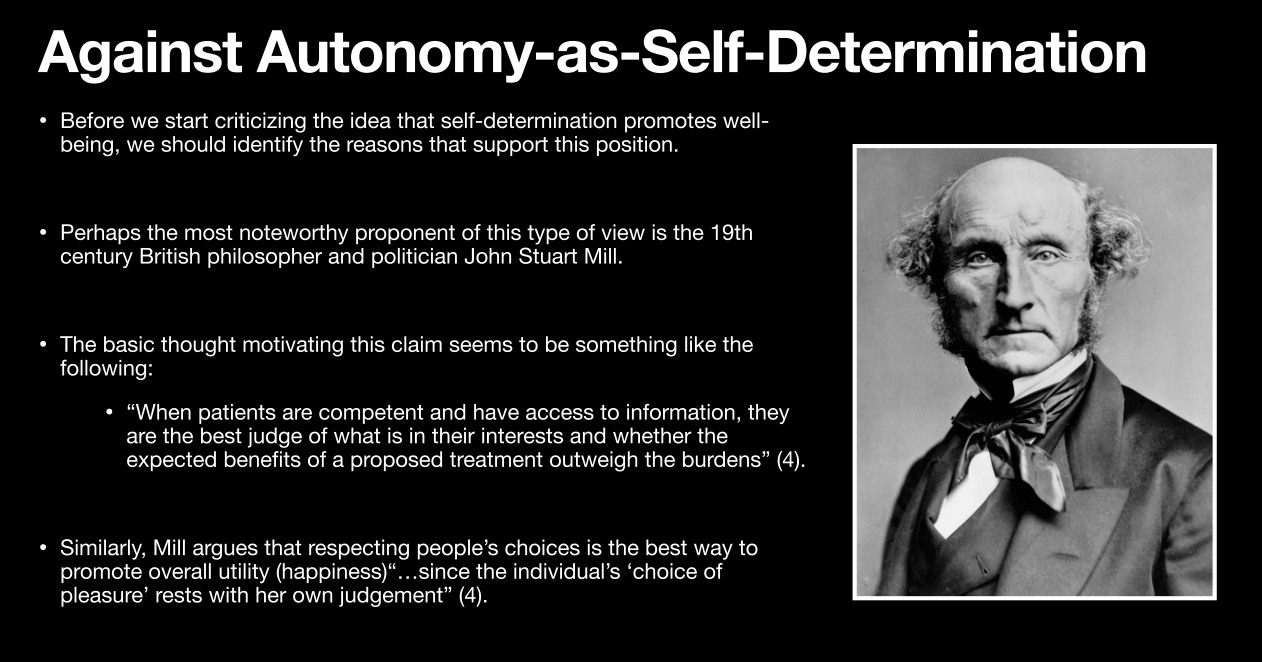
So Bullet wants to say self determination is not a good way of promoting wealth.
So before we start criticizing the position, let's see what speaks in the paper for this position.
Like why would we even entertain the idea of that self determination would be an effective way of human well being.
So perhaps the most noteworthy proponents of this sort of view is 19th century British philosopher and politician John Smith Mill.
Here's a really scary photo of him and the basic thought motivated this line of reasoning.
So again the claim on offer is the that the best way to promote each of our individual well being is to just respect the choices that we make.
That our lives and what we think supports this is that folks, when patients are competent and have access to information, they are the best judge of what is in their interests and whether the expected benefits of the post treatment is otherwise.
So why is self determination the best way of promoting?
Because self determination involves respecting each of our judgments about what's in our interests.
And as ourselves, we are the best judge of what is in our interest.
There's nobody that is better situated to know what would be good for me than me.
Why? Because I mean I know what it's like for my life to go well.
I know what it's like for my life to go forward. I know what the good things I want in my life are. I know what the things I don't care to have and therefore, when we're thinking about what sorts of like treatments I should be subject to or policies or whatever, it seems like the best judge of whether or not a policy or treatment or what have you is going to be good for me is me.
So Mill argues that respecting people's choices is the best way to promote overall utility.
Why? Because the individual's choice of pleasure rests with their own judgment that what constitutes a pleasure for each of us, what sorts of things are pleasurable and further, our well being is up to all of us.
Some of us might find listening to, you know, refined orchestral arrangements to be a great source of pleasure in our lives.
Some of us might think that listening to death metal is a source of, of pleasure in our lives.
Some of us might think that listening to soundcloud rap is a source of pleasure in our lives.
These are all sort of like distinct pleasures. They might be pleasurable for some of us and not brothers.
And who gets to decide whether or not there's a source of pleasure?
It seems like each of us has.
Okay, do you agree with this? Mill is pretty conscious that we are like epistemically preventing with respect to our own interests that we know better than everyone else on the planet what is good for us and what is bad for us.
I wonder if you think this is true. Can you think of counter examples in which actually in terms of other people might be better situated to know what to address than we?
Or do you just think that each of us is actually.
Speaker 2
Yes, like an example where like someone could be like a better judge for our life with like health care proxies.
When like someone is like deemed mentally unfit to make the best decisions for what they want in their life, they have somebody else make those decisions, decisions for them based off of what they.
Speaker 1
Believe are your goals for your clients. Exactly. We see this all the time, medicine. Indeed, we see it in the relationship between parents and children.
We typically think that just because, you know, a young six year old child says I don't want to go to school today, we don't take that to be the sort of like expression of what is in their interest.
We actually think that parents are allowed to override the autonomy of a child and say, no, actually I know you think you don't want to go to school today, but indeed it is in your best interest to go to school.
We think this in all sorts of ways and so we might doubt that this is just generally true that for any, whether or not we're children, whether or not we've lost sort of like the competency to make medical decisions.
You might think that just for any human being it's just true that sometimes other people are going to be better school in your evidence.
Okay, so note that if Mill is right, if it is the case that we are all best positioned to judge what's in our own interest, then the argument from self determination does seem to find like if we're all the best judge of what's in interests, then the best way to promote the well being of patients is to respect their choices, even if those choices are forgotten.
And Bullock wants to say like, look, this line of thought is widespread.
In fact, basically, you know, the vast majority of literature in bioethics or medical ethics or the literature on compositions, assisted suicide seems to accept this line of thought that we are best situated to determine what's in our interests and therefore we should respect the wishes of patients who just live their lives earlier.
And Bulloch just wants to say this is wrong. We're not best situated together within our interests.
Actually, there's a wide range of empirical evidence that suggests that individuals are in a particularly poor place to decide.
What is the minimum sentence?
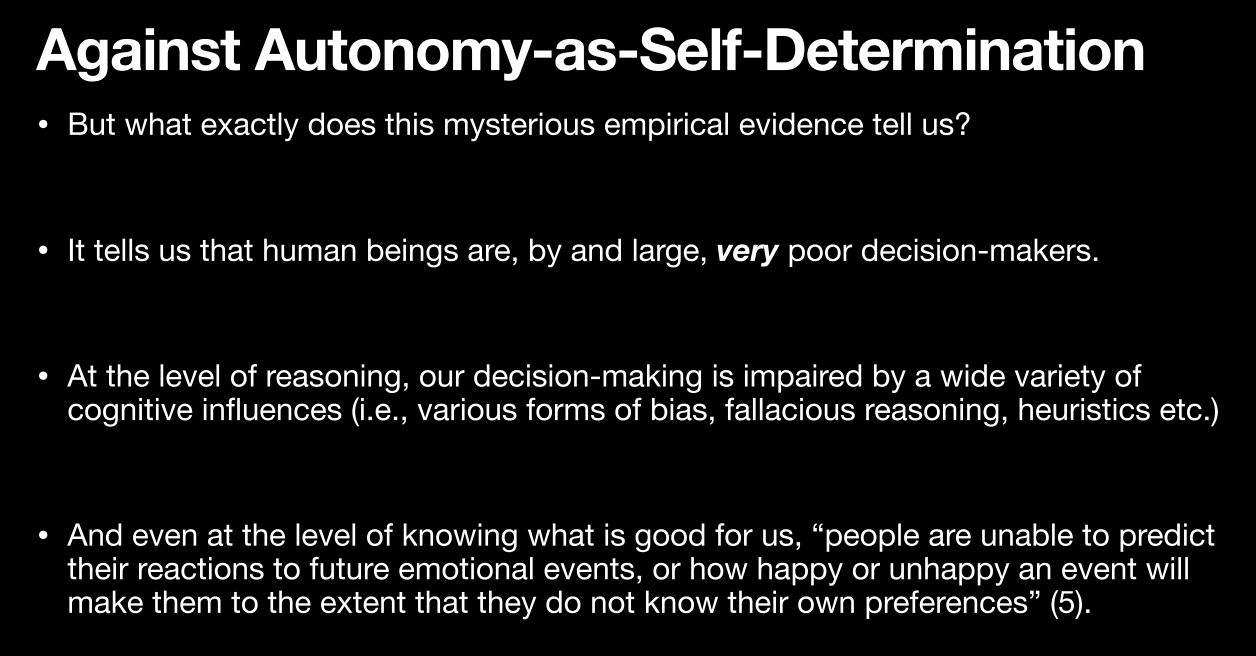
Okay, what does this mysterious tell us? Tells us that human beings are really, really shitty at making decisions.
This is actually a very interesting literature.
It's a literature in behavioral economics and also the world.
You never read the book Nudge by Richard Thaler as Sunstein, it's about this sort of thing.
Sarah Connolly has a book called against the Autonomy that Cinema made about this thing.
And they just think like, look, we have data here about how human beings reason practically and make decisions.
And it turns out we do a really shitty job at decision making.
We actually don't know what we're doing most of the time when we're making decisions.
So with a little bit of reasoning, our decision making is just impaired by like an insane amount of cognitive influences.
So there are various forms of bias alleviation. You know, whether it's like confirmation biases, whether it's base rate fallacies, whether it's handler's fallacy, all of these biases inform our decision making in ways that don't actually track the truth, that don't track, you know, the logical relationship between some and we have to find what the means needed to achieve it.
We also engage in all sorts of fallacious reasoning.
You can look up, you can look up the Wikipedia page on logical fallacies and see just how many of these logical fallacies you fall prey to in your day to day life.
I, I promise it'll Shock you just how often we are racing about the world and what's in our interest in ways that are just not supported by logic, certain heuristics we do, these are like mental shortcuts that we use in order to make information processing more efficient.
But in making information more efficient, in taking shortcuts, sometimes we get things wrong.
And all of these various cognitive influences make it the case that sometimes when we're practically reasoning about what's in our own interest, we get the answer wrong.
Even if we could reason well just at the level of knowing what's good for us.
It turns out that, quote, people are unable to predict what their reactions to future emotional events or how happy or unhappy, uneventful make them to the extent that they do not know their own preferences.
So if the idea is that I should be able to make judgments about what's in my own interest, because I can predict how various various future states in the world will make me feel like, you know, I can predict that if the Toronto Blue Jays win the World Series this year, I will be very happy, and if they don't win the World Series this year, I'll be very sad.
But it turns out these sorts of predictions we get wrong.
I think I'm probably right about that one. But there are a whole bunch of ways in which we think we are going to have particular kinds of emotional responses or reactions to events like unfolding in certain ways.
And that actually does not track the actual emotional responses we have these events.
And so we actually don't know what we even want in many cases because what we think we want turns out to be once we get it or once it eventually unfolds, not the way we thought it was going to be, not the reaction we thought we were going to have, and other related things.
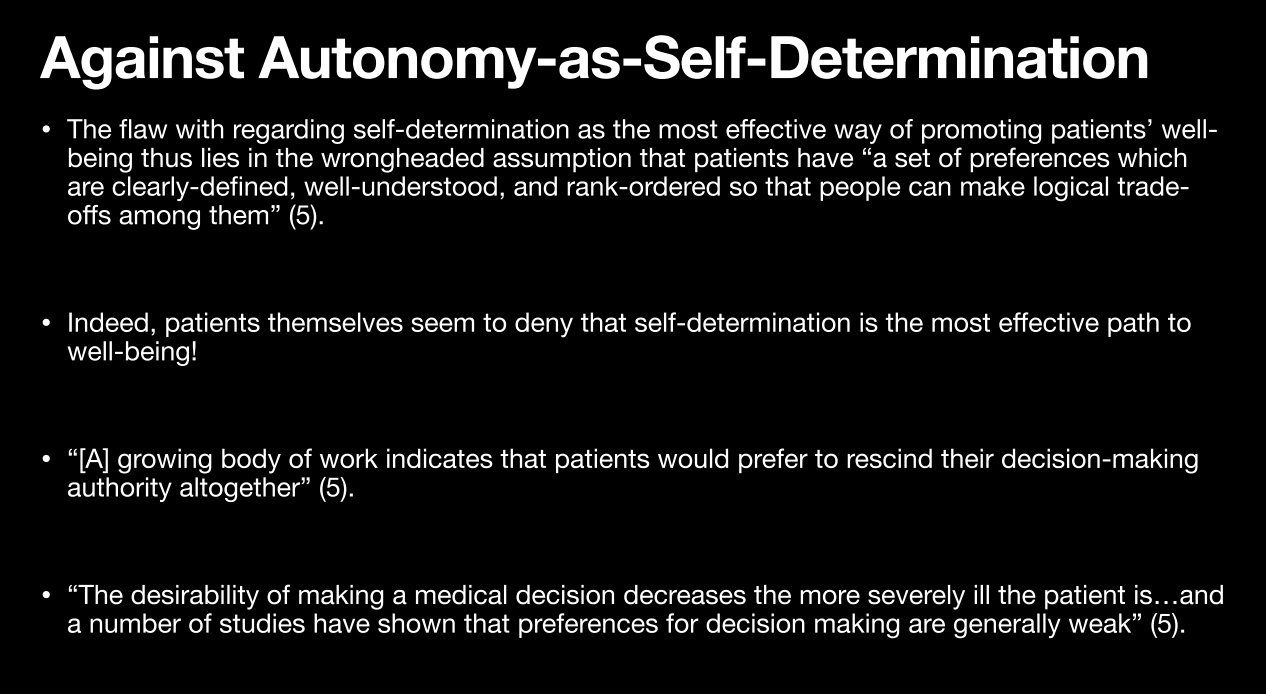
Okay, so the sort of like center point here is that the flaw, which is already self determination as the most effective way of promoting a patient's well being, lies in a wrong headed assumption that patients have, quote, set of preferences which are clearly defined, well understood, and rank order so that people can take Claudia So the idea is that if we all did have this, if all of us knew exactly what preferences we have about the ways we want the world to go, we understand what all these preferences are and what it would take to achieve these preferences, and we actually have an internal ranking of how much we care about all these preferences so that when we're made to make choices between one preference or another, we're able to make those choices and see what the trade off.
If we have all those things, then sure, self determination might be a great way to evolving.
We lack all these things. We don't know what our preferences are at any given time.
We don't really understand what it would take to achieve the preferences that we do have.
And we certainly don't have an internal ranking of the value of all these preferences that we can then just sort of like look at when we need to make decisions.
So the self determination relies on a sort of like fictional account of what human beings are as practical reasoners.
And once we sort of like grow that out, it's unclear why we should take individuals to be the best judges of what's in their interest.
And actually patients themselves seem to deny this.
So a growing body of work indicates that patients would prefer to rescind their decision making authority altogether.
What would explain why we want to rescind our decision making authority?
Presumably part of that explanation is like, yeah, we ourselves acknowledge sometimes we get **** wrong.
And I would rather have some, you know, qualified doctor making decisions than me who doesn't know anything about how to take care of myself.
Bullock also writes for the desirability of making an ethical decision decreases the more severely ill the patient is.
As we know, when we're thinking about suicide, patients are going to be particularly severely ill. And a number of studies have shown that preferences for decision making are generally weak.
So even we seem to acknowledge that self determination is just not that important to us.
Might this just be a practical issue? Is this just like a problem with the institution of medicine?
And actually we can think of ways to remove these biases, remove these influences, make it the case that we're actually the best judges of what's in our interest.
Bullet takes no. These are indebted. These are unavoidable influences. All of us go through life in a particular social world and this social world influences our ability to reason about what's in our interests.
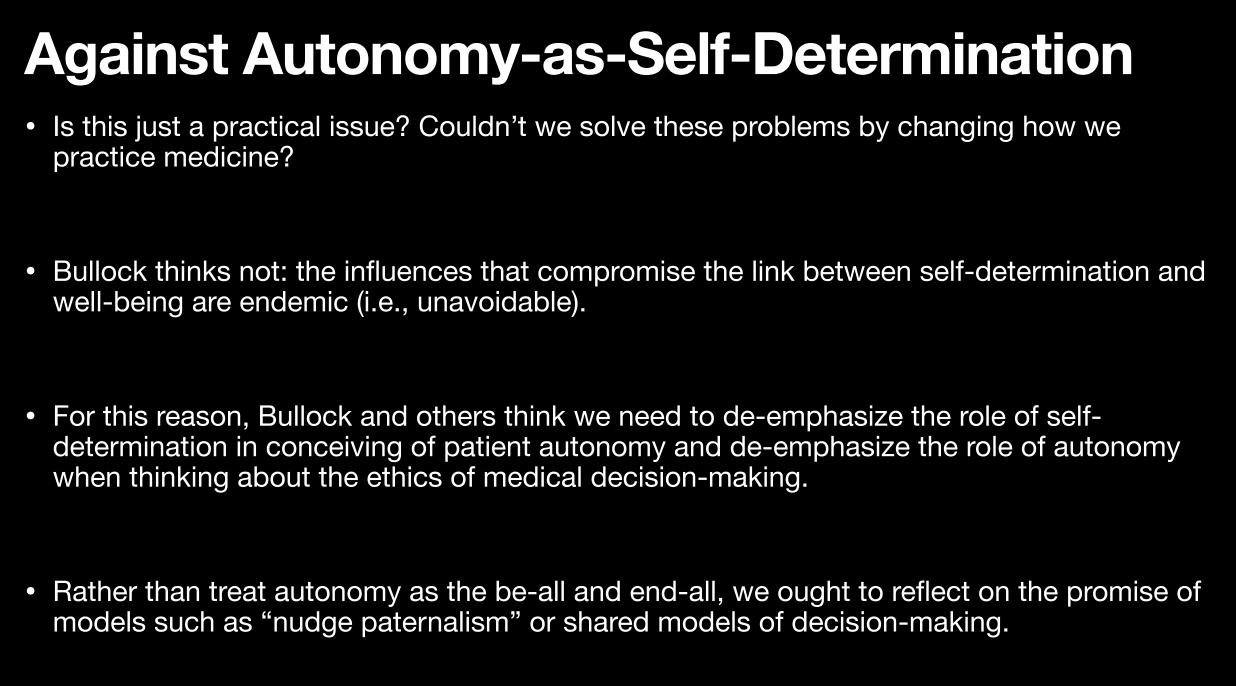
So for this reason, she concludes, we can deemphasize the rule of self determination thinking of the patient autonomy.
And as a result of that, we need to de emphasize the role of autonomy when we're thinking about the ethics position that there are other important things going on here, that the autonomy of the patient, specifically the self determination of the patient, is not the only matter that's relevant to whether or not we should be.
2 sort of alternative models that she thinks that we could, we could look at.
One is this view called nudge paternalism. This is the view that Thaler and Sunstein defend in their book.
It's a really interesting book. I do highly encourage you to read it. And another is like, shared models of decisions where decision making is made by like not only the patients, but a team of medical practitioners, Physicians, whether they are sort of like therapists, family council, what have you.
Decision making is not best within the individual patient, within a team, practitioners.
so let's take stock of what we've done so far.
At this point, we have pretty good reasons to doubt that autonomy should be understood entirely in terms of self determination.
And we have pretty good reason to doubt that autonomy should be the only thing we're concerned with when we're thinking about benefit decision.
And that leads to question like, okay, so we shouldn't think of climbing a cell.
How should we think about it? What should its role be in medical decision making?
So Bullock wants to say something like this is implied by the fact that she concerns most of the article with showing why self determination doesn't promote the well being of the patient.
She would only take up this concern. She would only make this the focus of the patient paper if she thought medical decision making ought to be guided by the aim of well being patient.
And so the reason we shouldn't focus on self determination is that it's not an effective way of promoting well being.
And so the goal is, okay, what would be an effective way of promoting patient well being?
Okay, I said that. Okay, but in order to know what it would take to promote the patient well being and how autonomy is going to factor into our thinking about these centers, we first need to know what.
What well being consists. What is it to be well?
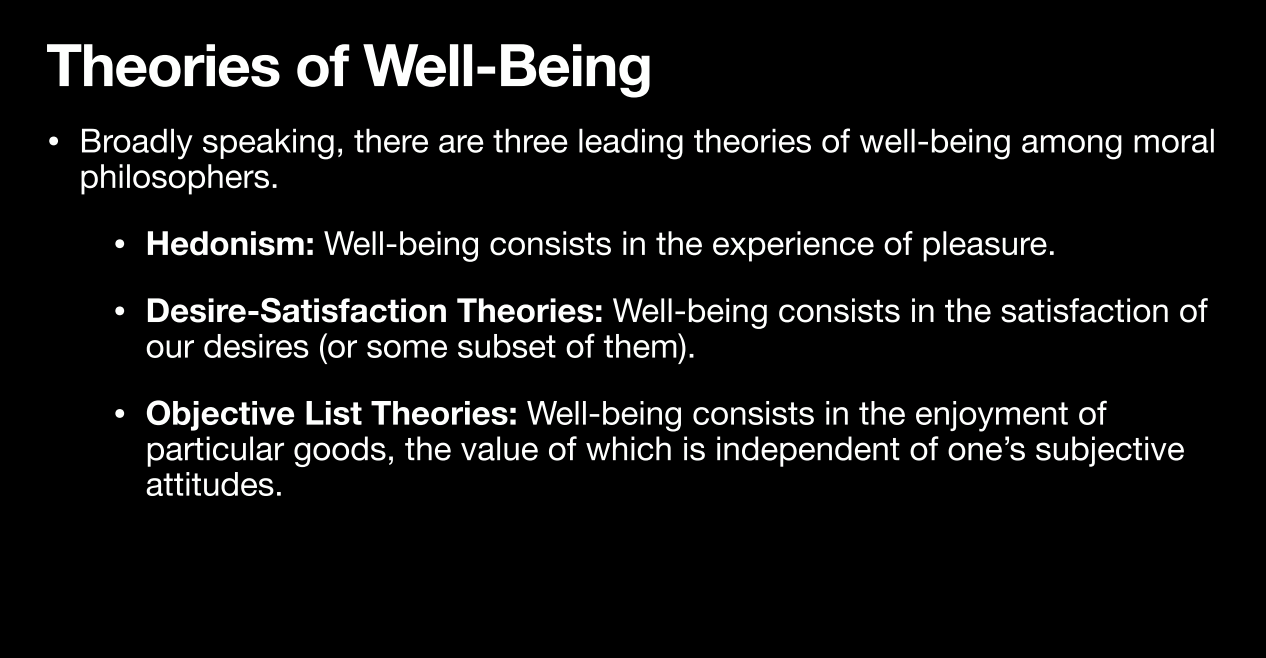
And when I talk about well being, like, you might replace the word well being with happiness.
I don't think that that works perfectly because sometimes we tend to think of happiness as like, like feeling that we experience and that's not what we have in mind.
We're talking about well being. Well being is like, what is it for your life to go above?
A theory of well being tells us like, yeah, what is it for Jordan's life to go above?
What sort of features need to be a part of Jordan's life for us to look at his life and be like, you know, things seem to be going on pretty good for sure.
Similarly, we can have theories of Elvian, which tells almost like, what is it for a life to go poorly?
What is what features need to be present in a life that we look at James and be like, things are going really poorly for James.
We should probably try to help this guy in so theories of well being just try to tell us, like, what is it for our lives to go on?
How do we know when our lives are going well? And broadly speaking, in moral policy there are like three general camps that argue we should think about well being in a particular way.
So the hedonists, of which I don't know if they're that any these days, but for instance, John Stuart Millman's hedonist, the hedonist thinks that well being consists entirely in the experience of pleasure.
That the only thing we need to know to know whether or not someone's life is going wrong is to look at how much pleasure they experience.
And similarly, as a theory of ill being, it might say the only thing we need to know to know whether or not a life is going poorly is how much pain they're experiencing.
But the only thing that matters to how well our life goes or how poorly our life goes is experiencing, experiencing pleasure and avoiding pain.
Okay, the second hand of theories we might call desire satisfaction theories.
These views hold. What it is for our life to go well is just to have desire satisfied.
Every time I have a desire satisfied, my life feels better than I did before I had that desire satisfied.
I have a desire for the Toronto Blue Jays to win the World Series.
If the Toronto Blue Jays should win the 2026 World Series, my life will end with effort.
For that being, even though I didn't win the World Series, even though I actually played no role whatsoever in their success, the mere fact that I have a desire for this to be true and then it becomes true is enough to say that my life has gone better.
Okay, now the final category of use that people tend to hold are what we might call objective list theories of well being.
On these views, well being consists in the enjoyment of particular goods, the value which is independent of one's subjective attitudes.
So there are just things that make a life feel better.
There are certain goods, like, I mean pleasure might be one of them, but like goods like play or knowledge or truth, that when you have them, your life goes better independently of whether or not you care about, independently of what your attitude towards those goods are, independently of whether you subjectively think your life is going well.
If you have these goods in your life, then your life goes better as a matter of objective.
So bullet favors subjective list theory of well being.
But it's worth considering for a second why she might favor this kind of aggressive thinking about well being.
So it's worth considering like why shouldn't we be heonists?
Or why shouldn't we be desire satisfaction theorists?
Why should we be objective list theorists? Okay, can you think of counter examples to heed in the sympathetic status?
Think of, like, pleasures that would be bad for us to experience or desires that would be bad for us to satisfy such that, like, if you experience that pleasure or if you have that desire satisfied, your life will actually go worse than others.
Speaker 2
Yeah, drugs.
Speaker 1
Drugs, Great example. We probably think that, like.
Speaker 2
That the.
Speaker 1
Heroin addict who is consistently able to experience.
Experience the pleasure of taking heroin or is consistently able to experience the satisfaction of their desire for heroin, their life does not go better every single time they take a hit of heroin, even though they're experiencing extreme pleasure, even though they're having a particularly strong desire satisfied.
We tend to think that, like, it is not good for you to experience that pleasure or to have that exercise.
The hedonist is going to. The hedonist is going to say no. That would be the only reason it would be bad for the drug addict to take drugs is that it might rob them a pleasure of the future.
Because taking drugs might make your life end earlier.
That means you won't get to have as much pleasure later in your life.
But say I could just like, Say I could choose between a life where I only live to the age of 30, but I experience 100 units of pleasure over the course of that 30 years because I'm just like, mainlining heroin the entire time, or I could choose a life where I lived to the age of 100, but I only experienced 99 units of pleasure over the course of that number of years.
The hedonist is going to say, you should opt for the 30 years.
100 units of pleasure is better than 99 units of pleasure.
Even if you would live longer, it is better to just experience more pleasure in a short amount of time than it is to experience less pleasure over a longer period of time.
Most of us think this is pretty unintuitive, that the person who dedicates their 30 years on the earth just taking heroin the entire time probably isn't living a very good life.
If we think that's true, then we have to deny that hedonism is the right view.
Similarly, I think we can think of all sorts of desires that would not be good for us.
Desires for drugs would be a good example. Certain people might argue that, like, masochism would be an example of this, that getting your desire to be hurt by another person satisfied does not make your life go better.
But just generally, I think that many people think that the reason we think he desire satisfaction theories are implausible.
Is that when you think of all sorts of like bad pleasures and bad desires.
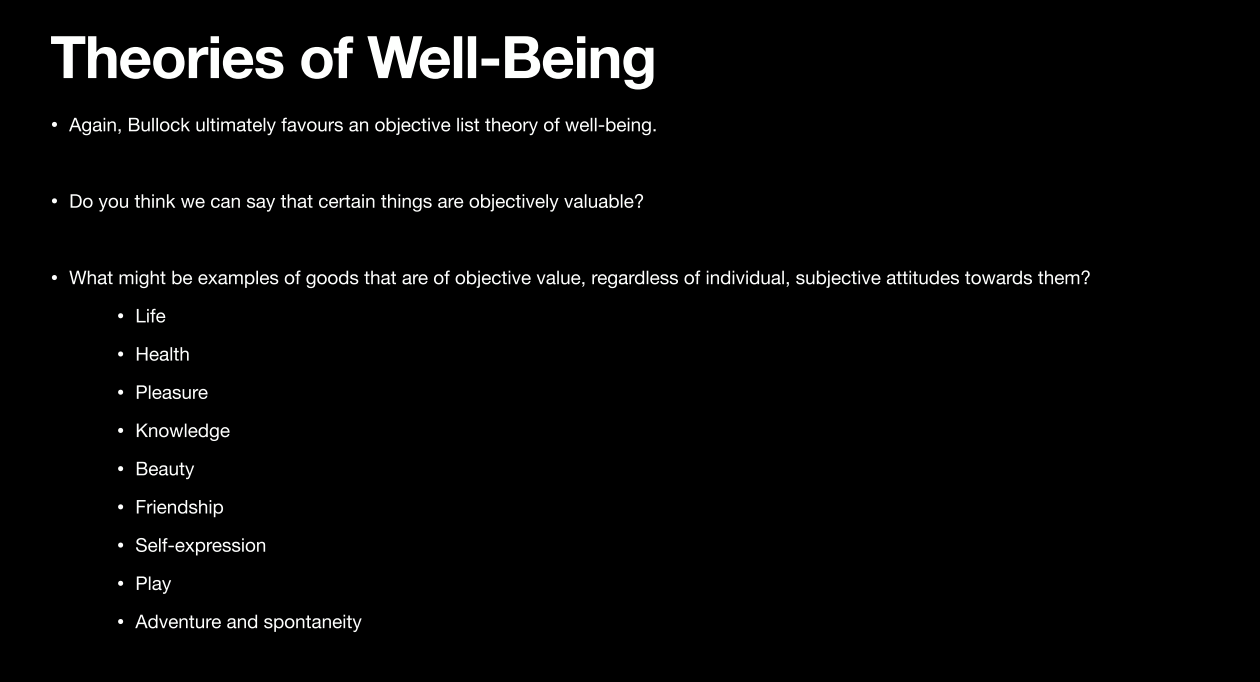
Okay, so Bullock ultimately favors an objective list theory of well being.
So do you agree that. I'm sorry to take this one here. I don't know why that's the case. Do you agree that well being is objective in this story?
Like, do you think that there are certain things that are just good no matter what, even if you don't care about them, even if you actively don't want them in your life?
We can say your life goes better than ever. What do you think about this? I feel like, especially like undergrads really tend to like subjective accounts of morality.
Like, I just find that a lot of undergrads think morality subjective.
I'm not sure why that is my culture. The sort of like generational dynamics are there, but I guess that is my sort of your experience or anecdotal experience.
And I wonder if that's the case for like well being too.
Do we also think that, like, what makes your life go well is just up to you?
It's entirely subjective. In the same way, what's right or wrong is subjective.
Depends on what you think about things. What makes your life go better or worse is up to you.
It's entirely subjective. Do you think that's true or do you think that what look is right actually it's not up to you.
What makes your life go better. What makes your life go better is entirely determined.
Yes.
Speaker 2
I feel like you can have a lot of those things and just have like a bad outlook on life.
And therefore you like don't have a good well being.
And then at the same time you can like not have some of those things or a lot of those things, but then have a good outlook on life still, you might have a good well being.
So I feel like it's just, yeah, up to the person.
Speaker 1
Yeah, good. I think you're completely right. Like, the tension for these sorts of views is that like, I can imagine a person who has all the goods on the list you want to give me and still is just like having a miserable time, just like not happy for the life.
And it seems really difficult to say, like, oh no, that person's life is going great.
Like, look at all these goods that they have. It doesn't really matter if they're miserable all the time, like they have all these great goods, their life is possible.
And similarly, we might think of like the person who lacks a bunch of these goods but is just like constantly experiencing the joy of life and constantly happy to be alive.
It would seem very strange to think like their life is actually going worse than the person who is an interval that has all these.
So, yeah, I think that that is the sort of tension for a view like this to overcome is like, how can we pull those two things at this time?
Do other people have thoughts on this? Do you think value is objective, subjective? Do you care? Does it matter? It might not. Okay, so assuming you do think there are things that are objectively valuable, what would examples of these sorts of things be?
Like, what are things that you think are good to have no matter what?
Yeah. Health and friendship both appear like. So there's like, you know, probably hundreds of people who hold these views and they all give us their respective lists.
Health and friendship, I think, show up on basically all that.
Like, it just is objectively good for you to be healthy, and it's objectively good for human beings to have a rewarding, intimate friendship.
Yeah.
Speaker 2
Money.
Speaker 1
What's that?
Speaker 2
Money.
Speaker 1
Money is an interesting one. So. So typically, so objective listeries are trying many things that are, like, intrinsically valuable in and of themselves.
And money is. I mean, you might think that money is valuable in and of itself, but typically we think money is valuable because it gets us out of things.
Like, why do I value the paycheck that I get from using the first year of month?
Because I can use that paycheck to pay my rent and buy groceries and do the things that I want to do.
And so in that sense, money is only, like, instrumentally valuable.
It's not intrinsically valuable in the way things like good health might be or friendship.
You know, we don't. I mean, sometimes we want good health for other reasons.
But, like, it's not as if I am friends with James because I think James is going to help me further my career in philosophy.
There's a good chance James detracts from my career in philosophy.
And yet I find it sort of like, intrinsically rewarding to be friends with him separate from whatever else he could do for me, it is just like a source of value in my life that I have friendships, like my friendship with James, irrespective of whether he can do anything instrumentally about him before other examples of goods that might be access to basic needs of like.
Okay, yeah, so sorry. The point I wanted to bring up about money is like, well, on the one hand, you might say money is not intrinsically valuable because we just use it as an instrument.
But on the other hand, we might say, well, one Objectively good thing to have is the ability to meet your basic needs.
And one way to have the ability to make meet your basic needs is to have one.
And so there might be this sort of like indirect way in which money appears on because we think probably one thing that is objectively good to have, no matter what, is the ability to interface with people.
Good. Okay, other thoughts on this. So this is just some of the like highlights that Paula gives in her paper.
Life, health, pleasure, knowledge, beauty, friendship, self expression, play, adventure and spontaneity.
Do you guys think these are all objectively valuable?
Do you look at any of the entries on this list and think like I don't care if I have that.
My life doesn't go bad. Like knowledge, I don't need knowledge. It's instrumentally valuable. Maybe like it's, it helps me get things. It's nice for me to know things because I get to know things in order to get the things that I want.
But it's not like intrinsically good for me to for instance, like.
So one counter example that people sometimes raise against knowledge as an intrinsic is that like if knowledge is intrinsically valuable, then every sort of like justified true belief I have is intrinsically valuable.
There are a number of chairs in this room. I don't know what the number is, but it's probably somewhere in the area of 150.
And were I to count all chairs in this room, I would then know for a fact that there's 150 chairs in this room.
And then we would have to say that because I now have this knowledge, my life is going better than it did before I knew how many chairs there were in this room.
That seems very strange that now my life is going better just because I know how many chairs there are in this room.
You can make an even more absurd example by being like, I mean most of the grass is dead now, but like there is some number of blades of grass out on Queen's campus.
Like there are 10 million blades of grass out there or something like that.
And I could go out there and I could painstakingly count every single blade of grass so that eventually I know how many blades of grass there are.
And when I know that I would have a justifiable belief my knowledge of the world would be increased.
I would know more than I did before. But it seems very strange to say that my life now goes best better for the fact that I know how many blades of grass there are.
On point surface. It just doesn't seem like an intrinsically Good thing.
Okay, so notably, an objective list theory can help explain why self discrimination might not be the best way of promoting well being
Why? Because the self discrimination view seems to assume that patients can't, or at least are rarely wrong about what is in their interest.
But while this would be true on a desire satisfaction account, if my well being just consists of satisfying my desires, then I can never be wrong about what's in my interests because what's in my interest is determined by me.
It's not on an objectivist account. According to an objective list view, the goods that make our life go better are defined independently of our subjective attitudes, meaning that our subjective attributes can just get things wrong.
If I have no desire to have better health, or if I have no desire to have friendship, or if I have no desire to have knowledge, according to the objective list theorist, I'm just getting it wrong.
I'm wrong about the fact that I don't have this or not I'm wrong.
It's not that I'm wrong that I know I have to desire, but I'm sort of rationally criticizable for not having society.
Okay, we talked earlier about how like, okay, well, intention for this view is like, what about the person who doesn't care about these things?
It seems really strange that someone's life can go well independently of whether they subjectively feel like their life is going on.
Say, I despise adventure in spontaneity. I like, really hate surprise parties. I don't like traveling. I dislike my basic routine. It would be very strange if I like really reflected on this.
If I'm like really certain I've traveled, I've had surprise parties, I've done all this spontaneous stuff and I just have decided I don't like any of this stuff.
I don't want it in my life. It seems really strange for you to then come to me and be like, look, I know that you have thought long about this and that in fact you've actually experienced these doings and decided for yourself that, you know, finding valuable.
It turns out you're wrong in this. It turns out that these things are good for you, even if you despise every second of traveling being on that venture.
Okay, people are about to say, well, we can still build some subjectivity into the view.
It's an objective account, it's mind independent.
But we can still make room for our subjective attitudes even in the list of objectively valuable things.
So for instance, we might say it is objectively evaluable for an individual to realize Important life aims.
We probably all accept this. But of course, what constitutes an important life aim is something that each of us decides for ourselves.
So it's objectively important that all of us or objectively valuable for all of us to get to where we want to go.
Let's say like career wise. I am sure many of you have a particular career in mind that you are hoping to go into when you finish your it would be objectively valuable for all of us to get those aims realized.
But of course what career you go into or what career would be good for you to go into is determined by you.
It's not a set of leg. It is objectively valuable for all of us to become firefighters.
It might be valuable for some of us to come to become firefighters, namely those of us who have a particular interest in fighting fires, but not all of us.
For others of us, it might be important that we become marine biologists or philosophers or helicopter pilots.
What determines what is important to us is subjective.
But getting the things that is important to us is subjective.
In this way. Instead of regarding self determination as what defines what is good for us, we can think of self determination as one of the things that's good for us.
It is good for us to determine where ourselves our lives go, but it is also good for us to have other things that are not that are mind.
Okay, so the virtue of adopting this way of thinking about well being is that it seems to explain a lot of our strongly held intuitions about assisted dying.
So here's a case that bold gives in the paper. Imagine that Frank suffered a shoulder injury a year ago that would prevent him from ever again playing head of golf, his life's passion.
He is no longer depressed about his situation, but feels certain that he has nothing to live for and would be better off dead.
Legalization with limits rightly denies assisted dying eligibility to print to extend the eligibility of people like him would, as Dame Callahan says, the self determination of run him up.
He should be denied suicide assistance because he is better off alive than dead notwithstanding.
Maybe you don't share this intuition. I think a lot of people have an intuition like, look, Frank is just sort of being a bit dramatic here.
I know Frank's sort of passion was playing competitive golf.
And now he thinks that his life is entirely devoid or meeting because he can't put competitive golf anymore.
But he's being overly dramatic. If we ascent to his request for assisted suicide, then he'll never be able to discover that there are actually other meaningful things in life that maybe if he continues living, he'll realize that he actually really enjoys painting or walking or running or some other form of activity that doesn't require him to ease to shoulder.
If you have this intuition, what explains this intuition?
It's that we think that there is an objective fact of the matter, namely that it is in Frank's interest to go on living whether or not he thinks that's true.
Similarly, we're reluctant to permit assisted dying in cases where the patient is young or the disease is non terminal, even if their decision is completely self determined.
And, and this is because we rightly judge it's not in the patient's best interest.
We might think this of teens or children who express a desire for position assisted suicide who would presumably think like look, what explains why we don't think it is in the best interest of a teen or a child to undergo position assisted suicide.
We think that it is objectively not a narrative that they are sort of not able to see from their firms perspective what why life might continue to be worth living and therefore we should not respect order of us to end at us.
Okay, so we decided at this point that whether or not it's an actress to continue living is largely determined by does this mean that the permissibility of assisted dying is entirely determined by objective facts that like we don't need to think about autonomy whatsoever.
We just need to for any given patient ask, okay, is it objectively in our interest to keep living or is it objectively in our interest to die?
Probably not. It doesn't. It would be very strange if autonomy just dropped out of the pictures entirely because that would mean that we no longer need to seek out consent for a system done.
I, the doctor would just make some judgment about whether it's in James's interest to continue living.
And it might be that without even consulting James, without even getting his consent, I just decided like actually things are going pretty shitty for James.
I think it would be better for him to cease living and therefore I'm going to give him a legal objective and something like that.
We probably, probably don't think that would be good.
Even if we think it's right. Even if you judge, even if you think that I was right to judge that James's life is not worth living anymore.
We probably don't think that the mere fact that I made that judgment makes it permissible for me to just kill James.
Okay, so instead of making the vocation a communism in terms of self discrimination, Bullock isn't like let's just throw the baby out of the bathwater.
Bullock wants to say, look how we think about autonomy in case the assistant dying is as a constraint on permissible action.
So instead of thinking about autonomy as, like, if I will to die, then we must respect my will to die, we should think about it as a sort of like setting a limit on what others need.
You choose namely life or not leaving kill us. So think about how informal consent typically offers.
What are we doing when we give people consent for this?
We're doing it to waive the right that we hold against others.
So what am I doing when I consent to receiving surgery?
Typically, we think I have a right to bodily autonomy.
And that right to bodily autonomy means that, like, people can't just, like, cut into me.
If you were to like, come up to me and cut into me and start pulling out my logins and doing, you would think, like, whoa, you just violated my rights.
That's not cool. But if I say, hey, by the way, totally cool for you to come over, take my ro, then it looks like I've given you permission to do so.
I've waged my rights. It would no longer be on your credit.
Speaker 2
Right?
Speaker 1
Yeah. So when I consent surgery, I wait for my right to bomb the autonomy, My right not to be cut out, cut open without permission.
If I fail to consent surgery, you were to just come start doing surgery on me, it would be morally prohibited.
Why? Because the act of having autonomy. Okay, so Bullet thinks this is how we should make the world Asian economy causing medicines to death patients, all of us have a right to be have a right not to be killed intentionally without our permission.
At least in medical context, we all have the right for people not to intentionally kill us.
This means that even if it's judged that it would be objectively in my best interest to die, it would be impermissible for James to kill me unless I made this.
When we issued consent to assist a dime, we waived the rights that we have against them.
So in normal cases, I have a right not to be killed.
When I give James consent to perform a legal objection on me, what I have done is wait my right not be killed.
Whereas it would have been wrong for James to perform a lethal objection upon me in the absence of my consent.
Okay, what does this mean? Basically, it means that Bullet thinks that there are two necessary conditions for a system.
So the self determination view held. There is one necessary condition, one necessary insufficient on the self determination.
Dude, all we need to know to know whether assisted dying is whether or not it's been consented to.
On bullets view, there are two necessary conditions that are jointly sufficient.
The first condition is that assisted dying must be in the best interest of the patient.
In other words, if we cannot make the judgments that it would be better for you to die living, that it is morally impermissible for us to assist your death.
Okay, but that's not the only thing that matters.
We also need your consent to assist and die. So it needs to be in our best interest as a matter of objective fact, and it needs to be consented to by the person on to whom the procedure will be performed.
Okay. Obviously, determining whether informed consent has been given is recognized relatively simple.
We might think there are some complicated factors, but by and large we know people have consented.
Obviously, determining one is going to prove complicated.
Figuring out whether or not it is in someone's best interest to die is going to be difficult.
It is going to require much more than just like taking a cursory line to their file.
We probably need to sit down and have extended conversations with them about what their goals in life are or continue to be or were, about what their relationships are, about what sorts of supports they have to continue living.
So even though there is an objective fact in the matter, that doesn't mean that that objective fact is going to like, reveal itself obviously to us whenever we need it to.
We need to engage in sort of like, yeah, robust forms of communication that allow us to make these judgments and reliable ways.
Okay, we have two minutes left. If any of these questions should permit you to speak, that would be your time.
So I mean, maybe I'll start Tuesday's class with this in case people want to talk about it more.
But like, what do you think about this argument? Are you convinced? Do you think that these appeals to empirical evidence are convincing?
I don't know if I do. All this stuff about nudging about poor decision makers.
Speaker 2
We are.
Speaker 1
It's not clear to me that the conclusion of this empirical evidence is that we are not the best judges.
What's in our interest? Do you think well being is fundamentally objective?
Do you think it's fundamentally subjective? Should the objective. Even if you think well being is objective, do you agree with Bullet that unnecessary condition of the permissibility of assisted dying is that it is in the objective, best interest of the patient to die?
Or do you think even though well being is subjective, we should still just listen to the patient and track with self determination interest?
And then might this argument extend to other forms of negative 3?
So this is, this is, this is an interesting question.
And you can think of better. What if I wanted to get a really risky and medically non necessary form of treatment?
So let's say I want to get a treatment that replaces all of my skin with scales.
This is a very experimental surgery. It's never been tried before. It's quite risky. My death is very likely either during the course of treatment or after treatment.
It's medically not necessary. I do not need skills of scales to continue living.
In fact, scales present a greater effect to my life.
Should it be okay for the doctor? I mean, so the doctor can refuse to perform the surgery for their own, you know, conscientious refusal, which we'll talk about next week.
They can say, well, I don't want to be involved with that, but should the doctor be able to make a judgment as well about what is in my interest with respect to the surgery and say, look, sorry pal, it is just objectively not in your interest to replace your skin and scales?
Or should my sort of self determination be. Be all end all this now? I want to get scales. I have the money to pay for scales. It's not. It's not. You do not have the standing to tell me whether or not it's going my best interest.
I get to decide whether I have a three. So it is interesting to me whether Bullock's argument extends to other forms of medical treatment about whether she's only talking about assisted suicide, or whether there are other forms of treatment that are not medically necessary for which doctors should be able to say, like, look, I know you consented to this treatment and I know you think that it's what you want, but actually it's not what you want, it's not in your interest, and you shouldn't be able to get it.