I/O FINALS
Module 5: Theories on Motivation
Prepared by: Jasmine Evasco
What is motivation?
Motivation in the workplace refers to the factors that drive individuals to perform their job duties effectively and strive to achieve organizational goals. It involves the internal and external forces that influence employees' behavior, effort, and persistence in their work. (Herzberg, 1968).
Hierarchy of Needs
Maslow's Hierarchy of Needs is an established motivation theory you might already be familiar with. Maslow argued that all humans are motivated by five hierarchies of needs.
Definition | Workplace Context |
| Ensure that employees have a comfortable and safe working environment. This includes providing adequate heating or cooling, proper ventilation, and ergonomic furniture. Additionally, fair wages and access to breaks are crucial to address basic physiological needs. |
| Establish job security by providing clear employment contracts and fair termination procedures. Implement and communicate health and safety regulations to create a stable work environment. This can include regular safety training, emergency procedures, and a commitment to physical and psychological well-being. |
| Foster a positive and inclusive workplace culture. Promote teamwork through collaborative projects and encourage social interaction through team-building activities and events. Recognize the importance of interpersonal relationships at work and create an environment where employees feel a sense of belonging. |
| Implement recognition programs to acknowledge employees' achievements and contributions. Provide opportunities for skill development and training to enhance employees' competence and confidence. Offer positive feedback and constructive performance reviews to boost self-esteem. |
| Provide challenging and meaningful tasks that allow employees to use their skills and creativity. Encourage employees to set and pursue personal and professional goals. Create a work environment that supports continuous learning and professional growth, allowing individuals to realize their full potential. |
Herzberg Two Factor Theory
Background:
In the 1950s, Frederick Herzberg, a psychologist and management theorist, conducted a study to investigate the factors that contribute to job satisfaction and dissatisfaction. His research involved interviews with hundreds of employees and professionals across various industries.
Motivation-Hygiene Factors:
Herzberg identified two sets of factors that impact employee motivation and job satisfaction:
Hygiene Factors (Maintenance Factors): These are external factors that, when lacking, can cause dissatisfaction, but their presence does not necessarily motivate. Examples include working conditions, salary, company policies, and interpersonal relationships.
Herzberg argued that the absence of hygiene factors can lead to dissatisfaction, but their presence does not necessarily lead to satisfaction. These factors address basic needs and are necessary to prevent dissatisfaction, but they don't serve as strong motivators.
For example, if working conditions are poor, employees may be dissatisfied, but improving conditions alone may not lead to increased job satisfaction.
Motivators (Satisfiers): These are internal factors that lead to job satisfaction and motivation. Examples include recognition, achievement, responsibility, and the nature of the work itself.
Motivators are factors that contribute to job satisfaction and higher levels of motivation. These factors are related to the nature of the work itself and the psychological needs of individuals.
According to Herzberg, true motivation comes from factors such as recognition for achievements, opportunities for personal and professional growth, challenging work, and a sense of responsibility.
McClelland Theory of Needs
Harvard professor David McClelland spent three decades researching motivation to understand human nature and develop tools to measure how people make certain choices.
He theorized that humans have three types of emotional needs: achievement, affiliation and power. While he determined that one trait is often more dominant than the others, people can have any mix of these needs and their motivations are influenced by the combination and strength of their specific needs.
McClelland also studied how motivation affects a person’s health by causing stress, high blood pressure and abnormal hormone levels. The Three Needs Theory is often used in business to create personality tests to determine what motivates employees. It also helps managers learn more about individuals in their team and what each person needs from their workplace.
A. Need for achievement.
If a person’s primary objective is achievement, they are motivated to do better and are focused on winning at any cost. Entrepreneurs typically have the drive to be successful, exceed expectations and outdo their peers.
Explanation:
Individuals with a high need for achievement are driven by a desire to excel, set challenging goals, and surpass performance standards. They seek feedback on their performance and strive for success in their endeavors.
Examples:
Entrepreneurs: Those who start their own businesses often have a strong need for achievement, aiming to build and grow successful ventures.
High-Performing Salespeople: Sales professionals with a high need for achievement may be motivated by meeting and exceeding sales targets.
Over exaggeration:
If the need for achievement is overemphasized, individuals may become overly focused on personal success, potentially leading to stress, burnout, or a disregard for collaborative efforts
B. Need for affiliation.
People whose main motive is affiliation are typically motivated by social connections. They are keen to please others, fit in and value relationships with their peers. They tend to appreciate familiar situations and are unlikely to want to leave their work location. These people don’t usually like working alone and will do anything to avoid disappointing their managers and colleagues.
Explanation:
Individuals with a high need for affiliation seek harmonious relationships, value social connections, and enjoy working in cooperative environments. They are motivated by a desire to be liked and accepted by others.
Examples:
Team Players: Employees who thrive in team settings, foster positive relationships, and enjoy group projects often have a strong need for affiliation.
Customer Service Professionals: Those who excel in customer service may be motivated by positive interactions and relationships with clients.
Over exaggeration:
If the need for affiliation is overemphasized, individuals may prioritize harmony at the expense of necessary conflicts or challenges. They might avoid necessary confrontations to maintain positive relationships.
C. Need for power.
When a person’s predominant motive is power, they are motivated to exert influence over others and be in control. Power-motivated people are best suited for leadership positions as they are driven to motivate others and delegate responsibility. They are also keen to climb the corporate ladder in pursuit of success, recognition, and wealth.
Explanation:
Individuals with a high need for power are motivated by a desire to influence others, control situations, and attain leadership positions. They seek recognition, success, and authority.
Examples:
Managers and Leaders: Individuals in leadership roles often have a strong need for power, as they are motivated to guide and influence their teams.
Politicians: Those in political positions may be motivated by the desire to shape policies and have a significant impact on society.
Over exaggeration:
If the need for power is overemphasized, individuals may become overly controlling, potentially leading to micromanagement, strained relationships, and a lack of collaboration.
References:
Herzberg, F. (1968). One More Time: How Do You Motivate Employees? Harvard Business Review, 46(1), 53-62.
Module 5B: Theories on Motivation
Prepared by: Jasmine Evasco
4. Self-Determination Theory (SDT)
[Self-determination: inherent right of individuals or groups to freely determine and decide for their interests, values, and aspirations without external interference or coercion]
/autonomy; independence; self-governance/
It is a psychological framework developed by Edward L. Deci and Richard M. Ryan, focusing on human motivation and personality development. It posits that people have innate psychological needs for competence, autonomy, and relatedness, and when these needs are satisfied, they foster intrinsic motivation, leading to enhanced well-being and personal growth. SDT highlights the significance of intrinsic motivation, emphasizing that individuals are driven by internal factors and a desire to fulfill their own potential. In contrast, extrinsic motivation, which stems from external rewards or pressures, is seen as less effective in fostering long-term motivation and satisfaction.
[intrinsic: Personal satisfaction/fulfillment; sense of competence; Interest in the task or subject matter; Inner drive to learn new things; Desire for personal growth and development
Ex. Artist, musicians, and other jobs with high task significance spending their free time learning and working not for money, competitions, or fame, but simply because she loves the process of exploring and pushing her own musical boundaries. The joy and personal satisfaction she gets from her music are intrinsic motivating factors.]
[extrinsic: Monetary rewards or bonuses; Recognition or praise from others; Awards or certificates; Promotions or career advancement;Peer pressure or societal expectations;Avoidance of negative consequences or penalties.]
SDT is a macro theory of human motivation that has been successfully applied across domains including parenting, education, healthcare, sports and physical activity, psychotherapy, and virtual worlds, as well as the fields of work motivation and management (Deci & Ryan 1985a, Ryan & Deci 2017). [helps in designing more effective reward systems in work environments, sports, or educational settings that leads to increased job satisfaction, better academic performance, more effective parenting and improved health outcomes.]
SDT specifically suggests that both employees’ performance and their well-being are affected by the type of motivation they have for their job activities. SDT therefore differentiates types of motivation and maintains that different types of motivation have functionally different catalyzers /stimulant; activators/, concomitants /accompaniments; complements/, and consequences.
Key components of Self-Determination Theory:
Competence: This refers to the need to feel capable and effective in one's actions. When individuals believe they are competent, they are more likely to be motivated to take on challenges and pursue activities that align with their interests and values. [increases individuals' confidence and makes them believe they can be successful in achieving their goals. If not feeling competent, they might be demotivated, set low standards or give up. “Hayaan mo na yung magaling.”]
Autonomy: Autonomy represents the need to feel in control and to have a sense of choice in one's actions. When individuals have the freedom to make choices that reflect their true selves, they are more likely to engage in activities willingly and with a greater sense of commitment. [by not being restrained by rigid rules or guidelines, people feel validated and respected for their individuality; thus, they are more likely to innovate and be accountable]
Relatedness: Relatedness pertains to the need for connections and meaningful relationships with others. When individuals feel a sense of belonging and support from their social environment, they are more motivated to engage in activities that foster cooperation and collaboration.
Intrinsic motivation.
This is a specific type of autonomous motivation. It refers to activities for which the motivation lies in the behavior itself. When intrinsically motivated, it is the spontaneous experiences of interest and enjoyment entailed in the activity that supply the “rewards.”
Intrinsic motivation is a ubiquitous human phenomenon, but it is exemplified in the play of children, who enthusiastically engage in activities without external rewards or prompts. However, intrinsic motivation is also evident in the activities of adults, such as sports and avocations, and it is surprisingly important even in in the workplace. Employees can be intrinsically motivated for at least parts of their jobs, if not for all aspects of them, and when intrinsically motivated the individuals tend to display high-quality performance and wellness
Extrinsic motivation.
Extrinsically motivated behavior involves doing an activity to attain a separable consequence, whether tangible or otherwise. That is, extrinsic motivation encompasses all instrumental behaviors. Rather than viewing all extrinsic motivation as “bad,” which some authors (e.g., Gerhart & Fang 2015) have claimed we did, SDT has always maintained that extrinsic rewards can have different functional significances that lead to enhancements, diminishments, or no effects on intrinsic motivation (e.g., Deci 1972).
Furthermore, and very importantly, SDT has long differentiated extrinsic motivation into various forms, each of which is recognizable in the workplace, and which range from being less to more autonomous (Deci & Ryan 1985a, Ryan & Connell 1989). External regulation is at the least-autonomous end of the extrinsic-motivation continuum of autonomy.
When externally regulated, individuals perceive their behavior as being directly controlled by others, often through contingent rewards and threats. As we shall see, external regulation can powerfully motivate specific behaviors, but it often comes with collateral damage in the form of long-term decrements in autonomous motivation and well-being, sometimes with organizational spillover effects.
A somewhat more autonomous form of extrinsic motivation is introjected regulation, which involves people being focused on approval versus disapproval in their jobs and from their leaders. Introjected behavior is self-controlled by processes such as contingent self-esteem, ego-involvements, and guilt, as well as a concern with status and recognition.
[introjected regulation : behavior is driven by internal pressures; internalized form of extrinsic motivation that reflects a transitional stage between external control and true self-regulation
EXAMPLE: an employee under introjected regulation may take up extra work not because they truly want to or because they will receive extra pay, but more because they want to avoid feelings of guilt for not doing enough or to maintain their status or recognition within the team.]
Cognitive Evaluation Theory (CET), derived from SDT, specifically focuses on the impact of intrinsic motivation on cognitive processes and behavior. CET emphasizes how the introduction of external factors, such as rewards or controls /rules;deadlines/ , can influence an individual's intrinsic motivation. It suggests that while external factors can initially enhance motivation, over-reliance on these factors might undermine intrinsic motivation, leading to a decrease in overall engagement and interest in the activity.
For example, consider a student who enjoys writing as a form of creative expression. In this scenario, the student's intrinsic motivation is driven by the desire to express themselves and their thoughts. If the student receives a monetary reward for every essay they write, their initial motivation might increase due to the external incentive. However, over time, the student's focus might shift from the joy of self-expression to the pursuit of monetary rewards, potentially diminishing their intrinsic motivation for writing.
Similarly, in a workplace setting, employees who feel a sense of autonomy in their roles and have opportunities for personal development are more likely to demonstrate higher levels of intrinsic motivation. On the other hand, employees who feel micromanaged or overly controlled by external factors might experience a decline in their intrinsic motivation, leading to reduced job satisfaction and engagement.
[CET: effects of external motivators on internal motivation
CORE IDEA: extrinsic motivators have the potential to diminish intrinsic motivation
CRITICAL CONDITIONS: perceived competence; perceived autonomy
SUGGESTION: empower employees and recognise their contributions
5. Self-efficacy (also known as social cognitive theory or social learning theory)
- is a person’s belief that she is capable of performing a particular task successfully (Bandura, 1977, 1997). Think of self-efficacy as a kind of self-confidence (Kanter, 2006) or a task specific version of self-esteem (Brockner, 1988). Self-efficacy has three dimensions: magnitude, the level of task difficulty a person believes she can attain; strength, the conviction regarding magnitude as strong or weak; and generality, the degree to which the expectation is generalized across situations. An employee’s sense of capability influences his perception, motivation, and performance (Bandura, 1997).
[Generality: person's belief in their ability to perform a specific task in one situation can be transferred or generalized to other situations
Example: a person who feels confident (has high self-efficacy) about their ability to speak in public at work, may also have high self-efficacy for public speaking at a community event or in a social scenario. This is an example of high generality, as the expectation (confidence in public speaking) is applicable across multiple situations.]
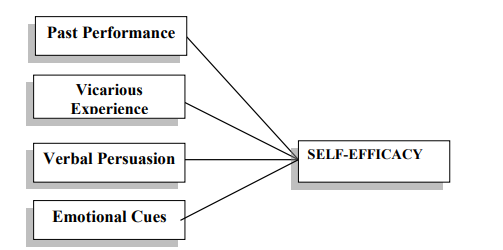 Sources of Self-Efficacy:
Past Performance
According to Bandura, the most important source of self-efficacy is past performance. Employees who have succeeded on job-related tasks are likely to have more confidence to complete similar tasks in the future (high self-efficacy) than employees who have been unsuccessful (low self-efficacy). Managers or supervisors can boost self-efficacy through careful hiring, providing challenging assignments, professional development and coaching, goal setting, supportive leadership, and rewards for improvement.
Vicarious /indirect/ Experience
A second source of self-efficacy is through vicarious experience. Seeing a coworker succeed at a particular task may boost your self-efficacy. For example, if your coworker loses weight, this may increase your confidence that you can lose weight as well. Vicarious experience is most effective when you see yourself as similar to the person you are modeling. Watching LeBron James dunk a basketball might not increase your confidence in being able to dunk the basketball yourself if you are 5 feet, 6 inches tall. But if you observe a basketball player with physical characteristics similar to yourself, it can be persuasive.
Verbal Persuasion
The third source of self-efficacy is through verbal persuasion. Essentially this involves convincing people that they have the ability to succeed at a particular task. The best way for a leader to use verbal persuasion is through the Pygmalion effect. The Pygmalion effect is a form of a self-fulfilling prophesy in which believing something to be true can make it true. Rosenthal and Jacobson’s (1968) classic study is a good example of the Pygmalion effect. Teachers were told by their supervisor that one group of students had very high IQ scores (when in fact they had average to low IQ scores), and the same teacher was told that another group of students had low IQ scores (when in fact they had high IQ scores). Consistent with the Pygmalion effect, the teachers spent more time with the students they thought were smart, gave them more challenging assignments, and expected more of them—all of which led to higher student self-efficacy and better student grades. A more recent experiment conducted by Harvard researchers in a ghetto community produced similar results (Rist, 2000). The Pygmalion effect also has been used in the workplace. Research has indicated that when managers are confident that their subordinates can successfully perform a task, the subordinates perform at a higher level. However, the power of the persuasion would be contingent /subject to chance; conditional/ on the leader’s credibility, previous relationship with the employees, and the leader’s influence in the organization (Eden, 2003).
Emotional Cues
Finally, Bandura argues that emotional cues dictate self-efficacy. A person who expects to fail at some task or finds something too demanding is likely to experience certain physiological symptoms: a pounding heart, feeling flushed, sweaty palms, headaches, and so on. The symptoms vary from individual to individual, but if they persist may become associated with poor performance. Self-efficacy has been related to other motivation theories.
Edwin Locke and Gary Latham suggest that goal-setting theory and self-efficacy theory complement each other. When a leader sets difficult goals for employees, this leads employees to have a higher level of self-efficacy and also leads them to set higher goals for their own performance. Why does this happen? Research has shown that setting difficult goals for people communicates confidence (Locke & Latham, 2002). For example, suppose that your supervisor sets a high goal for you. You learn that it is higher than the goal she has set for your colleagues. How would you interpret this? You would probably think that your supervisor believes you are capable of performing better than others. This sets in motion a psychological process in which you are more confident in yourself (higher self efficacy) and then you set higher personal goals for yourself causing you to perform better. Self-efficacy also may be related to effort-performance relationships in expectancy theory (Vroom, 1964).
[Expectancy Theory: individual's behavior is driven by their expected outcomes.
Three components:expectancy; instrumentality; valence
Effort-performance relationship: an individual's effort level depends directly on their expectation of how that effort will affect their performance. If they believe that more effort will result in better performance and that better performance will result in a desirable reward, they will be motivated to work harder. If either of these expectations is low, motivation will be impacted negatively]
References:
Houdson(2011). Self-Efficacy in the Workplace: Implications for Motivation and Performance. International Journal of Management, Business, and Administration, 14(1).
Deci, E. L., Olafsen, A. H., & Ryan, R. M. (2017). Self-Determination Theory in Work Organizations: The State of a Science.
Module 5C: Theories on Motivation
Prepared by: Jasmine Evasco
6. ERG Theory (Aldefer, 1927)
Clayton Paul Alderfer is an American psychologist who developed Maslow’s hierarchy of needs into a theory of his own. Alderfer’s ERG theory suggests that there are three groups of core needs: existence (E), relatedness (R), and growth (G)—hence the acronym ERG. These groups align with Maslow’s levels of physiological needs, social needs, and self-actualization needs, respectively.
Existence needs concern our basic material requirements for living. These include what Maslow categorized as physiological needs (such as air, food, water, and shelter) and safety-related needs (such as health, secure employment, and property).
Relatedness needs have to do with the importance of maintaining interpersonal relationships. These needs are based in social interactions with others and align with Maslow’s levels of love/belonging-related needs (such as friendship, family, and sexual intimacy) and esteem-related needs (gaining the respect of others).
Finally, growth needs describe our intrinsic desire for personal development. These needs align with the other portion of Maslow’s esteem-related needs (self-esteem, self-confidence, and achievement) and self-actualization needs (such as morality, creativity, problem-solving, and discovery).
7. Expectancy Theory
The expectancy theory was proposed by Victor Vroom of Yale School of Management in 1964. Vroom stresses and focuses on outcomes, and not on needs unlike Maslow and Herzberg.
The theory states that the intensity of a tendency to perform in a particular manner is dependent on the intensity of an expectation that the performance will be followed by a definite outcome and on the appeal of the outcome to the individual.
The Expectancy theory states that employee’s motivation is an outcome of:
how much an individual wants a reward (Valence),
the assessment that the likelihood that the effort will lead to expected performance (Expectancy) and
the belief that the performance will lead to reward (Instrumentality).
In short, Valence is the significance associated by an individual about the expected outcome. It is the expected and not the actual satisfaction that an employee expects to receive after achieving the goals.
Expectancy is the faith that better efforts will result in better performance.
Expectancy is influenced by factors such as possession of appropriate skills for performing the job, availability of right resources, availability of crucial information and getting the required support for completing the job.
Instrumentality is the faith that if you perform well, then a valid outcome will be there.
Instrumentality is affected by factors such as belief in the people who decide who receives what outcome, the simplicity of the process deciding who gets what outcome, and clarity of relationship between performance and outcomes.
Thus, the expectancy theory concentrates on the following three relationships:
Effort-performance relationship: What is the likelihood that the individual’s effort be recognized in his performance appraisal?
Performance-reward relationship: It talks about the extent to which the employee believes that getting a good performance appraisal leads to organizational rewards.
Rewards-personal goals relationship: It is all about the attractiveness or appeal of the potential reward to the individual.
Vroom was of view that employees consciously decide whether to perform or not at the job. This decision solely depended on the employee’s motivation level which in turn depends on three factors of expectancy, valence, and instrumentality.
Advantages of the Expectancy Theory
It is based on self-interest individual who want to achieve maximum satisfaction and who wants to minimize dissatisfaction.
This theory stresses upon the expectations and perception; what is real and actual is immaterial.
It emphasizes on rewards or pay-offs.
It focuses on psychological extravagance where final objective of individual is to attain maximum pleasure and least pain.
Limitations of the Expectancy Theory
The expectancy theory seems to be idealistic because quite a few individuals perceive high degree correlation between performance and rewards.
The application of this theory is limited as reward is not directly correlated with performance in many organizations. It is related to other parameters also such as position, effort, responsibility, education, etc.
Implications of the Expectancy Theory
The managers can correlate the preferred outcomes to the aimed performance levels.
The managers must ensure that the employees can achieve the aimed performance levels.
The deserving employees must be rewarded for their exceptional performance.
The reward system must be fair and just in an organization.
Organizations must design interesting, dynamic and challenging jobs.
The employee’s motivation level should be continually assessed through various techniques such as questionnaire, personal interviews, etc.
8. Equity Theory (Adams, 1965)
J. Stacey Adams’ equity theory is a process model of motivation. It says that the level of reward we receive, compared to our own sense of our contribution, affects our motivation. The theory considers the concept of equality and fairness, as well as the importance of comparison to others.
Ways to make ration equal:
Seek greater output.
Reducing inputs
Change the ratios of other employees.
Rationalizing the input/output differences
When an employee’s inputs are Greater than the output
Works less hard (Hauenstein and Lord, 1989)
Becomes more selfish (Harder, 1992)
Has lower job satisfaction (Carr et al, 2001)
When an employee’s OUTPUTS are greater than the output
Is less likely to be persuaded by his underpaid peers.
Does not feel guilty.
Works harder
Becomes more team oriented.
Module 6: Employee Attitude and Employee Relations
Prepared by: Jasmine Evasco
Productive Attitudes
Attitudes serve as frame of reference that enable employees to better navigate their work environment, adjust to situations and conduct themselves in appropriate ways that correspond to others’ expectations.
Job Attitudes
Job Satisfaction
The attitude employees have toward their jobs.
A pleasurable or positive emotional state from the appraisal of one’s job or job experiences.
A positive feeling about a job resulting from an evaluation of its characteristics.
Job Involvement
The degree to which people identify psychologically with their jobs and consider their perceived performance levels important to their self-worth.
High job involvement= strongly identify with the kind of work they do
Psychological Empowerment
Employees’ belief regarding the degree to which they influence their work environment, their competencies, the meaningfulness of their job, and their perceived autonomy.
Organizational Commitment
The extent to which an employee identifies with, and it’s involved with an organization.
Perceived Organizational Support
The degree to which employees believe the organization values their contributions and cares about their well-being.
Employee Engagement
The term employee engagement was coined by Kahn in 1990 and defined it as the harnessing of the selves of the members of the organization to their work roles. In engagement, workers employ and express themselves physically, cognitively, and emotionally during role performance.
He described engagement as being psychologically present when occupying and performing and organizational role.
In positive psychology by Csikszentmihalyi (1982) employee engagement is expressed as a flow concept, wherein flow is a holistic sensation which employees experience when they are totally involved in their work.
In the academe, faculty employees who manifest employee’s engagement do not merely teach the content of their lesson like a parrot, but they open areas for active engagement with their students both inside and outside the classroom.
For others, employee engagement is defined as the emotional and intellectual commitment to the organization (Baumruk, 2004)
Employees’ involvement with, satisfaction with, and enthusiasm for the work they do.
Highly engaged employees have a passion for their work and feel a deep connection to their companies.
Disengaged employees have essentially checked out, putting time but not energy or attention into their work.
Why should we care about employee attitude?
-Meta-analyses indicate that satisfied employees tend to be committed to an organization (Cooper-Hakim and Viswesvaran, 2005), and employees who are satisfied and committed are more likely to attend work (Hackett, 1989), stay with an organization (Tett and Meyer, 1993), arrive at work on time, (Ksolowsky, 1997), perform well (judge, 2001), and engage in behaviors helpful to the organization (Erez and Johnson, 2002) than are employees who are not satisfied or committed.
What Causes Employees to Be satisfied with and Committed to their Jobs?
Dispositional Theories
Individual Differences Theory
-Personal predisposition to be satisfied
-Job satisfaction is due to an individual’s personal tendency across situations to enjoy what he/she does.
Example: individuals with an optimistic and positive outlook may naturally find satisfaction in their work, even if they face challenging situations. Their positive disposition allows them to focus on the aspects of the job that they enjoy, leading to overall job satisfaction.
Genetic Predispositions
-Genetic predispositions, such as the trait of negative affectivity, can impact an individual's propensity for job satisfaction. Negative affectivity refers to a consistent tendency to experience negative emotions like fear, hostility, and anger.
-This inherited personality trait can influence how individuals perceive and react to various aspects of their work environment, ultimately affecting their overall job satisfaction.
Example:
The employee's natural inclination toward conscientiousness could result in consistently high-quality work output and efficient task completion, leading to a sense of accomplishment and job satisfaction.
Core Self-Evaluations
-Judge, Locke, and Durham (1997) have hypothesized that four personality variables are related to people’s predisposition to be satisfied with life and their jobs:
Emotional stability
Self-Esteem
Self- Efficacy (perceived ability to master their environment)
External locus of control (perceived ability to control their environment)
Watson, Clark, and Tellegen (1988)
-Positive Affectivity
High energy
Enthusiasm
Pleasant engagement
-Negative Affectivity
Distress
Unpleasant Engagement
Nervousness
Situational Theories
-Job satisfaction stems from the nature of the job itself or from other facets of the work environment.
Locke (1976)
Pay
Promotions
Co-Worker
Supervision
Work Itself
Recognition
Working Conditions
Company
Management
Job Characteristics Model by Hackman and Oldman (1980)
Task identity
Task Significance
Skill variety
Autonomy
Feedback
Interactive theories
-assume that job satisfaction is the outcome of the interaction between the individual’s personality and the situation
Value- Precept Theory
-employees’ values influence their level of job satisfaction or displeasure toward their jobs
Measuring Job Satisfaction
Face Scale
Job Descriptive Scale
-consists of a series of job-related adjectives and statements that are rated by employees
Supervision
Pay
Promotional Opportunities
Co-workers
Work itself
Minnesota Satisfaction Questionnaire (MSQ)
Contains 100 items that yield scores on 20 dimensions.
Job in General (JIG) Scale
-useful when an organization wants to measure the overall level of job satisfaction rather than specific aspects
Measuring Organizational Commitment
Allen and Meyer (1990)- Allen and Meyer survey has 24 items, eight each for the three factors of affective, continuance, and normative commitment.
Organizational Commitment Questionnaire (OCQ)- a 15 item questionnaires developed by Mowday, Steers, and Porter (1979) to measure three commitment factors:
Acceptance of the organization’s value and goals
Willingness to work to help the organization.
Desire to remain with the organization.
Organizational Commitment Scale (OCS)- a nine item survey developed by Balfour and Wechsler (1996) that measures three aspects of commitment: identification, exchange, and affiliation.
Module 6B; Job Attitudes
Prepared by: Jasmine Evasco
Is the employee a good fit with the Job in the Organization?
Fit- The extent to which employees’ values, interests, personality, lifestyle, and skills match those of their vocation (example: a career such as nursing, law enforcement, or psychology), job (its particular task), organization, co-workers, and supervisors.
Needs/ Supplies fit:
The extent to which rewards, salary, and benefits receive by employees are perceived to be consistent with their effort and performance.
The extent to which employees’ desire for a particular work schedule (shift, number of hours) matches their actual schedules.
Signs to which an organization should pay attention indicate job mismatch.
Branham (2005)
Does not seem excited when first hired or assigned to a job.
Starts asking for some tasks to be given by other employees.
Applies for other jobs in an organization.
Begins to ask for new projects.
Appears bored or unchallenged.
Richard S. Lazarus, a prominent psychologist known for his work on stress and coping theory. Some signs that an organization should pay attention to, which may indicate job mismatch, include:
High Turnover Rates: If there is a consistent pattern of employees leaving their positions within a short period, it could suggest that the job roles are not aligned with their expectations or skill sets.
Increased Absenteeism: Frequent absenteeism or a rise in sick leave requests might signal that employees are experiencing high levels of stress or dissatisfaction within their roles.
Decline in Productivity: A noticeable decrease in employee productivity and performance, coupled with a lack of motivation, could point to a mismatch between job demands and employees' abilities or interests.
Low Employee Engagement: A lack of enthusiasm or active involvement in company activities and initiatives may indicate that employees do not feel connected to their roles or the organization's mission.
Negative Employee Feedback: Consistent negative feedback from employees during performance reviews or through internal surveys may highlight issues related to job dissatisfaction and a potential mismatch between employee skills and job requirements.
Do Employees Enjoy Working with Supervisors and Co-workers?
The Social Exchange Theory was developed by George Homans in the 1950s and further expanded upon by Peter M. Blau in the 1960s. Their work in the field of sociology laid the groundwork for understanding social relationships and interactions, emphasizing the importance of mutual exchanges and their impact on interpersonal dynamics and group behavior.
The concept of social exchange aligns with the broader understanding of the significance of positive workplace relationships in fostering a supportive and collaborative work environment. When employees experience mutual respect, trust, and effective communication within their teams and with their supervisors, they are more likely to enjoy their work and feel a sense of belonging within the organization. This, in turn, can lead to improved job satisfaction and overall well-being in the workplace.
Are Rewards and Resources given Equitably?
The Equity Theory
Was proposed by the behavioral psychologist J. Stacy Adams in 1963. The theory focuses on the idea that individuals are motivated by fairness in social exchanges, particularly in the workplace. It suggests that people strive to maintain a balance between their inputs (such as effort, time, and skills) and the outcomes they receive (such as recognition, rewards, and benefits) in comparison to their colleagues.
According to the Equity Theory, employees evaluate the fairness of their work situations by comparing their input-outcome ratios to those of others. If they perceive an inequity, whether it's over-reward or under-reward, they may experience distress and adjust their behavior to restore a sense of balance. This theory has had a significant influence on organizational psychology and has been instrumental in understanding employee motivation, job satisfaction, and overall workplace dynamics.
Organizational justice refers to the perceived fairness in the workplace and is classified into three main types:
Distributive Justice: This aspect of organizational justice focuses on the perceived fairness of the distribution of outcomes or rewards. Employees assess whether the allocation of rewards, such as pay, promotions, and benefits, is equitable. An example of distributive justice is when employees receive equal pay for equal work, regardless of gender, race, or other factors.
Procedural Justice: Procedural justice relates to the fairness of the processes and procedures used to make decisions. It emphasizes the importance of fair and transparent decision-making processes, such as performance evaluations, promotions, or disciplinary actions. For instance, employees perceive procedural justice when they are given the opportunity to voice their opinions during decision-making processes and when decisions are made based on unbiased and consistent criteria.
Interactional Justice: Interactional justice pertains to the quality of interpersonal treatment and communication experienced by employees during organizational processes. It involves respectful and considerate treatment, as well as the provision of adequate explanations and justifications for decisions. An example of interactional justice is when managers communicate with employees in a respectful and transparent manner, providing constructive feedback and demonstrating empathy in difficult situations.
Module 6C: Job Attitudes
Prepared by: Jasmine Evasco
Consequences of Dissatisfaction and Other Negative Work Attitudes
Absenteeism
Theories:
Job Dissatisfaction Theory: employees who are dissatisfied with their jobs are more likely to experience a lack of motivation, leading to increased absenteeism. The dissatisfaction may stem from various factors, such as unfulfilling work tasks, inadequate compensation, poor relationships with colleagues or supervisors, or a negative work environment. The absence from work can be seen as a way for employees to avoid the stress and dissatisfaction associated with their job.
Equity Theory: According to the Equity Theory, employees compare their input-output ratio with that of their colleagues. If they perceive an inequity in the rewards they receive compared to their efforts, they may become dissatisfied and subsequently exhibit absenteeism as a way to restore balance or as a form of protest against perceived unfair treatment.
Two-Factor Theory (Herzberg's Motivation-Hygiene Theory): Herzberg's theory suggests that certain factors, such as salary, work conditions, and company policies, can create job dissatisfaction (hygiene factors), leading to increased absenteeism. If these factors are not addressed, they can result in reduced motivation and job engagement.
Turnover
Turnover refers to the rate at which employees leave an organization over a specified period. It can be classified into voluntary turnover, where employees choose to leave, and involuntary turnover, where employees are terminated. Several theories help explain the causes and implications of turnover, including the following:
Mobility Theory: This theory suggests that turnover occurs due to employees' pursuit of better job opportunities or career advancement. Employees may leave an organization when they perceive that other opportunities offer more favorable prospects for their career growth. While this theory doesn't specifically address turnover, it highlights the role of employee mobility in career progression.
Job Embeddedness Theory: Job embeddedness theory emphasizes the interplay of various factors that bind employees to their jobs and organizations. It highlights the influence of both individual and organizational factors in influencing turnover. Employees with strong job embeddedness are less likely to leave their positions because of the connections they have with their work, colleagues, and the organization itself.
Counterproductive Behaviors
Counterproductive behaviors refer to actions or activities that go against the goals and values of an organization, leading to a decrease in productivity, efficiency, and overall performance. These behaviors can range from minor infractions, such as frequent lateness and unproductive time-wasting, to more serious issues, such as workplace aggression, theft, and sabotage. Several theories help explain the causes and dynamics of counterproductive behaviors, including the following:
Social Learning Theory (Bandura): According to this theory, individuals learn behavior through observation, imitation, and modeling of others. In the context of counterproductive behaviors, employees might observe and mimic negative behaviors exhibited by their peers or superiors, leading to a spread of these behaviors within the organization.
Frustration-Aggression Theory: Proposed by Dollard, Doob, Miller, Mowrer, and Sears, this theory suggests that frustration can lead to aggressive behavior. In the workplace, employees may engage in counterproductive behaviors as a result of job-related frustrations, such as perceived unfair treatment, lack of recognition, or unmet expectations.
Job Demands-Resources Model (JD-R Model): The JD-R Model emphasizes the role of job demands and job resources in influencing employee well-being and behavior. High job demands combined with low job resources can lead to stress and burnout, which might manifest as counterproductive behaviors in the workplace.
Lack of Organizational Citizenship behavior (OCB)
Organizational Citizenship Behavior (OCB) refers to discretionary, positive behaviors that are not formally recognized or rewarded but contribute to the effective functioning of an organization. Dennis Organ, in his 1988 work, delineated five dimensions of OCB:
Altruism: Employees engage in altruistic behaviors when they voluntarily help and assist their colleagues without expecting anything in return. This can involve providing guidance, support, or resources to help others succeed in their tasks.
Courtesy: Demonstrating courtesy involves displaying politeness and respect towards coworkers and customers. It includes acts such as being considerate, using polite language, and showing respect for others' opinions and perspectives.
Sportsmanship: Employees exhibit sportsmanship when they maintain a positive attitude and resilience in challenging situations. This involves handling work-related stress and conflicts with grace and maturity, without engaging in negative or disruptive behaviors.
Civic Virtue: Civic virtue refers to employees' active participation in the organization's decision-making processes and their willingness to go beyond their prescribed roles to contribute to the betterment of the organization. This can include attending optional meetings, providing constructive feedback, and engaging in organizational improvement initiatives.
Conscientiousness: Conscientiousness entails employees' dedication to their work, their commitment to high-quality performance, and their willingness to go the extra mile to achieve organizational goals. This involves taking initiative, being responsible, and displaying a strong work ethic.
MODULE 7: LEADERSHIP THEORIES
Political Socialization
Describes the process by which citizens crystallize political identities, values, and behavior that remain relatively permanent throughout later life (Neundorf & Smets, 2017).
It refers to a learning process by which political norms and behavior are transmitted from one generation to another.
Theory of Leadership
A. Chan and Drasgow, 2001
1. Affective Identity Motivation
This form of motivation is seen when an individual is driven by a desire to lead or be in charge of others. The individual derives a sense of happiness and satisfaction from the very act of leading others.
2. Calculative Motivation
Those who seek leadership positions because they will result in personal gain.
3. Social- Normative Motivation
Desire to lead out of sense of duty or responsibility
B. Path Goal Theory: Types of Leadership (Mitchell, 1974)
1. Directive
The leader informs her followers on what is expected of them, such as telling them what to do, how to perform a task, and scheduling and coordinating work.
It is most effective when people are unsure about the task or when there is a lot of uncertainty within the environment.
2. Supportive
The leader makes work pleasant for the workers by showing concern for them and by being friendly and approachable. It is most effective in situations in which tasks and relationships are physically or psychologically challenging.
3. Participative
The leader consults with his followers before making a decision on how to proceed.
It is most effective when subordinates are highly trained and involved in their work.
4. Achievement
The leader sets challenging goals for her followers, expects them to perform at their highest level, and shows confidence in their ability to meet this expectation.
It is most effective in professional work environments, such as technical, scientific; or achievement environments, such as sales.
Theory X and Theory Y Leaders
In the 1960s, social psychologist Douglas McGregor developed two contrasting theories that explained how managers' beliefs about what motivates their people can affect their management style. He labeled these Theory X and Theory Y.
Theory X
Theory X managers tend to take a pessimistic view of their people, and assume that they are naturally unmotivated and dislike work.
Work in organizations that are managed like this can be repetitive, and people are often motivated with a "carrot and stick" approach. Performance appraisals and remuneration are usually based on tangible results, such as sales figures or product output, and are used to control and "keep tabs" on staff.
This style of management assumes that workers:
Dislike their work.
Avoid responsibility and need constant direction.
Have to be controlled, forced and threatened to deliver work.
Need to be supervised at every step.
Have no incentive to work or ambition, and therefore need to be enticed by rewards to achieve goals.
Theory Y
Theory Y managers have an optimistic opinion of their people, and they use a decentralized, participative management style. This encourages a more collaborative, trust-based relationship between managers and their team members.
This style of management assumes that workers are:
Happy to work on their own initiative.
More involved in decision making.
Self-motivated to complete their tasks.
Enjoy taking ownership of their work.
Seek and accept responsibility, and need little direction.
View work as fulfillling and challenging.
Solve problems creatively and imaginatively
The Transactional Theory or Management Theory
During the Industrial Revolution, this transactional theory was developed to boost company productivity. It is a leadership approach that emphasizes the value of hierarchy for enhancing organizational effectiveness. These managers place high importance on structure and utilize their authority to enforce rules to inspire staff to perform at their best. In accordance with this philosophy, workers are rewarded for achieving their given objectives. The concept also presupposes that workers must comply with managerial directives.
Leaders Who Practice Transactional Leadership:
Target immediate objectives.
Favor standardized processes and regulations
Recent changes
Discourage original thought Emphasis on one's own interests Encourage performance
The Great Man Theory
The Great Man Theory is mostly associated with Thomas Carlyle, who looked for a source of strength and direction during the Napoleonic wars. According to the Great Man Theory, great leaders are born, not made. Leadership traits are inherent and cannot be learned.
The theory is the result of studies of great leaders throughout history, mapping both their personality and physical traits. Some of the natural qualities of a successful leader that have been identified are:
Charisma
Drive to achieve
Desire to lead
Integrity
Confidence
Intellect
Political skills
Business knowledge
Emotional Maturity
The Trait Theory
The great man theory is expanded upon by the trait theory of leadership, which is predicated on the idea that effective leaders have particular personality qualities and features of behavior. They can become effective leaders in a number of circumstances thanks to these qualities. It also promotes the idea that certain people are more naturally gifted as leaders than others. Effective people have hobbies and personality traits that are very different from those of non-leaders.
The main characteristics of a successful leader are:
Emotional equilibrium
Acknowledging one's duty
Competence
Recognising obstacles
Thinking with action
Motivational abilities
Talents in communication
Tenacity and flexibility
Making decisions with assurance
Behaviorist/Behavioral Theory
According to this view, a person's leadership abilities are a product of their environment. Different learning talents contribute to effective management. The behavioral idea holds that leaders are formed and trained, not born, in contrast to the model of leadership. In other words, a leader's performance is not influenced by their inherent traits because leadership qualities are driven by behavior. Anyone is capable of becoming a leader with the right training and instruction.
The behavioral leadership theory puts forth that there are multiple “styles of leadership, ” founded upon specific behavioral patterns. Some of the styles of leadership include:
People-oriented leaders: encourage innovation, empower employees, reward success
Task-oriented leaders: initiate projects, clarify instructions, organize processes
Participative leaders: facilitate communication, take suggestions, foster collaboration
Status quo leaders: distribute tasks evenly, enforce company policies, remain neutral
This theory classifies managers into the following categories depending on the leadership styles it acknowledges:
Task-focused managers
Leaders who put people first
Apathetic leaders
Effective leaders
Dictatorial authorities
Reliable leaders
Shrewd businesspeople
Daddy-like bosses
Module 7B: Leadership
Prepared by: Jasmine Evasco
(A) Great Man Theory
This theory assumes that leaders are born, and not made and great leaders will arise when there is a great need. Early research on leadership was based on the study of people who were already great leaders. These people were often from the aristocracy, as few from the lower classes had the opportunity to lead. This contributed to the notion that leadership had something to do with breeding. This was easy to verify, by pointing to people such as Eisenhower and Churchill.
(B) Trait Theory
This theory is based on the assumptions that people are born with inherited traits. There are some traits particularly suited to leadership and people who make good leaders have the right (or sufficient) combination of traits. Early research on leadership was based on the psychological focus of the day, which was of people having inherited characteristics or traits. Attention was thus put on discovering these traits, often by studying successful leaders, but with the underlying assumption that if other people could also be found with these traits, then they, too, could also become great leaders. Stogdill (1974) identified the following traits and skills as critical to leaders.
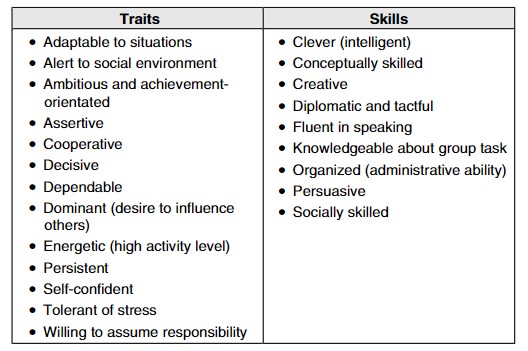
McCall and Lombardo (1983) researched both success and failure identified four primary traits by which leaders could succeed or 'derail':
Emotional stability and composure: Calm, confident and predictable, particularly when under stress.
Admitting error: Owning up to mistakes, rather than putting energy into covering up.
Good interpersonal skills: Able to communicate and persuade others without resort to negative or coercive tactics.
Intellectual breadth: Able to understand a wide range of areas, rather than having a narrow (and narrow-minded) area of expertise.
(C) Behavioral Theory
Leaders can be made, rather than are born and successful leadership is based in definable, learnable behavior. These are the assumptions of behavioral theory. Behavioral theories of leadership do not seek inborn traits or capabilities. Rather, they look at what leaders do. If success can be defined in terms of describable actions, then it should be relatively easy for other people to act in the same way. This is easier to teach and learn than to adopt the more ephemeral ‘traits’ or ‘capabilities.
Role Theory
The assumptions of role theory are people define roles for themselves and others based on social learning and reading. People form expectations about the roles that they and others will play. People delicately encourage others. to act within the role expectations, they have for them, and they will act within the roles they adopt.
Leaders are influenced by management expectations, particularly if they are sensitive to the people around them, and will generally conform to these, playing the leadership role that is put upon them by others. Within organizations, there is much formal and informal information about what the leader's role should be, including 'leadership values', culture, training sessions, modeling by senior managers, and so on. These and more (including contextual factors) act to shape expectations and behaviors around leadership.
Role conflict can also occur when people have differing expectations of their leaders. It also happens when leaders have different ideas about what they should be doing vs. the expectations that are put upon them.
The Managerial Grid
Leaders may be concerned for their people, and they also must have some. concern or the work to be done. The question is how much attention to they pay to one or the other? This is a model defined by Blake and Mouton in the early 1960s.
Impoverished management
Leader put minimum effort to get the work done and basically lazy approach that avoids as much work as possible.
Authority-compliance
Strong focus on task, but with little concern for people. Focus on efficiency, including the elimination of people wherever possible.
Country club management
Care and concern for the people, with a comfortable and friendly environment and collegial style. But a low focus on task may give questionable results.
Middle of the road management
A weak balance of focus on both people and the work. Doing enough to get things done, but not pushing the boundaries of what may be possible.
❖ Team management
People are committed to task and leader is committed to people. The concern for production and people both are high
(D) Participative Leadership
People are more committed to actions where they have been involved in the relevant decision-making. People are less competitive and more collaborative when they are working on joint goals. When people make decisions together, the social commitment to one another is greater and thus increases their commitment to the decision.
(i) Lewin’s Leadership Styles
Kurt Lewin and colleagues did leadership decision experiments in 1939 and identified three different styles of leadership, around decision- making.
Autocratic—In the autocratic style, the leader takes decisions without consulting with others. The decision is made without any form of consultation. In Lewin's experiments, he found that this caused the most level of discontent. An autocratic style works when there is no need for input on the decision, where the decision would not change as a result of input and where the motivation of people to carry out subsequent actions would not be affected whether they were or were not involved in the decision-making.
Democratic—In the democratic style, the leader involves the people in the decisionmaking, although the process for the final decision may vary from the leader having the final say to them facilitating consensus in the group.
Laissez-Faire—This style is to minimize the leader's involvement in decision-making, and hence allowing people to make their own decisions, although they may still be responsible for the outcome. Laissez-faire works best when people are capable and motivated in making their own decisions, and where there is no requirement for a central coordination, for example in sharing resources across a range of different people and groups.
(ii) Likert’s Leadership Styles
Rensis Likert identified four main styles of leadership, in particular around decision-making and the degree to which people are involved in the decision.
Exploitive authoritative—In this style, the leader has a low concern for people and uses such methods as threats and other fear-based methods to achieve conformance. Communication is almost entirely downwards and the psychologically distant concerns of people are ignored.
Benevolent authoritative—When the leader adds concern for people to an authoritative position, a 'benevolent dictatorship' is formed. The leader now uses rewards to encourage appropriate performance and listens more to concerns lower down the organization, although what they hear is often rose-tinted, being limited to what their subordinates think that the boss wants to hear. Although there may be some delegation of decisions, almost all major decisions are still made centrally.
Consultative—The upward flow of information here is still cautious and rose-tinted to some degree, although the leader is making genuine efforts to listen carefully to ideas. Nevertheless, major decisions are still largely centrally made.
Participative—At this level, the leader makes maximum use of participative methods, engaging people lower down the organization in decision-making. People across the organization are psychologically closer together and work well together at all levels.
(E) Situational Leadership
This theory assumes that the best action of the leader depends on a range of situational factors.
When a decision is needed, an effective leader does not just fall into a single preferred style, such as using transactional or transformational methods. In practice, as they say, things are not that simple. Factors that affect situational decisions include motivation and capability of followers. This, in turn, is affected by factors within the situation. The relationship between followers and the leader may be another factor that affects leader behavior as much as it does follower behavior.
(i) Hersey and Blanchard's Situational Leadership
Leaders should adapt their style to follower development style (or 'maturity'), based on how ready and willing the follower is to perform required tasks (that is, their competence and motivation). There are four leadership styles (S1 to S4) that match the development levels (D1 to D4) of the followers. The four styles suggest that leaders should put greater or less focus on the task in question and/or the relationship between the leader and the follower, depending on the development level of the follower.
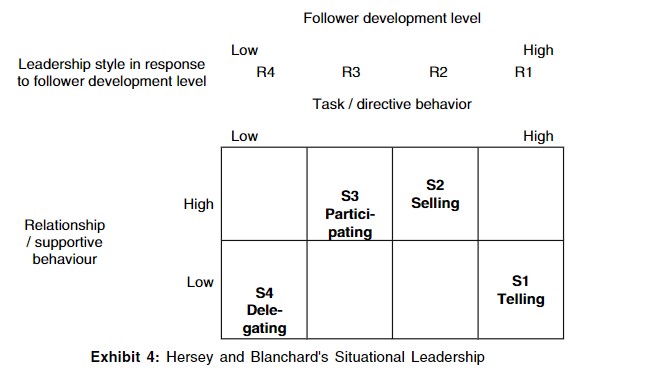
S1: Telling/ Directing
Follower: R1: Low competence, low commitment/Unable and unwilling or insecure
Leader: High task focus, low relationship focus
S2: Selling/Coaching
Follower: R2: Some competence, variable commitment / Unable but willing or motivated
Leader: High task focus, high relationship focus Note: S1 and S2 are leader-driven.
S3: Participating / Supporting
Follower: R3: High competence, variable commitment/Able but unwilling or
Insecure Leader: Low task focus, high relationship focus
S4: Delegating/Observing
Follower: R4: High competence, high commitment/Able and willing or motivated
Leader: Low task focus, low relationship focus Note: S3 and S4 are follower-led.
Module 8A: Team, Groups and Team Conflict
Prepared by: Jasmine Evasco
What is a team?
A team is defined as a group of people who perform interdependent tasks to work toward accomplishing a common mission or specific objective.
Some teams have a limited life: for example, a design team developing a new product, or a continuous process improvement team organized to solve a particular problem. Others are ongoing, such as a department team that meets regularly to review goals, activities, and performance.
Difference between group and team
Aspect | Group | Team |
|---|---|---|
Definition | Collection of individuals within an organization | Cohesive coalition of people working together to achieve mutual goals |
Focus | Can encompass entire store, branch, or project-related groups | Centered on joint goals or products, such as presentations, discussions, or projects |
Size | Can vary in size, potentially larger | Relatively smaller size, typically a small number of people |
Performance | Determined by inputs of the group minus process losses | Aims to accomplish larger, more complex goals than individuals working alone |
Composition | Individuals may have individual responsibilities | Complementary skills, committed to a common purpose and performance goals |
Purpose | May work independently or with limited collaboration | Achieving mutual goals, performing, and achieving victory |
Leadership | May have individual leaders overseeing specific areas | Requires commitment to a common vision and involves each individual working toward team objectives |
Collaboration | Individual focus; collaboration may vary | Emphasizes collaborative action with shared goals and tasks |
Compensation | Individual compensation based on individual performance | Shared rewards based on team performance outcomes |
Sacrifice for Common Good | Individuals may not necessarily sacrifice personal interests | Members are willing to sacrifice for the common good and support each other |
Team Tasks
Teams differ in terms of the tasks they are trying to accomplish. Richard Hackman identified three major classes of tasks: production tasks, idea-generation tasks, and problem-solving tasks (Hackman, 1976).
Production tasks include actually making something, such as a building, product, or a marketing plan.
Idea-generation tasks deal with creative tasks, such as brainstorming a new direction or creating a new process.
Problem-solving tasks refer to coming up with plans for actions and making decisions.
For example, a team may be charged with coming up with a new marketing slogan, which is an idea-generation task, while another team might be asked to manage an entire line of products, including making decisions about products to produce, managing the production of the product lines, marketing them, and staffing their division. The second team has all three types of tasks to accomplish at different points in time.
Another key to understanding how tasks is related to teams is to understand their level of task interdependence:
Task interdependence refers to the degree that team members are dependent on one another to get information, support, or materials from other team members to be effective. Research shows that self-managing teams are most effective when their tasks are highly interdependent (Langfred, 2005; Liden, Wayne, & Bradway, 1997). There are three types of task interdependence.
Pooled interdependence exists when team members may work independently and simply combine their efforts to create the team’s output. For example, when students meet to divide the section of a research paper and one person simply puts all the sections together to create one paper, the team is using the pooled interdependence model. However, they might decide that it makes more sense to start with one person writing the introduction of their research paper, then the second person reads what was written by the first person and, drawing from this section, writes about the findings within the paper.
Using the findings section, the third person writes the conclusions. If one person’s output becomes another person’s input, the team would be experiencing sequential interdependence. And finally, if the student team decided that in order to create a top-notch research paper they should work together on each phase of the research paper so that their best ideas would be captured at each stage, they would be undertaking reciprocal interdependence. Another important type of interdependence that is not specific to the task itself is outcome interdependence, in which the rewards that an individual receives depend on the performance of others.
Team Roles
Studies show that individuals who are more aware of team roles and the behavior required for each role perform better than individuals who do not. This fact remains true for both student project teams as well as work teams, even after accounting for intelligence and personality (Mumford et al., 2008).
Early research found that teams tend to have two categories of roles consisting of those related to the tasks at hand and those related to the team’s functioning. For example, teams that focus only on production at all costs may be successful in the short run, but if they pay no attention to how team members feel about working 70 hours a week, they are likely to experience high turnover.
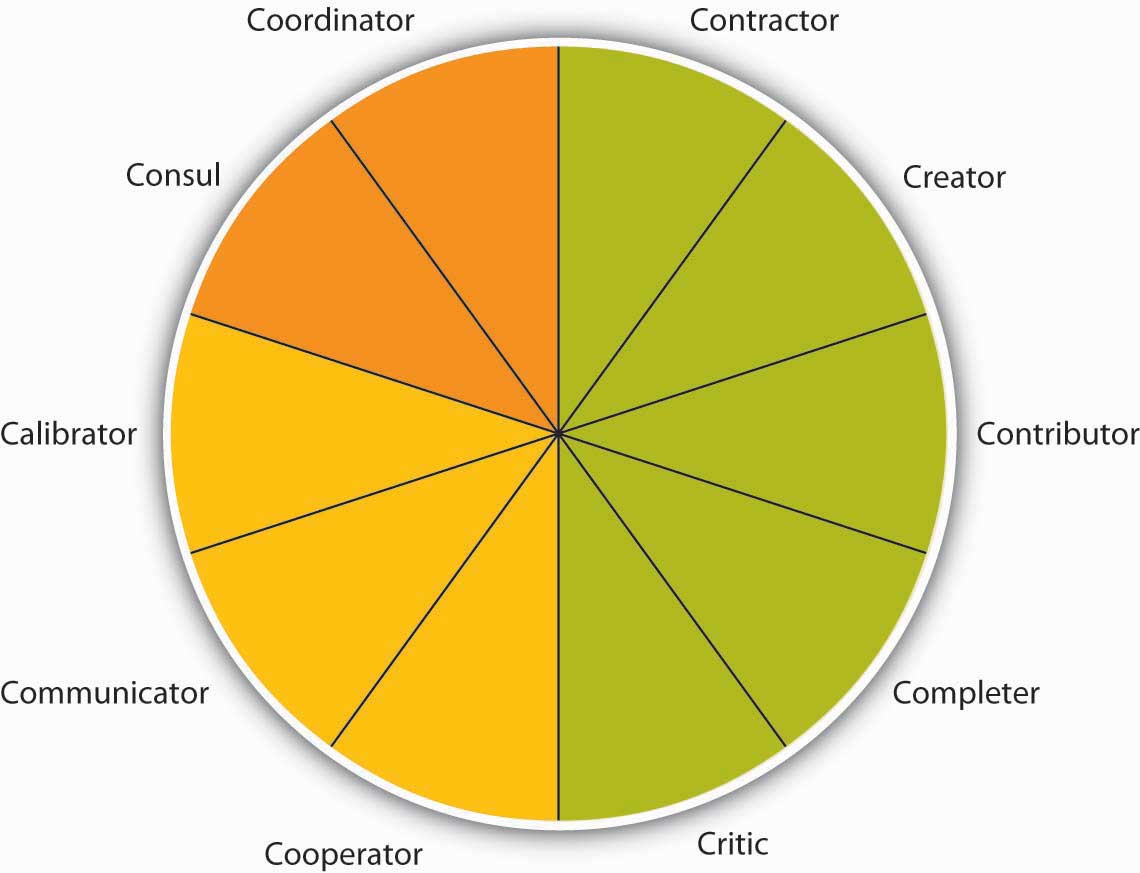
Teams are based on many roles being carried out, as summarized by the Team Role Typology. These 10 roles include task roles (green), social roles (yellow), and boundary-spanning roles (orange).
Team Roles
Five roles make up the task portion of the typology.
The contractor role includes behaviors that serve to organize the team’s work, including creating team timelines, production schedules, and task sequencing.
The creator role deals more with changes in the team’s task process structure. For example, reframing the team goals and looking at the context of goals would fall under this role.
The contributor role is important, because it brings information and expertise to the team. This role is characterized by sharing knowledge and training with those who have less expertise to strengthen the team. Research shows that teams with highly intelligent members and evenly distributed workloads are more effective than those with uneven workloads (Ellis et al., 2003).
The completer role is also important, as it transforms ideas into action. Behaviors associated with this role include following up on tasks, such as gathering needed background information or summarizing the team’s ideas into reports.
Finally, the critic role includes “devil’s advocate” behaviors that go against the assumptions being made by the team.
Social Roles
Social roles serve to keep the team operating effectively. When the social roles are filled, team members feel more cohesive, and the group is less prone to suffer process losses or biases such as social loafing, groupthink, or a lack of participation from all members. Three roles fall under the umbrella of social roles.
The cooperator role includes supporting those with expertise toward the team’s goals. This is a proactive role.
The communicator role includes behaviors that are targeted at collaboration, such as practicing good listening skills and appropriately using humor to diffuse tense situations. Having a good communicator helps the team to feel more open to sharing ideas.
The calibrator role is an important one that serves to keep the team on track in terms of suggesting any needed changes to the team’s process. This role includes initiating discussions about potential team problems such as power struggles or other tensions. Similarly, this role may involve settling disagreements or pointing out what is working and what is not in terms of team process.
Boundary-Spanning Roles
The final two goals are related to activities outside the team that help to connect the team to the larger organization (Anacona, 1990; Anacona, 1992; Druskat & Wheeler, 2003). Teams that engage in a greater level of boundary-spanning behaviors increase their team effectiveness (Marrone, Tesluk, & Carson, 2007).
The consul role includes gathering information from the larger organization and informing those within the organization about team activities, goals, and successes. Often the consul role is filled by team managers or leaders.
The coordinator role includes interfacing with others within the organization so that the team’s efforts are in line with other individuals and teams within the organization.
Module 8B: Team, Groups and Conflict
Prepared by: Jasmine Evasco
Team Development
Forming stage
The forming stage involves a period of orientation and getting acquainted. Uncertainty is high during this stage, and people are looking for leadership and authority. A member who asserts authority or is knowledgeable may be looked to take control. Team members are asking such questions as “What does the team offer me?” “What is expected of me?” “Will I fit in?” Most interactions are social as members get to know each other.
Storming stage
The storming stage is the most difficult and critical stage to pass through. It is a period marked by conflict and competition as individual personalities emerge. Team performance may decrease in this stage because energy is put into unproductive activities. Members may disagree on team goals, and subgroups and cliques may form around strong personalities or areas of agreement. To get through this stage, members must work to overcome obstacles, to accept individual differences, and to work through conflicting ideas on team tasks and goals. Teams can get bogged down in this stage. Failure to address conflicts may result in long-term problems.
Norming stage
If teams get through the storming stage, conflict is resolved, and some degree of unity emerges. In the norming stage, consensus develops around who the leader or leaders are, and individual member’s roles. Interpersonal differences begin to be resolved, and a sense of cohesion and unity emerges. Team performance increases during this stage as members learn to cooperate and begin to focus on team goals. However, the harmony is precarious, and if disagreements re-emerge the team can slide back into storming.
Performing stage
In the performing stage, consensus and cooperation have been well-established and the team is mature, organized, and well-functioning. There is a clear and stable structure, and members are committed to the team’s mission. Problems and conflicts still emerge, but they are dealt with constructively. The team is focused on problem solving and meeting team goals.
Adjourning stage
In the adjourning stage, most of the team’s goals have been accomplished. The emphasis is on wrapping up final tasks and documenting the effort and results. As the work load is diminished, individual members may be reassigned to other teams, and the team disbands. There may be regret as the team ends, so a ceremonial acknowledgement of the work and success of the team can be helpful. If the team is a standing committee with ongoing responsibility, members may be replaced by new people and the team can go back to a forming or storming stage and repeat the development process.
Types of Teams
Functional Teams:
Functional teams represent conventional organizational units, often aligned with specific departments, where team members share similar professional expertise.
Advantages:
Streamlined task allocation due to specialization.
Operational efficiency in handling specialized problems.
Strict coordination and control by a designated manager.
Opportunities for skill growth through focused responsibilities.
Disadvantages:
Potential segregation from other company teams.
Slower decision-making processes requiring coordination among different units.
Authoritative decision-making, limiting individual contributions.
Additional Example: Legal department teams.
Cross-functional Teams:
Cross-functional teams consist of members from diverse departments, pooling varied functional expertise to achieve common objectives.
Advantages:
Diverse perspectives enhance problem-solving creativity.
Improved organizational alignment and interdepartmental understanding.
Accountability for outcomes rather than interdepartmental blame.
Ability to handle different project types.
Disadvantages:
Initial challenges in achieving team cohesion.
Potential conflicts arising from diverse opinions.
Difficulty in maintaining efficiency due to different processes and tools.
Additional Example: Research and development teams involving engineering, marketing, and design departments.
Self-managed Teams:
Self-managed teams are autonomous groups of employees responsible for both work processes and final results, functioning without direct managerial supervision.
Advantages:
High motivation and active participation due to decision-making autonomy.
Focus on customer satisfaction over hierarchical directives.
Enhanced adaptability in dynamic situations.
Cost-effectiveness by eliminating the need for traditional managers.
Disadvantages:
Implementation challenges requiring specialized training.
Potential leadership problems with informal leaders emerging.
Dependency on individual self-sufficiency for team success.
Additional Example: Agile development teams in software companies.
Virtual Teams:
Virtual teams, including remote or geographically dispersed teams, work without physical presence, often leveraging technology for collaboration.
Advantages:
Reduced costs for both employers and employees.
Access to a wider talent pool without geographical limitations.
Improved work-life balance for team members.
Disadvantages:
Slower decision-making processes.
Challenges in maintaining team culture and trust.
Potential difficulties in personal time management.
Additional Example: Global customer support teams working from different continents.
Team of Teams (Multiteam System):
A team of teams encompasses various departments within an organization, collaborating to address complex problems through decentralized power and a focus on meritocracy.
Advantages:
Gathering diverse perspectives for optimal solutions.
High adaptability and quick decision-making.
Disadvantages:
Alignment challenges between teams.
Potential conflicts and trust issues among teams.
Additional Example: Emergency response teams consisting of police, medical technicians, and firefighters.
Module 9: JOB CHARACTERISTICS
Prepared by: Jasmine Evasco
JOB CHARACTERISTICS
The Job Characteristics Model provides recommendations on how to best enrich jobs in organizations and was designed by Hackman and Oldham in 1976 and updated in 1980 (Hackman & Oldham, 1976, 1980). The JCM proposes that five core job characteristics contribute to an employee's meaningful work experience and job satisfaction. These five core job distinguishing features are:
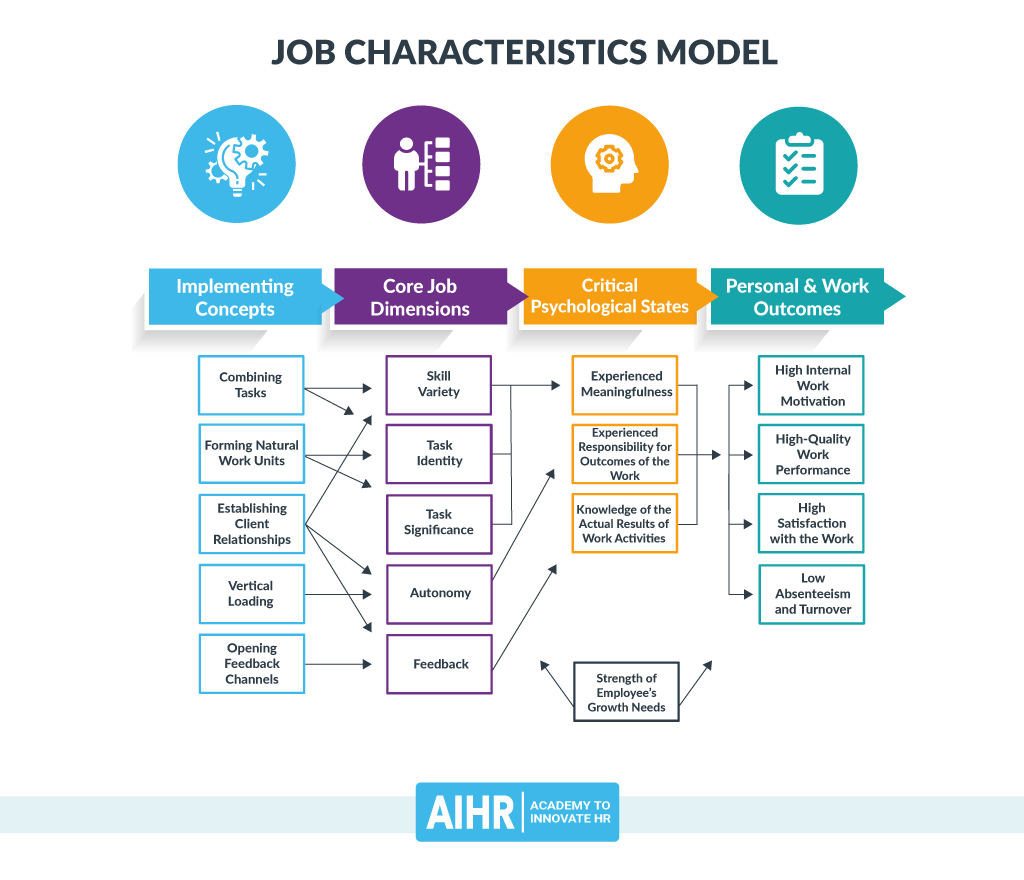
Skill variety – This describes the range of skills and activities necessary to complete the job. The more a worker is challenged to use a wide variety of skills, the more satisfying the job is likely to be. Jobs that ask workers to make decisions and solve problems will usually be more satisfying than jobs with tasks that are routine and predictable.
Examples:
In a creative design job, an individual may need a combination of graphic design, problem-solving, and communication skills.
A software developer may require coding skills, problem-solving, and collaboration with team members.
Task identity – This dimension measures the degree to which a person can complete an activity or job in full. Workers who are able to take an activity from start to finish are usually more satisfied. For example, sewing an entire dress would be more satisfying than just sewing buttons onto it.
Examples:
In manufacturing, assembling a product from start to finish gives a worker a sense of completion.
A chef who creates a dish from selecting ingredients to presenting the final plate experiences task identity.
Task significance – This looks at the impact and influence of a job. Jobs are more satisfying if workers believe that they make a difference, and are adding real value to co-workers, the organization, or the larger community. For example, if a worker is interested in sports, constructing signs for the Olympic games would be more satisfying than constructing signs for a new business park.
Examples:
Healthcare professionals directly impact lives by improving health outcomes.
Customer service representatives contribute to customer satisfaction and the company's reputation.
Autonomy – This describes the amount of individual choice and discretion involved in a job. More autonomy leads to more satisfaction. For instance, a job is likely to be more satisfying if people are involved in making decisions, instead of simply being told what to do.
Examples:
A freelance writer has the autonomy to choose projects, set deadlines, and work independently.
An entrepreneur has the freedom to make business decisions and shape the direction of their company.
Feedback – This dimension measures the amount of information a worker receives about his or her performance, and the extent to which he or she can see the impact of the work. The more that people are told about their performance, the more interested they'll be in doing a good job.
Examples:
A teacher receives feedback through student performance and assessments.
An IT professional benefits from regular performance reviews and constructive criticism from peers.