Chapter 4: secondary production - the macrobiota
4.5 human impacts on secondary production
human activity has the potential to change the magnitude of secondary production in the seas and oceans, primarily through, fisheries, eutrophication, and climate change
a key assumption behind fisheries management is that exploitation will increase the production to biomass ratio of exploited stocks by removing the larger individuals from the population
secondary production might be a useful indicator of the integrity of the functioning ecosystem
4.5.1 fisheries
intraspecific competition → when members of the same species compete for food, water, mates, and other limited resources
exploitation will decrease the standing stock biomass of a population, and will also lead to a reduction in the average body size of individuals within the stock when the largest individuals of a species are preferentially caught
by reducing overall population size, the fishery will also reduce intraspecific competition for resources
the most productive species tend to be least severely affected by exploitation
species with low natural mortality rates will be strongly affected by fisheries, because the mortality rate is higher through fisheries than through natural causes
in exploited communities, there will be a shift in dominance to smaller species
a single pass of a bottom trawl results in about 50% mortality of the benthic invertebrates that live on or in the seabed
in areas that are trawled regularly, the physical disturbances results in changes in biomass, production, species richness, and size distribution of benthic invertebrates
the biomass of large hard bodies benthic organisms decreases strongly in response to bottom trawling, due to their naturally slow life history
small soft bodied animals like polychaete are much less severely affected by trawling, or may benefit from the release in competition form larger hard bodied individuals
therefore, bottom trawling has a negative impact on the biomass and production of benthic invertebrates
CURRENT FOCUS: effect of bottom trawling on the production of benthic ecosystems
bottom trawl fisheries are wide spread and cause mortality of benthic invertebrates, which in turn may change the availability of prey for target fish species
the idea: ploughing the seabeds with trawls increases the production of the small benthos that flatfish feed on by removing the large fauna that prey on and compete with the small benthos
support for this idea is found in the “plaice box” which is an area that has gear/trawling restrictions, to reduce the by catch of undersized plaice
at the time of the closure, it was expected that this closure would result in an increase in plaice stocks, but instead plaice spawning stock biomass strongly declined
the trawling that used to happen in that area used to disturb the seabed enough that teh abundance of small benthic animals was high compared to the larger benthic animals, allowing the plaice to feed on the small benthos invertebrates
so basically, repeating myself from the previous heading, a delicate balance had to be created for the plaice to increase in biomass, and that was by trawling the area, but not so frequently that the ecosystem crashed.
4.5.2 eutrophication
eutrophication is known to be generally negative for coastal waters, leading to hypoxia and blooms of toxic algae
however, it can sometimes have positive effects, like on secondary production, through an increase in primary production
in some countries, after installations of water treatment plants, the decrease in nutrients runoff seems to have affected the productivity of coastal shrimp and flatfish fisheries
when dissolved oxygen levels fall below a certain point, benthic fauna start to show unsual behaviour by abandoning their burrows.
this gives and opportunity for epibenthic predators to feed on these benthic invertebrates, creating a spike in energy flow through the ecosystem.
the conditions have to be very delicately balanced for this event to occur.
if oxygen concnetration keep falling further than said level, it will lead to anoxic conditions in the benthic environment
Griffiths (2017) Benthic pelagic coupling in a changing world
study guide:
main topics and subtopics
benthic pelagic coupling (BPC)
exchange of energy, nutrients, and materials between seafloor (benthos) and overlying water (pelagic zone)
role of bioturbation, bioirrigation, and organic matter remineralisation
anthropogenic impacts
eutrophication (excess nutrients → algal blooms → oxygen depletion)
bottom trawling (disturbance of sediment structure and biota)
climate change (warming, hypoxia, acidification)
feedback mechanisms
how changes in the pelagic zone (e.g. algal blooms) alter benthic processes, which then feedback to influence water quality and productivity
functional biodiversity
how different species or functional groups contribute to ecosystem processes (e.g., deposit feeders vs. filter feeders)
essential definitions and terminology
Term | Definition |
Benthic-pelagic coupling (BPC) | two way flow of matter and energy between seabed and water column |
Bioturbation | mixing of sediment by animals (e.g., burrowing, feeding) |
Bioirrigation | pumping of water into and out of sediment by animals’ burrows |
Eutrophication | enrichment of water by nutrients, leading to oxygen depletion |
Hypoxia | low oxygen levels in bottom waters (< 2 mg O2 L-1) |
Functional diversity | variety of ecological roles within a community that sustain ecosystem responses |
Feedback loop | reciprocal cause-effect cycle between benthic and pelagic systems |
core principles and frameworks
ecosystem connectivity:
benthic and pelagic systems are not isolated; processes in one layer directly regulate the other
energy flow framework:
organic matter from plankton → sink to sediment → decomposed → nutrients regenerated → support new pelagic production
disturbance-response principle:
external stress (e.g. eutrophication, trawling) → alters sediment oxygen, community structure, and coupling intensity
functional redundancy:
having multiple species that perform similar ecological roles buffers the system against loss of function
learning objectives
after studying this paper, you should be able to:
define benthic pelagic coupling and describe its mechanisms
identify anthropogenic pressures that weaken BPC
explain how benthic fauna mediate sediment-water nutrient fluxes
recognize the feedbacks between benthic disturbance and pelagic productivity
interpret diagram showing nutrient flux and oxygen gradients
analyze how environmental stress alters benthic processes
apply concepts of functional diversity and ecosystem resilience
predict how changing temperature, nutrient input, or oxygen levels affect benthic function
evaluate management or conservation strategies to restore benthic-pelagic balance
content organisation
introduction to BPC
definition and importance
historical context and conceptual models
processes driving coupling
organic matter deposition and remineralisation
bioturbation and bioirrigation by benthic fauna
stressors affecting BPC
eutrophication and hypoxia
physical disturbance
warming, acidification, and stratification
feedback loops and system resilience
positive feedbacks: eutrophication → hypoxia → reduced fauna → less nutrient recycling → more hypoxia
role of biodiversity in breaking or buffering feedback loops
management and future outlook
integrated ecosystem-based management
restoration of benthic habitats
need for cross-scale research linking processes to global change
relationships between concepts
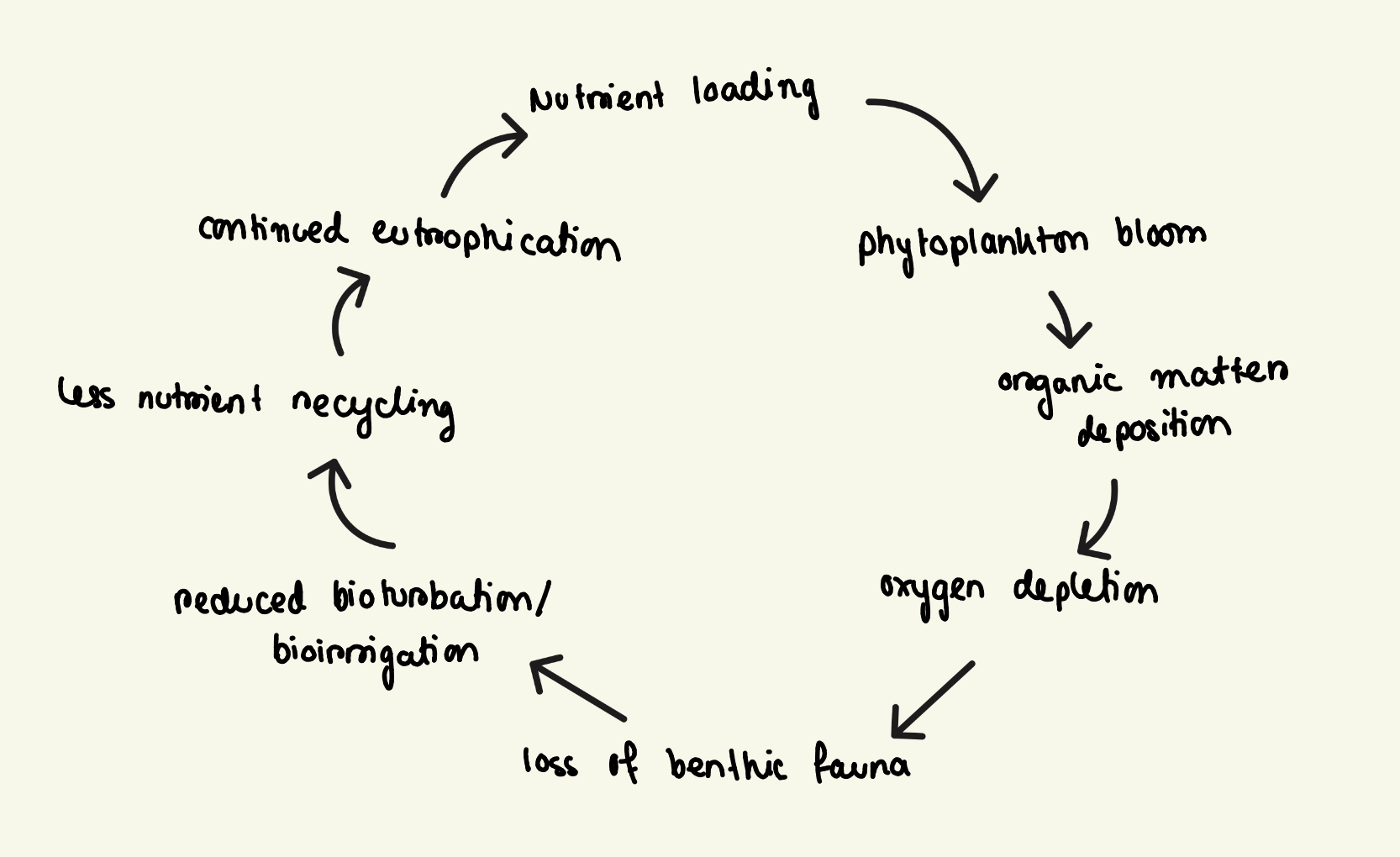
progressive learning path
start with definition and mechanisms of BPC (basic)
move to faunal mediation and nutrient cycles (intermediate)
connect to stressors and feedbacks (advanced)
end with ecosystem management and resilience frameworks (applied)
study resources
abstract + introduction: overview of coupling concepts
middle sections: human pressures, feedback loops, and resilience
figures: show conceptual models of BPC under stress
discussion: synthesis and implications for management
review strategies
Benthic–pelagic coupling keeps nutrient cycles efficient; disruption leads to ecosystem imbalance.
Bioturbation and bioirrigation are critical for oxygenation and nutrient regeneration.
Eutrophication, warming, and hypoxia form reinforcing feedback loops.
Functional diversity = ecosystem insurance.
Restoration efforts must target both benthic and pelagic components simultaneously.
practice and self assessment
Explain: What is benthic–pelagic coupling, and why is it essential for ecosystem functioning?
Compare: How do bioturbation and bioirrigation differ in their ecological roles?
Analyze: What are the key feedback loops linking eutrophication, hypoxia, and benthic collapse?
Apply: Predict how increasing water temperature could alter BPC in a shallow shelf ecosystem.
Evaluate: Suggest management interventions to restore BPC in a eutrophic coastal sea.
quick visual summary
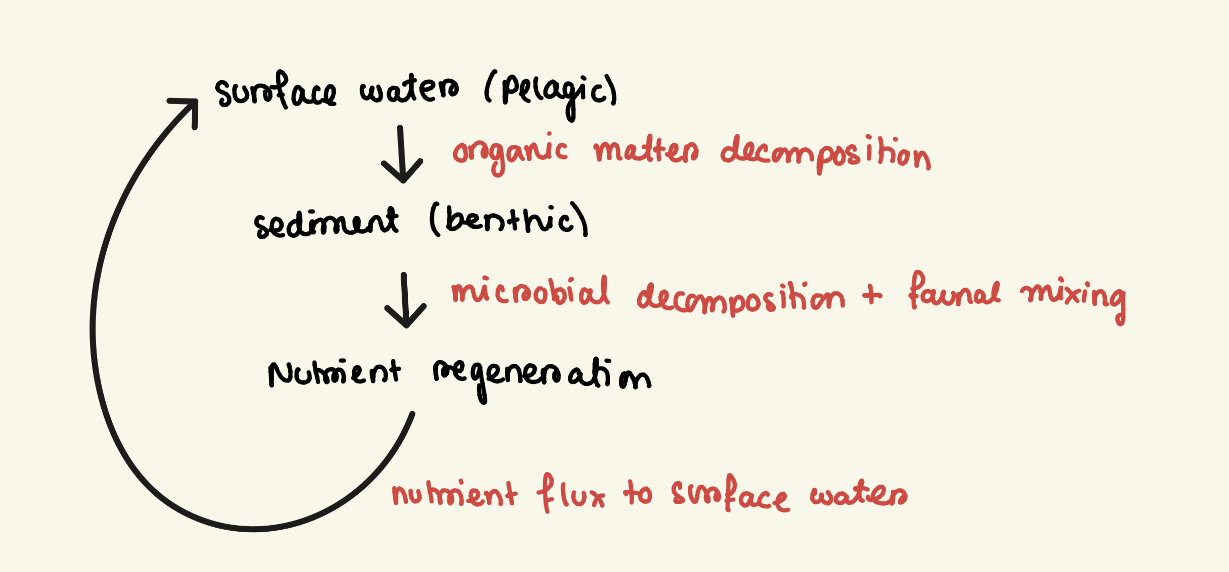
feedback: human impacts (eutrophication, trawling, warming) disrupt the cycle
Practice Questions – Griffiths et al. (2017): Benthic–Pelagic Coupling in a Changing World
Section 1 – Multiple-Choice Questions (MCQs)
Q1 – Fundamental Concept
Learning Objective: Define benthic–pelagic coupling (BPC).
Difficulty: Basic Time: 2 min
Question:
Benthic–pelagic coupling primarily refers to:
A. Exchange of heat between surface and deep ocean layers
B. Nutrient and energy exchange between sediments and the water column
C. Physical movement of organisms from benthos to pelagos
D. Ocean current-driven circulation patterns
✅ Correct Answer: B
Explanation: BPC describes the two-way exchange of nutrients, carbon, and energy between the benthic (sea-floor) and pelagic (water column) zones. (See Griffiths et al. 2017, p. 2)
A = thermal process, not nutrient cycling.
C = migration, not coupling.
D = physical circulation, not biogeochemical exchange.
Q2 – Functional Mechanisms
Learning Objective: Identify benthic processes that drive BPC.
Difficulty: Intermediate Time: 3 min
Which pair of processes most directly enhances benthic–pelagic coupling?
A. Bioturbation and bioirrigation
B. Upwelling and downwelling
C. Photosynthesis and chemosynthesis
D. Stratification and mixing
✅ A. Bioturbation and Bioirrigation
Explanation: Griffiths et al. emphasize these two macrofaunal behaviors as the main biological drivers of nutrient and gas exchange across the sediment–water interface (p. 4-5).
Other options describe broader oceanographic or metabolic processes, not specifically sediment–water interactions.
Q3 – Human Impacts
Learning Objective: Explain how anthropogenic stress affects BPC.
Difficulty: Intermediate Time: 4 min
Eutrophication weakens benthic–pelagic coupling primarily because it:
A. Increases sediment oxygenation
B. Reduces organic matter deposition
C. Causes hypoxia that kills benthic fauna
D. Increases the abundance of bioturbators
✅ C. Causes hypoxia that kills benthic fauna
Explanation: Excess nutrients → algal blooms → decomposition consumes oxygen → benthic fauna die → loss of mixing and nutrient recycling (positive feedback loop, p. 7).
Q4 – Analytical / Applied
Learning Objective: Assess feedback mechanisms in BPC.
Difficulty: Advanced Time: 5 min
What type of feedback loop results when eutrophication leads to reduced oxygen and loss of benthic fauna, further decreasing nutrient recycling and exacerbating eutrophication?
A. Positive feedback loop
B. Negative feedback loop
C. Neutral equilibrium
D. Stabilizing response
✅ A. Positive feedback loop
Explanation: This self-reinforcing loop amplifies degradation — low oxygen → loss of fauna → less nutrient uptake → more hypoxia (p. 8, Fig. 3).
Q5 – Concept Integration
Learning Objective: Link functional diversity to ecosystem resilience.
Difficulty: Advanced Time: 5 min
According to Griffiths et al. (2017), why does high benthic functional diversity increase resilience?
A. It reduces total productivity to conserve resources.
B. Different species perform overlapping ecological roles, ensuring continuity of function.
C. It limits nutrient fluxes between benthos and pelagos.
D. It increases dominance of a single efficient species.
✅ B. Functional redundancy ensures continuity of ecosystem processes.
Explanation: Systems with multiple species that share functions (e.g., different types of bioturbators) maintain coupling even after disturbances (p. 9).
Section 2 – Short-Answer Questions
Q1 – Mechanisms of Coupling
Learning Objective: Describe major processes linking benthos and pelagos.
Difficulty: Intermediate Time: 6 min
Question: Explain how organic matter sedimentation and bioturbation jointly regulate nutrient fluxes at the sediment–water interface.
Key Points / Sample Answer:
Phytoplankton settle as organic matter to sediments.
Microbial decomposition releases nutrients (NH₄⁺, PO₄³⁻).
Bioturbation by macrofauna redistributes organic particles and oxygen, accelerating remineralization.
Nutrients diffuse upward → support new pelagic primary production.
(Sections 2–4, Griffiths et al. 2017)
Q2 – Eutrophication Feedbacks
Learning Objective: Apply feedback-loop reasoning.
Difficulty: Advanced Time: 8 min
Describe the sequence of events linking eutrophication to weakened benthic–pelagic coupling, and identify two ecosystem consequences.
Sample Answer:
Nutrient enrichment → algal bloom → excessive organic deposition.
Microbial decomposition → oxygen depletion (hypoxia).
Benthic macrofauna die → loss of bioturbation & bioirrigation.
Sediment nutrient flux decreases; phosphorus may be released instead of retained.
Feedback reinforces eutrophication and reduces biodiversity.
Consequences: persistent hypoxia, collapse of benthic productivity.
Q3 – Climate Link
Learning Objective: Evaluate climate-driven changes.
Difficulty: Intermediate Time: 6 min
How might rising bottom-water temperature affect benthic–pelagic coupling in coastal shelf seas?
Sample Answer:
Warmer water → stronger stratification, reducing oxygen exchange.
Increased microbial metabolism → faster oxygen consumption.
Fauna stressed → reduced mixing → weaker coupling.
Net effect: shallower oxic zone and lower resilience.
(See Discussion section, Griffiths et al. 2017, p. 9–10)
Section 3 – Case / Scenario-Based Questions
Scenario 1 – Eutrophic Estuary Recovery Plan
Learning Objective: Integrate ecological processes into management.
Difficulty: Advanced Time: 15 min
Case: A shallow estuary has chronic hypoxia and algal blooms. Managers plan to restore benthic–pelagic coupling to improve water quality.
Question: Propose a management strategy that targets both benthic and pelagic components. Explain step-by-step how it would break the positive feedback loop described by Griffiths et al. (2017).
Solution Approach:
Reduce nutrient inputs → control eutrophication source.
Restore benthic fauna → reintroduce or protect key bioturbators (e.g., bivalves).
Habitat rehabilitation → add artificial reefs or sediment refuges for recolonization.
Enhance oxygenation → via mechanical mixing or seasonal aeration.
Monitor fluxes → track NH₄⁺, PO₄³⁻, O₂, organic matter turnover.
Outcome: Re-established fauna increase sediment oxygenation and nutrient recycling, breaking the eutrophication–hypoxia feedback.
Scenario 2 – Trawling Impact Assessment
Learning Objective: Analyze physical disturbance on coupling.
Difficulty: Intermediate Time: 12 min
Case: A continental shelf area experiences intense bottom trawling.
Question: Using the BPC framework, predict short- and long-term ecological effects.
Step-by-Step Reasoning:
Immediate: Sediment resuspension → nutrient pulse → possible temporary productivity spike.
Medium-term: Destruction of burrows and bioturbators → reduced oxygen penetration.
Long-term: Flattened sediment, loss of biodiversity → weaker nutrient regeneration.
Overall: Transition from a dynamic, coupled system to a degraded, decoupled one.
(Supports arguments on physical disturbance, p. 6–7, Griffiths et al. 2017)
Scenario 3 – Functional Diversity Under Warming
Learning Objective: Assess trait-based resilience.
Difficulty: Advanced Time: 15 min
Case: Two coastal systems experience similar warming. One has high benthic functional diversity; the other is dominated by a single species.
Question: Predict how each system’s benthic–pelagic coupling will respond and justify your reasoning.
Solution Approach:
High-diversity system: Different species fill overlapping roles → functional redundancy → coupling maintained.
Low-diversity system: Loss of the dominant species disrupts sediment mixing and nutrient fluxes → coupling collapses.
Conclusion: Biodiversity acts as ecological insurance, buffering against warming stress.
(See Discussion on resilience, p. 9–10)