Social Thinking 1: The Self - Week 3
The self
Who am I? Who am I really?
Social psychology:
How does the sense of self develop?
How does it influence the way we think about others and behave towards others?
How do others influence how we feel about ourselves?
We play different roles depending who we are with.
William James (1890): “a man has as many social selves as there are individuals who recognize him and carry an image of him in their minds.”
Self-Concept
How we perceive our self and feel about our self is strongly influences by our environment(s)
Herbert Mead (1934): “the self is initially not there at birth, but develops through contact with others.”
Versions of Self
Potentially 3 different selves develop:
Individual self (what distinguishes me from all others, personality traits)
Relational self (relationship with others, e.g., son, daughter, brother, friend, etc)
Collective self (defined by group membership, e.g., student, British, European)
Aspects of the Self
Self-concept - Who am I?
Self-esteem - My sense of self-worth
Self-knowledge - How can I explain and predict myself?
Social self - My roles as a student, family member, and friend; my group identity.
Version vs. Aspect of the self - Each one of the versions of the self (individual, relational, collective) have each one of the 4 aspects of the self (self-concept, self-esteem, self-knowledge, and social self)
Seld concept (Who am I?)
The set of beliefs that people have about themselves.
Attempt to measure self-concept`:
Twenty Statements Test (Kuhn & McPartland, 1954):
Assumes that language is the basis of the self, therefore, self-concept can be assessed through verbal self-descriptions.
Twenty Statements Test
Four types of responses:
Physicaly description: “I have brown eyes”, I am fit..etc
Social roles: e.g., student/sciemtist, member of the running club
Personal Traits: “I’m impulsive…I’m generous…I tend to worry a lot.”
Existential statements: e.g., “I’m a human being”, “I’m a spiritual being”.
Self-schemas
Self-schemas: elements of the self-concept
Schema refers to way to store and organise information and knowledge, including about oneself:
Current self: I am a runner, I am creative, I am smart…
Possible selves: selves that you could have been or could become: the loved self, the loving self, the unloved self, the unemployed self
Self-reference effect
Information relevant to our self-concept is processed and rememberd better than other info.
Kahan and Johnson (1992)
Aim: Pairs of females (subject +confederate) > atudy of the accuracy of first impressions.
Procedure: They reported their opinions on several current issues, and generated descriptors of herself and the other person.
Two days later, participants returned to the lab for a surprise memory test.
Findings: Recalled more of what the confederate said about them than what the confederate said about herself.
you remember stuff most relevant to you
Adjectives describing characteristics very like or very unlike the self are rated faster than adjectives moderately descriptive of the self (e.g., Kupier, 1981)
Self-reference effect suggests that the self is the center of our world
Spotlight Effect
Spotlight effect: belief others are paying more attention to one’s appearance and behaviour than they really are.
Far fewer peers noticed that students were wearing “uncool” Barry Manilow T-shirt than students themselves has expected.
Illusion of transparency
Our concealed emotions leak our and can be read by others.
Our emotions are vivid for ourselves and must therefore be visible for others.
Savitsky & Gilovich (2003)
Procedure: Students who gave short speech rated themselves as appearing more nervous to the audience than people in the audience rated the speaker.
Results: Nervousness of the speaker was not as obvious as the speaker thought.
Self-discrepancy theory (SDT)
SDT (Higgins, 1987) attempts to explain feelings of discomfort by these discrepancies.
Self subdivided into 3 domains
Actual self: attributes that we possess
Ought self: attributes that you should possess (as a moral obligation)
Ideal self: attributes that ideally you would possess.
People strive to ensure that the actual self is as close as possible to ideal self and ought self.
The development of the Self
Self-concepts ‘emerge’ from several ‘sources’:
The roles we play, e.g., everyone plays different roles in different social situations (e.g. student, child, parent, team member, friend)
Social identity (e.g., nationality, religion, gender) - stronger in a minority group surrounded by a larger group (e.g., being the only European on a train in Japan)
Daily experiences of failure and success - failure and success influence self-concept (feeling more able or less able, sense of self-worth).
Social comparison
Evaluating one’s abilities, opinions and posessions by comparing with others.
Comparisons with others define whether we feel rich or poort, clever or stupid, handsome or plain.
Comparison with others is irresistable.
Comparison upwards can spoil satisfaction with achievements.
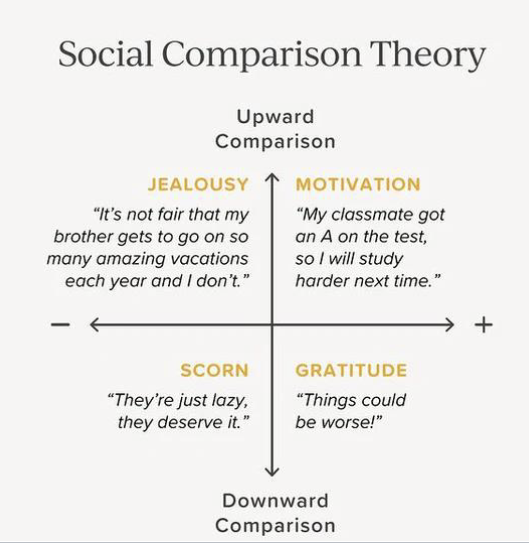
Social Comparison Theory (SCT, Festinger, 1954)
Social comparison: Comparing our behaviours and opinions with those of others to establish the correct or socially approved way of thinking and behaving.
Downward comparison: we try to compare ourselves with people who are slightly worse than us → evaluatively positive self-concept (Wills, 1981)
Upward comparison: some upward comparison can have a harmful effect on self-esteem (Wood, 1989)
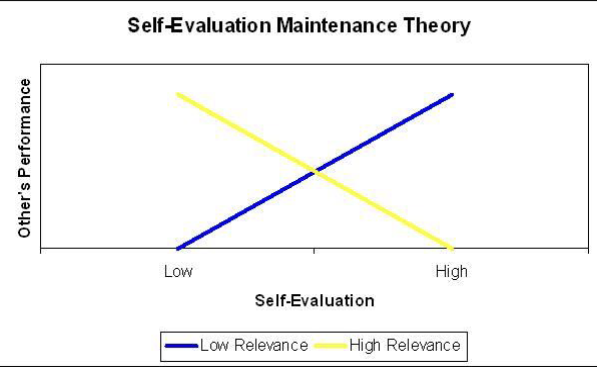
Self-evaluation maintenance model (Tesser, 1988)
People who are constrained to make esteem-damaging upward comparisons can underplay or deny similarity to the target, or they can withdraw from their relationship with the target.
Cultural aspects of the Self
Independence: self-contained, independent self, individual is more important than the group, self-concept independent of where one lives.
Interdependence: greater emphasis on collectivism: group more important than the individual. Self-concept more likely to be described as member of group (“I am a Maasai”)
Self-esteem in interdependent cultures related to opinion of others
“what others think of me and my group”
comparison with others (who do better) to stimulate self-improvement
Self-esteem in independent cultures:
more personal
less dependent on group
comparison with others (who do less well) to improve self-esteem
Japanese students are happy with positive social engagement, feeling close, friendly and respectful.
American studemts happier when feeling effective, superior aand proud (Kitayama & Markus, 2000)
Self-concept can change when living in another culture
Japanese exchange students showed increase in personal self-esteem (self-esteem common in independent cultures).
Self-Knowledge
Use self-knowledge to:
Explain our own behaviour
Predict how we will behave
Predict our emotions and how we will feel (affective forecasting).
Predict how we will behave → Predictions are often inaccurate.
People deny that they will be influences by the by-stander-effect, but many are, in fact, influenced.
Dating couples tend to be over-optimistic over the longevity of their relationships.
Friends and family (i.e., others) often have more accurare expectations (MacDonald & Ross, 1997)
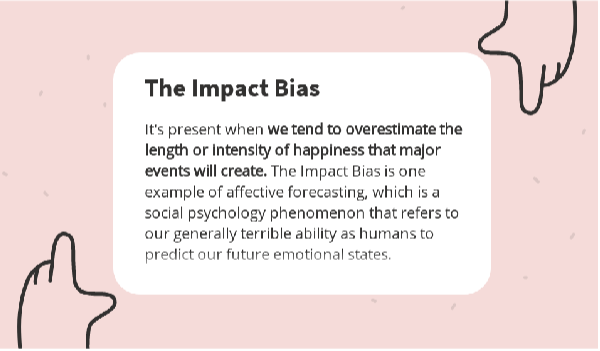
Impact Bias
Overestimating the enduring impact of emotional events.
Holiday on idyllic island does not make one completely happy.
Losing your job does not lead to feeling miserable for years to come.
Buying a new car will not bring the happiness that was anticipated.
Wilson and Gilbert (2005): overestimating duration and intensity of forecasted pleasure can lead to ill-advised decisions (e.g., expensive cars, cosmetic surgery).
Affective Forecastung
Predicting our emotions and how we will feel!
How will we feel after an emotion-arousing experience in the future?
Difficult to predict itensity and duration of future emotion.
By focusing on one event (e.g., holdiay, losing job), the influence of other factors is discounted
‘One thing vs Everything else.’
We are unaware of most of our mental processes.
We only become aware of the results.
The mental processes that control our social behaviour are distinct from the mental processes used to explain behaviour (Wilson, 1977)
Attitudes expressed consciously predict future behaviour reasonably well: how happy couples were with their relationship predicted whether they would still be together several months later.
Attitudes less predictive if participants first analysed their feelings:
Couples listed reasons why their relationship was good or bad .
Ratings of happiness no longer predicted whether they would still be together in several months.
Recent issue with self-esteem
“Warning over youth career….
Self-esteem
A person’s overall positive and negative self-evaluation or sense of self-worth, subjective appraisal of our self.
Bottom-up view: self-esteem is sum of self-schemas and possible selves (I am attractive, clever, popular, I will be successful):
Depends on domains that are important: looks, intelligence, social functioning.
Top-down view (Brown & Dutton, 1994): self esteem not only sum of self-schemas, but self-schemas are also influenced by self-esteem:
People with high self-esteem also have positive self-schemas; they are also likely to value their looks, abilities, intelligence.
Main….
Chapter notes