ATOMIC STRUCTURE AND THE PERIODIC TABLE
Atoms, elements and compounds
Atoms make up everything and have a radius of around 0.1 nanometres (1 × 10⁻¹m)
Neutrons have a relative mass of 1, and no charge
Protons have a relative mass of 1, and a positive 1 charge
Electrons have a very small mass, and a charge of negative 1
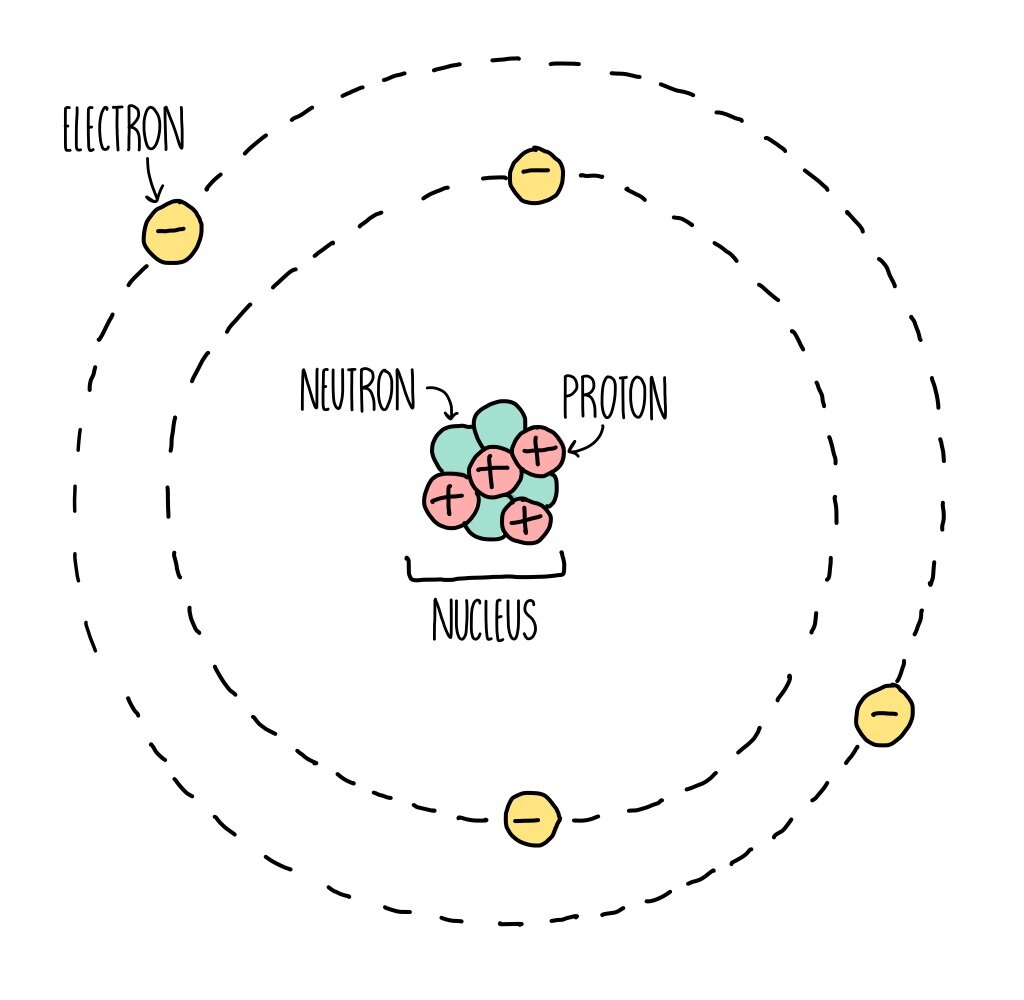
Elements are different types of atoms, and are shown on the periodic table

An isotope is an element with the same number of protons, but different numbers of neutrons, so therefore different mass numbers
Relative atomic mass of an element’s isotopes = the sum of(isotope abundance x mass) / sum of percentage of all isotopes
Should be divided by 100 if all isotopes are present
Compounds are two or more different elements that are chemically bonded
H2O or CO2, but not O2 OR Cl2
Elements in compounds are always found in the same proportions
Molecules
Molecules are two or more atoms chemically bonded
For example, O2 and CO2 are both molecules
Electronic structure
The first shell of an atom has 2 electrons, then 8 electrons and then 8 electrons (2,8,8)
The group number tells you the number of electrons an element has in it’s outer shell
The number of shells an element has is the same as the number of shells it has
The size and mass of atoms
Atoms have a radius of around 1 × 10⁻¹⁰ m, or 0.1 nanometres
Their mass is made of the total number of neutrons and protons
Development of the model of the atom
Democritus - Atomic theory
In 500 B.C
Everything is made up of tiny indestructible particles, with empty space between
John Dalton - In the 1800’s
Everything is made up of ‘solid spheres’
Different types of spheres are different elements
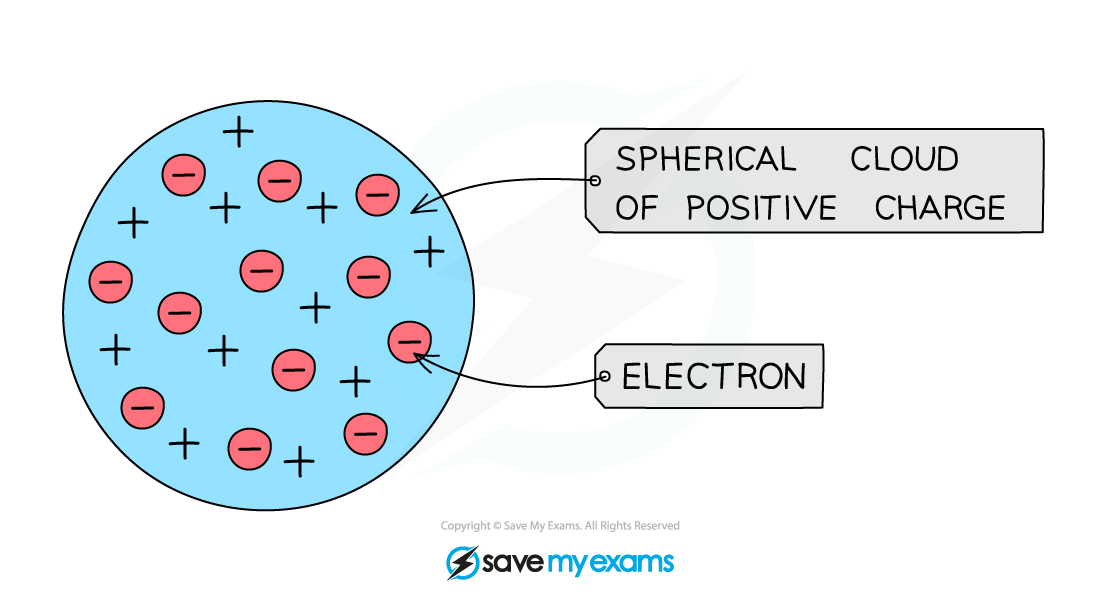
JJ Thompson - The plum pudding model
In 1897
He found that atoms couldn’t be solid spheres and that most contained charged particles
He thought the atom was a ball of positive charge with discrete negative particles embedded in it
Ernest Rutherford - Alpha scattering experiment
In 1909
He fired positive alpha particles at a thin sheet of gold
If the positive mass was spread out, like in the plum pudding model, all the particles should pass through as the positive charge is not dense enough to repel
However, not all of the particles did and some were deflected
This showed that there was a concentrated positive nucleus - the nuclear model

Niels Bohr - In 1913
He suggested that electrons orbit the nucleus in shells, which prevents the atom from collapsing like in Rutherford’s model (1909)

Rutherford - In 1913
He suggested that the nucleus in made up of small discrete particles, called protons, and wasn’t just a cloud of charge
James Chadwick - In 1932
He found that the nucleus contained neutrons with mass
The periodic table
The periodic table was created by Dimitri Mendeleev in the mid 19th century
He left spaces to predict new, undiscovered elements
Columns are called group and have similar chemical properties and have the same number of electrons in the outer shell
Rows are called periods and shows the number of shells an element has
The development of the periodic table
Before Dimitri Mendeleev, neutron and proton scientists tried to classify their discoveries in order of atomic weights
They were incomplete, and the groups were often inaccurate
Dimitri Mendeleev made the periodic table in 1869, and he predicted new elements and left spaces in his table
He included elements mass number, element symbol and atomic number in his table
He made groups with similar chemical properties, with the same number of electrons in the outer shell
Metals and non-metals
Metals are found on the left side of the periodic table
They form positive ions - they lose electrons
The fewer electrons they have in their outer shells, the easier they are lost
They get more reactive the further down the table you go
This is because they have more shells, so the outer shell electrons have little attraction to the nucleus and are lost easily
Metals metallically bond so are very strong
They are malleable, conductors of electricity and heat
They have high melting and boiling points, and they are shiny and sonorous
Non-metals are found on the right side of the periodic table
They form negative ions, or none at all
Non-metals have lower densities than metals, are brittle and dull in colour
They don’t conduct and have low melting and boiling points
The transition metals have typical metal properties
They can form more than one ion
For example, iron (II) and iron (III)
They also form good catalysts
Group 1 - The alkali metals
The group 1 elements are lithium, sodium, potassium, rubidium, caesium and francium
Their properties include:
Soft, low densities and low melting points, which are different to other metals
They get more reactive down the group
Their melting and boiling points decrease down the group
They have one electron in their outer shells, which can be lost mor easily the further down the group as the are more shell
They are further from the nucleus, so less attraction as there is a further distance between
They are almost always found as ionic compounds
With electrostatic forces between non-metal and alkali metals
Alkali metals and water react vigorously to form metal hydroxide and hydrogen gas
Alkali metals and chlorine gas react to form metal chloride salt
Na + Cl NaCl (salt)
Alkali metals and oxygen react to form metal oxides
Lithium and oxygen react to form lithium oxide
Sodium and oxygen react to for sodium oxide OR sodium peroxide
Potassium and oxygen react to form potassium peroxide OR potassium superoxide
Group 7 - The halogens
All of the halogens are a bit dangerous ☹
They all exist as diatomic molecules
Make covalent bonds to gain a full outer shell, like chlorine
They can form covalent bonds with other non-metals as well
Properties and trends of the halogens:
Their melting and boiling points increase down the group
Their reactivity decreases down the group as the more shells there are, the weaker forces of attraction there is from the nucleus to gain more electrons
They form negative 1 ions with metals
Their name changes to end in -ide, like chloride or fluoride
In displacement reactions, a more reactive element can displace another element that is less reactive
Cl2 + 2KBr Br2 + 2KCl - bromide is displaced by chlorine
The more reactive element will always displace the less reactive one
Group 0 - The noble gases
The noble gases exist as colourless gases
They are all unreactive and have a full outer shell
They exist as singular atoms
They are non-flammable
Their boiling points increase down the group
The transition metals
The transition metals are found in the middle of the periodic table (between groups 2 and 3)
Their properties in comparison to group 1
They both conduct electricity
They are both shiny
They have higher melting and boiling points
They have higher densities and are stronger and harder than the alkali metals
They have slow or non-existent reactions with oxygen, water and the halogens
They react vigorously with group 1
They make good catalysts
DONE!!!