Allosteric Applications
Definition of Binding Sites:
Orthosteric Binding Site: The primary binding site on a receptor where the endogenous ligand (e.g., a hormone or neurotransmitter) naturally binds. An example provided is the Epidermal Growth Factor (EGF) binding to the EGF receptor (EGFR) at its orthosteric site. These sites are often critical for the direct effects of drugs, as they typically represent the way the body naturally activates a receptor. Think of it as a key fitting into a lock.
Allosteric Binding Site: A distinct, separate site on the receptor protein where a molecule can bind to modulate the receptor's activity. The term "allosteric" is derived from the Greek words allo () and stereos (). This is similar to the prefix usage in terms like "allograft." The allosteric site is like another lock on the same door that doesn't open it directly but can change how the door functions or how easy it is to open the main lock.
Function of Allosteric Modulators:
These molecules can influence the effects of agonists or antagonists on a target protein. Agonists are compounds that activate receptors, while antagonists block them. Allosteric modulators provide a nuanced way to balance these actions.
Almost all receptors exist in multiple conformations, typically categorized as an active conformation (the receptor is turned on and doing its job) or an inactive conformation (the receptor is turned off). This means that receptors can switch back and forth between states, much like flipping a light switch.
Agonists: Traditionally favor and stabilize the active conformation. When an agonist binds, it promotes the receptor to stay in its active state, ensuring that the intended effects occur (like turning on a light).
Allosteric Modulators: Drive conformational changes from separate binding sites, which can either promote or inhibit the transition between active and inactive states. Although the allosteric site is separate from the orthosteric site, the two sites can influence each other through protein conformational shifts. This interconnectedness means that allosteric modulators can fine-tune the receptor's activity without directly activating it themselves.
Major Models of Allosterism
The Concerted Model (Monod-Wyman-Changeux or MWC Model):
History: Developed by Monod, Wyman, and Changeux; it was the first model, largely based on observations of oligomeric ion channels. These channels are proteins that form a pore to allow ions to pass in and out of cells.
Mechanism: This model applies to homomultimeric proteins (e.g., dimers, trimers, tetramers). It assumes a conformational change at one subunit from the "tense" () state to the "relaxed" () state. Imagine a stable team of four players who can only play well if they are all in sync.
Key Feature: The change is concerted, meaning all subunits in the oligomer must exist in the same state simultaneously ( or ). In a tetrameric molecule, all four subunits must be either all or all . There is unity in action, which ensures the receptor functions optimally or not at all.
Equilibrium: There is a natural equilibrium between the and forms. Allosteric modulators work by shifting this equilibrium. When a drug binds, it cannot convert only one monomer; it converts the entire complex or has no effect. Think of it like a group of friends deciding where to go — everyone needs to agree, or they don’t move.
The Sequential Model (Koshland-Nemethy-Filmer or KNF Model):
Alternative Names: Also known as the Induced Fit or Lock and Key model. This emphasizes how molecules shape-fit onto receptors.
Mechanism: When a ligand binds to a single subunit, a conformational change occurs in that specific subunit. This can signal others in the group to follow suit.
Key Feature: Not all subunits are required to change at once. One subunit can be in the state while its neighbors remain in the state. This allows for a broader range of functional states within the receptor, much like having different team players perform their roles while one leads.
Neighboring Effects: The change in one subunit can alter the interactions between subunits, favoring a change in adjacent subunits and increasing the probability of them transitioning, though it does not mandate it. This allows for intermediate mixtures of states within a single oligomer (e.g., a tetramer with three and one subunit). The neighbors communicate, leading to a team that can adapt based on a leader’s actions.
Pharmacological Interpretations of States:
In abstract terms, receptors move between and states. In an ion channel, this corresponds to the open or closed state. An open state allows substances to pass through, while a closed state blocks passage.
In an enzyme, this corresponds to an active or inactive state. An active enzyme catalyzes reactions, while an inactive enzyme cannot perform its function.
Specific Types of Allosteric Regulation
Positive and Negative Modulators:
Positive Allosteric Modulator (PAM): An activating modulator that stabilizes the active state or increases the affinity of the receptor for its ligand. This means it helps the receptor work better and respond more vigorously to signals.
Negative Allosteric Modulator (NAM): A modulator that stabilizes the inactive state or decreases affinity. This means it dampens the response, reducing the receptor's activity.
Cooperativity:
Positive Cooperativity: Binding of a ligand to one site increases the affinity or avidity for subsequent ligands at other sites. Example: Hemoglobin (the protein that carries oxygen in our blood), which has oxygen binding sites. When one oxygen molecule binds, it makes it easier for more oxygen to bind, illustrating how teamwork enhances performance.
Negative Cooperativity: Binding of the first ligand decreases the affinity for the second ligand. This is like playing on a team where one player going for the ball makes it harder for others to get in the play.
Advantages of Allosteric Drugs vs. Orthosteric Drugs
Lack of Competition: Allosteric modulators do not compete with the endogenous orthosteric ligand. For example, an estrogen receptor antagonist must outcompete circulating estrogen. An allosteric ligand can block receptor function regardless of estrogen concentration because it binds a different site. This is like a guest getting into a party through a side door rather than competing with everyone entering through the main entrance.
"Drug-likeness": Many orthosteric ligands are proteins or peptides (e.g., insulin). Peptides are unstable, susceptible to proteases, and usually require injection. Small molecule allosteric modulators can be designed to be more stable, orally available, and metabolically robust (e.g., pill form). This opens a door for more accessible medications for patients.
Isoform Selectivity: Orthosteric sites are often evolutionarily conserved among related receptors (e.g., adrenergic receptors like and ). Allosteric sites are less conserved, making it easier to design drugs that target specific receptor isoforms. This means that drug developers can create medicines that work well without affecting other similar receptors, reducing side effects.
Safety and Endogenous Control: Some allosteric modulators are only active in the presence of the endogenous ligand. They amplify or dampen the natural signal (timing and amplitude), which preserves the body's natural pulsatile signaling. It’s like using the dimmer switch on a light — adjusting the brightness without turning it off completely.
Avoidance of Desensitization: Chronic pharmaceutical administration of orthosteric agonists can lead to desensitization (e.g., hormones for prostate cancer reducing testosterone production by turning off the signal). Allosteric modulators might avoid this by preserving natural signaling patterns, giving the body a balance between activation and rest.
Partial Modulation: Allosteric modulators can be designed to produce a "partial" effect (e.g., 20\text{\text{%}} activation), which may be safer than the toxicity associated with 100\text{\text{%}} activation or total inactivation. This allows for fine-tuning of receptor activity, reducing the risk of unwanted side effects.
Patentability and Marketability: Orthosteric sites for many receptors have been studied for decades. Developing a new allosteric drug provides a pathway for new patents and potentially superior products compared to existing orthosteric treatments. This can lead to more innovative therapies becoming available to patients.
Case Study: G Protein-Coupled Receptors (GPCRs)
Modes of GPCR Allosteric Modulation (Linsley et al., 2009):
Affinity Modulation: Shifts the concentration-binding curve to the left (higher potency) without changing maximum efficacy. This allows for more effective treatment with lower doses.
Efficacy Modulation: Shifts the response curve upward, increasing the maximum response (efficacy) without necessarily changing potency. This means the drug’s effects can be amplified.
Allosteric Agonism: The allosteric ligand produces a response on its own in the absence of the orthosteric agonist. This is significant because it showcases how allosteric modulators can act independently under certain conditions.
Structure: GPCRs are -transmembrane receptors with various clefts and crevices between helices that serve as potential allosteric binding sites. This complex structure allows for diverse interactions and functional states.
Biased Ligands:
Normally, a GPCR agonist triggers multiple pathways (e.g., the Adenylate Cyclase/cAMP/PKA pathway and the Beta-Arrestin/GRK/ERK signaling pathway).
Biased Agonist: A molecule designed to preferentially activate one downstream response over another. This targeted approach can be advantageous, as it allows for selectivity in treatment with potentially fewer side effects.
Application: In heart failure, it may be beneficial to activate one pathway while avoiding the other to improve long-term outcomes. This specificity can lead to better therapeutic strategies.
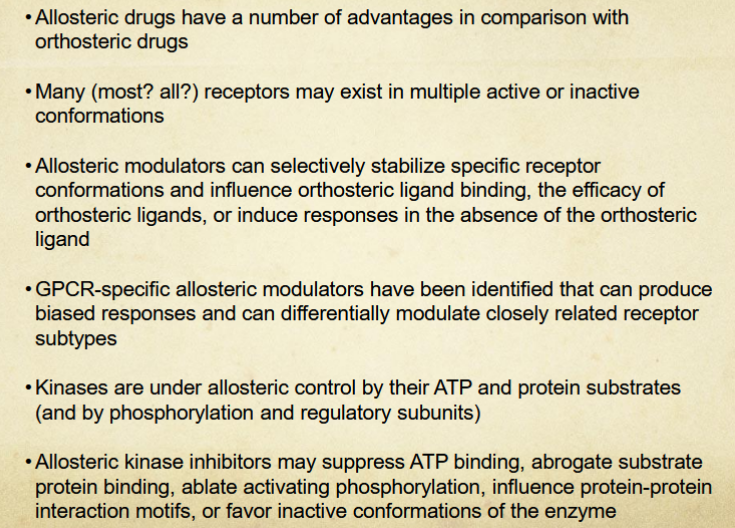
Allostery allows multiple signaling responses from a single receptor
Some allosteric modulators can selectively influence receptor responses (signaling out-puts) differentially
One receptor’s orthosteric ligand may be another receptor’s allosteric ligand and vice versa
It is possible to identify allosteric modulator for specific receptor subtypes
This may reduce toxicity by allowing drug action in a tissue-specific manner
Allosteric Regulation in Protein Kinases
Thermodynamics and Gibbs Free Energy:
Proteins seek the lowest energy state (the bottom of a "well" in energy traces). Much like people prefer the most comfortable chair at a party, proteins prefer their most stable state.
Apo Form: The free kinase (nothing bound) is most stable in the open (inactive) confirmation. This stage represents a form where the protein is not currently engaged in its job, akin to a closed toolbox that isn’t being used yet.
ATP-Bound: Shifts the energy profile toward an intermediate stability state. Binding ATP can get the protein prime and ready to work.
Substrate-Bound: Also favors an intermediate state. When molecules that the enzyme acts on (substrates) bind, it also prepares the protein for activity.
ATP + Substrate Bound: When both are present, the closed (active) conformation becomes the lowest energy state. This ensures the enzyme is only active when both substrates are positioned for phosphate transfer, ensuring efficiency and precision in reactions.
Kinase Inhibitors:
ATP-Competitive Inhibitors: Bind where ATP normally binds (orthosteric site). These inhibitors compete directly with ATP for the same space.
Allosteric Inhibitors: Bind a separate site, often inducing a conformational change that indirectly blocks ATP or protein substrate binding. Some bind to separate domains, such as the pH domain in AKT kinases, preventing activation. This flexibility in how inhibitors work allows for varied therapeutic approaches.
The RAF Kinase Dimerization Issue:
RAF kinase is a homodimer following the concerted (MWC) model. Its function relies on its ability to exist in an active or inactive state based on its dimerization.
Kinases have a "switch" called the DFG motif. DFG-out is the active state, and DFG-in is the inactive state. This