PSY 4521: Control and Stress
Perceived Control
How can we help people deal more effectively with stressors?
Research that has focused on psychosocial factors that can be changed.
Perceived control
Social support
Coping strategies
Different aspects of perceived control and how they are related to mental health outcomes
General locus of control
Event-specific control perceptions
Temporal model of control
Past control
Present control
Future control
General Locus of Control (Julian Rotter)
General Locus of Control: Personality trait; Extent to which people believe they generally can control events in their lives.
Two Dimensions of Control
Internal locus of control: You make things happen.
Pearlin Mastery Scale: “I can do just about anything I really set my mind to. “ and “What happens to me in the future mostly depends on me.”
External locus of control: Things happen to you.
Pearlin Mastery Scale: “There is really no way I can solve some of the problems I have.” and “Sometimes I feel that I’m being pushed around in life.”
Examples Items from Rotter’s
People’s misfortunes result form the mistakes they make.
One of the major reasons why we have wars is because people don’t take enough interest in politics.
Rotter’s theory has been very influential
"Few if any concepts in psychological theory, research, and practice have had such a widespread influence as the concept of perceived control.”
Internal Locus of Control is Associated with Better Physical and Mental Health
Mental Health: Less depression and anxiety; higher self-esteem
Physical Health: Better self-reported health, fewer and less severe physical symptoms, faster recovery from illness, better physical functioning, and more likely to engage in health-promoting behaviors.
Perceived Control, Trauma, and Mortality Risk Study
Elliot et al. (2018) Study
Sample: 5,000 US adults age 25-74
Measures: Internal LOC (mastery), external LOC (constraints), lifetime trauma history (ACEs and Criterion A), whether they had died within 10 years (based on death records).
Data collected in 2005 and 2015
Results: Perceived control (and trauma) associated with higher mortality risk over a 10 year period
Internal LOC: Associated with lower risk of death.
Buffers the effects of trauma exposure on mortality risk.
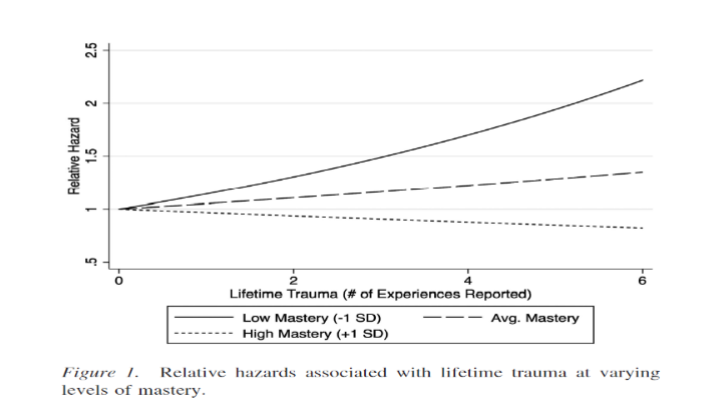
External LOC: Associated with higher risk of death.
Greater lifetime trauma exposure
Associated with higher risk of death.
General locus of control is not the same as event-specific control beliefs.
General locus of control is a personality trait
Event-specific control refers to perception about whether a specific event is controllable
Even someone with an internal locus of control will perceive some events as uncontrollable (like someone else dying).
Event-specific beliefs tend to be more related to important outcomes than general control beliefs.
Summary: Different aspects of perceived control and how they are related to different outcomes
General Locus of Control
General personality trait
Two dimensions: Internal vs. External
Internal locus of control is associated with better physical and mental health and buffers the effect of trauma exposure on mortality risk.
Event-specific control tends to be more related than general locus of control to outcomes (like mental health).
Event-Specific Control Beliefs in Sexual Assault Survivors
Sexual assault is a common - and very distressing - event but beliefs and how they are related to adjustment may differ across events.
Reviewed broader literature on control and adjustment to stressors to examine this issue.
Temporal Aspects of Event-Specific Control
Past Control: Focusing on past and why event happened.
“Could I have prevented this?
Future Control: Focusing on preventing event from happening again.
“Can I keep this from happening again?
Present Control: Focusing on what you can do about event in the present.
Control over illness symptoms
Control over medical care and treatment
Control over the recovery process
Different Forms of Control Seemed to Have Different Relations with Distress
Past Control: Unassociated or positively associated with distress.
Contrary to assumption in literature that controllable events are less distressing.
Traumas generally aren’t controllable.
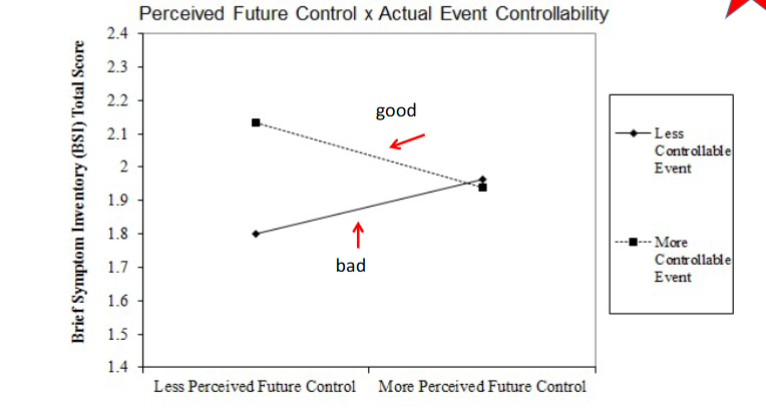
Future Control: Evidence mixed
May depend on actual controllability.
Present Control: Consistently related to less distress.
More strongly related to less distress than other types of control.
Needed to Develop Measure of Temporal Control Constructs
No standard measure that could be used to assess perceived past, present, and future control across events.
Existing measures often combined past, present, and future control.
Were event-specific (e.g., to illness)
Needed measure to assess efficacy of interventions to increase present control.
Perceived Control Over Stressful Events Scale
Past Control: I could have done something to prevent this event from happening.
Present Control: I have control over my day-to-day reactions to this event.
Future Control: There is nothing I can do to prevent a similar event from happening again.
Only present control is related to less event-related distress.
Present control is related to general internal locus of control.
Present control more important than general control beliefs in predicting distress.
Present control predicts distress beyond other known predictors
Present control predicts (lower) distress beyond
General perceptions of control
Approach and avoidant coping strategies
Number of lifetime traumas
Social support
Neuroticism
Present control has the strongest relations with (less) distress
It is one of the only factors associated with better adjustment.
Temporal Model: Past Control
Data does not support idea that controllable events are less distressing.
Most human traumas are not controllable.
Focusing on how events could have been controlled/prevented in past either unrelated to distress or associated with more distress.
Temporal Model: Present Control
One way to maintain a sense of control in the face of trauma is to focus on what we can actually control.
How we react to the event, how we think and feel about it.
Present control is consistently related to better adjustment with medium to large effects.
Controlling for several other important factors, including general control beliefs.
Few other factors are associated with better adjustment.
Unhelpful support more strongly associated with more distress than helpful support is associated with less distress.
Temporal Model: Future Control
For uncontrollable events, future control generally associated with more distress.
Trying to control things that are not really controllable (another’s death)
Future control may be more adaptive for events that are more controllable.
Future control over upcoming exam associated with better subsequent exam grades.
Across events, future control beliefs are good if event is controllable; bad if event is uncontrollable.
Perceived Control Interventions
Different Forms of Control are Differentially Related to Distress
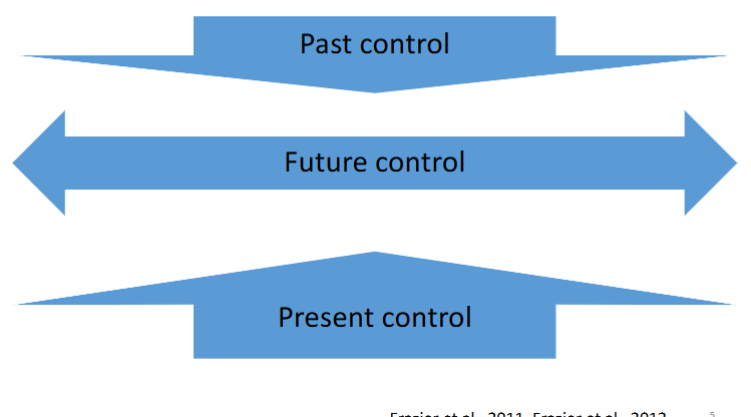
Focusing on what we can actually control is most helpful
How we react to the event, how we think and feel about it.
More strongly related to better adjustment than several other factors
Social support, coping, general control beliefs, neuroticism, prior trauma history.
How can we teach people to focus on the present and what they can control?
Reasons for using online format
Can be done in private
Reduce stigma
Convenient
Can be done at any time
Cost effective
We created ours for free
Increase access
No waiting lists
Skills-based online interventions are effective for improving college student mental health
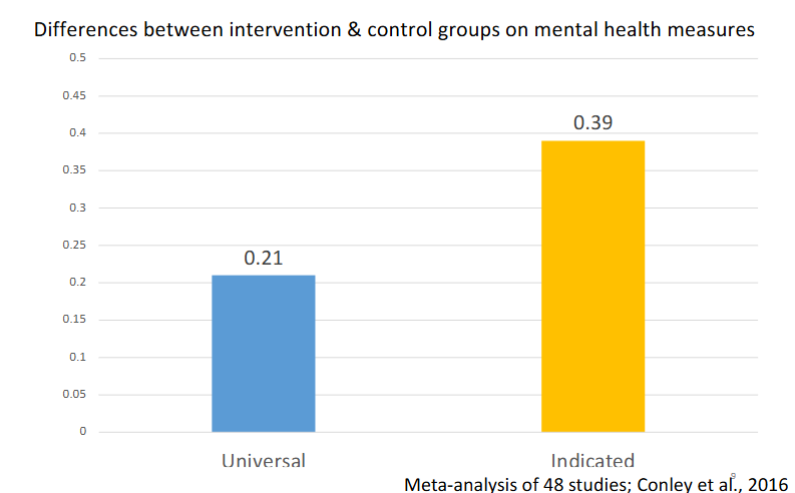
Internet-delivered Cognitive Behavioral Therapy (CBT) as effective as face-to-face CBT
Rationale for Present Control Intervention
Practical need for tools to help students manage stress.
Scientific reasons
Present control is correlated with less stress, anxiety, depression.
Need to take an experimental approach to show causation.
Perceived Control Intervention
Designed to take one hour broken up in several discrete modules
Structured modules contained expert videos, student examples, and application exercises.
Module Topics
Module 1: Stress and its effects
Social persuasion
Module 2: Different aspects of control and benefits of present control.
Vicarious experiences
Module 3: Problem solving around focusing on present control.
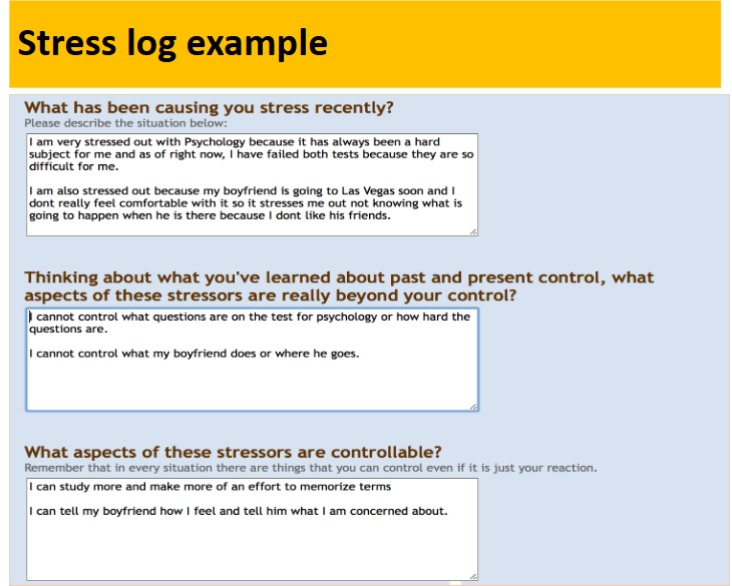
Stress/control logs (n = 3)
What has been causing you stress?
What aspects of these stressors are out of your control?
Subsequent logs:
Thinking about what actions you listed last time, which have you been able to do?
What has changed about the stressor as a result of the action you’ve taken?
Design of First Randomized Controlled Trial (RCT): Spring 2012
Hintz, Frazier, & Meredith, 2015
Sample: 233 UMN psychology students
Selected those on the < 3 on present control scale (indicated intervention)
Randomized to 1 of 3 conditions:
Present Control Intervention (n = 77)
Present Control with Feedback (n = 79)
Stress module (1) only (n = 77)
Pre-intervention, post-intervention, and 3 week follow-up assessments
Results:
Intervention groups report greater increases in present control
Intervention groups reported less perceived stress and fewer stress symptoms
Intervention groups reported fewer anxiety symptoms and fewer depressive symptoms.
Small to moderate between-group effect sizes at 3-week follow-up (interventions decrease distress more than control group).
Responses from Sample
What has changed about the stressor as a result of the action you’ve taken?
I have less work to do now because I was proactive and started going at it instead of freaking out about how much there was.
I’ve started to take things less personally and realized that I can only do so much to make him (boyfriend) happy.
Does present control intervention work for students with a trauma history?
Background: In a multisite study of college students, interpersonal violence (IPV) (e.g., family violence, sexual assault) was the only category of lifetime trauma associated with more current distress (Frazier et al., 2009).
Research Question: Would our intervention be effective for this at-risk group?
Sample: 512 UMN PSY 1001 students; not preselected to be low in present control (universal)
Conditions: Randomized to 1 of 2 conditions at beginning of semester.
Present control intervention (n = 335)
6 stress logs (vs. 3)
Waitlist
Pre- and post-intervention measures
Present control over stressful events scale (PCOSES)
Perceived stress scale (PSS)
Depression, anxiety, and stress scale (DASS-21)
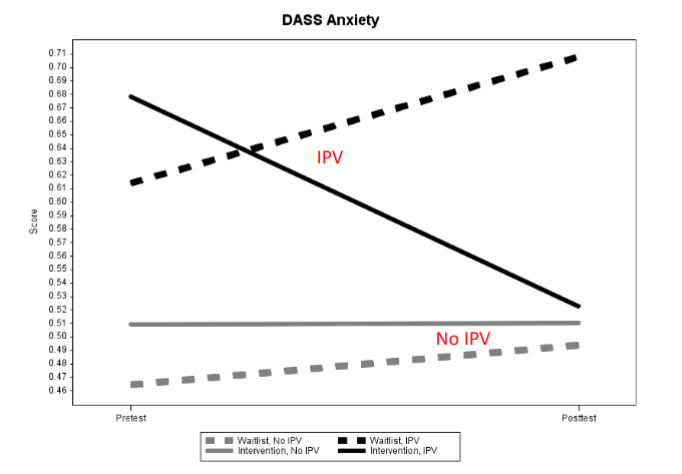
Results: IPV was common and related to higher distress
39% of the sample had a history of IPV
Witnessing family violence
Sexual assault
Unwanted sexual attention
At baseline, students with a history of IPV reported more:
Depression, anxiety, stress symptoms, perceived stress and rumination
Not less present control
Intervention was more effective for students with IPV history
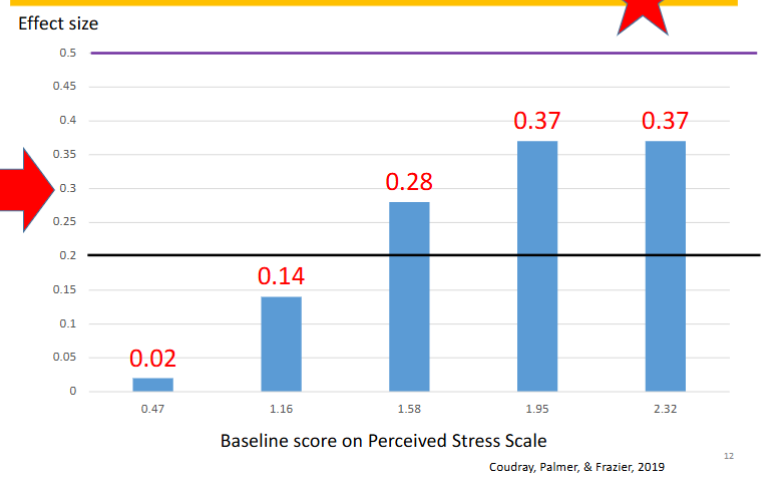
Do you need a certain level of distress to benefit from the intervention?:
Intervention more effective for those who were more stressed at baseline
Does intervention work as a mobile app (vs. web-based program)?
Study: Ecological momentary intervention (EMI) study
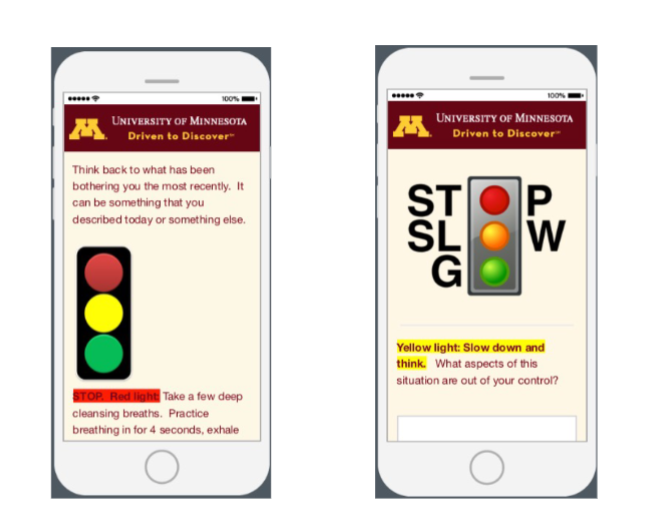
Background: Intervention done on Smartphone (vs. web)
Two brief videos re: present control and mindfulness skills
Present control/mindfulness exercises 3X/week for 2 weeks
Daily reminders to use skills
Daily motivational messages
Additional skills on app
Twice daily brief surveys on stressors
Comparison Group
One brief psychoeducational video on stress
Twice daily brief surveys on stressors
Results:
Much smaller within-group effect sizes in app (phone) vs. web-based version of intervention for general student population
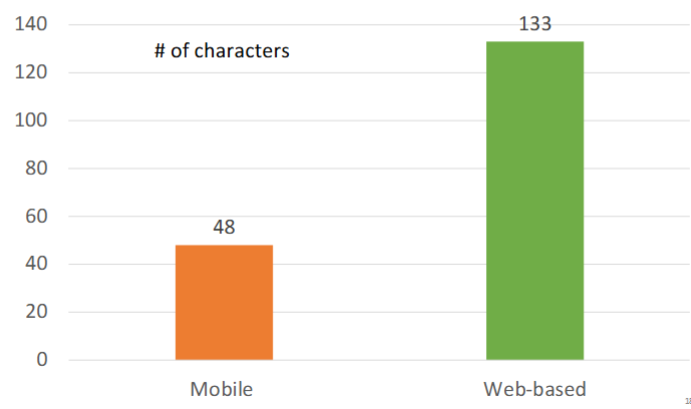
Participants who did mobile app intervention wrote 1/3 as much as those who did web-based version.
Module 4: Moving forward
What intervention is most effective?
Students with trauma histories
Students who are more distressed
What does not work
Completing it on a phone (vs. computer)
Perceived Control Intervention During COVID
More UMN students reported moderate to severe stress symptoms during pandemic vs. pre-pandemic.
Control What You Can (CWYC) Intervention Format
Focus on what you can control exercise
For each current stressor, what aspects of it are outside of your control?
What aspects of each stressor can you control? In every situation, there are things you can control even if it is only your reaction.
Looking at the things you can control, list the specific actions you can take. If you have several action items, it may be helpful to prioritize them.
Think about the actions you listed on your last exercise. Which of those have you been able to do?
What has changed about the stressor as a result of the action you’ve taken?
Reminder: You can control, remind yourself that you have a plan for dealing with them.
You can’t control, remind yourself that worry won’t change the situation.
CDC Stress Management Recommendations
Take breaks from watching, reading, or listening to new stories, including social media.
Take care of your body
Take deep breaths, stretch, or meditate
Try to eat healthy, well-balanced meals
Exercise regularly
Get plenty of sleep
Avoid alcohol and drugs
Make time to unwind.
Connect with others.
Spring, Summer, and Fall 2020 Intervention Study
Sample: 775 students in Psychology classes (REP)
Design:
Spring: Randomly assigned to CWYC or CDC intervention.
Summer: Randomly assigned to CWYC vs. waitlist
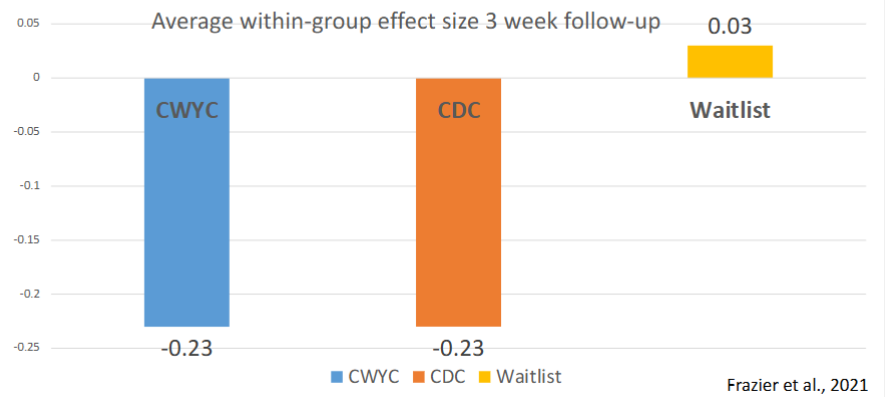
Fall: Randomly assigned to CWYC, CDC, or waitlist
Measures (Pre and post intervention; 3 week follow-up in Fall):
Perceived stress; depression, anxiety, stress symptom scale; boredom; pandemic related stressors.
Results:
Both CWYC and CDC interventions reduced symptoms more than being on waitlist (which tended to get worse)
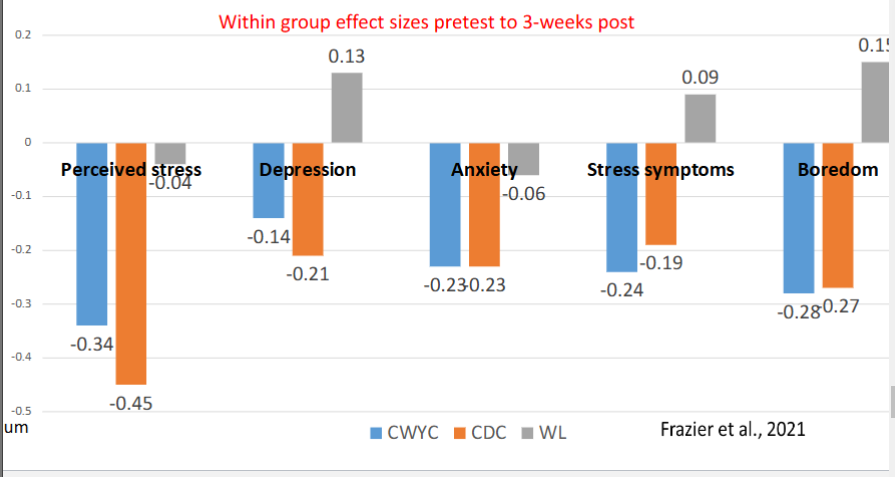
CWYC and CDC interventions equally effective and better than no intervention (waitlist)