POL 261 Notes
Foundations and Four Frames of Public Administration
Definition: Public administration encompasses the work performed within government and public service, lacking a single definition due to its complex, interdisciplinary nature.
Four Frames:
Political Frame: Focuses on government in action, implementing public policy, and taking collective action in the public interest.
Legal Frame: Centers on the execution of public law, statutory authority, and regulatory frameworks governing administrative actions.
Managerial Frame: Highlights the executive function of government, managing programs and organizations, translating policy into action, and tracking outcomes.
Occupational Frame: Encompasses diverse professions carrying out public functions, including engineering, planning, law, ethics, social services, and public safety.
Interdisciplinary Nature: Integrates multiple fields, including economics, management, political science, sociology, psychology, engineering, and health.
Key Historical Foundations and Theoretical Perspectives
Historical Scope: Public administration is both ancient (as old as organized government, such as grain management in ancient Egypt) and young (emerging as an academic field in the 20th century).
Leonard White (1926): Authored the first public administration textbook, Introduction to the Study of Public Administration, based on four key assumptions:
Administration is a unitary process studied uniformly at federal, state, and local levels.
The primary basis of study is management, not law.
Administration is an art with the potential to transform into a science.
Administration is central to the core challenges of modern government.
Frederick Mosher: Outlined the evolution of civil service, moving from early "government by gentlemen" (e.g., Benjamin Franklin serving as Postmaster) toward professionalized civil service with distinctions between political appointees and career public servants.
Modern Era and Intergovernmental Relations
Modern Era Context: Spans from the 1960s to the present, driven by significant growth in federal budgets (e.g., space race funding and Vietnam War expansion).
Intergovernmental Dynamics: Involves overlapping roles across federal, state, and local levels, alongside increased delegation of federal tasks to state/local governments, non-profits, and private contractors.
Social Equity and Policy:
Expanded focus during the Civil Rights Era toward social justice, poverty reduction, and environmental sustainability.
Michael Harrington's book The Other America revealed that 25% of Americans lived below the poverty line based on 1959 Census data, shaping Lyndon Johnson's War on Poverty and programs like Head Start.
Environmental Governance: The Environmental Protection Agency (EPA) was created under President Richard Nixon.
Questions & Discussion
Class Composition Survey: Previous section demographics showed that 57% of students in one section and 52% in another were freshmen.
Notes: Modern Policy Implementation/ Political and social environment of public admin 8/31/26
Many levels of government rely on private firms to implement public policy
Implementing private sector work has boomed since the 70s
So while govt may be in charge of providing various services, it doesn’t always do the work itself.
Instead, through contracts and partnerships, governments are able to leverage the expertise and efficiency of private firms, leading to increased innovation and responsiveness in service delivery.
Its not always about the cost
Cities often charge residents for trash collection but the services are done by private corporations: such as Kimbel, Republic, Rumpke, etc.
A decision to go to war is arguably the most important public policy decision made by a government/state.
Although congress has the explicit ability to declare war, the president has implied powers to give military orders/action.
Unhappy with loss in leverage congress passed the war powers act to clarify the respective roles of the president and congress in cases involving the military without official declaration of wars
Street level beauraucrat includes people like police officers
Street level bearaucrats can act as the primary points of contact between government policies and the public, often making critical decisions that affect service delivery and the implementation of laws. They also can interpret public policy different such as police officers giving warnings
These interpretations can lead to variations in how policies are enforced, highlighting the importance of discretion in their roles. Additionally, street-level bureaucrats often face challenges such as limited resources and high demand for services, which can impact their ability to effectively carry out their responsibilities.
Public policy is whatever a government decides to do in response to a political issue
Public policy is hierarchical. This hierarchy can shape the implementation process, as policies are created at higher levels of government and must be translated through various tiers before reaching street-level bureaucrats.
We are provided 3 conceptualizations of executive power
the restricted view maintains that the president governor or mayor is an agent of the legislature and is restricted by it.
The executive prerogative theory holds that under certain circumstances, the president possesses extraordinary powers to safeguard the nation and can go above congress as needed.
The stewardship theory argues that the president is a trustee of the people and can take any action not forbidden by the constitution to act on their behalf.
Public policy in a republic means that it is the sovereign (the people) that makes legitimate policy in a political system
The policymaking process consists of a complex, multi stage set of five actions
Agenda setting, policy decision or non-decision, implementation of a new program or change in an old public program, criticism from citizens and formal program evaluation, and feedback.
Each stage is critical to ensuring that the policies reflect the will of the public and address the needs of society effectively.
Agenda setting is the process by which ideas or issues bubble up through various political channels to wind up for consideration by a political institution such as a legislature or court.
Agendas are often set up by public policy entrepreneurs.
These individuals play a key role in highlighting specific issues, mobilizing support, and framing the discussions around public concerns. By strategically presenting problems, they can influence which topics gain visibility and priority on the policy agenda.
Anthony downs cycle of agenda setting is called the issue attention cycle.
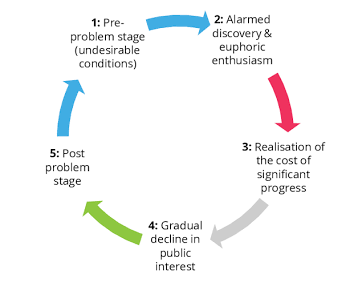
Pre-Problem Stage: Low public awareness despite bad underlying conditions.
Alarmed Discovery & Euphoric Enthusiasm: A sudden peak in public concern and optimism for a fast solution.
Realizing the Cost of Progress: Realization that solutions require high financial or personal sacrifices.
Gradual Decline in Public Interest: Fatigue, discouragement, and attention shifting away.
Post-Problem Stage: A lingering baseline level of interest that occasionally spikes during minor crises.
Notes on Decision Making: 9/2/26
Public policy making is the totality of the process by which the govt decided to deal to not to deal with a particular problem or concern
There are two alternative theories of decision making: Laswells Rational model and Lindbloms incremental model
Laswells rational model: All options and means are considered, Decisions are the product of structured evaluation, Major changes be made on a daily basis decisions should be removed from political pressures decisions are made proactively
Lindbloms Incremental model: Only a few options and means are considered, decisions are the product of negotiated settlements, changes are made gradually over time, political considerations are important in determining outcomes, decisions are made reactively
In addition to these models, it is essential to recognize that real-world public policy often operates in a complex environment, shaped by societal values, interest group pressures, and bureaucratic politics, which can further complicate the decision-making process.
A program evaluation is the systematic examination of activities undertaken by govt to make a determination about their effects both for short and long term
Evaluations can provide critical insights that inform future policy decisions, enhance accountability, and improve the efficiency and effectiveness of public programs. Additionally, integrating both qualitative and quantitative methods in evaluations allows for a comprehensive understanding of program impacts and stakeholder experiences.
the concepts of efficiency and effectiveness are the standard criteria by which programs are evaluated
Garbage can model or organizational choice: This theory posits that decision-making in organizations often resembles a chaotic process where choices are made based on the available options at the moment, rather than through a systematic, comprehensive analysis. It highlights how organizations may settle on satisfactory solutions rather than optimal ones, reflecting real-world complexities in public administration.
Rittel and webber expressed the complexity facing the public administrators as wicked problems.
1. There is no definitive formulation of a wicked problem.
Wicked problems have no stopping rule.
Solutions to wicked problems are not true or false, but good or bad.
There is no immediate or ultimate test of a solution.
Every solution to a wicked problem is a “one-shot operation.”
Wicked problems do not have a well-described set of potential solutions.
Every wicked problem is essentially unique.
A wicked problem can be considered a symptom of another problem.
The choice of explanation determines the nature of the problem and its solution
Social Equity and Voting Rights in Democratic Governance
Definition of Social Equity: Social equity is defined as basic fairness, egalitarianism, the protection of individual rights, and equal treatment in the delivery of public services within a democratic society.
Democratic Context: Public administration in the United States operates fundamentally within a democracy, differentiating it from administrative execution in authoritarian regimes (such as Russia). Social equity is central to maintaining democratic legitimacy, responsiveness, and public trust.
Equitable Access to Voting Rights: Voting rights are fundamental to democratic functionality because who votes dictates elected leadership, shaping public policy and the legitimacy of representative governance.
Voter Disenfranchisement:
Disenfranchisement occurs when eligible citizens are prohibited or legally prevented from participating in elections.
Legal Basis: State laws disenfranchising individuals with felony convictions represent statutory disenfranchisement.
Systemic Impact: Disenfranchisement restricts the political voice and participation of specific populations, blocking the passage of policies designed to level socioeconomic and political playing fields.
Constitutional Amendments Governing Franchise:
Amendment: Granted voting rights to African American men (former slaves).
Amendment: Extended suffrage to women in the early century.
Amendment: Lowered the voting age from to . This change was driven by late and early youth activism during the Vietnam War under the principle that individuals old enough to serve in the military should possess the right to vote.
Historical Barriers to Voting: Poll taxes (which financially excluded low-income populations), literacy tests, and administrative hurdles were historically utilized by state legislatures to restrict voting access for people of color, Native Americans, naturalized immigrants, and poor populations.
Voting Rights Act (VRA) of : Enacted under President Lyndon Baines Johnson to prohibit state and local governments from denying voting access on the basis of race or immutable characteristics (essential, unchangeable individual traits).
Legislative Expansions of the VRA:
Expansion: Extended protections to linguistic minorities who do not speak English as a primary language.
Expansion: Mandated voter accommodations for persons with disabilities, addressing physical access barriers (such as steps at polling places) prior to the passage of the Americans with Disabilities Act.
Motor Voter Act: Allowed citizens to register to vote at motor vehicle departments during driver's license applications or renewals under President Bill Clinton.
Help America Vote Act (HAVA): Set federal minimum administrative standards for states to combat voter disenfranchisement.
Bipartisan History: Three of the four major statutory expansions (, , and ) were enacted under Republican presidential administrations, reflecting a historical bipartisan consensus on protecting voting access.
Modern Contestation and Federal Standards:
Supreme Court Decision: Invalidated core enforcement provisions of the VRA, enabling states to enact stricter voter identification statutes.
Voter Fraud Frequency: Empirical evidence indicates voter fraud in the United States is extremely rare, occurring in less than (under ) of all cast ballots.
John Lewis Voting Rights Advancement Act of : Passed by the House of Representatives to counter state-level voting restrictions.
Freedom to Vote Act (October ): Proposed federal standards for early voting, mail-in voting, voter identification, and voter registration; debate was blocked by Senate Republicans.
Constitutional Allocation: Under the U.S. Constitution, the regulation of voting qualifications, election mechanics, and procedures remains primarily the province of state governments.
Conceptual Foundations and the New Public Administration
Impact of Systemic Crises: Exogenous crises, such as the COVID-19 pandemic, expose overlapping societal equity gaps across racial, economic, gender, healthcare, housing, criminal justice, and education domains.
Unintentional Administrative Inequity: Inequitable outcomes frequently arise from administrative routines established with good intentions rather than explicit discriminatory intent.
Administrative Example: A municipal housing assistance office operating exclusively out of City Hall during standard business hours ( to , Monday through Friday) treats all applicants equally on paper. However, it inadvertently creates equity barriers for working-class citizens who cannot take time off work, lack reliable transportation, or lack childcare to apply in person.
Challenges in Operationalizing Equity:
Public managers from middle-class backgrounds often lack lived experience regarding transportation dependency, childcare shortages, or lower-income operational constraints, leading to blind spots in policy design.
Systemic and historical structural factors reinforce policy inequities across specific sectors unless explicitly re-engineered.
Interdisciplinary and socioeconomically diverse administrative outreach teams (integrating perspectives from social work, urban planning, and criminal justice) improve the identification of administrative barriers.
New Public Administration (NPA) Framework:
Origins: Emerged in the late following the publication of H. George Frederickson's paper, Toward a New Public Administration.
Core Mandate: Elevated social equity alongside efficiency and economy as a central pillar of public administration, incorporating democratic governance theories into administrative practice.
Opposition: Opponents criticized NPA as left-wing radical policy, resulting in limited adoption in immediate administrative practice, though it remains a central touchstone in administrative theory.
NPA vs. New Public Management (NPM): NPA () centers on social equity, democratic governance, and fairness; NPM ( to early century) sits at the opposite pole, focusing on market principles, privatization, and efficiency metrics.
Shift to Group Analysis: NPA moved administrative evaluation beyond individual citizens to focus on structural impacts on groups defined by race, ethnicity, gender, and disability status.
Governance Tensions, Legal Protections, and Employment Equity
Structural Drivers of Governance: Three structural features shape social equity advances and retrenchment in the United States: Constitutionalism, Separation of Powers (across three branches), and Federalism (distributing power across federal, state, and local levels).
Constitutional and Economic Tensions:
A fundamental tension exists between democracy's commitment to freedom and equality (social equity) and capitalism's commitment to private property and wealth accumulation (which generates social inequity).
Adam Smith's Capitalist Theory: -century capitalist theory envisioned free and fair exchanges between buyers and sellers without concentrated market power. Extreme concentration of wealth in a tiny minority threatens democratic governance and deviates from true market exchange principles.
Equity-Efficiency Trade-Off: Public managers face operational trade-offs where an overemphasis on cost-efficiency results in the elimination of social equity considerations.
Constitutional Legacy and Anti-Discrimination Statutes:
The Emancipation Proclamation () and the , , and Amendments abolished slavery and mandated legal equality, but failed to prevent the establishment of Post-Reconstruction Jim Crow laws.
The Civil Rights Act of and the Fair Housing Act of established landmark statutory protections, but systemic racial discrimination persisted in government-assisted housing programs, such as Low-Income Housing Tax Credit (LIHTC) properties.
Equal Employment Opportunity (EEO) vs. Affirmative Action:
Equal Employment Opportunity (EEO):
Initiated under President John F. Kennedy in the early .
Prohibits intentional and unintentional workplace discrimination on the basis of race, color, gender, religion, and national origin.
Statutory amendments subsequently expanded EEO protections to cover age, pregnancy, and disabilities.
- **Affirmative Action**:
- Established in to actively dismantle artificial employment barriers for women and racial minorities within the federal civil service.
- Does not mandate numerical quotas or force the hiring of specific individuals.
- In the , federal courts imposed specific hiring goals, timetables, and compensatory opportunities for underrepresented groups.
- Judicial decisions in the and concerning higher education admissions weakened affirmative action programs across public sector administration.
Representative Bureaucracy and Administrative Case Studies
Theory of Representative Bureaucracy:
Originated in within public administration scholarship.
Asserts that all social groups have a right to participate in governance institutions.
Empirical evidence demonstrates that when a administrative workforce mirrors the demographic diversity (race, ethnicity, gender) of the general population, public agencies are better equipped to communicate, deliver services, and interpret the public interest equitably.
Case Study: Hurricane Katrina: An unrepresentative administrative structure during Hurricane Katrina contributed to severe breakdowns in disaster preparedness, execution, and equitable post-disaster recovery distribution.
Case Study: Ferguson, Missouri ():
Critical Incident: The shooting of Michael Brown, an unarmed African American youth, by a Ferguson police officer triggered widespread civil unrest.
Demographic Imbalance: Ferguson's civilian population was African American, yet the city police force comprised white officers and only Black officers.
Systemic Administrative Disparities: A Department of Justice (DOJ) investigation revealed that African American residents accounted for of traffic stops, of municipal citations, and of all arrests.
Fiscal Exploitation: Municipal court officials and city administrators systematically utilized traffic stops and minor municipal code violations (such as lawn height citations) to raise municipal budget revenues, substituting code enforcement for proper tax policy.
Non-Racial Discrimination, Intersectionality, and Operationalizing Equity
Non-Racial Protections and Disparities:
Sexual Harassment: Unlawful workplace conduct that remains an ongoing administrative and regulatory issue.
Pregnancy Discrimination: Historically legal; in the early , employers routinely questioned job applicants about family planning to screen out female candidates before outlawing the practice under statutory EEO expansions.
Age Discrimination: Statutory protections were passed by Congress in the late to ban employment discrimination against older workers.
Disabilities Discrimination: Applies across physical, mental, and intellectual impairments, regulating accessibility across public accommodations, employment, and housing.
Sexual Orientation Discrimination: As of , at least states enforce statutory protections against employment discrimination based on sexual orientation, leaving workers in states without state-level protections.
Intersectionality: An analytical framework examining how overlapping social identities (such as race, gender, socioeconomic status, and disability) intersect to compound systemic discrimination and institutional equity challenges.
Operationalizing Social Equity in Practice:
Constitutional Role: Public managers run constitutions by coordinating federalism and the separation of powers under the joint authority of executive, legislative, and judicial branches.
Implementation Steps:
Identify and define social inequities explicitly as actionable policy problems.
Connect equity standards directly to administrative ethics across policy formulation, implementation, and evaluation.
- **Four Equity Performance Measures**:

    - **Procedural Fairness**: Uniform, unbiased application of rules and administrative procedures.

    - **Access / Distributional Equity**: Fair physical, financial, and procedural access to public programs and services.

    - **Quality / Process Equity**: Equivalent quality of service and respectful treatment across all recipient groups.

    - **Outcome Equity**: Equitable final results and systemic impacts across diverse demographic groups.
9/21 Notes: Intergovernmental Relations Chapter 5
3 different kind of powers in this chapter
Unitary: Power lies in the national government, no state govt powers
Federal: Power is shared between national and state govts
Confederation: Power with sovereign states
Devolution is something that began in the US under Nixon and accelerated under Reagan
Devolution is when something at the federal level was moved down to the states
This transfer of responsibility has implications for how states manage programs such as healthcare, education, and welfare.
US was originally a loose confederation of independent states that only delegated selected issues to the federal govt
Essential characteristics of a federal system include: written constitution that divides govt powers between central and lower govts, levels of govt exercising power over citizens, and a constitutional distribution of powers that cannot be changed unilaterally by any level of govt or by ordinary process of legislation
9/23 Notes Historical Understandings of Federalism
Dual federalism: Separate govts (No longer exists)
Cooperative federalism: Collaborative relationships
Creative federalism: Federal bypassed states and gave grants to local govts
New federalism: Attempted to return states autonomy, yet retaining a strong central govt
New, new federalism: an attempt at revenue sharing
The following are various concepts that explain intergovernmental management
Picket fence federalism: Bureaucratic specialists interact constantly with each other at all govt and occupational levels.
Council of Govts: Represents any multi jurisdictional units across governments. To provide for water, power, etc.
Cost of compliance: Compliance with mandates from upper levels can be costly and impede smooth IG relations. To address this, Congress passed the unfunded mandate act of 1995, which restricts financial mandates of over 50m dollars on a state govt
Intergovernmental relations (IGR): The collaboration and interactions between different levels of government, particularly state and federal, to address issues that affect multiple jurisdictions.
Fiscal federalism is the focus on financial relationships between units of federalism and suggests that a

Notes for 9/28
Philosophical Origins and Foundations of Administrative Honor
Historical Roots: Western conceptualizations of honor originate in ancient Greece and Rome and continue to serve as a fundamental driver of human conduct.
Relationship Between Honor and Ethics: Honor logically precedes ethics because an individual lacking honor possesses no internal moral compass to distinguish right from wrong.
Personal Integrity: Honor is rooted in personal integrity and honesty, providing a firm internal baseline of core beliefs that dictates conduct regardless of external pressures.
Exemplars of Honor: Public figures, such as the late Senator John McCain, exemplify enduring political and administrative honor by maintaining trustworthiness throughout public service.
Public Obligations and Regime Values
Special Moral Obligations: Public administrators carry explicit, multi-tiered moral responsibilities within a democratic system:
Obligation to Citizens: A direct duty to serve the public interest and the population.
Obligation to Regime Values: A commitment to maintaining core democratic values enshrined in the U.S. Constitution, including individual rights and freedom of the press.
Obligation to Constitutional Structure: A primary commitment to uphold the U.S. Constitution, respect federalism, checks and balances, separation of powers, and the legal reality that local government authority derives entirely from state delegation.
Corruption, Public Trust, and Governance Scandals
Mechanisms of Corruption: Administrative corruption emerges when institutional integrity degrades, taking forms such as bribery, official misconduct, or trading favors for personal gain.
Illustrative Cases and Scandals:
Building Inspections and Safety Code Bribery: Unethical practices include inspectors accepting bribes to overlook safety violations, or public officials bypassing mandatory building inspections (such as New York City Mayor Adams permitting embassy occupancy for a foreign nation, such as India, in exchange for lavish vacations).
Iran-Contra Affair (): Illicit off-the-books operations conducted by the CIA involving arms transactions with Iran to fund South American resistance fighters.
Monica Lewinsky Scandal: Executive ethics violation involving President Bill Clinton's inappropriate relationship with a White House intern.
Blackwater Military Contracting Scandal: Favoritism and bribery surrounding private military defense contractors (mercenaries) hired for government operations.
Impact of Modern Technology: Internet communications and widespread media access accelerate public exposure of administrative scandals, escalating citizen outrage and political demands for administrative reform.
Economic and Political Costs of Public Corruption
Erosion of Systemic Legitimacy: Public corruption severely damages the perceived legitimacy of democratic governance structures.
Electorate Alienation: Systemic corruption fosters political alienation, driving citizens to abandon electoral participation due to perceived powerlessness.
Economic Rights and Transaction Costs: Corrupt practices distort competitive bidding, compromise economic rights, and inflate financial burdens on taxpayers.
Pentagon Toilet Seat Scandal: An audit in the revealed the U.S. Department of Defense paid \\$600 for a single toilet seat that normally cost approximately \\$20.
Ethical Dilemmas: Deception, Truth-Telling, and the "Dirty Hands" Quandary
Forms of Deception: Administrative lying manifests through direct falsehoods, misleading innuendo, and deliberate omissions of critical information.
Theoretical Perspectives on Lying for the Public Good:
Plato: Postulated the concept of the "noble lie," arguing that elite deception can be justified if it serves the broader public good (an early form of "ends justify the means").
Niccolò Machiavelli: Asserted that improper means (such as intentional lying) are justified when they yield stable and effective governance outcomes.
Modern Public Administration Practice: Modern academic and professional training explicitly rejects Machiavellian logic, teaching that bad means are not justified by positive ends.
Administrative Deception Case Study:
Florida COVID-19 Data Suppression: During the COVID-19 pandemic, the State of Florida withheld official mortality data to avoid negative publicity, leading to the public resignation of the state's lead data analyst in protest. This aligns with broader state practices of suppressing administrative data (such as housing unaffordability metrics) that create political embarrassment.
The "Dirty Hands" Dilemma:
A classic ethical paradox in public administration occurring when a public official commits a morally wrong act (e.g., lying or breaching rules) under the justification of advancing a vital public good.
Raises fundamental questions regarding whether intentional administrative misconduct can ever be morally or legally justified.
Notes for 9/30/26
Western thinking about honor dates back to ancient Greece and
Rome, and today remains a core influence on human behavior.
● It is argued that Honor comes before Ethics, because a person
without honor has no moral compass about what is good or bad.
● Honor is a particularly apt choice for a book on public administration
because we need honorable officials to take care of the public
interest.
● Honor begins with personal integrity and honesty- this is important
because those who have integrity have a sure sense of right from
wrong; they know what their core beliefs are, and what they will or
will not do, no matter what the pressure.
● Understand the role of honor and integrity in public administration
for upholding regime values in a democracy
Public administrators have 3 special obligations:
Citizens
• Public administrators have
a special moral obligation to
the people they serve
Regime Values
• Public administrators have
a special obligation to the
regime values of the United
States system of
government
Constitution
• Public administrators have
a primary obligation to
uphold the Constitution of
the United States
Codes of Honor, Conduct and Ethics have their origins in
ancient precepts from all traditions on how individuals should
behave when faced with danger or difficult choices. Many of
the codes are not binding, but dishonor falls on those who
violate them.
• Religious Teachings: Many of the important precepts come to
us from religious teachings, such as The Ten Commandments.
• Civilian Agencies set up their own conduct of ethical behavior.
• Professions establish codes of ethics—e.g., the Hippocratic
Oath in medicine.
• While standards of conduct are always related to a specific
organization, codes of ethics are wide in scope and encompass a
whole profession or occupational category
Chapter 6 Notes
Typology of Ethics and ASPA Professional Standards
Four Kinds of Ethics: Public administration operates across four distinct levels of ethical consideration:
- **Personal Morality**: The foundational moral compass, integrity, and core values of an individual administrator.

- **Professional Ethics**: Code of ethics and professional standards established across an entire occupational category or profession (e.g., the Hippocratic Oath in medicine).

- **Organizational Ethics**: Rules, administrative guidelines, and standards of conduct defined by specific agencies and organizations.

- **Social Ethics**: Broad social obligations and moral principles guiding democratic governance and civic society.
American Society for Public Administration (ASPA) Code of Ethics:
Established in to promote high standards of ethical practice and reinforce public trust in public service.
Eight Core Principles:
Advance the Public Interest: Serve the public interest and prioritize public service above personal self-interest.
Uphold the Constitution and the Law: Respect and support governing constitutions and legal statutes while actively working to improve policies and laws to serve the public good.
Promote Democratic Participation: Inform the citizenry, encourage active civic engagement, operate transparently and responsively, and assist all individuals dealing with public agencies.
Strengthen Social Equity: Treat all people with fairness, justice, and equality; respect individual rights and freedoms; and advance affirmative action and targeted initiatives to mitigate social inequality and injustice.
Fully Inform and Advise: Deliver accurate, honest, comprehensive, and timely advice and information to elected officials, governing boards, appointed leaders, and agency staff.
Demonstrate Personal Integrity: Maintain high standards of personal conduct to foster public confidence and trust in administrative institutions.
Promote Ethical Organizations: Model and advance high standards of ethics, public stewardship, and service quality across public organizations.
Advance Professional Excellence: Strengthen personal competence, uphold professional ethics, and support the ongoing professional development of colleagues.
Whistleblowing Mechanisms and Legal Protections
Definition and Concept: Whistleblowing occurs when a public employee places moral obligations to society above organizational loyalty by calling attention to internal wrongdoing or illegal activities within an agency.
Government Accountability Project (GAP):
A U.S.-based whistleblower protection and advocacy organization.
Identifies four specific methods of blowing the whistle:
Reporting illegal acts or wrongdoing to proper authorities (e.g., an Inspector General, supervisor, or administrative hotline).
Refusing to participate in unlawful workplace conduct.
Presenting testimony in formal legal proceedings.
Disclosing evidence of organizational wrongdoing directly to news media.
Federal Statutory Protections:
Civil Service Reform Act (): Empowered the Merit Systems Protection Board (MSPB) to reverse retaliatory demotions, suspensions, or terminations, and established an Office of Special Counsel to prosecute officials engaging in unlawful retaliation.
Whistleblower Protection Act (): Formally created an independent U.S. Office of Special Counsel outside the MSPB to enforce federal whistleblower protection laws.
Whistleblower Protection Enhancement Act (): Strengthened existing protections by streamlining disciplinary actions against retaliatory supervisors and shifting the burden of proof onto administrative organizations to prove actions taken against whistleblowers were non-retaliatory.
State Protections: Following the federal statutory model, at least states have enacted state-level statutes offering varying degrees of legal protection to whistleblowers.
MSPB Whistleblower Survey Data: Empirical findings outlining factors public employees consider when deciding whether to report employer wrongdoing:
Danger to human life: agreement.
Serious monetary cost to government: agreement.
Belief that corrective action would occur: agreement.
Protection from organizational reprisal: agreement.
Serious ethical violation with small financial cost: agreement.
Assurance of identity confidentiality: agreement.
Guarantee that wrongdoers are punished: agreement.
Positive management recognition for reporting: agreement.
Eligibility for monetary cash awards: agreement.
Institutional Accountability and Democratic Governance
Rule of Law and Separation of Powers: Public administrators in democratic systems operate within the rule of law. Internal accountability is enforced through organizational professional standards, codes of conduct, and constitutional separation of powers providing structural checks and balances.
External Watchdogs: Government transparency and administrative accountability are enforced externally by key monitoring groups:
News media.
Official governmental auditors.
Community and public scrutiny bodies.
Whistleblowers.
Democratic vs. Despotic Public Administration:
Democratic Framework: Features constitutional, legal, and procedural mechanisms that subject public officials to rigorous oversight by independent courts, arm's-length monitoring bodies, and democratic legislative bodies through committee investigations, hearings, and statutory constraints.
Despotic Systems: Lack independent judicial or legislative constraints, allowing unmonitored administrative authority and institutional opacity.
October 7th Notes: Organizational Theory
Theoretical Foundations and Administrative Doctrine
Core Objectives of Organization Theory:
Serves as an analytical and structural design framework for understanding the mechanisms of public and corporate administration.
Traces the historical progression of administrative practices as they formalized into enduring management doctrines.
Evaluates the fundamental distinctions between early classical approaches (such as scientific management) and subsequent paradigms, including neoclassical theory, modern structural theories, systems theory, and network-based collaborative models.
Addresses orthodox administrative ideologies alongside structural bureaucratic systems.
Administrative Doctrine and Core Values:
Administrative doctrine derives its foundational principles directly from early military models, championing institutional values of loyalty, precision, obedience, and hierarchical order.
Staying Power: Structural incentives—such as guaranteed compensation, retirement protections, and organizational prestige—secure the stability, loyalty, and tenure of leadership, operational personnel, and administrative processes.
Flexibility and Institutional Growth: Administrative structures and policies are structured yet sufficiently elastic to allow organizational adaptability and growth rather than rigid ossification.
Evolutionary Nature of Models: Administrative thought continually adapts in response to developing insights into human behavior, changes in physical working environments, and shifting political or economic realities. Many administrative theories emerge, become modified, or fade from practice, demonstrating that there is no singular or royal road to administrative wisdom.
Post-Pandemic Organizational Challenges
Workplace Restructuring:
The global COVID-19 pandemic significantly disrupted and restructured traditional workplace operations, institutional norms, and employment modalities.
Remote work transitioned from an occasional contingency to a standardized practice for vast segments of nonessential personnel, challenging orthodox assumptions regarding physical presence and supervisory control.
Seven Critical Inquiries for Organization Theory in the Post-Pandemic Era:
1. Persistence of Remote Modalities: Will the widespread transition toward remote and hybrid work persist permanently in future organizational configurations?
2. Morale and Engagement: How did the shift to distributed, remote operations impact employee morale, institutional loyalty, and psychological engagement?
3. Supervisory Expectations: Will managerial personnel and supervisors demand that employees return to on-site cubicles and traditional physical monitoring environments?
4. Productivity Trajectories: Did overall organizational and individual productivity increase, decrease, or remain stable away from conventional office settings?
5. Innovation and Spontaneous Collaboration: How was institutional innovation impacted by the absence of serendipitous, face-to-face "chance encounters" historically fostered within shared office corridors?
6. Post-Pandemic Structural Models: Is an entirely novel structural paradigm required to understand and coordinate the post-pandemic enterprise?
7. Meeting Volume and Efficacy: Did organizational meetings proliferate or decline, and did digital meetings result in superior or degraded operational communication?
Military Heritage of Administrative Theory
The Roman Military Precedent:
The Roman military represents the earliest, most pervasive institutional influence on the development of public administration.
The modern lexicon, conceptual architecture, and operational symbolism of administrative governance remain saturated with terms, concepts, and structures originally forged within military command.
Four Structural Pillars of Roman Military Administration:
Regular Pay, Pensions & Pride: Systematized financial compensation, long-term post-service pensions, and collective institutional pride were deployed to maintain unyielding loyalty, discipline, and sustained motivation across extensive terms of service.
Depersonalized Owner: Institutional authority was decoupled from private ownership; the administrative state was not the personal property of a monarch or an individual owner, establishing an impersonal, continuous public entity.
Hierarchical Structure: Institutionalized clear unity of command, formalized spans of control, orderly procedural workflows, and unambiguous authoritarian leadership chains.
Use of Tax Revenue: Public revenues collected through formal taxation were mobilized systematically to underwrite and sustain the operational costs of the administrative state apparatus.

The Classical Model: Scientific Management and Orthodoxy
The Industrial Revolution and Classical Organizational Foundations:
Classical organization theory integrated the authoritarian control systems of the military with the machine-driven efficiencies demanded by the Industrial Revolution.
It adopted an explicit engineering mindset: systems were designed to be organization-centered and production-focused rather than human-centered, resulting in tenets that were often austere and mechanical.
Adam Smith, the founder of modern economics, established foundational guiding principles regarding the economic necessity of the division of labor and specialized functional tasks.
Four Core Tenets of Classical Organization Theory:
1. Organizations exist fundamentally to fulfill production-oriented and economic objectives.
2. There is "one best way" to organize production, and this optimal method can be uncovered through systematic, scientific inquiry.
3. Production and operational output are maximized through rigorous division of labor and specialized work roles.
4. Human beings and organizations behave as rational economic actors driven by rational economic principles.
Frederick Winslow Taylor’s Scientific Management:
As industrial organizations expanded in technical complexity, engineers sought the "one best way" to maximize worker efficiency, utilizing empirical "time and motion" studies as the cornerstone of management science.
Four Essential Duties of Management:
1. Replacing Rule-of-Thumb Methods: Supplanting informal, traditional work habits with systematic, scientifically validated measurements and standardized management of each discrete work element.
2. Scientific Selection and Sequential Development: Rigorously studying, selecting, and sequentially training workers to ensure optimal, scientifically matched placement into designated roles.
3. Securing Worker Cooperation: Establishing active managerial collaboration with laborers to guarantee that all tasks are performed in complete alignment with established scientific principles.
4. Logical Division of Labor: Enforcing an equitable, logical division of daily tasks, responsibilities, and functions between operational workers and management.
Henri Fayol’s General Theory of Management:
Formulated universal administrative principles asserted to be uniformly applicable across all organizational entities, whether industrial, commercial, or governmental.
Comprehensive principles covered: the production of goods and services; commerce and finance; accounting; managerial coordination and control; security; equity; scalar chains (unbroken lines of authority); and esprit de corps (organizational harmony and unity).
The Period of Orthodoxy and Gulick’s Functional Model:
During the era of the New Deal, theorists increasingly recognized that public administrative choices carried unavoidable political implications, prompting a return to formal scientific principles to insulate administrative competence.
Luther Gulick formalized administrative orthodoxy and Taylor's "one best way" into the executive functional framework known as POSDCORB (or PODSCORB):
Planning: Outlining the broad agenda of what must be accomplished alongside the specific methods for achieving institutional objectives.
Organizing: Establishing the formal hierarchy of authority through which specialized work subdivisions are demarcated, defined, and coordinated.
Directing: Exercising ongoing decision-making, issuing general directives and specific orders, and providing executive leadership.
Staffing: Managing the personnel apparatus, including recruitment, hiring, technical training, and maintaining favorable workplace conditions.
Coordinating (COordinating): Interrelating, harmonizing, and integrating the discrete operational branches and tasks of the organization.
Reporting: Keeping executive leadership systematically informed of workflow status through centralized records, research, and inspections, while ensuring operational information flows down to subordinates.
Budgeting: Administering comprehensive fiscal management, including financial planning, accounting processes, and budgetary controls.
Max Weber’s Classical Theory of Bureaucracy
The Rational "Ideal Type":
Formulated an analytical "ideal type" of modern bureaucracy characterized by formal legal rationality, institutional conservatism, alignment with the Protestant ethic, an objective, value-free orientation toward administrative tasks, and an ultimate reliance on a stabilizing charismatic leader.
Ten Structural Characteristics of Ideal-Type Bureaucracy:
1. Personal Freedom and Official Duty: Officials are personal agents who enjoy individual freedom, governed by superiors only regarding the impersonal, codified duties of their formal office.
2. Clear Hierarchy of Offices: Personnel occupy clearly defined, vertical scalar chains of authority wherein every official possesses a fixed, unambiguous position and knows their place.
3. Written Specifications of Office: The specific functions, duties, and jurisdictions of each administrative post are codified and preserved in explicit written records.
4. Free Contractual Appointment: Administrative offices are entered into freely, with appointments accepted without legal, physical, or social duress.
5. Technical Qualifications: Selection is executed on the basis of certified technical qualifications, objectively evaluated via formal examinations administered by the organization, academic bodies, or both.
6. Monetary Remuneration and Tenure: Officials receive graded monetary salaries and guaranteed pension rights reflecting their rank within the hierarchy; they retain the freedom to resign, while removal occurs only under pre-specified, legally documented criteria.
7. Primary Occupation: The administrative position serves as the primary, if not exclusive, professional occupation of the bureaucrat.
8. Career Structure and Promotion: Employment is organized as an ongoing career; promotional advancement is based upon seniority, merit, or both, determined by the judgment of administrative superiors.
9. Separation from Means of Administration: Officials hold no private ownership rights over their public office, nor can they lay personal claim to the material resources, property, or revenues of the administrative apparatus.
Systematic Control and Discipline: All official conduct, execution of duties, and workplace behaviors are subject to continuous, centralized systems of strict control, regulation, and discipline.
Neoclassical Organization Theory
Critique of the Rational-Structural Paradigm:
Emerged as a direct critique and modification of the classical rational-structural approach, which scholars and practitioners viewed as overly rigid, excessively mechanistic, and artificially detached from human behavioral realities.
Herbert Simon and Bounded Rationality:
Simon directly dismantled the classical premise that human decision-makers act with omniscient economic rationality.
Cognitive Limitations: Human decision-makers face inescapable cognitive, neurological, and computational limits, preventing them from comprehensively analyzing every available choice.
Satisficing vs. Optimizing: Instead of optimizing to uncover the single best solution, individuals "satisfice"—selecting alternatives that merely meet an acceptable threshold of adequacy.
Incomplete Information: The administrative decision-making environment can never consolidate all complete, relevant operational data simultaneously, precluding the realization of pure, comprehensive rationality.
Philip Selznick and the Sociological Influence:
Selznick and contemporary sociologists argued that organizations do not exist as insulated, sterile islands detached from their societal environments.
Environmental Interdependence: The external social, political, and institutional environment actively permeates, molds, and transforms the internal operations and culture of organizations.
Non-Rational Behavioral Realities: Organizational functions cannot be adequately interpreted through purely rationalist frameworks; analysis must account for informal group dynamics, emotional commitments, and non-rational human behaviors.
Modern Structural Organization Theory
Theoretical Lineage and Core Assumptions:
Advanced by theorists including Lee Bolman, Terrence Deal, Thomas Burns, and G. M. Stalker, modern structural theory synthesizes classical formalization with organizational adaptability.
Bolman and Deal’s Four Basic Assumptions:
1. Rational Institutions: Organizations are fundamentally rational instruments engineered to achieve established goals; this rationality is preserved through systems of defined rules, formal authority, centralized coordination, and structured control.
2. Structural Fit: There exists a "best" or most appropriate organizational structure determined by the enterprise's unique objectives, environmental volatility, output of goods or services, and prevailing production technologies.
3. Specialization and Efficiency: Division of labor and technical specialization continuously enhance the volume and quality of outputs, particularly within complex, knowledge-intensive professions.
4. Structural Origin of Dysfunction: Organizational failures and operational inefficiencies typically stem from structural defects and must be remedied by realigning structural design.
Burns and Stalker’s Environmental Framework:
Mechanistic Systems:
Strongly aligned with classical bureaucratic and scientific management models.
Characterized by rigid functional boundaries, specialized tasks, centralized vertical command, and strict procedural rules.
Most effective and appropriate within stable, predictable, and unchanging environmental conditions.
Organic Systems:
Evolutionary structural configurations analogous to biological organisms.
Defined by fluid task responsibilities, decentralized authority, lateral communication, and rapid structural elasticity.
Specifically engineered to navigate unstable, volatile, and highly dynamic operating environments.
Systems Theory and Networked Governance
Systems Thinking in Organizations:
Asserts that organizations are not closed, linear machines, but rather open, dynamic systems embedded within a broader matrix of interrelated biological, economic, and societal systems.
Organizations continuously import inputs, process workflows, deliver outputs, and process feedback within dynamic environments, frequently generating unintended, unpredictable consequences.

Dynamic Equilibrium:
Rather than achieving permanent, static stability, organizations exist in continuously shifting states of dynamic equilibrium.
Chester Barnard identified the core executive responsibility as the preservation of this dynamic equilibrium, balancing the formal requirements of the enterprise with the subjective needs, incentives, and motivations of individual personnel.
Cybernetics and Self-Regulation:
Norbert Wiener established that complex organizations function as cybernetic systems striving to maintain dynamic equilibrium through internal communication and feedback loops.
Administrative leadership acts as a regulating governor within the cybernetic apparatus, monitoring variances and correcting trajectories to preserve internal balance.
Collaborative Management and Boundary-Spanning:
Focuses on operating within multi-organizational, networked environments that span across and beyond traditional bureaucratic perimeters.
Managers navigate complex external relationships rather than relying strictly on vertical internal authority.
Robert Agranoff’s Model of Collaborative Governance:
Maps the theoretical transition from traditional, internally focused hierarchies toward externally focused, collaborative governance networks.
Internally Focused Architecture (Command & Control Pyramid):
Apex: Executive Leadership.
Tier 2: Organizational Structure - Scalar Hierarchy.
Tier 3: Administrative Functional Principles (POSDCORB).
Tier 4: Internal Core Functions (Budget, Human Resources, Contracting).
Base: Program Evaluation and Audit.
Externally Focused Architecture (Collaborative Governance Network):
Replaces vertical command with an interconnected, circular network model designed for cross-sector coordination.
Composed of interactive boundary-spanning nodes:
Contracts & Grants
Interagency Agreements
Partnerships
Networks & Forums
Advisory Committees
Research & University Arrangements

Foundational Dimensions and Group Dynamics in Organizational Behavior
Core Pillars of Organizational Behavior:
Organizational behavior is structured around key interrelated domains: Group Behavior, Organizational Development, Personality, Bureaucratic Structure, Motivation, and Future Organizations.
Group Dynamics:
Scientific observations of group behavior established a dedicated subfield analyzing group interaction within organizations.
Outlines how shared group norms and core values establish group stability, operational predictability, and internal cohesion.
Groupthink Pathology:
Defined by Irving Janis (1972) as the mode of thinking that individuals engage in when concurrence-seeking becomes so dominant in a cohesive in-group that it overrides realistic appraisals of alternative courses of action.
Characterized by a desperate drive for consensus at any cost, which actively suppresses dissent, censors conflicting viewpoints, and stifles the flow of critical information.
Enforces strict adherence to group norms, producing extreme over-conformity, intellectual rigidity, and ultimately incompetent or disastrous organizational decisions.
Brainstorming as an Antidote:
Alex Osborne proposed the structured process of brainstorming as a direct remedy to groupthink.
Seeks to neutralize conformity pressures by intentionally surfacing, unearthing, and evaluating creative alternatives and diverse viewpoints.
Churchill’s Leadership Self-Audit:
Formulated by Winston Churchill following his discovery of the strategic vulnerability of Singapore to a landward Japanese invasion.
Reflects severe self-criticism and organizational critique, formalizing a four-part interrogation framework for leaders to prevent information breakdown:
(1) "Why didn’t I know?"
(2) "Why didn’t my advisers know?"
(3) "Why wasn’t I told?"
(4) "Why didn’t I ask?"
Human Relations, Individual Personality, and Organizational Development
The Humanistic Shift of the 1960s:
During the 1960s, organizational discourse shifted away from authoritarian-centered management toward an employee-centered framework.
Centered on the humanistic premise that sustainable organizational growth, productivity, and development stem directly from employee creativity, well-being, and personal prosperity.
Psychological Foundations of Employee Productivity:
Hugo Munsterberg pioneered the application of experimental laboratory psychology to organizational behavior.
Munsterberg's initial application focused on shaping and fitting the individual worker directly to the functional requirements of the organization.
Chester Bernard on Formal and Informal Groups:
In The Functions of the Executive (1938), Chester Bernard detailed the reciprocal, symbiotic relationship between formal and informal organizations:
Repetitive interactions between individuals based on personal rather than joint or common purposes systematize over time.
Informal organization naturally gives rise to formal organization, and formal organization is indispensable to the functioning of any large-scale societal or informal system.
Formal structures codify and make explicit many of the underlying attitudes, emotional states, and social institutions generated within informal groups, creating divergence, mutual interdependence, and reciprocal course-correction.
Established formal organizations continuously generate new informal organizations within their boundaries.
Informal organization is essential to the vitality of formal structures by serving as a vital channel of communication, maintaining cohesion, and protecting the personal integrity of the individual worker.
Organizational Development (OD):
Represents planned, comprehensive, and deep organizational adaptation and cultural change.
Emerged historically from the Hawthorne Studies and the applied behavioral change processes developed by Kurt Lewin and his associates.
The Impact of Personality (Chris Argyris):
Chris Argyris identified a fundamental, structural conflict between the personality needs of psychologically mature individuals and the rigid demands of formal organizations.
Authoritarian, traditional organizational hierarchies systematically infantilize workers by treating them like dependent children.
This fundamental mismatch breeds job dissatisfaction, widespread psychological alienation, employee frustration, and operational ineffectiveness.
Bureaucratic Structure and Behavioral Dysfunctions
Bureaucratic Impersonality:
Max Weber conceptualized impersonality and dehumanization as foundational virtues of the ideal-type bureaucracy.
Entails the systematic elimination of personal feelings, biases, emotional entanglements, and individual traits from official administrative business to guarantee rational, uniform execution.
Bureaucratic Dysfunction and "Bureaupaths":
Bureaucratic structures prioritize strictly depersonalized relationships, formal rules, and power derived exclusively from position rather than individual competence, innovation, or problem-solving.
Thompson classified the individual who retreats into pathological rule-following, rigid defensiveness, and positional power as a "bureaupath."
Bureaucrat Bashing:
During the Reagan administration, "bureaucratic bashing" became a prominent political strategy.
Public bureaucracies and civil servants were broadly blamed for systemic waste, operational inefficiency, and economic underperformance.
\Theories of Workplace Motivation
The Hawthorne Studies:
Empirical experiments demonstrating that workplaces are fundamentally social systems rather than purely mechanical environments.
Employee performance and motivation are heavily governed by informal peer pressure, attention received from leaders and supervisors (the Hawthorne Effect), and complex psychological factors completely separate from monetary remuneration.
Abraham Maslow’s Hierarchy of Needs:
Postulates that human needs are hierarchical rather than equal, progressing sequentially from base to summit:
Base: Physiological/survival needs.
Middle: Social affiliation and belonging needs.
Summit: Self-actualization and personal realization.
Operates on a satisfaction-progression principle: once a lower-level need is satisfied, it ceases to function as an active motivator, redirecting motivation upward.
Herzberg’s Motivation-Hygiene Theory:
Differentiates between two distinct sets of workplace factors:
Motivators (Job Content Factors): Elements intrinsic to the work itself, including personal achievement, professional advancement, recognition, and responsibility. These drive growth, self-actualization, and positive job satisfaction.
Hygiene Factors (Job Context Factors): Extrinsic working conditions, company policies, supervision quality, salary, and benefits. Hygiene factors do not inspire positive motivation; their adequate provision merely prevents dissatisfaction and unpleasantness.
McGregor’s Theory X and Theory Y:
Contrasting managerial assumptions regarding human nature and organizational leadership styles:
Theory X: Authoritarian managerial paradigm premised on the belief that employees are inherently lazy, irresponsible, avoidant of work, and requiring coercive control and strict direction.
Theory Y: Participative, humanistic paradigm grounded in the belief that human beings possess intrinsic goodness, seek meaning, and naturally exert effort, discipline, and creative problem-solving when work aligns with personal purpose.

The Post-Bureaucratic Organization, Postmodernism, and Feminist Perspectives
The Drive Toward the Post-Bureaucratic Organization:
Dwight Waldo (1952): Early prophet of post-bureaucratic organizational evolution, anticipating the decline of classical bureaucratic structures.
Warren Bennis: Predicted that bureaucratic hierarchies would be replaced by rapidly changing, adaptive, and flexible organizational systems capable of navigating volatility.
Alvin Toffler: In Future Shock, argued that psychological and structural over-stimulation in bureaucratic systems necessitates deep institutional transformation.
Reformist Policymakers: Figures including Elliot Jaques, Michael Barzelay, and Leon Panetta advanced models advocating for modern, modified, and restructured bureaucracies.
Postmodern Critiques of Organizations:
Soshana Zuboff: In The Age of the Smart Machine, observed contemporary workers interacting primarily with computer screens and staring into electronic space within an increasingly dehumanized workplace, eroding the shared sense of workplace community.
William Bergquist: Argued that while postmodern organizations present themselves as flexible, open, and adaptive, they frequently regress to the classical assumption that workers are entirely rational, value-neutral instruments who operate in fixed, predictable ways.
The Feminist Perspective on Organizational Theory:
Despite the expanding participation of women across the workforce, systemic barriers persist, notably the "glass ceiling" and institutional discrimination reinforced across both workplaces and legal court systems.
Joan Acker (1992): Contended that entrenched historical male domination within organizations has embedded male-centered paradigms directly into organizational theory through four distinct processes:
(1) Gender divisions: Structural boundaries that deliberately shape and sustain the gender patterning of specific jobs and organizational roles.
(2) Masculine symbols and imagery: Creation and reinforcement of organizational symbols, culture, and public images celebrating masculine archetypes.
(3) Dominance and subordination: Pervasive interpersonal interactions and leadership behaviors defined by patterns of dominance and submission.
(4) Internal mental construction: The internal cognitive processing through which individual workers actively construct their personal understanding of the gendered structure of opportunity, work, and institutional expectations for gender-appropriate attitudes and behavior.
Technological Evolution and Social Network Theory
21st-Century Technological Shifts:
Advanced technologies—specifically Information Technology (IT), Artificial Intelligence (AI), and Quantum Computing—are fundamentally altering the internal architecture of organizations.
Horizontal and decentralized digital networks bypass conventional corporate reporting chains.
Middle management faces increasing vulnerability as information accessibility expands, stripping traditional management layers of their historical monopoly over corporate intelligence.
Social Network Theory (R Cross):
Outlines the divergence between formal organizational reporting and actual operational behavior:
Formal Structure: The codified, vertical hierarchy detailing official lines of accountability (answering "Who reports to whom?").
Informal Structure: The organic, cross-functional social network illustrating interpersonal communication channels and workflows (answering "Who actually talks to whom?").
Demonstrates that key problem-solving, collaboration, and day-to-day decisions frequently occur across informal lateral networks rather than rigid bureaucratic reporting lines.

Foundations of Strategic Management and Management Control Systems
Definition and Scope of Strategic Management:
Serves as an operational guide for agency executives and subordinate managers across both public and private sectors.
Articulates how an agency's overarching mission (its codified purposes and core values) translates into actionable goals, operational objectives, and defined priorities.
Strategizes the systematic expenditure of public resources into direct organizational action.
Mission-Driven Transformation: All strategic management efforts rely on an explicit approach to change initiated through a mission statement (including the deliberate choice to maintain the status quo, which itself serves as an active statement of purpose) by which an organization determines where it intends to be by a specified future target date.
Six Defining Features of a Strategic Management Approach:
1. Identification of Future Objectives: Defining the explicit milestones to be achieved in the future, commonly announced through a formal vision statement.
2. Adoption of a Target Timeframe: Establishing a concrete future date or timeline within which all designated objectives must be accomplished.
3. Systematic Analysis of Current Capabilities: Conducting a rigorous internal evaluation of the organization's existing baseline conditions, resources, and operational competencies.
4. Environmental Assessment: Analyzing the external operating environment surrounding the organization, evaluating both immediate conditions and horizon developments.
5. Selection of Strategic Pathways: Choosing an operational strategy designed to fulfill organizational objectives by the target date, determined by comparing and evaluating viable strategic alternatives.
6. Integration and Budgetary Allocation: Aligning all organizational units around the selected strategy and allocating fiscal resources through the budgetary process to drive execution.
Management Control Mechanisms:
Core Purpose: Strives to ensure administrative accountability and rigorous compliance with organizational rules, statutes, regulations, and operational procedures.
Delineation of Functions versus Objectives: Public agencies routinely construct separate administrative statements to differentiate their core functions ("what do we do?") from their operational objectives ("what are we trying to achieve, and by when?").
Management Information and Control Systems (MICS): Comprehensive digital and procedural tracking systems deployed by public administrators to verify whether implementation plans are being executed as intended, monitor goal-oriented behavior across personnel, and institute corrective interventions whenever behavior or operational results deviate from designated goals.
Evolution of Productivity Measurement in Federal Administration
Historical Trajectory of Productivity Initiatives:
Public concern over the operational footprint, expansion, and productivity of government agencies has persisted over multiple decades.
Formal federal productivity measurement programs have repeatedly emerged and dissipated as administrative theories transitioned into and out of popular fashion.
Federal Productivity Management Program (FPMP) of the :
Centered on quantitative evaluations measuring agency productivity output relative to direct labor costs.
Drivers of Productivity Variance: Federal agencies accounted for significant fluctuations in productivity levels by pointing to workload volatility and the integration of new technologies.
External Influences: Agency productivity metrics were heavily impacted by unforeseen political, financial, and environmental shocks.
Reagan Administration Productivity Mandates ():
Implemented formal productivity initiatives across more than designated primary federal agencies placed under the direct purview of the Office of Management and Budget (OMB).
Structural Requirements: Each designated agency was required to establish a specialized productivity office and publish an ongoing productivity improvement plan supported by a formal measurement framework.
The Target: Set an explicit goal requiring agencies to realize a improvement in overall productivity by .
Workforce Pushback: Career federal employees and agency managers actively resented and resisted these top-down quotas, characterizing the rigid quantitative framework as arbitrary "productivity math."
Total Quality Management (TQM) versus Business Process Reengineering (BPR)
Total Quality Management (TQM):
Introduced by the Clinton Administration in to dismantle and replace Reagan-era productivity measurement frameworks.
Employee Empowerment: Required comprehensive workforce participation, training civil servants across all hierarchical levels to assemble into specialized project efforts and improvement teams to diagnose quality defects and engineer operational solutions.
The Quality Circle (QC): The institutional vanguard of the TQM movement, consisting of recurring employee meetings (frequently held outside standard work hours) dedicated to systematically analyzing product quality, service reliability, and end-user customer experiences.
Labor-Management Partnerships: The Clinton Administration established formal labor-management partnerships across the federal government to bridge administrative divides and improve public agency service delivery.
Abolition Under Bush: The George W. Bush Administration formally dissolved and terminated all federal labor-management partnerships.
Inherent Limitation of TQM: Emphasized continuous, incremental improvements, which inadvertently locked agencies into their legacy processes, outdated systems, and existing service paradigms.
Business Process Reengineering (BPR):
Emerged as an alternative administrative paradigm addressing the systemic limitations of TQM.
Depth of Change: Differentiated from simple "reorganization" by enacting radical, sophisticated, deep, and broad organizational restructuring.
Integration of Behavioral and Technological Sciences: Deployed advanced technological tools alongside behavioral sciences to transform administrative workflows.
Process Value-Added: Prioritized operational value-added to maximize service accessibility, responsiveness, and service quality from the customer's point of view, targeting dramatic reductions in processing time and operational costs.
Innovation over Improvement: Capitalized directly on technology to drive structural innovation, directly contrasting TQM's narrower focus on incremental operational improvement.
Four Focal Arenas of Public Sector Reengineering:
Quality
Cost
Service
Speed
Reinventing Government (REGO / NPR) versus New Public Management (NPM)
Reinventing Government / National Performance Review (NPR):
Advanced under the Clinton-Gore administration to restructure federal operations around modern, agile managerial principles.
Creating Entrepreneurial Organizations: Transforming rigid public agencies into dynamic, innovative, risk-tolerant enterprises.
Cutting Red Tape: Stripping away excessive administrative rules, procedural bottlenecks, and regulatory encumbrances that stifle operational agility.
Putting Customers First: Restructuring public operations around customer satisfaction, ensuring service delivery mirrors top-tier private service standards.
Empowering Employees to Get Results: Decentralizing administrative discretion and operational authority to frontline bureaucrats to achieve performance targets.
Cutting Back to Basics: Eliminating bureaucratic redundancies and nonessential procedures to produce better public services at lower public costs.
New Public Management (Christopher Pollitt):
An administrative doctrine emphasizing structural decentralization and marketization across public sector delivery.
Quasi-Markets: Establishing bolder, large-scale deployments of market-mimicking mechanisms across those governmental sectors that cannot be transitioned into full private ownership.
Intensified Decentralization: Expanding both organizational and spatial decentralization across the management, production, and execution of public services.
Rhetorical Focus on Quality: Maintaining continuous, high-visibility rhetorical emphasis on the imperative to enhance service quality.
Citizen as Consumer: Insisting relentlessly that public agencies must orient their operational workflows around the specific preferences and demands of the individual service user, conceptualized strictly as a "consumer."
E-Government, Emergent Technologies, and Cyber-Management
Foundations of E-Government:
Represents an umbrella concept describing the technological mechanisms public managers deploy to upgrade public service delivery.
Encompasses diverse digital formats, including the Internet, specialized agency software, web-based internal workflows, online form submission portals, management information systems, and citizen-facing digital interfaces.
Core Organizational Benefits: Delivers substantial reductions in operational expenditures, enhances overall service quality, and increases delivery speed.
The Dual Dilemma of E-Management:
1. Cyberspace Governance: Constructing an effective model of virtual management that accounts for how public authority and democratic governance operate within digital spaces, analyzing institutional impacts across citizens, interest groups, and broader civil society.
2. Internal Structural and Analytical Transformation: Developing concurrent adaptations as Information Technology fundamentally reshapes administrative workflows, organizational pyramids, workforce technical competencies, and the infrastructure supporting knowledge management and data analytics.
E-Government Innovations and Platforms:
One-Stop Government: Consolidating diverse administrative portals, cross-agency services, and civic processing pipelines into unified, seamless digital access points for citizens.
Social Media and Digital Channels: Government agency adoption of modern mass-communication channels—including YouTube, Facebook, Twitter, and TikTok—to broadcast updates, solicit citizen feedback, and execute public outreach.
Big Data and Analytics: Deploying large-scale digital datasets and algorithmic analytical tools to evaluate organizational performance, model operational contingencies, and optimize policy decision-making.
Public Budgeting and Financial Management Notes
PBFM offer critical tools to manage large and small communities,
especially when large economic, public health and natural
disasters strike.
• Public policy makers manage these shocks through government
interventions, as witnesses during the Great Recession of 2008,
COVID-19 Pandemic of 2020, and hurricanes Maria and Irma of
2018 and 2019
During the great recession the Obama admin had to engage a large fiscal stimulus package
Things like financial stabilizers saved us from another depression in 2008
GLobal pandemic led to stay at home orders and impeded economic activity
As a result, in 2020, the government implemented unprecedented measures, including direct cash payments to individuals and expanded unemployment benefits, to support the economy during this crisis.
Additionally, the Federal Reserve also took significant steps, such as lowering interest rates and purchasing large amounts of government securities, to ensure liquidity in the financial markets and encourage lending.
Asset purchases: Quantitative easing measures to stimulate the economy through increasing money supply
Liquidity Measures: Ensure access to credit for domestic actors and access to USD to foreign markets
Lending facilities: Creation of new or reactivation of liquidity and credit support to financial markets
If interest rates go down stock market reacts favorably
1. Public Budgeting and Financial Management (PBFM)
- Public Budgeting and Financial Management (PBFM):
- Tools governments use to manage public money and resources.
- Helps governments provide services, respond to emergencies, and keep the economy functioning.
- Applies to both large and small communities.
- PBFM becomes especially important during:
- Economic recessions.
- Public health emergencies.
- Natural disasters.
- Governments use budgeting and financial management to respond to unexpected problems through government intervention.
Examples of PBFM in action:
- Great Recession of 2008.
- COVID-19 pandemic of 2020.
- Hurricanes Maria and Irma (2018–2019).
2. PBFM During the Great Recession of 2008
- The Great Recession caused major economic problems throughout the United States.
- State and local government revenues decreased because:
- Mass foreclosures occurred.
- Housing values dropped significantly.
- Unemployment increased.
- Stock market values declined.
- The Obama Administration responded with a large fiscal stimulus package in 2009.
What did the government do?
- Attempted to stabilize the job market.
- Provided emergency lending.
- Increased government spending and investment in:
- Energy.
- Healthcare.
- Education.
- Used government spending to stimulate economic activity.
Important takeaway:
- Government spending increased to help the economy recover.
- As a result, the federal budget deficit increased further.
3. PBFM During the COVID-19 Pandemic of 2020
- COVID-19 created a worldwide economic and public health crisis.
- Stay-at-home orders prevented many businesses from operating normally.
- Economic activity decreased.
- Unemployment increased.
- Supply and demand shocks created shortages of important supplies.
- The federal government intervened to financially assist:
- American businesses.
- American households.
- State and local governments.
Important takeaway:
- The federal government used financial assistance and spending to reduce the economic damage caused by the pandemic.
4. PBFM Tools Available to the Federal Reserve
The Federal Reserve has several financial tools that can help stabilize and stimulate the economy.
- Asset Purchases (Quantitative Easing):
- The Federal Reserve purchases financial assets.
- Increases the money supply.
- Helps stimulate economic activity.
- Liquidity Measures:
- Help ensure that domestic businesses and financial institutions have access to credit.
- Help foreign markets maintain access to U.S. dollars.
- Other Loan Purchase Programs:
- Government-supported programs that help businesses access financial assistance.
- Example: Paycheck Protection Program (PPP).
- Lending Facilities:
- New or reactivated programs that provide liquidity and credit support to financial markets.
- Help keep financial markets operating during economic emergencies.
Remember: The Federal Reserve focuses on monetary and financial tools that support economic stability.
5. PBFM Tools Available to Congress
Congress uses legislation and government spending to provide financial assistance.
- Loan and Grant Programs:
- Financial assistance distributed through the Federal Reserve, Treasury Department, and Small Business Administration.
- Income Support:
- Unemployment compensation.
- Cash transfers.
- Nutritional assistance.
- Rent support.
- State and Local Funding:
- Financial transfers from the federal government to state, local, tribal, and other governments.
- Helps governments continue providing public services.
- Direct Payments to Households:
- Money sent directly to individuals and families.
- Tax Policy Changes:
- Changes to taxes that provide financial relief to businesses and households.
- Other Government Spending:
- Grants.
- Loans.
- Direct payments.
- Assistance for losses caused by economic crises, public health emergencies, and natural disasters.
Remember: Congress can use legislation, taxes, grants, and direct spending to provide financial assistance.
6. PBFM Tools Deployed by the Executive Branch
- Both the Trump and Biden Administrations used government spending and financial policies to respond to COVID-19.
- The federal government used the Treasury Department to help stabilize financial markets.
- Sold Treasury securities.
- Issued Treasury bills.
- Attempted to reduce market disruptions.
Important legislation:
- CARES Act (2020):
- Coronavirus Aid, Relief, and Economic Security Act.
- Signed by President Donald Trump.
- Provided economic assistance during COVID-19.
- Response and Relief Act of 2020:
- Signed by President Donald Trump.
- Provided additional pandemic-related assistance.
- American Rescue Plan (2021):
- Signed by President Joe Biden.
- Provided additional economic support during the pandemic.
Comparison of administrations:
- George W. Bush and Barack Obama:
- Focused on banking and financial reforms during the Great Recession.
- Donald Trump and Joe Biden:
- Focused on direct financial support to businesses and households during COVID-19.
7. Public Budgeting as a Political and Economic Process
Governments use public budgeting and financial management to manage resources and keep the economy functioning.
There are three major functions:
A. Ensuring Efficient Operation of Markets
- Governments help markets operate fairly and efficiently.
- This includes:
- Protecting private property.
- Providing a legal system.
- Preventing monopolies from forming.
- The government establishes rules that allow businesses and individuals to participate in the economy.
B. Redistributing Income
- Governments use public resources to help distribute income and provide assistance.
- Provides a safety net to ensure citizens can meet basic living conditions.
- Examples include:
- Welfare programs.
- Unemployment benefits.
- Food assistance.
C. Promoting Macroeconomic Stabilization
- Governments use fiscal and monetary policies to promote economic growth.
- Attempts to prevent market failures and stabilize the economy.
- Can involve:
- Increasing government spending.
- Adjusting taxes.
- Monetary policy.
8. Primary Principles for Effective Management of Public Resources
These six principles help ensure governments manage public money responsibly.
- Democratic Consent:
- Public budgets should reflect democratic decision-making.
- Government spending should have legitimate public and political support.
- Equity:
- Public resources should be distributed fairly.
- Government spending should consider fairness and the needs of different groups.
- Transparency:
- Government financial decisions should be open and understandable.
- Citizens should be able to see how public money is being spent.
- Probity:
- Government officials should act honestly and ethically.
- Public money should not be misused for personal benefit.
- Prudence:
- Governments should spend money carefully and responsibly.
- Avoid unnecessary spending and financial risks.
- Accountability:
- Government officials must answer for their financial decisions.
- They should be held responsible for how public resources are used.
Important: Know all six principles and what each one means.
9. Public Budget Theory and History
- Public budgeting is both an art and a science.
- It involves:
- Normative arguments: What governments should do.
- Positive arguments: What governments actually do.
- There is no single perfect budgeting system.
- Debates often involve:
- Efficiency versus equity.
- Legislative versus executive control.
- Political influence versus rational decision-making.
Historical development of budgeting:
- 1940s:
- Government agencies became larger.
- Budgets increased.
- Planning became more separate from budgeting.
- Budget offices focused on short-term revenue and expenditure forecasts.
- Separate planning offices handled long-term economic and policy projections.
- Budget reform focused on efficiency and performance management.
- 1960s:
- Governments began using multiyear revenue forecasting.
- Planning, Programming, and Budgeting Systems (PPBS) were introduced.
- PPBS was first launched by RAND in the Department of Defense.
- Adopted for President Lyndon B. Johnson's Great Society programs in 1965.
- Many states and large cities developed PPBS models.
- 1990s:
- After decades of political conflict between Congress and the President, the federal government moved toward Performance Results Budgeting.
- Used the Government Performance and Results Act (GPRA) model.
- States developed their own versions.
- 2010:
- GPRA Modernization Act was passed.
- Intended to:
- Improve internal government management.
- Increase program effectiveness.
- Improve public accountability.
- Focus on results.
- Improve service quality.
- Increase customer satisfaction.
Important budgeting debate:
- Rational System Theory: Budgeting follows a logical, organized decision-making process.
- Incrementalism: Budgeting is influenced by political constraints and usually involves smaller changes to existing budgets.
10. Budget Functions and Types
- Public budgets show what the government plans to do.
- They reflect government priorities over a specific period.
- There are two primary types of public budgets.
A. Operating Budget
- Covers regular, everyday government expenses.
- Pays for the daily operations of government.
- Examples:
- Employee salaries.
- Utilities.
- Office supplies.
- Regular public services.
B. Capital Budget
- Dedicated to long-term projects and investments.
- Usually covers major infrastructure or construction projects.
- Examples:
- Building roads.
- Constructing government buildings.
- Major infrastructure improvements.
Main difference:
- Operating = Daily expenses.
- Capital = Long-term projects.
11. Systems of Budgeting
There are five major budgeting formats. Each emphasizes a different aspect of government spending.
1. Line-Item Budgeting (1920s–1940s)
- Focuses on controlling government expenditures.
- Organizes spending into specific categories.
- Emphasizes where money is being spent.
2. Performance Budgeting (1940s–1950s)
- Focuses on efficiency.
- Compares the costs of programs with their actual accomplishments.
- Evaluates whether government spending produces the intended results.
3. Planning and Programming Budgeting (PPB) (1960s)
- Connects government programs and services with available budget resources.
- Emphasizes long-term planning.
- Helps governments determine which programs should receive funding.
4. Zero-Based Budgeting (ZBB) (1970s)
- Does not automatically guarantee funding for existing programs.
- Programs must be evaluated and justified.
- Focuses on whether spending is necessary.
- Challenges the assumption that previous spending should continue.
5. New Performance and Performance Results Budgeting (1990s–Present)
- Combines the goals of performance budgeting and program budgeting.
- Focuses on program effectiveness and results.
- Attempts to connect spending with successful outcomes.
12. Different Budgeting Approaches
- Line-Item Budget:
- Focuses on controlling expenditures.
- Organizes spending according to government functions, programs, and services.
- Performance Budget:
- Focuses on efficient spending.
- Compares program costs with actual accomplishments.
- Asks whether the government is getting results for the money it spends.
- Planning and Programming Budget:
- Connects government programs and services with budget limitations.
- Helps determine how resources should be allocated.
- Incrementalism and Zero-Based Budgeting:
- Focuses on analyzing changes in spending.
- Examines whether programs should receive additional funding, reduced funding, or no funding.
- Previous programs are not guaranteed future funding.
- New Performance and Performance Results Budgeting:
- Attempts to combine performance and program budgeting.
- Focuses on both the efficiency and effectiveness of government programs.
13. The Budget Process and Budget Cycle
- The budget process varies depending on the level of government.
- Federal, state, and local governments may follow different procedures.
- The 10th Amendment gives states significant powers, contributing to differences in state budgeting systems.
Budget Cycle:
- The overall process governments follow to:
1. Prepare a budget.
2. Approve a budget.
3. Execute a budget.
4. Evaluate a budget.
- The budget cycle can last longer than one fiscal year depending on the government's schedule.
Fiscal Year:
- The annual financial period governments use to collect revenue, spend money, and provide services.
- It does not necessarily match the regular calendar year.
14. The Federal Budget Cycle
Important dates to memorize
The federal government follows an annual fiscal year:
- Begins: October 1.
- Ends: September 30.
There are three main phases:
A. Formulation (Spring–Early February)
- The Office of Management and Budget (OMB) works with executive agencies.
- Agencies plan, discuss, and submit budget requests.
- The President sends the proposed federal budget to Congress on the first Monday in February.
B. Congressional Phase (February 15–September 30)
- Congress reviews and considers the President's proposed budget.
- February 15:
- Congressional Budget Office (CBO) submits its economic and budget outlook to the Budget Committees.
- Includes estimates based on its own economic and technical assumptions.
- Mid-March:
- Committees submit their estimates to the Budget Committees.
- The Senate Budget Committee and House Appropriations Committee consider revenue and expenditure requests.
- By September 30:
- Congress must complete action on appropriations bills or provide a Continuing Resolution.
Continuing Resolution (CR):
- A temporary funding measure that allows the government to continue operating when regular appropriations have not been completed.
C. Execution Phase
- The new fiscal year begins October 1.
- The government begins operating under the new budget.
Federal Budget Timeline to Remember:
Date Event
First Monday in February President submits budget
February 15 CBO submits budget outlook
Mid-March Committees submit estimates
September 30 Appropriations completed or CR provided
October 1 New fiscal year begins
15. State and Local Budget Process
- State and local budgeting processes vary significantly.
- More than 20 states use biennial budgets.
- Biennial means the budget covers two years.
- States have different:
- Budget types.
- Executive powers.
- Budgeting procedures.
- Budget cycles.
- Some states have highly structured budgeting systems.
- Other states use more informal processes.
- Local governments have even more variation in their budgeting practices than state governments.
Important takeaway: Unlike the federal government, there is no single uniform budget process for every state and local government.
16. Contemporary Budget Reform: Participatory Budgeting and Equity Budgeting
Participatory Budgeting:
- A budgeting approach that involves citizens in government spending decisions.
- Governments seek public input and participation when deciding how public money should be spent.
- Citizens may be allowed to allocate part of the government's budget.
- Often involves discretionary spending (money that can be allocated based on government decisions).
Goals of Participatory Budgeting:
- Increase equity.
- Increase inclusion.
- Encourage civic engagement.
- Give ordinary citizens a voice in public spending decisions.
Equity Budgeting:
- Focuses on fairness in how government resources are distributed.
- Connects budgeting decisions to social equity and racial justice.
- Encourages governments to examine how spending affects different groups.
Important takeaway:
- Modern budget reforms increasingly emphasize public participation, fairness, and inclusion.
17. Financing Public Expenditure
Governments need revenue to pay for public services and programs.
Main Sources of Government Revenue:
- Income Taxes:
- Taxes collected on the income individuals and businesses earn.
- Sales Taxes:
- Taxes collected when people purchase goods and services.
- Property Taxes:
- Taxes collected based on the value of property.
- User Charges:
- Fees people pay when using a specific government service or facility.
- Examples:
- Toll roads.
- National park admission fees.
- Special Revenues:
- Revenue from specific sources.
- Examples:
- Lottery revenues.
- Casino revenues.
Five Principles for Measuring an Effective Tax System:
1. Adequacy of Revenue
- The tax system must generate enough money to fund government operations and services.
2. Equity
- Taxes should be distributed fairly among taxpayers.
3. Economic Efficiency
- Taxes should raise revenue without unnecessarily harming economic activity.
4. Cost of Administration
- The government should consider how much money and effort it takes to collect and administer taxes.
5. Political Feasibility
- A tax system must be politically realistic and capable of gaining sufficient support.
Program Evaluation and Audit
- Policy Analysis
- Uses different techniques to predict the probable effects of a policy BEFORE it is implemented.
- Helps government understand what might happen if a policy is put into place.
- If analysis examines a program that is already underway, it is more properly called program evaluation.
- Program Evaluation vs. Management Evaluation
- Program evaluation examines government activities to determine their short-term and long-term effects.
- Focuses on overall program objectives, implementation, and actual impacts.
- Management evaluation (also called organization evaluation) focuses mainly on a program's internal administrative procedures.
- Program evaluation is broader because it examines the overall success of a program, not just how it is managed.
- Program Evaluation as an Administrative Process
- Program evaluation looks at the past to help guide future decisions.
- Examines:
- How well a program was administered to achieve its objectives.
- Whether the program was worth doing.
- Whether the program performed well and at what cost.
- External evaluations are conducted by individuals or organizations outside the program.
- External evaluations can claim greater objectivity than internal evaluations.
- Internal evaluations are conducted within the organization itself.
- Organizations sometimes resist evaluations because findings may create a strong case for change.
- Planning Programming Budgeting Systems (PPBS)
- Modern program evaluation developed from PPBS and policy analysis techniques during the 1960s.
- PPBS emphasizes four important steps:
- Define program objectives in clear and measurable terms.
- Determine where budget funds are being spent and how human capital (employees/personnel) is allocated.
- Identify alternative policies for the future and collect all possible data.
- Establish a systematic procedure for bringing together all necessary information to make proper decisions.
- Program Evaluation in the Federal Government
- Evaluating public programs is difficult because different government agencies perform different functions and provide different services.
- Inspector General Act of 1978
- Created a system of Inspector Generals (IGs).
- Inspector Generals review internal management and program matters of federal agencies.
- Approximately half of federal IGs are nominated by the President.
- The other half are appointed by their respective agencies.
- IGs operate as independent units but are not completely protected from executive branch influence.
- Council of the Inspectors General on Integrity and Efficiency (CIGIE)
- Created through a 2008 reform act.
- Serves as an oversight body for Inspector Generals.
- Program Evaluation in State Governments
- Many state governments created legislative evaluation commissions to review government programs and spending.
- New York
- Created the Legislative Commission on Expenditure Review.
- Has separate staff dedicated to program evaluation.
- An executive director reports to the joint leadership of the legislature.
- Sunset Laws
- Require government agencies and programs to have termination dates.
- Force programs to undergo periodic review to determine whether they should continue.
- Texas
- A 12-member legislative body reviews the policies and programs of over 130 government agencies.
- Reviews occur every 12 years.
- Washington State
- Uses four criteria when evaluating government agencies:
- Has the agency complied with legislative intent?
- Is the agency operating efficiently and economically?
- Is the agency meeting expected performance goals and targets?
- Is the agency performing activities already being done by another government agency or the private sector?
- Types of Program Evaluation
- Ex-Ante Facto Evaluation
- Examines the potential impacts and outcomes of a program BEFORE implementation.
- Helps determine whether a program should be implemented.
- If serious problems are identified, the program may be canceled or significantly modified.
- Example: An environmental effects statement examining the possible consequences of a proposed project.
- Process Evaluation
- Examines a program's operations WHILE it is being implemented.
- Identifies problems with how a program operates.
- Findings can be used directly to improve the organization's management processes.
- Ex-Post Facto Evaluation
- Examines a program AFTER it has been completed.
- Also called a post-mortem or debriefing.
- Determines how well the program performed and what happened after its completion.
- Evaluation Criteria and Standards
- Standards used to determine how well a government program performs.
- Five major criteria:
- Compliance: Determines whether a program follows laws, regulations, and established requirements.
- Efficiency: Examines how well a program uses resources such as money, time, and personnel while minimizing waste.
- Effectiveness: Determines whether a program actually achieves its intended goals.
- Social Equity: Examines whether government programs treat people fairly and distribute services and benefits fairly throughout society.
- Ethics: Examines whether a government program operates according to ethical and moral standards.
- Social equity, racial justice, and ethics have become more recent additions to evaluation standards.
- Logic Model
- A graphic representation used by evaluation researchers to organize the design of a program evaluation.
- Shows the relationships between resources, activities, outputs, outcomes, and impact.
- Five main components:
- Resources: Money, employees, equipment, and other resources needed to operate a program.
- Activities: Actions and tasks performed by the program.
- Outputs: Immediate products or services produced by program activities.
- Outcomes: Results produced by the program. Includes short-term, intermediate-term, and long-term outcomes.
- Impact: The broader effects and overall difference the program makes.
- Four key questions shown in the slide 10 diagram:
- Is the organization doing the right things? (Activities compared to resource allocation.)
- Is the organization doing things right? (Outputs compared to activities.)
- Have the outputs made a difference? (Outcomes compared to outputs.)
- Have the outcomes had an impact? (Impact compared to external results.)
- Audit
- An independent examination or objective assessment of something.
- Audits help ensure the integrity and credibility of government offices and organizations.
- Two common activities in public administration:
- Official examination of financial reports to determine whether expenditures, deductions, and other financial allowances are accurately represented according to laws and regulations.
- Final phase of the government budgetary process, which reviews an agency's operations and financial transactions.
- Audits determine whether an agency:
- Spent money according to the law.
- Used money in the most efficient manner.
- Achieved its desired results.
- Other types of independent audits include environmental audits, energy audits, water audits, and social audits.
- Government Accountability Office (GAO) Standards for Audits
- A comprehensive audit program should include three types of audits:
- Financial and Compliance: Examines financial records and determines whether agencies follow laws and regulations.
- Economy and Efficiency: Examines whether agencies use resources economically and efficiently while minimizing waste.
- Program Results: Examines whether government programs achieve their intended objectives and produce the desired results.