Ionization
Ionization is the separation of an atom or molecule into positive and negative ions.
The difference between Ions and Ionization:
• the result: (a charged atom or molecule = ion)
• the process: (making of an ion = ionization)
Ionization is the act of turning a neutral atom into an ion.
Some water (H2O) molecules naturally ionize into hydrogen ions and hydroxide ions. The pH scales measure these ions.
HYDROGEN ION (H+)
The hydrogen ion is acidic. The more hydrogen ion dare there in a substance, the more acidic it will be.
HYDROXIDE ION (OH-)
The hydroxide is alkaline. The more hydroxide ion there are in an substance, the more alkaline it will be.
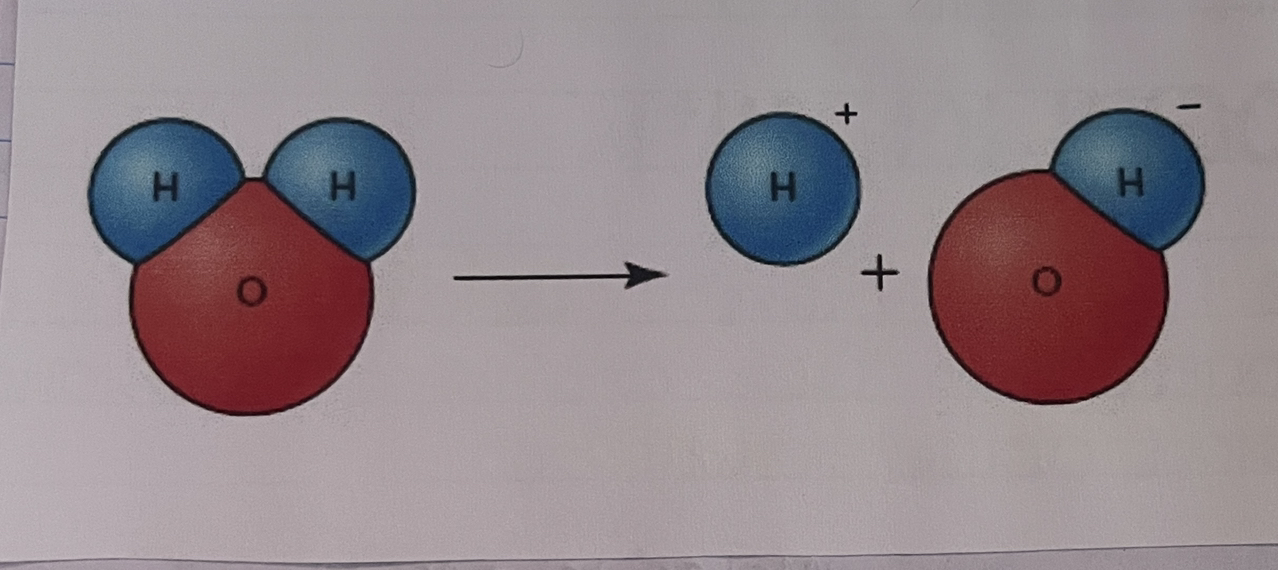
The ionization of water ⤴
Let walk through what happens step by step:
> 1. Two water molecules bump into each other
One of them steals a hydrogen nucleus, a proton (not a neutron nor electron) from another when they bump into each other.
> 2. Before the bump:
Water molecules #1: H2O (neutral). Water molecules #2: H2O (neutral).
> 3. After the bump:
Water molecule #1: H3O+ (gained a proton ➡ positive charge)
Water molecule #2: OH- (lost a proton ➡ negative charge)
So the hydroxide ion (OH-) is what’s left behind when a water molecule loses one of its hydrogens.
Pure water has a neutral pH because it contains the same number of hydrogen ions as hydroxide ions. It is equal balance of 50% acidic (hydrogen) and 50% alkaline (hydroxide).
pH is only possible because of water. Therefore, only products that contain water can have a pH.
In pH, as acidity increases, alkalinity decreases. Same thing: as alkalinity increases, acidity decreases