20- marine
M A R I N E A B I O T I C C O N D I T I O N S
A N D C O R A L R E E F S
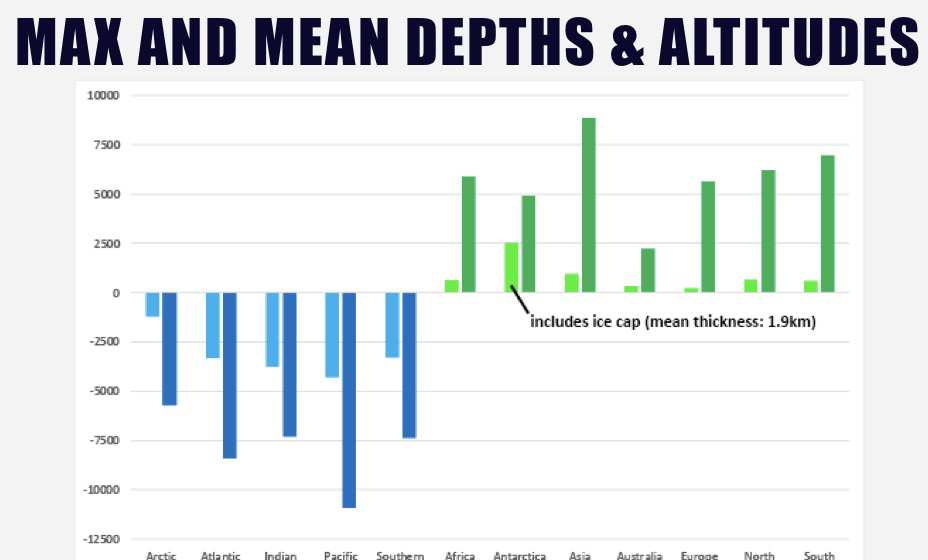
PROPERTIES OF (SEA)WATER
1. HIGH SURFACE TENSION
2. DISSOLVING POWER
3. HEAT CAPACITY
4. TRANSPARENCY TO LIGHT
1. SURFACE TENSION
e.g Sea Skaters (Halobates)
5 of them are truly oceanic. Only truly oceanic insect species. Small (up to 6.5mm long) but can be locally very common: caught in 60% of fast-moving sample trawls in some areas.
These compete aggressively for egg-laying sites, and this problem may be one reason there are so very few open ocean insect species.
They seem to benefit from floating plastic garbage, as they can lay their eggs on it.
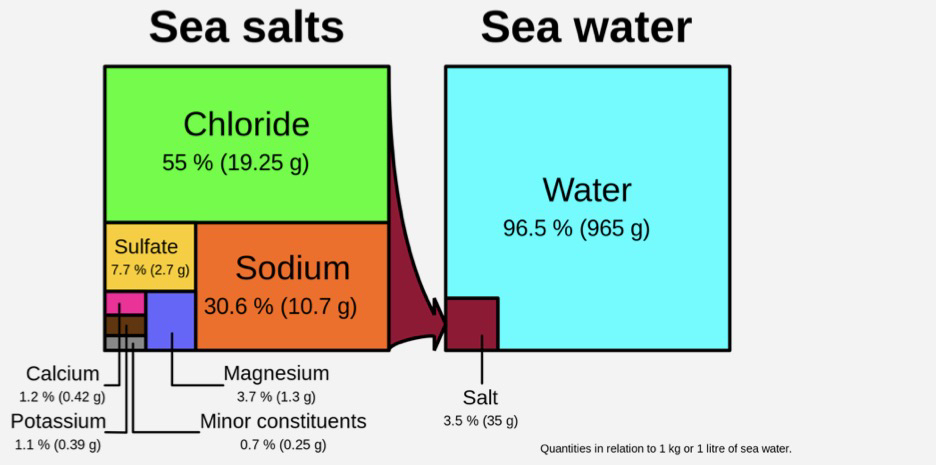
2. DISSOLVING POWER: SALINITY
~35 [PSU] = PRACTICAL SALINITY UNITY
3. WATER HAS HIGH HEAT CAPACITY
It takes a lot of energy to heat water, and water stores lots of heat energy:
HC of water: 4.2 J / K / kg
HC of rock: 2.0 J / K / kg
HC of snow, vegetated land & dry sand: 0.8 to 0.9 J / K / kg
HC of air: 0.7 J / K / kg
Therefore HC of water: 2.1x to 5.0x that of land.
Theoretical temp. loss of 1m3 blocks of water and of air, surrounded by a temp. of absolute zero (0K, -273C).
Water density: approx. 815x air.
HC of 1 m3 of water: approx. 4900x
HC of 1 m3 of air.
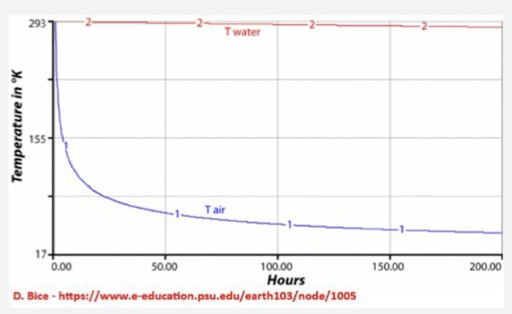
Sunlight penetrates far deeper into water than land, so effective HC difference is far, far more than 2.1x to 5x.
Water’s high HC means global climate patterns are dominated by the oceans, with land’s low HC causing disruptions, hence the word ‘continentality’.
We can see this effect here.
3. CONTINENTALITY & CLIMATE CHANGE
Crudely measured using ‘continentality index’:
max. monthly mean temperate minus minimum monthly mean temperature (13.5oC for Manchester.)
The index is very low near coast and very high in centre of landmasses. World record continentality index is approx. 57oC (NE Siberia).
The oceans are effective buffers against the warming climate (climate change), both in terms of absorbing heat and absorbing CO2, but there is a limit to that.
4. TRANSPARENCY TO LIGHT
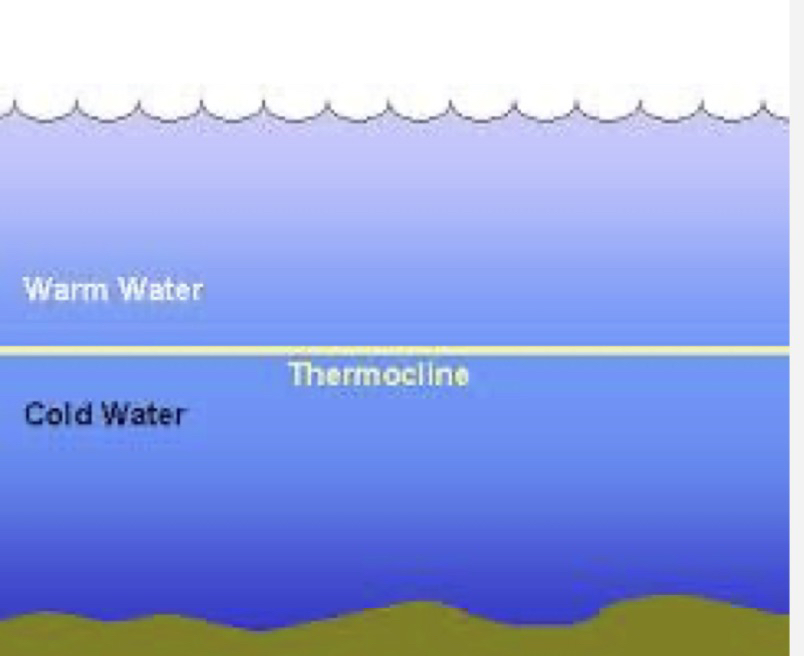
Vertical structure is determined by sunlight, hence HEAT: THERMOCLINE.
OCEAN CURRENTS
1. Heat
2. Winds
3. Coriolis effect
1. HEATING IS DIFFERENTIAL WITH LATITUDE
There is a LOT of solar energy available. It is approx. 1.35 KW/m2 reaching upper atmosphere when sun directly overhead, and at least 0.95 KW/m2at earth’s surface on a clear day.
But as we move away from the equator, the power of the sun received per square metre drops, for two reasons:
i. the oblique angle of the earth being warmed;
ii. the sunlight has to pass through more atmosphere before reaching the earth.
SST SEA SURFACE TEMPERATURE
Seasonality makes this even more complex
2. WINDS
They physically push masses of water, most rapidly at the surface, acting through friction with the surface.
Creates waves.
Waves increase friction.
Water tends to go in the same direction as the wind.
3. CORIOLIS EFFECT
Here the trade winds in the Atlantic Ocean can be seen moving from the SE and the NE towards the equator. These are part of the Hadley Cells.
If the Hadley Cells were acting alone, these winds would be from the N and S, but the Coriolis effect makes them from the NE and SE instead, with respect to the surface of the earth.
example: THE GULF STREAM
Keeps NW Europe (esp. Ireland, UK & Norway) warmer & wetter than would otherwise be. (Western UK is approx. 2oC warmer than eastern UK.)
Lack of continentality also keeps these areas more climactically stable than central and eastern Europe.
Off Newfoundland the Gulf Stream reaches 150 million m3/s: 250x total of all rivers that empty into the Atlantic!
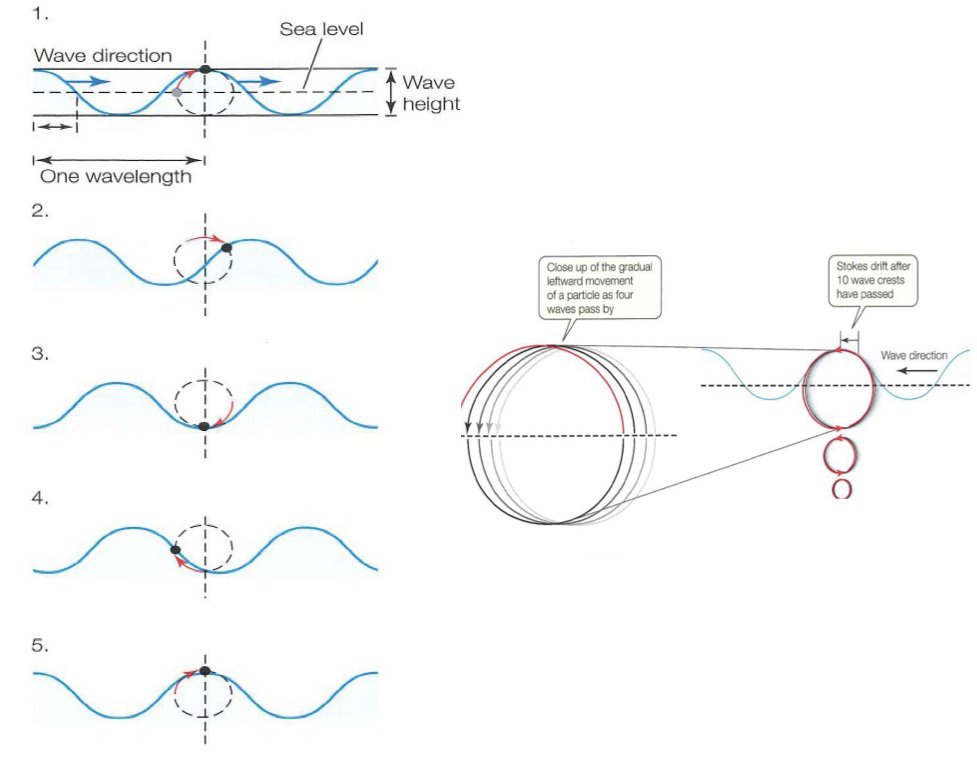
W A V E S
particles of water move in circle and slowly propagate
T I D E S
The Earth and the Moon ROTATE AROUND EACH OTHER, around a point that is almost entirely under the Earth (because the earth is 81 times the mass of the moon).
When the Sun and the Moon are aligned, their gravitational forces add up → extremely high/low tide (SPRING TIDE).
Spring tides are every 2 weeks
C O R A L R E E F S
LOCATION:
Reefs cover < 0.1% of the global ocean surface, yet they host > 25% of all known fish species on Earth
The vertebrate species’ density (number of species per unit area or volume) is far greater than the rain forest.
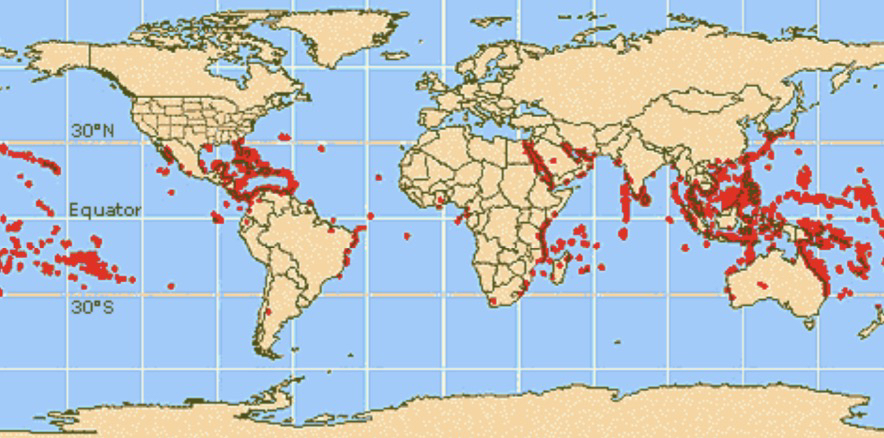
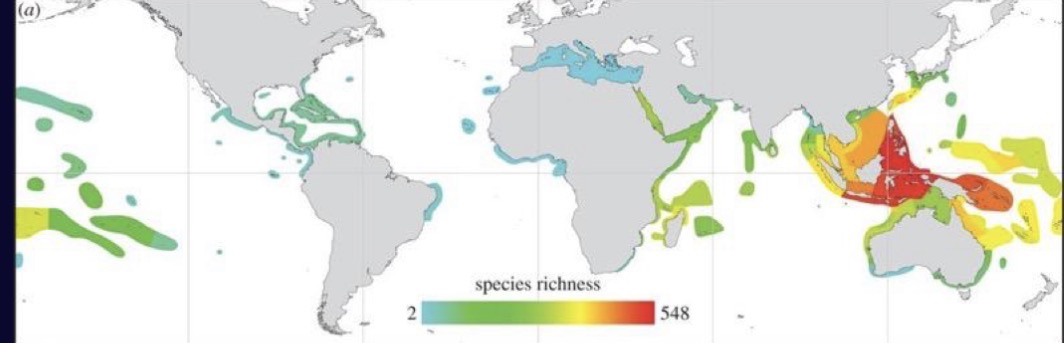
Corals exist in temperate and tropical waters but shallow-water reefs form only from 30° N to 30° S.
Tropical corals do not grow at depths of
over 50 meters.
The optimum temp for most coral reefs is 26 –27°C, and few reefs exist in waters below 18°C.
The large majority have very low tolerance to temperature variations. However, 37 scleractinian coral species in the Persian Gulf have adapted to temps of 13°C in winter and 38°C in summer. Part of a solution for the coral bleaching problem?
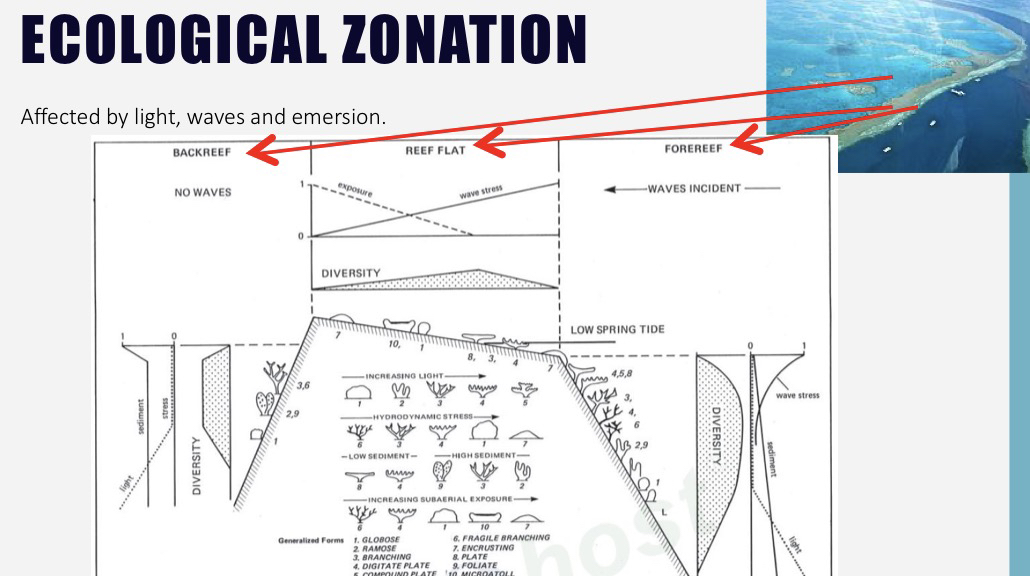
Ecological zonation
is the spatial distribution of species and communities into distinct bands or zones, driven by changing environmental factors like altitude, tidal level, or latitude
BACK REEF
SHELTERED FROM WAVE ACTION.
Salinity can fluctuate due to fresh water inputs. Sediment and runoff from shore can increase turbidity in this zone.
REEF FLAT
Here EXPOSURE is main limiting factor. LOW TIDE is usually the upper limit: they have to be immersed to survive / thrive.
FOREREEF
Here LIGHT is main limiting factor. Corals are more delicate (with larger surface area for light gathering) at depth, where less wave action
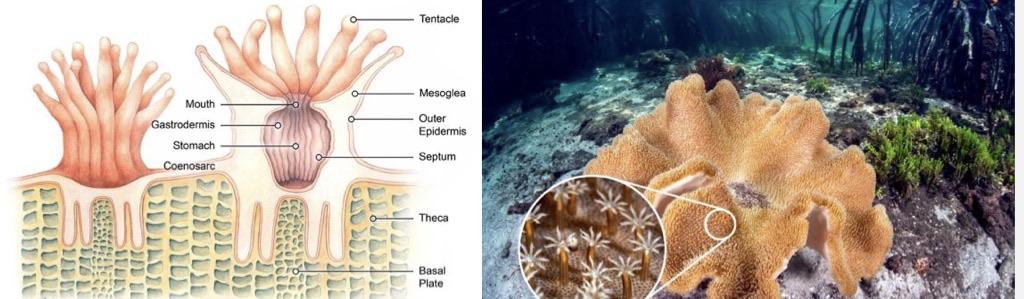
CORAL
Coral polyps themselves do not photosynthesize,
but have a symbiotic relationship with microscopic algae known as zooxanthellae (symbiotic algae of the genus Symbiodinium).
These algae live within the polyps' tissues and provide the polyp with glucose, glycerol and amino acids: up to 90% of the polyps’ nutrient needs.
Because of the zooxanthellae, coral reefs grow much faster in clear, sunlit water.
Without their symbionts, coral growth would be too slow to form significant reefs, so corals as a group would be far less ecologically important.
CALCIFICATION & REPRODUCTION
Many types of organism inc. hard corals absorb Calcium (Ca2+) from sea water to form their hard skeleton from calcium carbonate CaCO3, for support and/or protection.
Coral reefs are the net result of processes that form calcium carbonate (calcification) and those that take it away (physical and biological erosion).
EXAMPLE SPECIES
e.g. recently discovered Pink Floyd snapping shrimp (genus Synalpheus). Giant snapping claw can generate 210dB: enough to kill nearby fish and intruders.
Same volume as that detected 75 metres from a nuclear explosion.
S. pinkfloydi is not eusocial (as far as I could find out) but Synalpheus genus contains the only eusocial freshwater or marine species on earth!
Highly violent weapons (most Synalpheus have something similar) very useful for cooperative defence: essential for eusocial behavior.
Eusociality evolved at least 3x in Synalpheus. Several rapid radiations between 3 and 9 mya created the ancestors of these eusocial species.
Eusociality thought to have arisen due to competition for space: empty host sponges are rare.
Very likely that kin selection necessary for this to evolve because eusocial shrimp species are non-dispersing and hatch directly into ‘crawling’ individuals.
Until recently, eusocial species of Synalpheus have appeared in far greater abundance than, and appear to outcompete, less social species for space in sponges). In last few decades the sponges the eusocial species thrive in have become rare: eusocial species are declining.
—
Eusocial species are
animals that exhibit the highest level of social organization, characterized by cooperative brood care, overlapping adult generations, and a strict reproductive division of labor
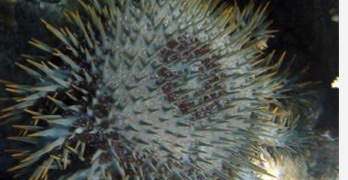
CROWN OF THORNS STARFISH
The crown of thorns starfish eats living coral (up to 10m2 per starfish per annum), and can be devastating to reef health if it is abundant (100 per hectare is possible!)
Only 11 species (or less) have been reported to prey on healthy adults. Sadly all of these are generalist feeders and none seems to specialise on feeding on the large, poison-spined starfish.
Hypotheses to explain their population booms:
- over-collecting of tritons, a predator of the starfish,
- overfishing of other predators of the starfish,
- decline in predator populations through habitat destruction,
- warmer sea temperatures enhance larvae development,
- anthropogenic impacts, such as runoff from land causing unusually high nutrient input.
ECOSYSTEM SERVICES
Costanza et al. (2014) estimate global coral reefs to be worth $352,000 per hectare per annum in total ecosystem services (ES). Globally this totals $9.9 trillion per annum: 3x the UK’s GDP.
- Tourism. Very important to many tropical nations, inc. over US $2bn per annum from Great Barrier Reef.
- Shoreline protection. Coral reefs can reduce wave energy by up to 97% (more effectively than almost all artificial breakwaters), greatly reducing loss of life, property damage and erosion.
- Fisheries. Yield can be 15 tonnes / km2 / annum total seafood in a healthy reef. $2.4 billion per annum in SE Asia reefs.
THREATS TO CORAL REEFS
These include:
Coral bleaching and other thermal stress effects
Ocean acidification
Overfishing
Pollution
Crown of thorns starfish
Direct physical human impacts
CORAL BLEACHING
Is a response to many forms of stress, especially rising water temperature
Zooxanthellae (which provide up to 90% of polyps’ nutritional needs) are expelled from the skeleton, removing much of the corals’ colouration. Prolonged bleaching will cause the coral to die.
CORAL BLEACHING: HOPE?
Different coral species are more or less prone to bleaching, so there is hope that some adaptation may occur.
Unusual (less temperature sensitive) algae have been observed in symbioses with some corals.
Many corals regularly experience high temperatures and bleaching during El Nino events, so this is likely not solely a 20th & 21st century phenomenon.
OCEAN ACIDIFICATION
Approx. 30–40% of human-released atmospheric CO2 dissolves into bodies of water,
where some reacts with water to form carbonic acid. Some of this acid then dissociates into a bicarbonate ion and an H+ ion, thus increasing ocean acidity.
This conversion of carbonate ions into bicarbonate ions deprives organisms at all levels of the food chain of free carbonate.
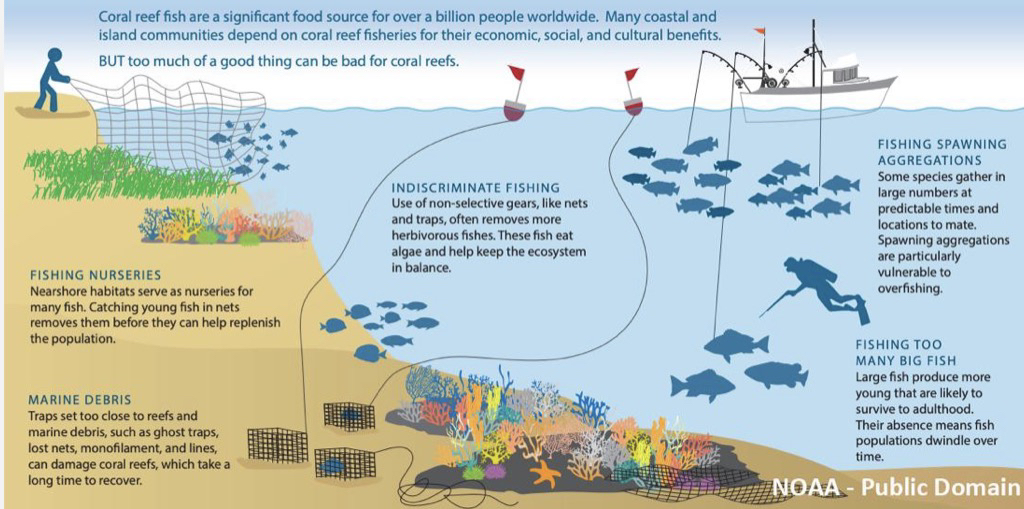
OVERFISHING
Algal Dynamics
One of corals’ major rivals for space are marine algae. Many reef animals feed on algae.
Overfishing can devastate corals by removing herbivores who consume algae.
Pet Trade
95% of tropical reef aquaria fish species are collected from tropical reefs.
80% to 90% of Philippines-captured aquaria fish are captured using sodium cyanide,.
Approx. 150 tonnes per annum is being used on Philippine reefs. A major catalyst of cyanide fishing is poverty within fishing communities
Dynamite fishing
Kills target fish, non-target animals and coral itself.
Bottom trawling
Has affected 50 million km2 of global continental shelf, inc. many soft coral reefs.
OVERFISHING
POLLUTION
Many factors, including eutrophication which boosts population of threats to corals including algae and the crown of thorns starfish
THE GREAT BARRIER REEF
The reef stretches over 2200 km from subtropical waters (~27°S) to the tropical waters of Torres Strait (8°S) and as far as 400 km from the coast to the outer shelf slope.
ORIGIN OF THE GBR
The INITIATION of the GBR likely did not occur until around 600,000 years ago.
The reef systems as we know them probably did not occur until around ~400,000 years ago (a very warm period)
Cores drilled into the reef show the GBR has been able to reestablish itself repeatedly during high sea level episodes associated with major environmental fluctuations in sea level, temperature and CO2.
The GBR is very similar to other reefs around the world in having grown during rises in sea level, associated with deglaciations. During rising seas, reefs can accumulate at rates exceeding 10 m per thousand years.
OCEANOGRAPHY
Currents erode and shape the reef. Currents influence the transport/deposition of sediments.
1. South Equatorial Current (SEC) flows towards the reef.
2. During EI Nino the climate in the entire tropical Pacific alters. When currents are weak during El Nino, recruitment of larvae to limestone reefs is poor. Coral bleaching on the GBR and elsewhere has been recorded during La Nina and El Nino, but the biggest bleaching events are during El Nino.
3. Patches of water generally exceeding 31°C stagnate on the GBR and when this hot for too long the zooxanthellae are lost, and in severe circumstances the coral will bleach and die.
GREAT BARRIER REEF BIODIVERSITY
30 species of cetaceans, inc. a world- famous albino humpback whale, Migaloo. (Species IUCN listed as ‘Least Concern’.)
1500+ species of fish, inc. the beautiful coral trout (IUCN listed as ‘Least Concern’).
Thriving dugong and saltwater crocodile populations. (IUCN listed as ‘Vulnerable’ and ‘Least Concern’, respectively).
17 species of sea snake (inc. the blue lipped sea krait, IUCN listed as ‘Least Concern’).
6 species of turtle breed there (inc. the leatherback, IUCN listed as ‘Vulnerable’).
25 species of shark, stingray, skates or chimaera (inc. the tiger shark, IUCN listed as ‘Near Threatened’. Conservation status of many large pelagic fish is very unclear)
Approx 5,000 mollusc species (inc. the giant clam and giant cuttlefish, IUCN listed as ‘Vulnerable’ and ‘Near Threatened’, respectively).
49 pipefish species & 9 seahorse species.
215 species of birds (inc. the Roseate Tern and white-bellied sea eagle, both IUCN listed as ‘Least Concern’).
2,195 known plant species.
330 species of ascidians (sea squirts), inc. the very colourful Polycarpa aurata, not IUCN listed.
300–500 species of bryozoans.
400 coral species, etc. etc.
The glamorous species I have chosen as examples in recent slides happen not to be very rare, (as far as we know…) but many, many Great Barrier Reef species are very much in need of protection.