BPK207 Week 2
how is movement commonly measured \ error, magnitude, time/speed;
A what is movement error used for \ used for discrete skills, also called accuracy;
what are the three ways to measure movement error (accuracy) \ 1.constant error (CE), -accuracy bias,
2.variable error VE consistency
3.root mean square error (RMSE) measures ovearll continuous error;
whats constant error \ measures average bias from the taarget, shows direction, doesn’t show variability, CE= (xi is score on trial i, T is target position, n is # of trials performed;
whats variable error \ measures consiitence/variability of performance, essentially the SD of CE , CE+VE together give a full accuracy picture xi is score on trial i, m is subjects average # of trials performed;
whats root mean square error RMSE \ -measures overall error over time, used for continuous skills such as tracking tasks, combines bias and variability across the entire movement where Xi is the effector position at point i, Ti is the target point i and n is the # of points of the movement;
whats the difference between CE and VE \
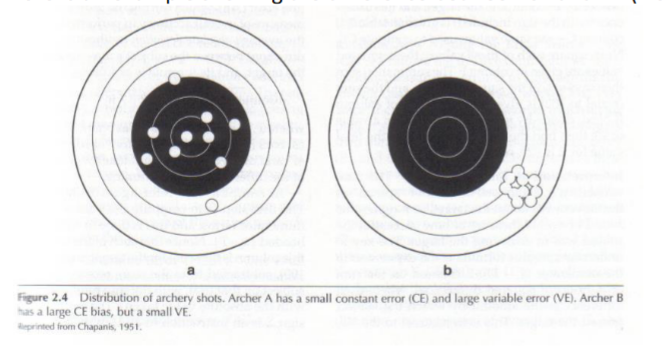
The figure on the left shows small CE and large VE. The figure on the right shows large CE but small
VE. CE and VE can provide a coach with important information—athletes can improve performance,
for instance, by shifting position slightly (e.g., a shooter) to correct CE. VE is a little harder to deal with.;
B what is movement magnitude \ describes how big a mevement or signal is;
how is movement magnitude commonly measure \ -distance traveled, peak or ave value, area under the curve, peak to peak amplitude, root mean square ;
whats root mean square RMS\ quantifies signal (set of data) magnitude, not the same as RMSE, useful when averages are misleading such as when sine waves around zero, where x is value of signal or set of data at aspecific point in timeand N is the number of data points;
why use RMS \ if you took the average of a sine wave oscillating around zero, the value would be
zero regardless of the amplitude of the wave. RMS is one of several ways to get a sense of magnitude
when an average might be misleading.;
when is movement time and speed measurements used and what are the 3 main measurements \ -used heavily in reaction time paradigms,
1.reaction time RT -time from stimulus onset →response initiation;
2.movement time (MT) time from movement initiation→movement completion
3.response time : RT+MT must be clearly defined to avoid confusion;
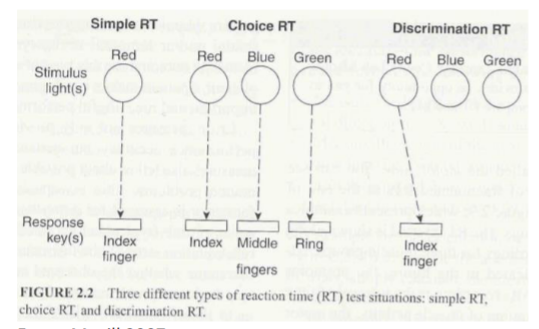
What are the types of RT tasks: \ 1.simple RT: one possible response 2.choice RT: multiple possible responses
;
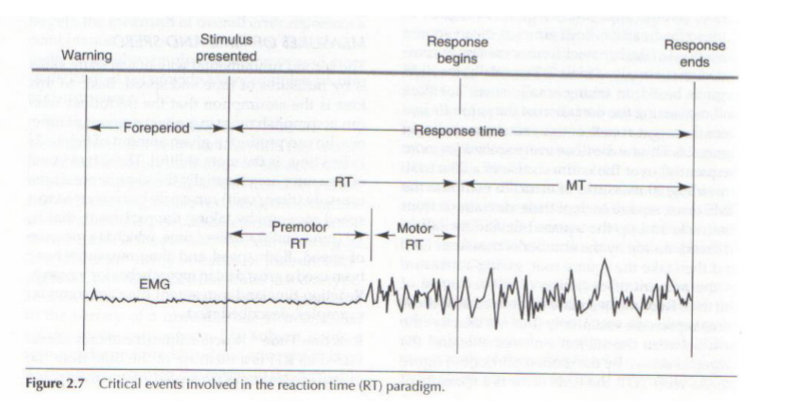
what is premotor RT \ central processing time;
whats motor RT \ delay between muscle activation and movement;
whats foreperiod \ time between warning signal and stimulus;
what are the critical events involved in the reaction time paradigm \
;
what are the six research equipemnt and techniques \ 1.force plates, 2.posturograph, 3.kinematic recording devices , 4.electromyography EMG 5.eye tracking 6.microneurography;
whats force plates, what do they measure and what are they used for \ measures kinetics (forces) used to asses ground reaction forces and centre of pressure COP→posutral sway and balance;
whats posturography, what does it assess and whats it used for \ asseses standing balance, uses force plates, uses computerized dynamic posturograph (CDP), used in Sensory organization test SOT to manipulate sensory input;
whats kinematic recording devices, what are the types and whats it used for \ -used to measure movement without forces - 1.motion caputre cameras 2.goniometers-joint angles 3.acceleromteres -acceleration, 4. IMUs→acceleration, orientation, force (used in gait analysis, sports, rehab, film and games;
whats electromyography EMG and what are the two types \ records muscle activity, 1.surface EMG is non invasive, 2.indwelling EMG is invasive into a single muscle;
whats eye tracing \ record gaze and eye movements, shows how task intructions change visual scanning behaviour;
whats microneurography \ -records activity from single peripheral nerve axons, highly invasive, used to study individual ssnesory receptors;
whats cell sorting \ -a microelectrode records all cells within 100micrometers, ech cell will have a slightly different waveform that must be isolated from the others;
whats single neuron recording \ extracellular recordings from neurons that require electrodes near neurons and cell sorting, the info is encoded by spike timing and rate (not shape);
whats baseline firing rate \ -rate whic neuron fires APs when no stimulus/movement/task, many aren’t completely silent, but fire at a steady low rate at rest, so info is about changes in baseline so increase and decrease in firing rate are meaningful ex: touch sensitive neuron: 5spikes/sec baseline, 20spikes/sec on pressure, drow below when stimulus removed, it acts as the referenc epoint;
labelled line coding \ the identity of a neuron or parthway tells the brain what kind of info it carries, which saves the brain some decoding, exoptic nerve is vision, auditory nerve is sound, somatosensory afferents are touch, pressure, pain;
whats the correlation between spikes wit stimuli or behaviour \ tekks what the neuron is responding to, ex: a neuron fires more whe pressure increases → codes pressure, ;
whats microstimulation \ -delivers current to neurons, used to map motor cortex, evokes movemnts or behaviours, recording observes function, stiulation manipulates function, invasive;
whats neuroimaging\ measures activity of large neruons populations : 3 types: fMRI→blood oxygen changes MEG→magnetic fields from neural activity, EEG→electrical activity from cortex, the tradeoff is lower spatial resolution than single neuron methods;
whats transcranila magnetic stimulation (TMS) \ -uses magnetic fields to activate neurons, it can map motor cortex, create teporary virtual lesions, assess platicity and recoveyr, produces motor evoked potentials MEPs when measured with EMG;
whats transcranial electrical stimulation tES \ includes tDCS, tACS, tRNS, doesn’t directly activate neruons, changes membrane excitability, effects can last up to 90 min, anode-current enters brain, cathode- currnet exits brain