Networks and Communications
A computer network is a collection of interconnected devices such as computers, servers, printers, routers, and switches that are linked together to allow the sharing of data, resources, and information.
Computer networks allow users to communicate and collaborate with each other, share files and software, and access shared resources such as printers and storage devices.
Advantages of computer networks:
Resource sharing: Computer networks allow devices to share hardware and software resources, such as printers, scanners, storage devices and applications.
Communication and collaboration: Computer networks provide a platform for users to communicate and collaborate with each other regardless of their physical location.
Centralised Management: Computer networks enable centralised management of devices, applications, and data, which can help to simplify administration and reduce the time and effort required to maintain the network.
Increased security: Computer networks provide a way to centralise and control access to data and resources which can help to improve security and reduce the risk of data breaches and cyber-attacks.
Scalability: Computer networks can be easily expanded or upgraded to accommodate new devices or users as needed which can help to support business growth and change.
Disadvantages of Networks:
Complexity: Computer networks can be complex to set up and maintain, requiring specialised knowlege and expertise. This can increase the cost and time required to manage the network.
Security risks: Computer networks are vulnerable to security risks such as hacking, viruses, and malware which can compromise data and systems. Proper security measures, such as firewalls, antivirus software and regular updates are necessary to minimise these risks.
Dependence on technology: Computer networks rely on technology to function and any hardware or software failure can cause disruptions and downtime which in turn can have a significant impact on productivity and revenue.
Bandwidth limitations: Networks can experience bandwidth limitations, especially when multiple users are accessing resources simultaneously.
Compatibility issues: Not all devices and software are compatible with all types of networks and protocols which can create issues and require additional investment in equipment and software.
Data Mining: This involves analysing network data to extract useful information and insights that can be used to optimise network performace, improve security and enhance user experience.
Point-to-Point Connection: This refers to a communications connection between two communication endpoints or nodes.
Point-to-point data communications: A type of communication in which data is transferred between two devices or nodes a network using a dedicated communication channel.
Advantages of point-to-point communication:
Provides a dedicated communication channel that is not shared with other devices or users which can help to ensure reliable and efficient communication.
Provides higher security as data is transmitted directly between the source and destination without passing through immediate devices that could potentially intercept or modify the data.
Disadvantage of point-to-point communication:
This can be more expensive and less flexible than other types of network communication as it requires dedicated communication links that may be costly to install and maintain.
Components of Data Communication
Sender: The device or program that originates the data that needs to be transmitted over the network.
Receiver: The device that receives the data transmitted by the sender.
Medium: The physical channel that is used to transmit data between the sender and receiver. E.g. a wired medium such as copper or fibre optic cables
Protocol: The set of rules and procedures that governs the transmission of data over the netwrok.
Message: Information to be communicated by the sender to the receiver.
Characteristics of data communications:
(1) Signal Type
(2) Transmission mode
(3) Direction of flow
(4) Transmission rate
Signal Type
Analog signals: Continuous electrical signals that vary in amplitude, frequency, or phase. Used in telephone systems and older types of networking technologies.
Digital signals: Discrete electrical signals that represent binary data (0s and 1s) Most common type of signal used in modern computer networks since they can be transmitted and processed more reliably than analog.
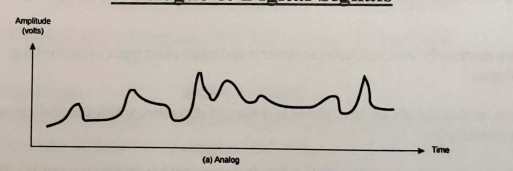
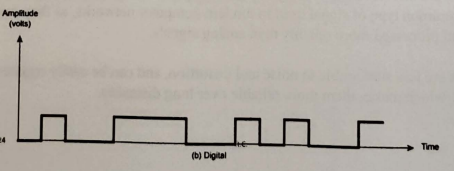
Digital-to-analog conversion (DAC): The process of converting digital signals into analog signals.
Analog-to-digital converter (ADC): When the signal is converted back to a digital signal.
Other signal types:
Radio waves: Electromagnetic signals that are used to transmit wireless signals in wireless networks such as WIFI and cellular networks.
Infrared signals: Light waves with a frequency lower than visible light that are used to transmit data between devices in short-range wireless networks such as remote controls and some types of sensors.
Optical signals: Light waves that are used to transmit data over fibre optic cables in high-speed network connections such as long-distance telecommunications and high-speed Internet connections.
Transmission Modes:
A transmission mode is the manner in which data is sent over the underlying medium. Transmission modes can be divided into two fundamental categories:
Serial
Parallel
Parallel transmission: A method of sending multiple data bits simultaneously over multiple communication channels.
This can be achieved using parallel cables consisting of multiple wires that carry bits of data simultaneously. It is commonly used for short-distance communications between devices within a computer system e.g. motherboard and a hard drive.
More expensive and difficult to implement due to the need for multiple wires or channels. It is also more susceptible to interference and crosstalk between the channels.
Latency: Refers to the amount of time it takes for data to travel from one point to another. It is measured in milliseconds and can be affected by various factors such as network congestion and distance between devices.
Serial transmission: Sends data one bit at a time over a single channel. This can be accomplished using various physical media including copper wires and wireless connections. The bites of data are sent one after the other in a sequential manner.
It has a lower cost, simpler cabling and is less susceptible to interference and noise. Generally has a lower data transfer rate due to the need for each bit to be transmitted separately.
Commonly used in applications such as transferring files, sending emails and accessing websites. Also used in communication protocols such as USB which is used for connecting peripheral devices to computers.
Synchronous transmission: Data transmitted in a continuous stream of bits that are synchronised with a clock signal. They have a common clock that is used to synchronise the transmission of data.
It allows for faster and more efficient data transfer since clock signal ensures that the data is transmitted at a constant rate. Requires a high degree of coordination between sender and receiver.
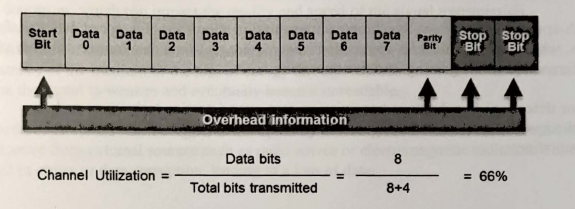
Asynchronous transmission: Data transmitted one byte or character at a time with each byte or character separated by start and stop bits. This does not require a clock signal and each byte / character is transmitted independently of each other.
It is more flexible and tolerant of errors as each byte or character can be transmitted at its own pace. It is slower and less efficient as it requires additional start and stop bits for each byte or character.
Synchronous vs. Asynchronous transmission
Synchronous: Typically used in high-speed networks such as fibre optic networks and satellite links where speed and efficiency are critical.
Asynchronous: Commonly used in slower networks such as dial-up modems and some serial communication protocols where flexibility and error tolerance is more important than speed.
Asynchronous serial communication uses a special structure called a frame to transmit data.
Advantages of Synchronous transmission:
Efficient use of bandwidth
High-speed transmission
Error detection
Disadvantages of Synchronous transmission:
Synchronisation
Complexity
Not suitable for long-distance communication.
Signal propagation: Refers to the process of transmitting a signal from one point to another through a physical medium such as copper wires, optical fibres or wireless signals.
Attenuation: The reduction of signal strength as it travels over a distance due to resistance of the medium or loss of energy through radiation or absorption.
Interference: Occurs when a signal is disrupted by other signals or noise either from other devices or from external sources such as radio waves or electromagnetic radiation. Can result in errors or data corruption → loss of data.
Distortion: When a signal is altered or distorted by the medium it travels. This can cause the signal to become distorted or delayed leading to errors in data transmission.
Asynchronous communication advantages:
Flexibility
Simple Implementation
Efficient use of resources
Asynchronous communication disadvantages:
Low Speeds
Limited Error Detection
Not suitable for real-time applications
Parity Check
It is used in asynchronous transmission and detects any errors in each character being sent. A bit in each byte is set aside as the parity bit.
Even parity: The bit is set to 1 or 0 to ensure an even number of 1’s
Odd parity: The bit is set to 1 or 0 to ensure an odd number of 1’s
The receiving system checks the system being used and the number of 1’s
Parity Block
A method of error checking similar to the parity check, but the datai s arranged in a virtual table with parity bits added to each row and column. Single column bit can be spotted at the intersection of a corrupted row and column. Does not work with multiple corrupted bits.
Direction of Transmission Flow: Simplex, Half-Duplex and Full-Duplex
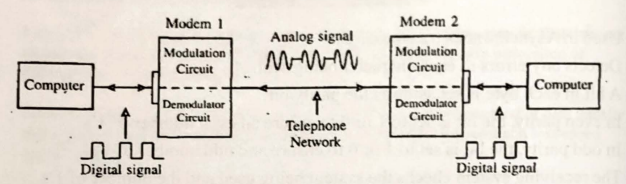
Modulator: This unit is used to convert the digital data from the computer into analog data. This process is called modulation.
Demodulator: This unit is used to convert the analog data from the telephone system into digital data.
Transmission modes:
Simplex: One side sends, other one receives. One way. The receiver cannot send data back to the sender. An example of this is a radio station that broadcasts music to listeners.
Half-duplex: Both sides can send and receive, not at the same. E.g. Walkie-Talkie
Full-duplex: Both sides can send and receive at the same time. E.g. any time of call or mainframe communications.
Transmission Rate: Frequency and Bandwidth
Transmission rate: Refers to the speed at which data can be transmitted over a network. Measured in bits per second and determines the maximum amount of data that can be transmitted over a given period of time. Higher transmission rates allow for faster data transfer.
Frequency: The amount of data that can be transmitted on a channel depends on wave frequency (expressed in Hertz) The more cycles per second, the more data that can be sent through that channel.
Network bandwidth: Refers to the maximum amount of data that can be transmitted over a network in a given amount of time. It is a measure of the capacity of the network to transfer data between devices. Measured in bits per second.
The number of bandwidth affects the speed and performance of data transfer between devices. Higher bandwidth → Faster data transfer → Improves performance of network.
It can be affected by a variety of factors:
Type of network (wired or wireless)
The type of cables or wireless technology used
The distance between devices
The number of devices on the network
The amount of data being transferred.
Transmission time: Refers to the time required to transmit a message or data from the sender to the receiver over a communication channel. Depends on factors such as size of the message, transmission medium, bandwidth of the medium and distance between the sender and the receiver.
Transmission time = message size / bandwidth
The above formula does not take into account factors that affect the overall time for the message to be delivered e.g. processing time, propagation delay and queuing delay.
Propagation delay: The amount of time it takes for a signal to travel from the sender to the receiver over a communication channel.
Bit rate and baud rate
These are two terms to describe the speed of data transmission.
Bit rate: The number of bits that can be transmitted per second over a communication channel (bps).
Baud rate: The number of signal units that can be transmitted per second over a communication channel. A signal unit can represent one or more bits.
Understanding Audio Quality: Bit Rate, Sample Rate
Audio Quality: The accuracy and enjoyability of the audio which the user can listen from an electronic device. Depends upon the bit rate, sample rate, file format and encoded method.
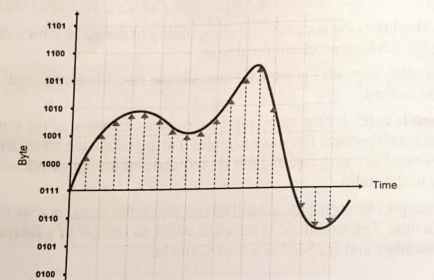
Sample Rate: How many samples, or measurements of the sound are taken each second. More samples → More detail about where the waves rise and fall is recorded and the higher the quality of the audio.
Each sample represents the amplitude of the digital signal at a specific point in time. The amplitude is stored as either an integer or a floating point number and encoded as a binary number.
Data Sampling: Refers to the process of selecting a subset of data from a larger dataset for analysis or processing.
Sampling is often used when it is impractical or impossible to capture and analyse all of the network traffic due to its volume.
Broadband and Baseband
Baseband: Refers to a method of transmission in which the entire bandwidth of the communication channel is used to transmit a single signal. Commonly used for short-range communication such as LAN or point-to-point communication.
Broadband: Refers to a method of transmission in which multiple signals are transmitted simultaneously over the same communication channel. Commonly used for long-range communication such in cable television, DSL internet or cellular networks.
Noise and Signal Distortion
Noise: Refers to unwanted electrical or electromagnetic energy that interferes with the desired signal. Reasons this can occur include: EMI from other devices, thermal noise from electronic components or crosstalk between adjacent wires in a cable.
Signal distortion: Refers to changes to the signal as it is transmitted through a communication channel. These changes can be caused by: attenuation, delay or interference from other signals.
To mitigate these problems, various techniques are used:
Shielding: These cables and equipment can reduce the effects of EMI and other sources of noise.
Filtering: Using these one can remove unwanted noise from the signal.
Eqalisation: Adjusting the amplitude and phase of the signal can compensate for signal distortion caused by the communication channel.
Error correction: Using error-correcting codes can detect and correct errors in the received data.
Retransmission: In some cases, it may be necessary to retransmit data that has been corrupted or lost due to noise or signal distortion.
Wave Modulation
This is a technique used in computer networks to increase data speed transmission over communication channels. This involves modifying a carrier wave to encode digital information and send it over a communication channel.
Carrier wave: A high-frequency signal used to transmit information
How can modulation increase data speed transmission?
Increases bandwidth → By allowing multiple signals to be transmitted at different frequencies within the same channel.
Reduces noise and interference → Can improve the reliability and speed of data transmission.
Increases efficiency → By using more of the available bandwidth of the communication channel.
Enables longer distances → By allowing the signal to travel further without losing its strength.
Modulation
The process of encoding digital data into analog signals that can be transmitted over a communication channel. Digital data can be transmitted via an analog carrier signal by modulating one or more of the carrier’s four characteristics:
Amplitude
Frequency
Phase
Pulse
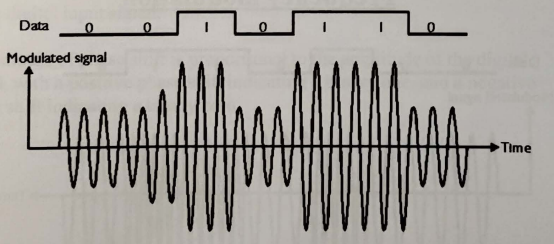
Amplitude Modulation:
Amplitude: The strength of the signal transmission medium such as the telephone wire. Since AM is more sensitive to noise than other modulation techniques it is not widely used in data transmission.
Frequency Modulation:
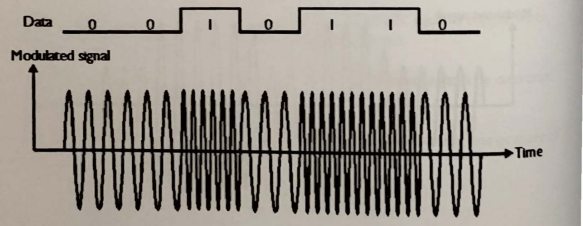
FM is the modification of the frequency of the carrier wave so that it carries information. The modulation does not alter the level of the carrier wave. FM is immune to noise and hence more reliable.
Phase Modulation:
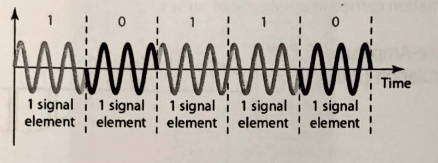
This technology works by altering the phase relationship between the waves in the signal. The phase of the carrier wave is change in response to the digital input signal. The amount of phase ship is proportional to the amplitude of the digital signal, with a positive shift indicating a binary one and a negative phase shift indicating a binary zero.
Pulse Amplitude Modulation
Transforming continuous time analog signals into discrete time analog pulses. Information is carried in amplitude of pulses. This modulation technique is where the amplitude of the pulse is varied in proportion to the amplitude of the digital signal being transmitted. Commonly used in DSL technology.
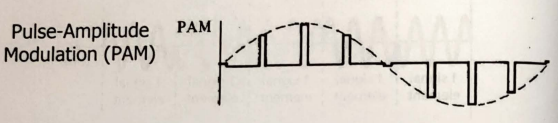
How data sampling affects the quality of data communication when modulating data.
The accuracy of the modulation process depends on how well the digital data is represented in the analog signal. Data sampling plays a critical role in the process by determining the accuracy of the analog representation of the digital data. If the sampling rate is too low, some of the information in the original signal may be lost, resulting in errors or distortion in the reconstructed signal.
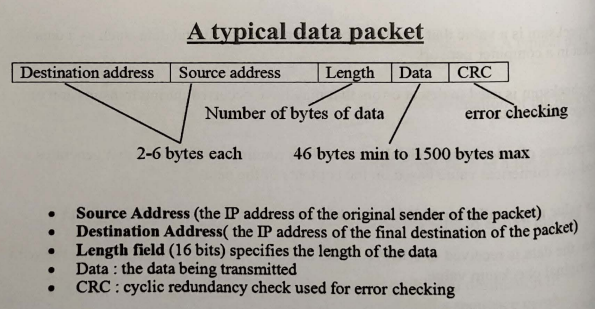
Data Packet: A unit of data that is transmitted over a computer network. A typical data packet consists of the following components →
Header → Contains information about the source and destination of the packet as well as information about the type of data being transmitted.
Payload → Contains the actual data being transmitted such as a file or a message.
Trailer → Contains a checksum which is used to ensure that the data in the packet has been transmitted without errors.
Checksum → A value that is calculated from a block of digital data such as a data packet in a computer network. Is used to detect errors that may have occurred during transmission or storage of the data. CRC is an algorithm used to calculate checksums in computer networks.
Data Transmission Media (Channels)
Before data can be communicated, it must be converted into a form suitable for communication. The basic forms into which data can be converted are:
Electronic pulses or charges: Used to transmit data over telephone lines or cable.
Electromagnetic waves: Used to transmit data through the air via microwave dishes and satellites.
Light pulses: Used to transmit data through glass fibres.
Infrared or standard radio waves: Used for some newer types of wireless data transmission.
Ethernet cables: A type of networking cable used to connect devices together in a wired LAN. They are made up of twisted pairs of copper wires encased in an outer sheath with connectors at either end. They are designed to transmit data signals between devices at high speeds and over relatively long distances.
Electronic Pulses: Telephone lines and Coaxial Cable
Telephone line is referred to as twisted pair. It is the cheapest but has slow transmission rates and suffers from electronic interference. The conductors are twisted together for the purpose of cancelling out EMI.
Coaxial cable is high quality, well insulated cable which can transmit data much faster and more accurately than twisted pair. It is made of a single copper wire encased in insulation and then covered with a layer of aluminum or copper braid that protects the conducting wire from radio frequency noise.
Unshielded Twisted Pair (UTP): The most popular and generally the best option for business networks. It is the cheapest and is very easy to install but it suffers from external interference.
Shielded Twisted Pair (STP): A type of copper telephone wiring in which each of the two copper wires that are twisted together are coated with an insulating coating that functions as a ground for the wires. It is more expensive and harder to handle.
Electromagnetic Waves: Microwave and Satellite Systems
Microwave systems
They use the earth’s atmosphere as the medium through which to transmit. These systems are used for high-volume as well as long-distance communication of both data and voice in the form of electromagnetic waves. Transmission distance between stations is limited to about 30 miles because of the earth’s curvature. No direct physical cabling is required.
Satellite systems
The satellite revolves once a day with the earth. It acts as a relay station between satellite transmission stations on the ground. Although costly, this has become one of the most popular and cost effective method for moving large quantities of data over long distances. An advantage of this is the vast area that can be covered by a single satellite.
Light Pulses: Fibre Optics
The dominant communications medium because of its high transmission volume, low error rate and message security. Signals are converted to light form and fired by laser in bursts through insulated, very thin glass. These cables are not subject to noise and thus have low error rates than normal phone lines and are faster than satellite. The cable does not interfere with electrical which are nearby.
Fibre Optic Cable: Since the signals it carries are pulses of light conducted over threads of glass, fibre optic cables aren’t affected by outside electric currents. Each glass strand passes signals only one direction, so a cable has two strands in separate jackets. Since free of interference + light pulses can travel without losing strength → Carry data at high signaling speeds over long distances.
Advantages of Fibre Optic:
Have a greater bandwidth than metal cables → Carry more data
Less susceptible than metal cables to interference.
Much thinner and lighter than metal wires.
Data can be transmitted digitally rather than analogically.
Less signal degrading over distance (lower attenuation)
Disadvantages of Fibre Optic:
Expensive over short distance
Fragile - Fibres can be broken or have transmission loses when wrapped around curves of only a few centimetres radius.
Protection - Optical fibres require more protection around the cable compared to copper.
Requires highly skilled installers
Adding additional nodes is difficult
Attenuation
This refers to the gradual loss of signal strength as it travels through a medium such as a cable or wireless transmission. Typically measured in decibels. It can be caused by: distance, interference and quality of the transmission medium. It can also be weakened by interference from other wireless devices or radio frequency interference (RFI) from sources such as microwave ovens. It can also have a significant impact on network performance, leading to slower data transfer rate.
Wireless Transmission: Infrared and Standard Radio Waves
This refers to the transfer of data between devices without the use of physical cables or wires. In a wireless network, devices communicate with each other using radio waves and infrared signals.
This can be accomplished through different methods:
Wi-Fi: A wireless networking technology that uses radio waves to connect devices to the internet or a local network.
Bluetooth: A wireless technology that enables devices to communicate with each other over short distances.
Infrared: Uses light waves to transfer data between devices. Often used in remote controls for televisions.
Advantages: Increased mobility, flexibility and convenience.
Disadvantages: More susceptible to interference and security vulnerabilities.
Satellite transmission applications:
Television distribution
A network provides programming from a central logation.
Direct broadcast satellite (DBS)
Long-distance telephone transmission
High-usage international trunks.
Data integrity: Refers to the overall completeness, accuracy and consistency of data. This must be imposed when sending data through a network.
Techniques to maintain data integrity:
Error detection and correction codes: Codes added to the data being transmitted and used to detect and correct errors that may occur.
Encryption: The process of transforming data into a code that is unreadable without the appropriate decryption key. Helps ensure data remains confidential.
Hashing: The process of generating a unique identifier for a piece of data. Can be used to verify that the data has not been modified during transmission.
Digital Signature: Used to verify the authenticity of data by associating it with a unique digital signature. Can be verified by the recipient to ensure that the data has not been modified.
Secure Protocols: E.g. HTTPS used to secure communications between devices by encrypting data and verifying the identity of the sender and recipient.
Digital Signature: A cryptographic technique used to verify the authenticity and integrity of a digital document or message.
Multiplexer (Mux)
A device that allows multiple signals to be transmitted over a single communication channel. Done by combining the signals from several input sources and then transmitting them over a single transmission line which then is separated back into its individual signals at the receiving end using a demultiplexer (demux). Multiplexing is used to increase the efficiency of communication channels by allowing multiple data streams to share the same physical connection.
Time-Division Multiplexing (TDM) → Different data streams are transmitted in alternating time slots. Terminals are polled in sequence, and each terminal is given a time slot whether or not it has anything to transmit.
Efficient use of bandwidth: Allows multiple signals to share the same communication channel.
Reduced cost: Since it allows multiple signals to be transmitted over a single channel.
Vulnerability to errors: If errors are encountered during transmission, the errors can affect all the other singals in the TDM system potentialy leading to a complete loss of data.
Synchronisation Issues: Requires strict synchronisation between the transmitter and receiver for each signal.
Applications include:
Telephony: Commonly used to transmit multiple voice calls over a single communication line.
Digital Audio: Used to multiplex multiple audio signals onto a single channel allowing for efficient transmission of digital audio signals.
Frequency-Division Multiplexing (FDM) → Each data stream is assigned a different frequency band within the transmission channel. By using different carrier frequencies two or more different signals can be sent simultaneously down the same link.
Efficient use of bandwidth: Allows multiple signals to share the same communication channel, increasing the capacity of the channel and enabling efficient use of available bandwidth.
Flexibility: Can be used with a wide range of communication systems include void and data communications.
Limited capacity: As the number of signals increase, the available frequency band for each signal decreases which can result in reduced data transfer rates and longer transmission delays.
Vulnerability to interference: If two signals are assigned to overlapping frequency bands, they can interfere with each other resulting in signal degradation or loss.
Applications include:
Radio and Television Broadcasting: Using to transmit multiple audio and video signals over a single communication channel in radio and television broadcasting.
Satellite Communication: FDM is used in satellite communication systems to transmit multiple signals over a single satellite channel.
FDM versus TDM
FDM is better suited for applications where a large number of signals need to be transmitted over a single channel and where each signal requires a fixed amount of bandwidth. It is also a good choice where the signals have varying data rates are are not transmitted continuously.
TDM is better for applications where a smaller number of signals need to be transmitted over a single channel and where each signal requires the entire available bandwidth. A good choice for applications where signals are transmitted continuously and require precise timing.
Switching Techniques
Circuit Switching
Message Switching
Packet Switching
Circuit Switching: A technique that directly connects the sender and the receiver in an unbroken path. Once a connection is established, a deciated path exists between both ends until the connection is terminated. For this reason, routing decisions must be made when the circuit is first established and not afterwards.
Advantages: The communication channel (once established) is dedicated.
Disadvantages:
Possible long wait to establish a connection during which no data can be transmitted.
More expensive since a dedicated path is required for each connection.
Inefficient use of the communication channel since the channel is not used when the connected system are not using it.
Message Switching: When a station sends a message, the destination address is appended to the message. Message is then transmitted through the network in its entirety from node to node. Each node receives the entire message, stores it in its entirety on disk and then transmits the message to the next node.
Advantages:
Channel efficiency greater than circuit-switched systems since more devices are sharing the channel.
Traffic congestion can be reduced since messages may be temporarily stored in route.
Disadvantages:
Store-and-forward devices are expensive since they must have large disks to hold long messages.
Not compatible with interactive applications.
Packet Switching: A solution which tries to combine the advantages of message and circuit switching and to minimise the disadvantages of both. Refers to protocols in which messages are divided into packets before they are sent. Each packet is transmitted individually and can even follow different routes to its destination.
Apart from the data each packet also carries:
Start/stop packet indicator: Serves to inform all other nodes on the network that a packet is being transmitted.
The source and destination address: Nodes on the network identify each other by means of a fixed address.
A packet sequence so that the whole message can be correctly reassembled.
Advantages:
More efficient use of lines is possible.
Cost effective because switching devices do not need massive amount of secondary storage.
Packet can be rerouted if there is any problem such as busy or disabled links.
Disadvantages:
Protocols are typically more complex.
It can add some initial cost in implementation.
Datagram
A self-contained, independent unit of data that is transmitted over a network. It is a basic unit of information that is sent between network devices and it contains all the information needed to be routed to its destination.
Each datagram typically consists of header and payload.
Header: Information such as the source and destination addresses.
Payload: The actual data being transmitted e.g. a file
Errors in Data Communication
Bit Errors: Occur when a single bit in a data packet is altered during transmission → Caused by interference
Frame Errors: Occur when one or more bits in a frame are lost or corrupted during transmission.
Packet Loss: Occurs when one or more packets are lost during transmission → Caused by network congestion.
Delay: Occurs when there is a delay between the time a packet is sent and the time it is received → Caused by network congestion
Techniques to ensure that data is transmitted accurately and efficiently
Congestion Control: A mechanism to prevent congestion and maintain optimal performance. How to prevent congestion →
Traffic Shaping: A technique used to manage the flow of network traffic by delaying or queuing packets.
Packet Dropping: Routers may drop packets to prevent further congestion.
Congestion Notification: A mechanism used to inform end systems about network congestion.
How to detect errors?
Parity Checking: Used to detect errors in data that are transmitted over a parallel or serial communication channel.
Checksum: Used to detect errors in data that are transmitted over a network.
Cyclic Redundancy Check (CRC): Used to detect errors in data that are transmitted over a network. Uses a polynomial to generate a number which is added to the data to be transmitted. At the receiver the same polynomial calculation is performed and if the result does not match the transmitted CRC an error is detected.
Echo Check: The receiving computer sends a copy of the data immediately back to the sending computer for comparison. If an error occurs, the data will be transmitted again.
Natural Noise: Refers to the interference caused by environmental factors such as lightning and electromagnetic radiation from other devices.
Thermal Noise: A type of noise that occurs in electronic circuits and communication channels due to the random movement of electrons in a conductor → Reduced by cooling the conductor to reduce thermal agitation.
Electro Magnetic Interference (EMI): Refers to the disturbance caused by electromagnetic radiation electronic devices or systems. The electromagnetic waves can disrupt the system’s normal operation and cause it to malfunction.
Ways to protected from EMI?
Shielding: Use conductive materials such as copper to enclose sensitive components or wiring.
Grounding: Ensures that all components are grounded to a common ground point to provide a low-resistance path for any unwanted currents to flow to ground.
Filtering: Filters which are designed to remove or attenuate specific frequency ranges of electromagnetic waves.
Avoidance: Avoid using electronic devices in areas with high levels of electromagnetic radiation.
Communication Protocols
A communications protocol must define the following:
Rate of transmission (in baud or bps)
Synchronous or asynchronous transmission?
Half-duplex or full-duplex mode transmission?
Communication Protocols are a set of rules and standards that govern the exchange of data between two or more devices over a network.
Types of communication protocols:
Transmission Control Protocol / Internet Protocol (TCP/IP): TCP ensures that data is transmitted accurately and completely while IP handles the routing of data packets between devices on the internet.
Hypertext Transfer Protocol (HTTP): Used for communication between web browsers and web servers. Defines how web pages are requested and served over the internet.
Simple Mail Transfer Protocol (SMTP): Used for sending and receiving email messages over the internet. Defines how email messages are formatted, transmitted and delivered between mail servers.
File Transfer Protocol (FTP): This protocol is used for transferring files between devices over a network. It defines how files are transmitted and how access is controlled.
User Datagram Protocol (UDP): Used for real-time applications like video streaming and online gaming where small delays in transmission are acceptable.
Wireless Application Protocol (WAP):Used for accessing web pages on mobile devices with limited screen sizes and processing power.
Simple Network Management Protocol (SNMP): Used for monitoring and managing network devices like routers and switches.
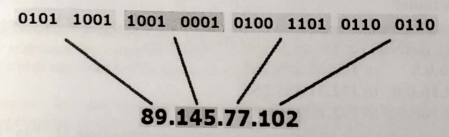
IP Address: A numerical label assigned to each device connected to a computer network that uses the IP for communication. Serves two main functions: Identifying the host or network interface and providing the location of the device in the network.
Network part: Identifies the network to which the device is connected. Remains constant for all devices on the network.
Host part: Identifies the specific device on the network. Unique for each device on the network.
Private IP Address: Used for identification of a device within a private network. Not globally unique. Not valid on the internet.
Public IP Address: For devices accessible on the internet. Computers use IP addresses to identify each other and data is sent from one computer to the other. A unique number.
Exclusive IP Address: Is used by only one site. With an exclusive IP no other side on the server uses the same IP.
Dynamic IP Address: Any type of IP address that changes.
Static IP Address: Remains the same
Why do Public IP addresses change?
Dynamic IP address allocation
Network maintenance
Security concerns
When do you need a Static IP address?
Hosting servers or services
Remote access
Security
Networked printers