Cell Biology and Organisation Study Notes
Cell Biology and Organization
Overview of Cellular Life Span and Types
Longest Life Span of Cells: The transcript does not specify which cell has the longest lifespan, but generally, neurons are considered to have very long lifespans, while skin cells have a shorter lifespan.
Components of Plant and Animal Cells:
Plant Cells: Cell wall, chloroplasts, large central vacuole, mitochondria, endoplasmic reticulum (smooth and rough), ribosomes, nucleus, cytoplasm.
Animal Cells: Plasma membrane, mitochondria, centriole, Golgi apparatus, endoplasmic reticulum (smooth and rough), lysosomes, ribosomes, nucleus, cytoplasm.
Life Processes of Unicellular Organisms: Unicellular organisms perform life processes including respiration, movement, nutrition, response to stimuli, reproduction, growth, and excretion.
Relationship Between Cell Structure and Function: Specialized cell structures are adapted to their specific functions, such as muscle cells’ ability to contract and nerve cells’ capacity to transmit signals.
Levels of Organization in Multicellular Organisms
Hierarchy of Organization:
Cell
Tissue
Organ
Organ System
Multicellular Organism
2.1.2 Identifying Structures of Cells
Components Observed:
Plant Cell: Cell wall, chloroplasts, large vacuole, nucleus.
Animal Cell: Plasma membrane, nucleus, mitochondria, centriole, etc.
2.1.3 Functions of Cell Components
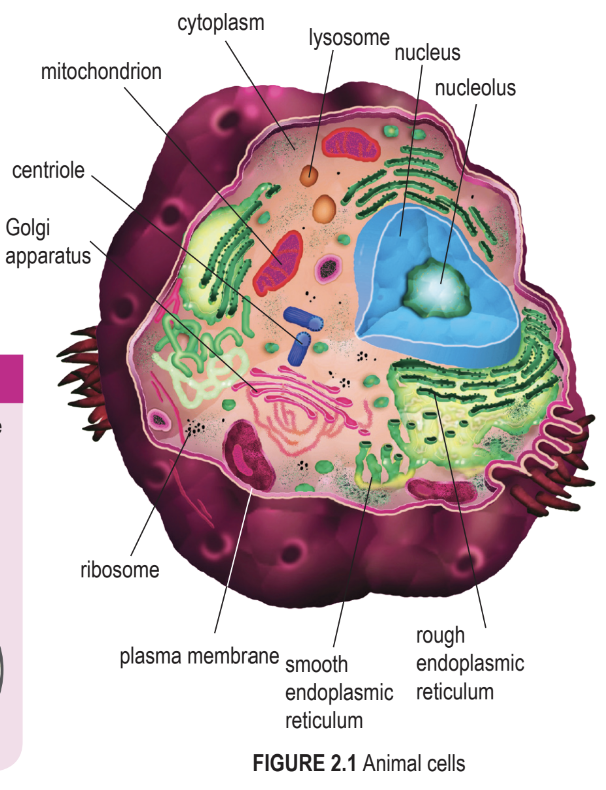
Mitochondrion:
Function: Energy production through cellular respiration, generating ATP.
Centriole:
Function: Forms spindle fibers for cell division.
Golgi Apparatus:
Function: Modifies, sorts, and packages proteins for secretion.
Nucleus: Control center of the cell containing DNA.
2.1.4 Comparing Animal and Plant Cells
Similarities:
Both types contain nucleus, cytoplasm, and organelles like mitochondria, endoplasmic reticulum, and Golgi apparatus.
Differences:
Plant Cells: Have a rigid cell wall, chloroplasts, and a large central vacuole.
Animal Cells: Lack cell wall and chloroplasts, and may have small vacuoles.
Section 2.2: Living Processes in Unicellular Organisms
2.2.1 Living Processes Demonstrated
Amoeba sp.: Moves through pseudopodia, exhibits phototropism, and undergoes excretion via osmosis.
Paramecium sp.: Utilizes cilia for movement and feeding.
2.2.2 Life Process Analysis
Processes such as growth and asexual reproduction (binary fission in suitable conditions or spore formation under stress).
Nutrition: Amoeba engulfs food through phagocytosis. Paramecium utilizes cilia to direct food particles to mouth region.
Section 2.3: Living Processes in Multicellular Organisms
2.3.1 Specialized Cell Structures
Muscle Cells: Multinucleated and striated; adapted for contraction.
Sperm Cells: Tail for swimming; carries genetic material.
Nerve Cells: Long structure for signal transmission.
White Blood Cells: Adaptive shape for pathogen destruction.
2.3.2 Types of Tissues
Epithelial Tissue: Protective layers surrounding organs and cavities.
Muscle Tissue: Three types—smooth, skeletal, cardiac.
Nerve Tissue: Transmits impulses for coordination and control.
Connective Tissue: Supports, connects, and protects organs; includes blood, bone, and cartilage.
Section 2.4: Levels of Organization
2.4.1 Organ Systems
Eleven Major Organ Systems: Include the respiratory, digestive, circulatory, and more, each with specific functions.
Collaboration of Systems: Each organ system works together to maintain homeostasis and overall function of the organism.
2.4.2 Organ Organization in Plants
Shoot System: Contains leaves and stems.
Root System: Anchors plant and absorbs water and nutrients.
2.4.3 Summary of Organ Functions
Interdependent functioning of systems ensures survival and adaptation.
Important Definitions and Concepts
Tissue: Group of cells working together for a specific function.
Organ: Structure composed of different tissues performing a specific task.
Organ System: Group of organs working towards a common function.
Formative Practices and Self-Reflection
Activities following sections encourage understanding through questions and practical applications related to topics covered.
Potential Essay Topics and Summary Questions
Discuss specific unicellular organisms and their life processes.
Explore the structure-function relationship in specific cells, tissues, and organs present in multicellular organisms.