Week 12 Pre-work PT1- Electric Currents and Resistance
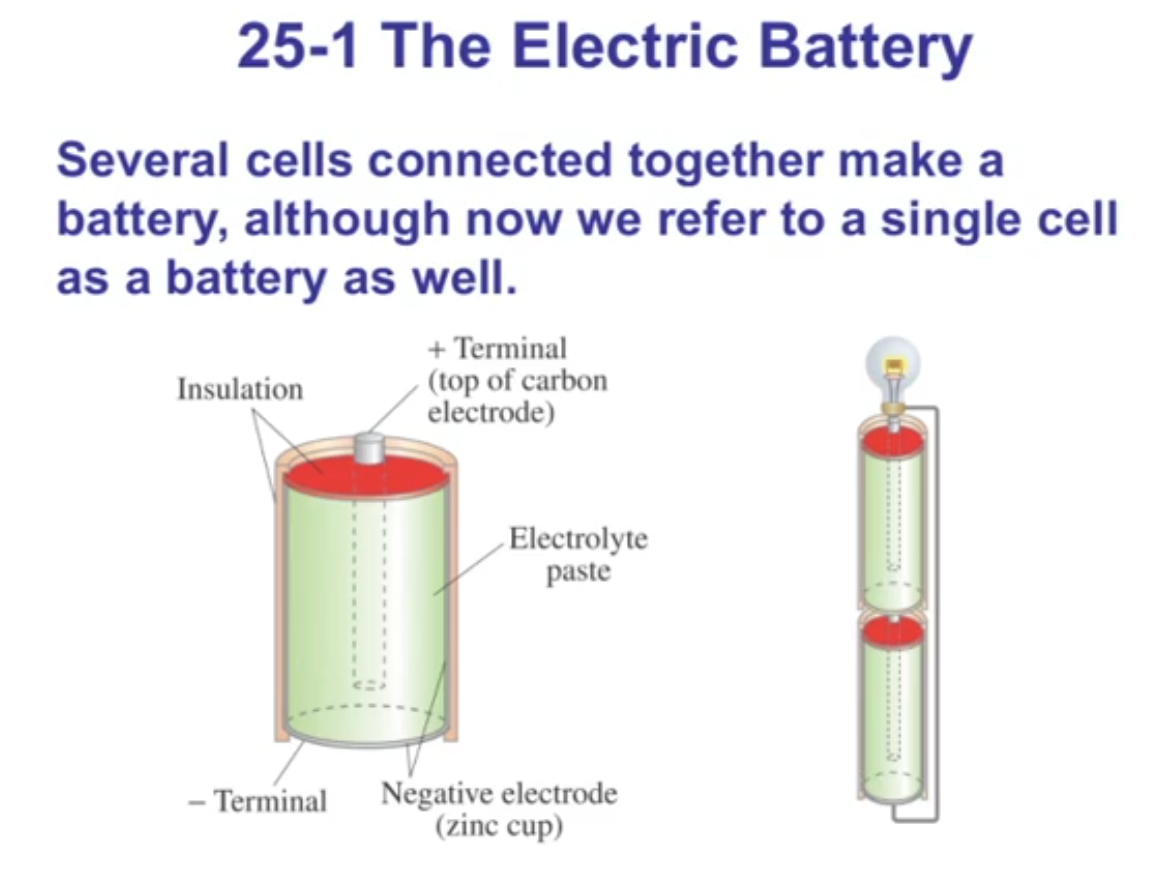
The Electric Battery
Volta discovered electricity could be created by connecting dissimilar metals with a conductive solution (electrolyte).
A battery transforms chemical energy into electrical energy.
Chemical reactions create a potential difference between terminals by dissolving them.
This potential difference is maintained until one terminal dissolves completely.
Several cells connected form a battery; now, a single cell is also called a battery.
Electric Current
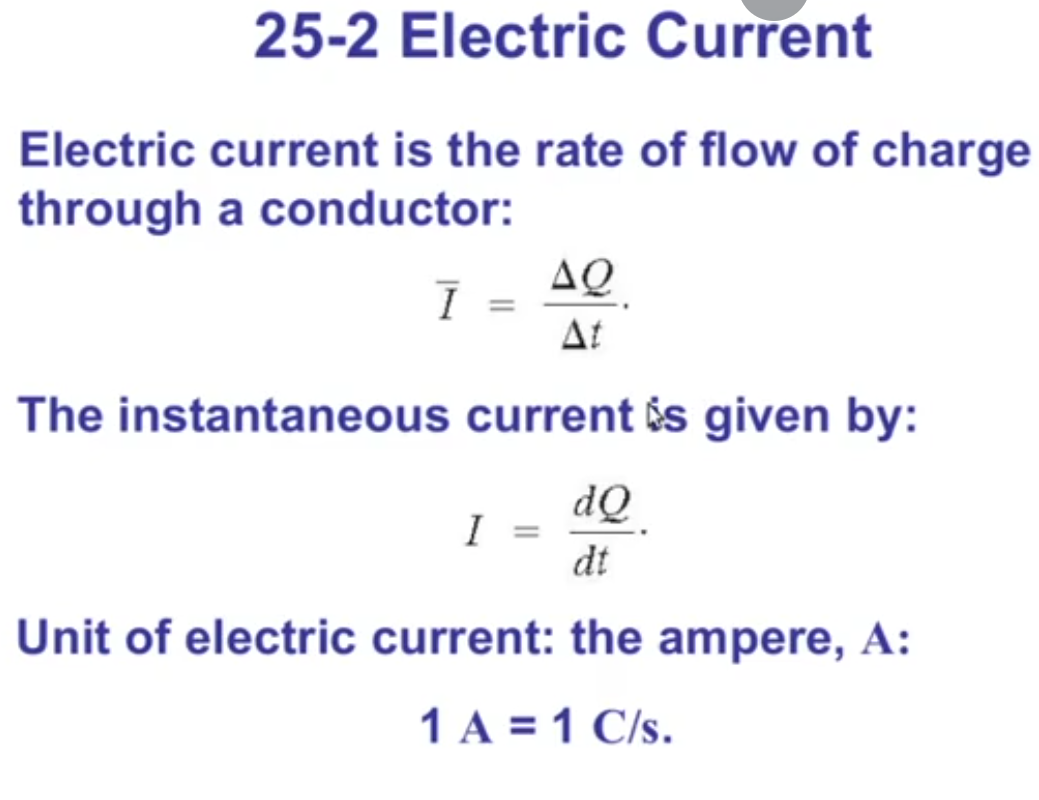
Electric current is the rate of flow of charge through a conductor.
Unit of electric current: Ampere (A).
The instantaneous current is given by: .
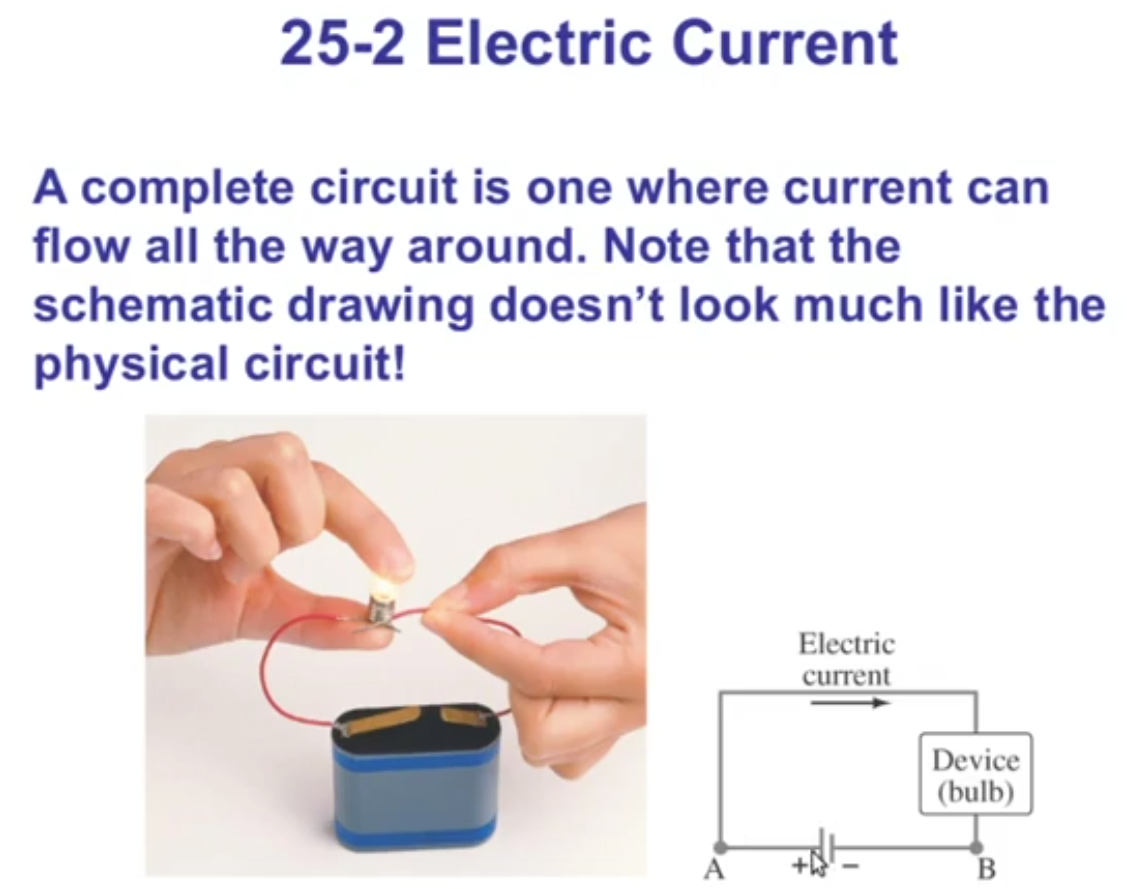
A complete circuit allows current to flow all the way around.
By convention, current flows from + to -.
Electrons flow in the opposite direction, but not all currents consist of electrons.
Example 25-1: Current is flow of charge
A steady current of 2.5 A exists in a wire for 4.0 min.
(a) How much total charge passed by a given point in the circuit during those 4.0 min?
(b) How many electrons would this be?
Solution:
(a)
(b)
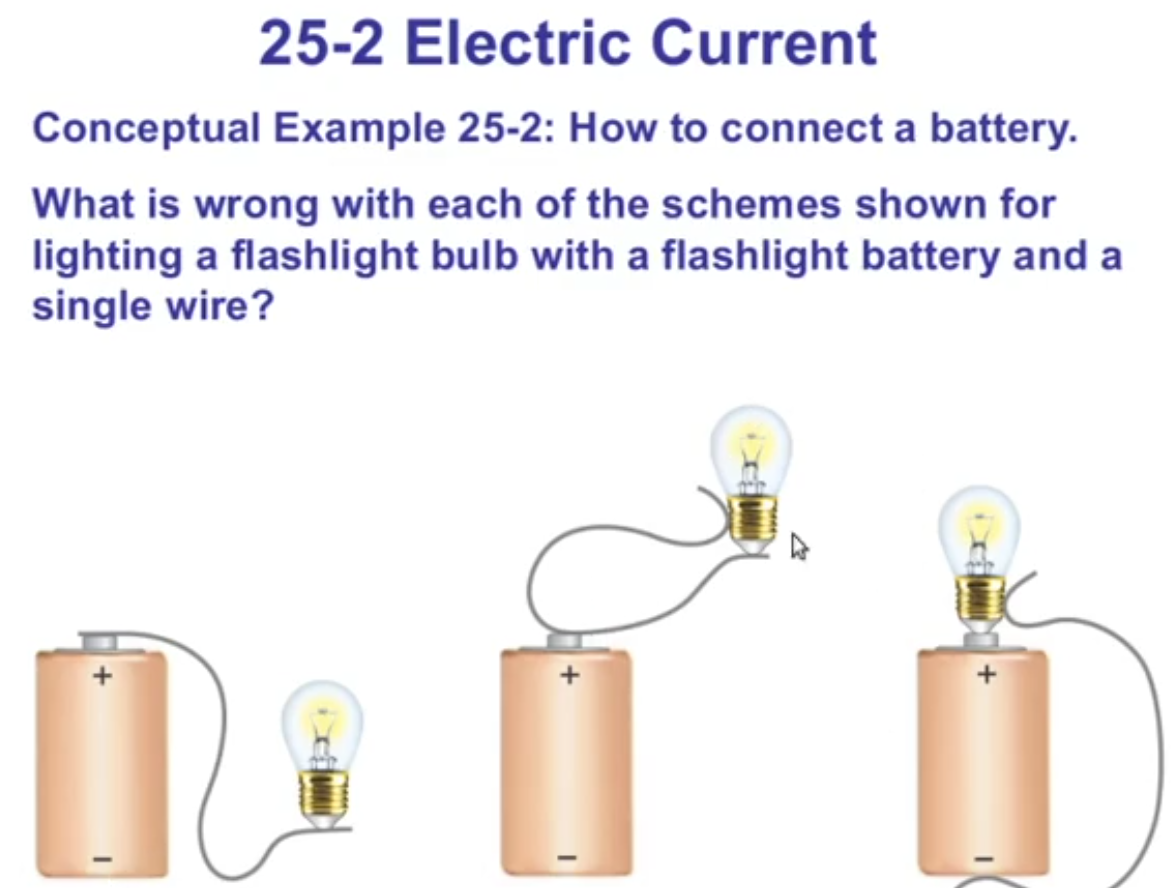
Conceptual Example 25-2: How to connect a battery
Correct circuit must include both battery terminals.
Ohm’s Law: Resistance and Resistors
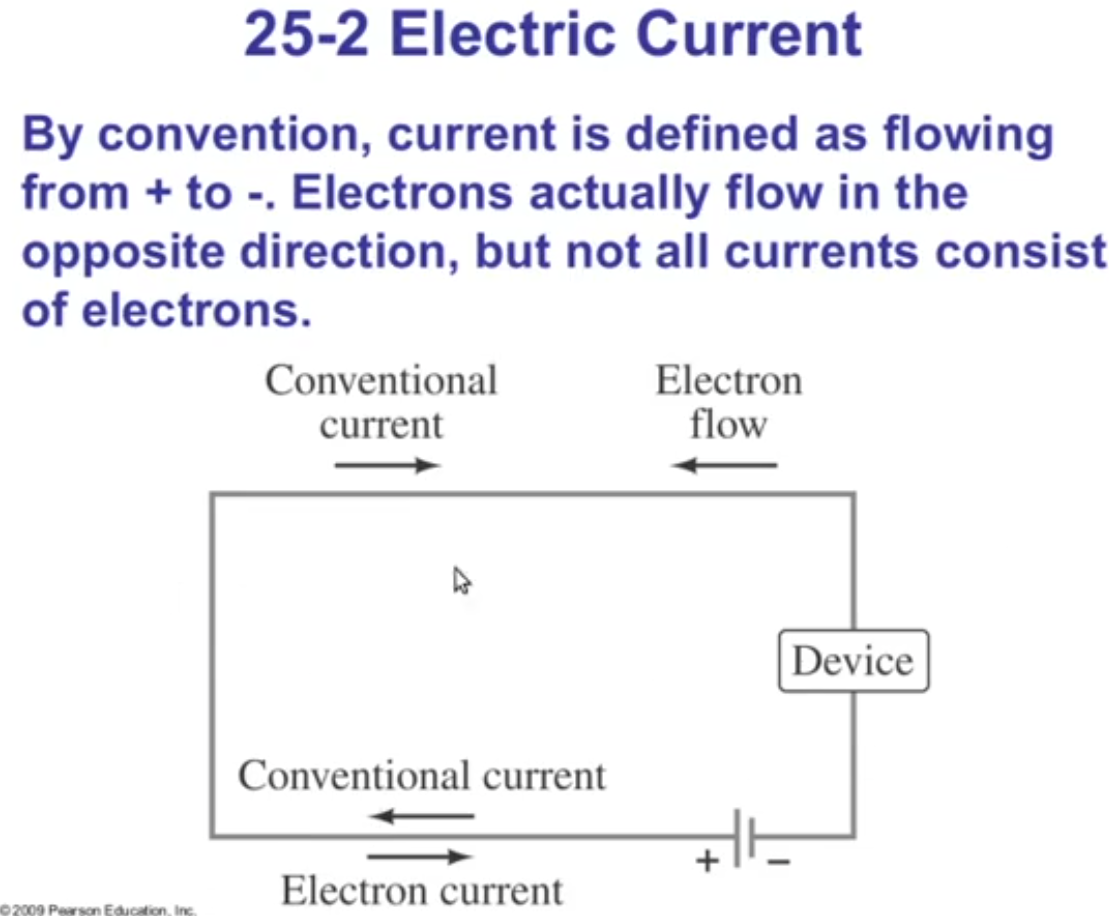
Experimentally, the current in a wire is proportional to the potential difference between its ends:
The ratio of voltage to current is called the resistance: .
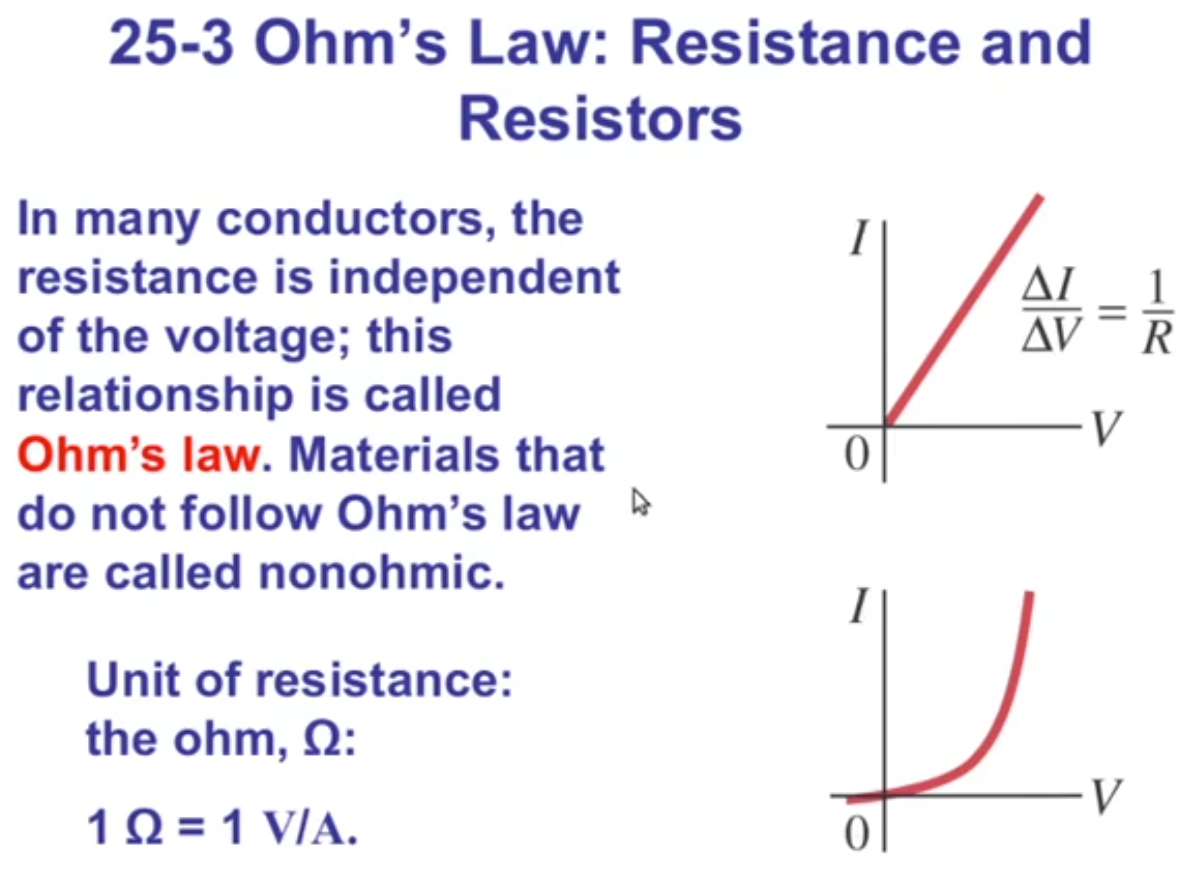
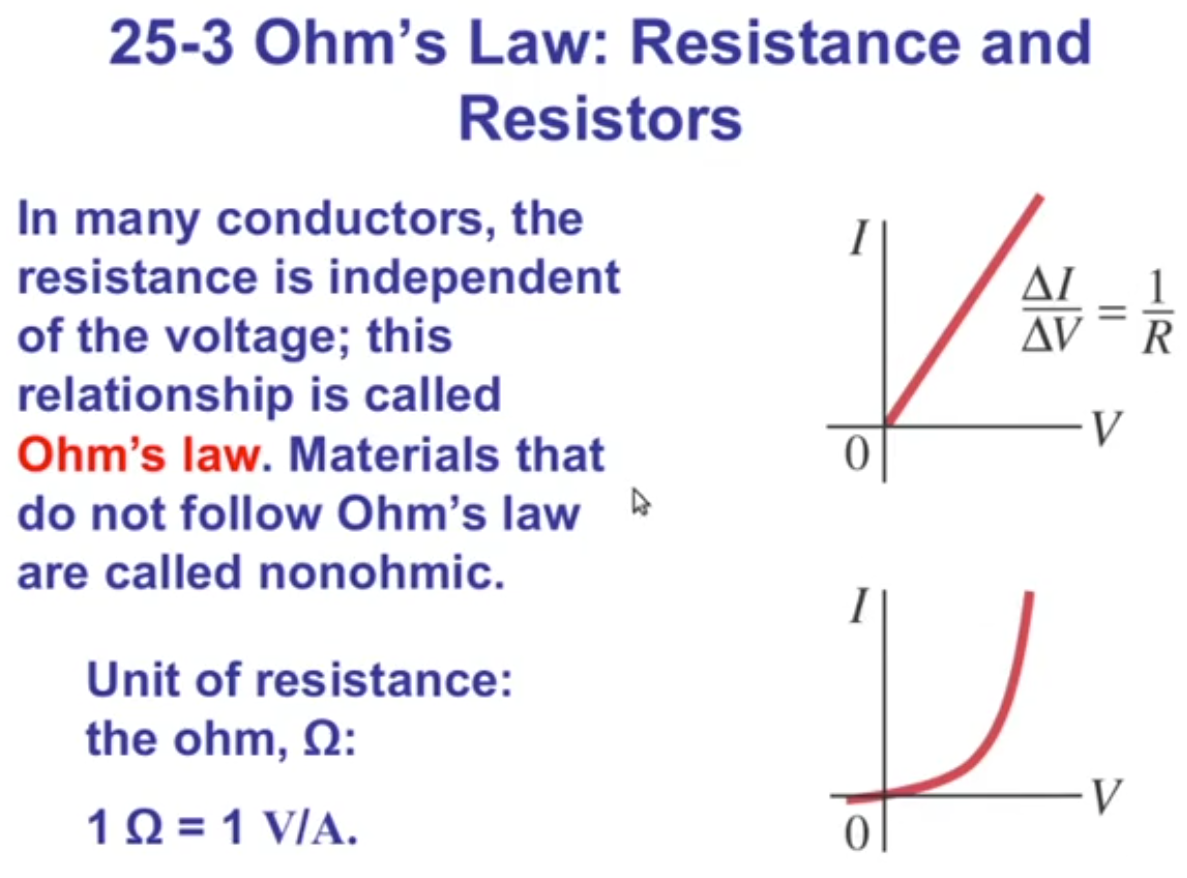
In many conductors, resistance is independent of voltage; this is Ohm’s law.
Materials not following Ohm’s law are nonohmic.
Unit of resistance: Ohm ().
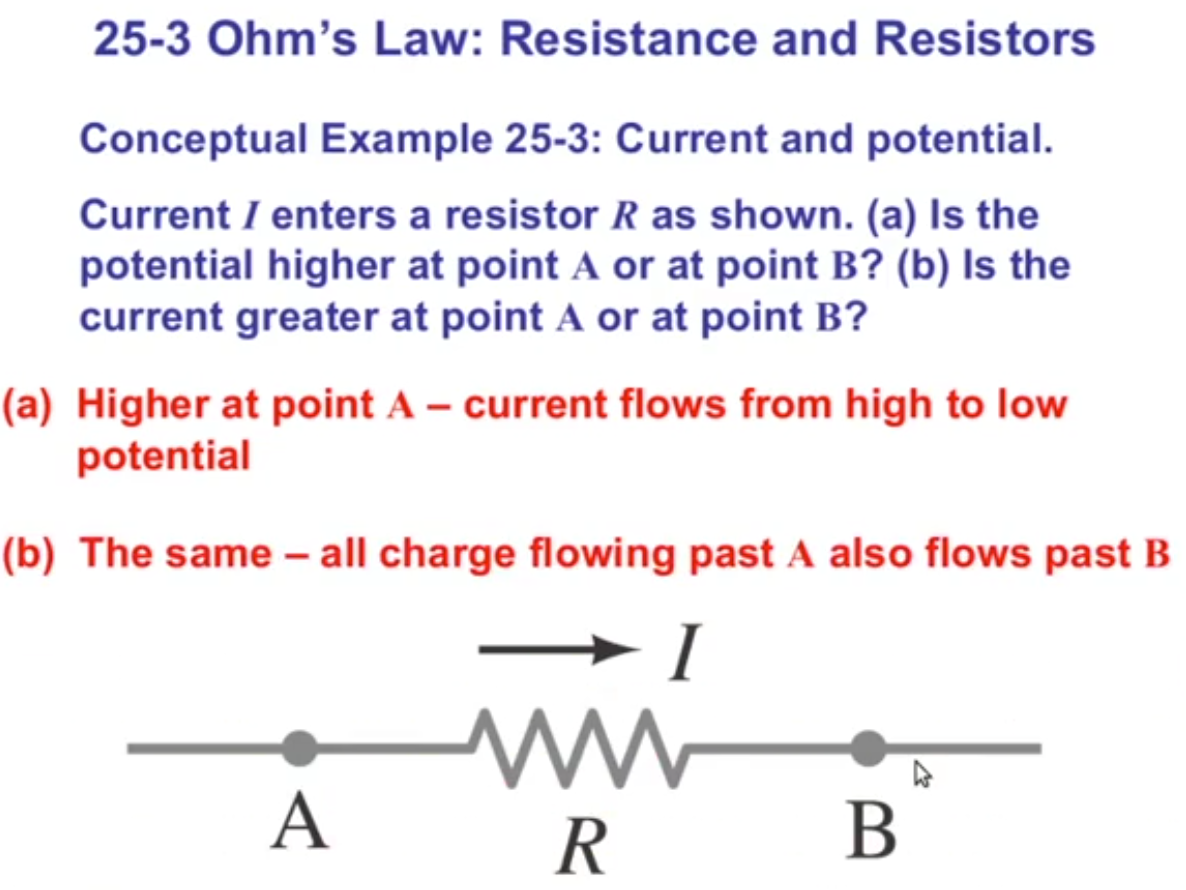
Conceptual Example 25-3: Current and potential
(a) Potential is higher at point A because current flows from high to low potential.
(b) Current is the same at points A and B because all charge flowing past A also flows past B.
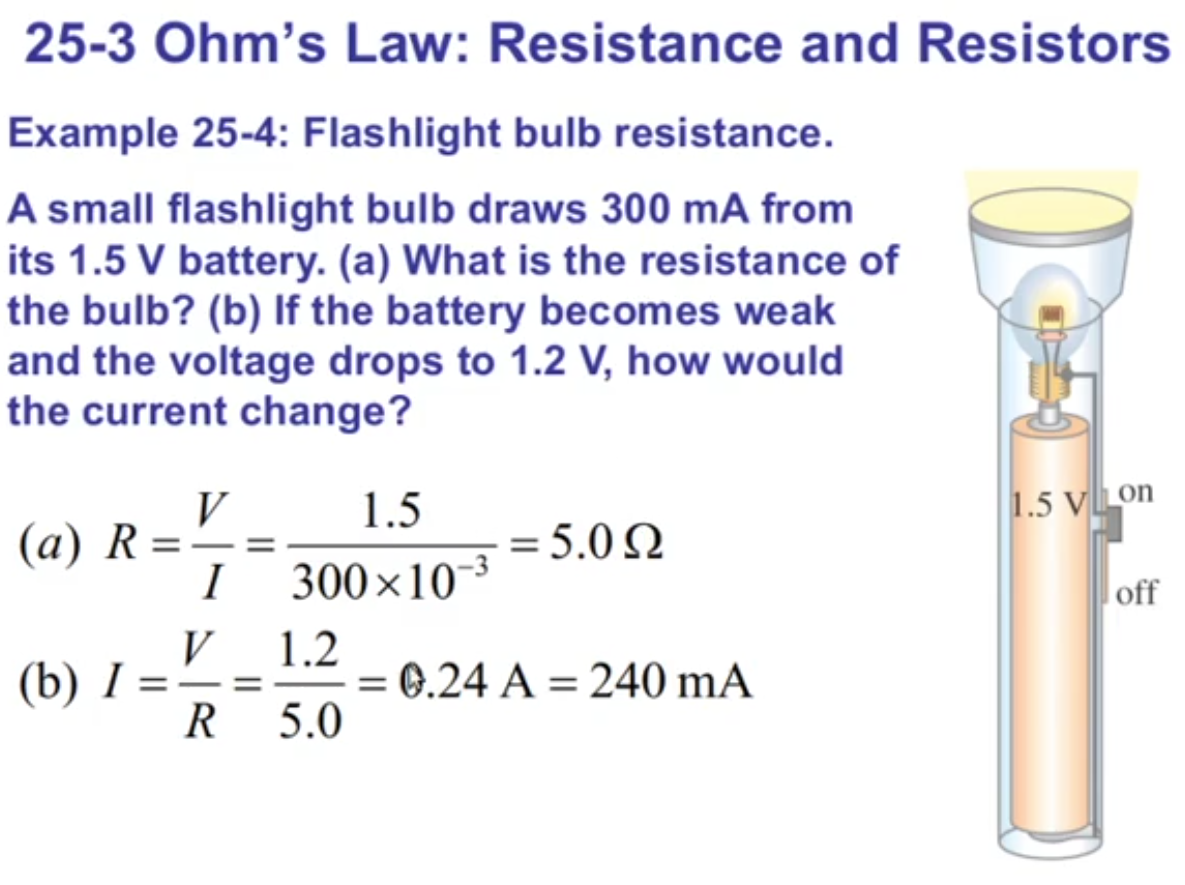
Example 25-4: Flashlight bulb resistance
A small flashlight bulb draws 300 mA from its 1.5 V battery.
(a) What is the resistance of the bulb?
(b) If the battery becomes weak and the voltage drops to 1.2 V, how would the current change?
Solution:
(a)
(b)
Standard Resistors
Standard resistors are color-coded to indicate value and precision.
Resistor Color Code:
Black = 0, Brown = 1, Red = 2, Orange = 3, Yellow = 4, Green = 5, Blue = 6, Violet = 7, Grey = 8, White = 9
Example: Red, Violet, Yellow => 2, 7, 4 zeroes =>
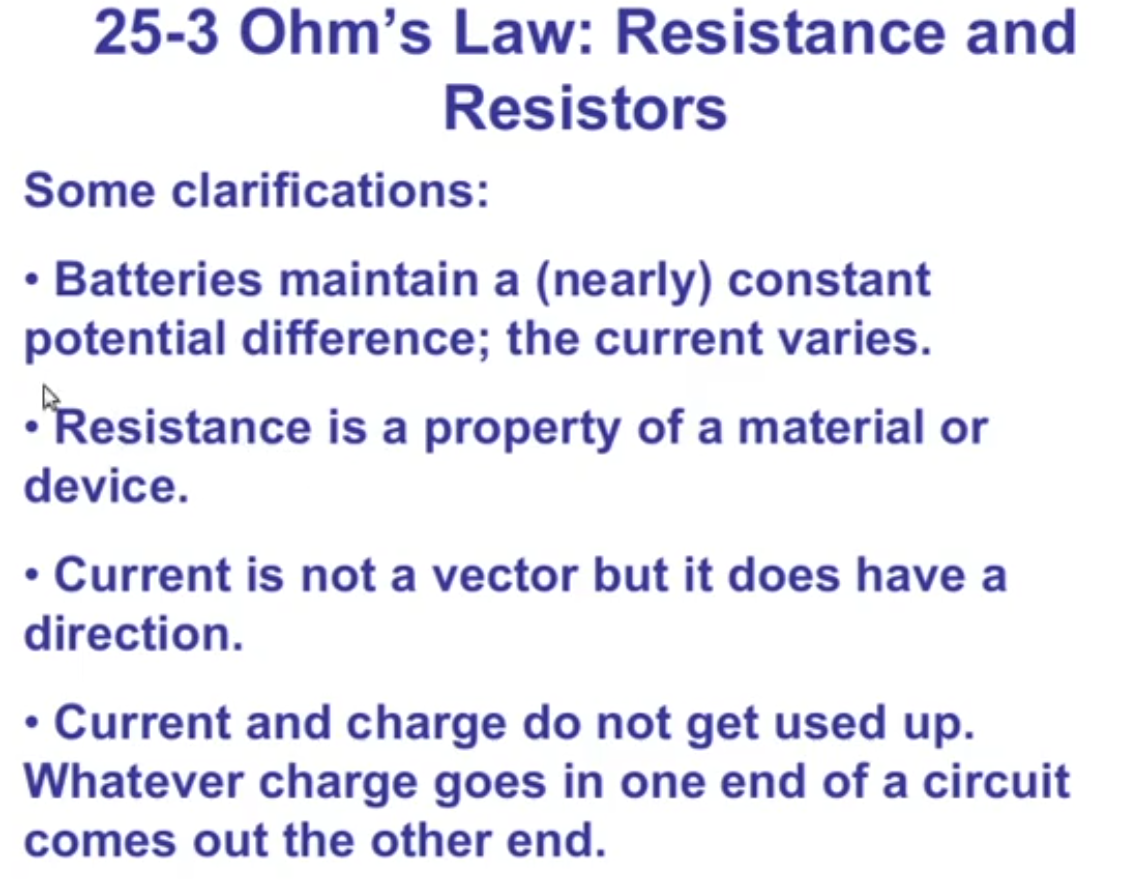
Clarifications
Batteries maintain a (nearly) constant potential difference; the current varies.
Resistance is a property of a material or device.
Current is not a vector but has a direction.
Current and charge do not get used up; charge entering one end of a circuit exits the other end.
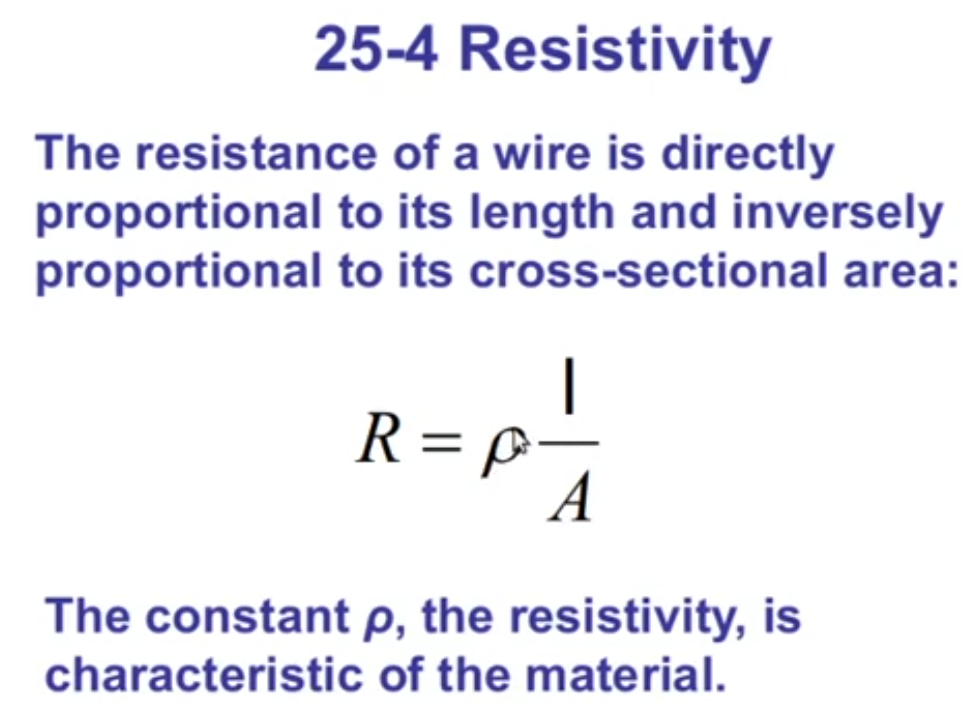
Resistivity
Resistance is directly proportional to length (l) and inversely proportional to cross-sectional area (A): .
is the resistivity, characteristic of the material.
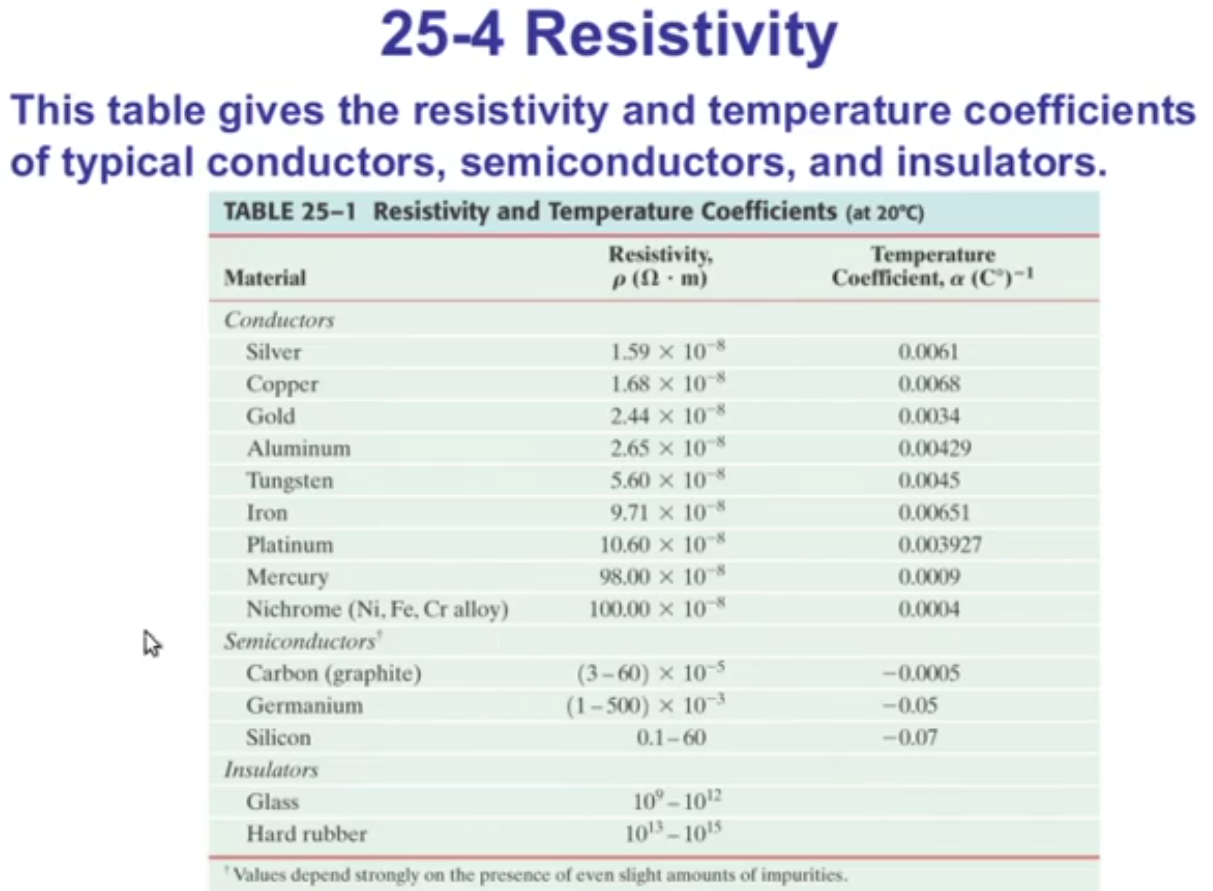
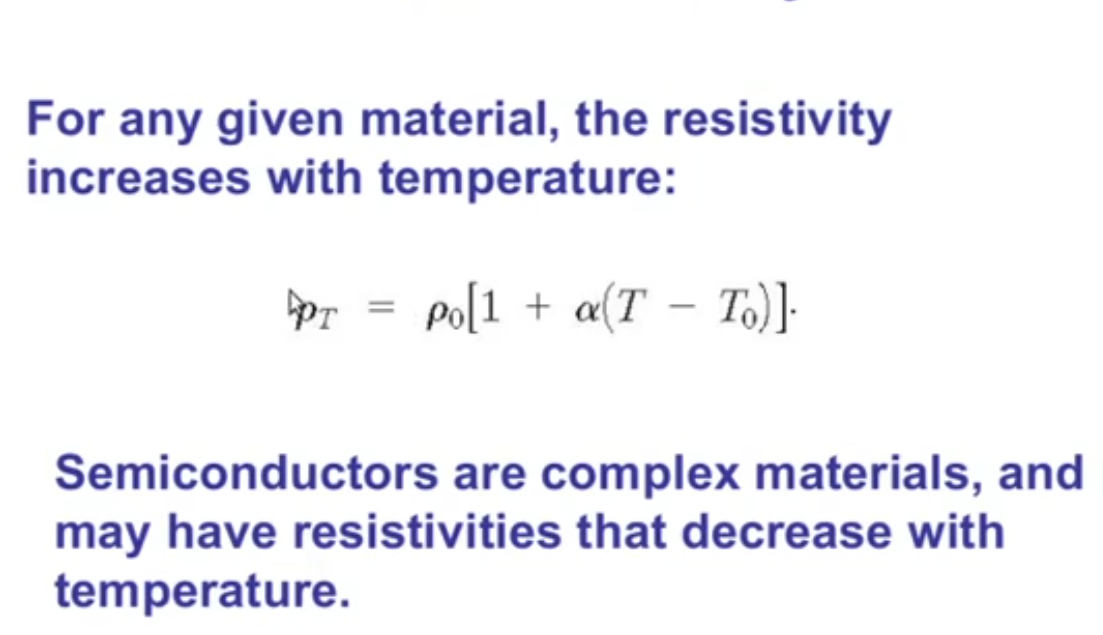
For a given material, resistivity increases with temperature.
Semiconductors are complex and may have resistivities that decrease with temperature.
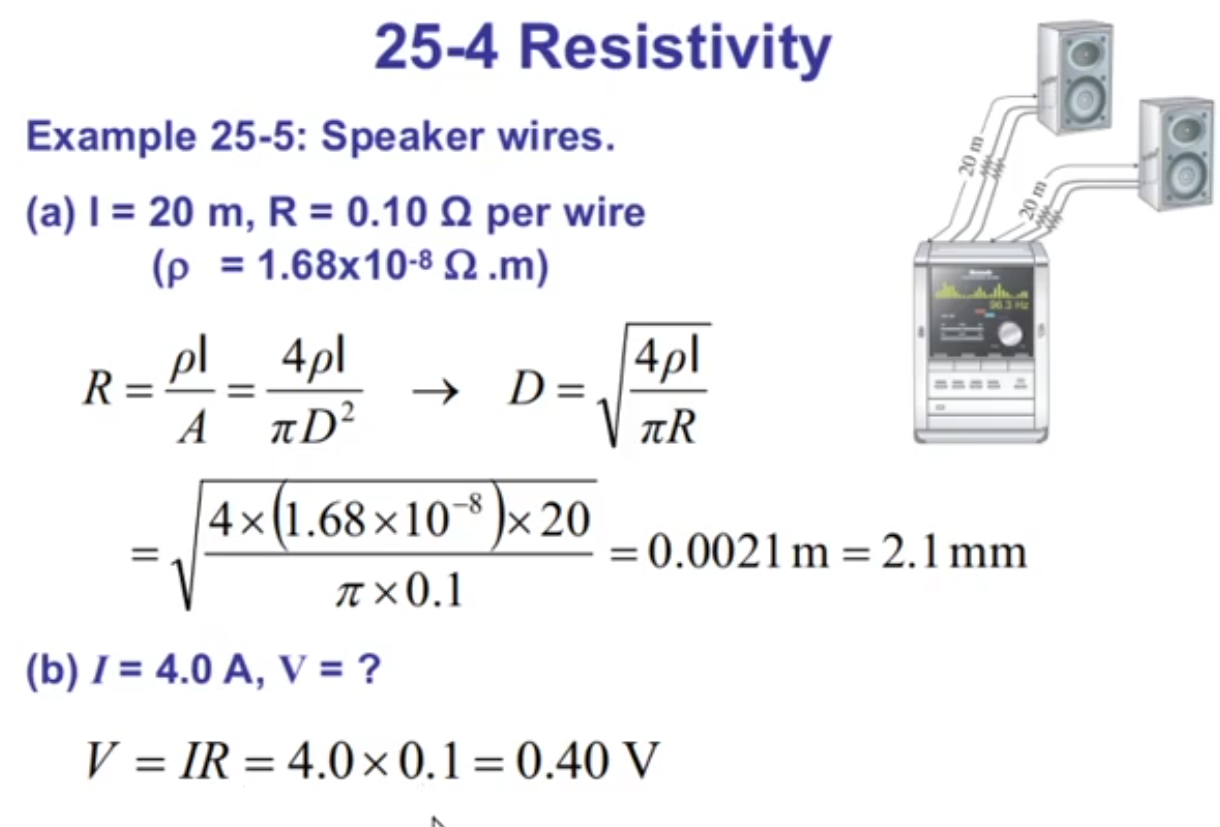
Example 25-5: Speaker wires
Each wire is 20 m long; keep resistance less than 0.10 per wire.
(a) What diameter copper wire should be used?
(b) If the current is 4.0 A, what is the voltage drop across each wire?
Solution:
(a) Given: , ,
(b)
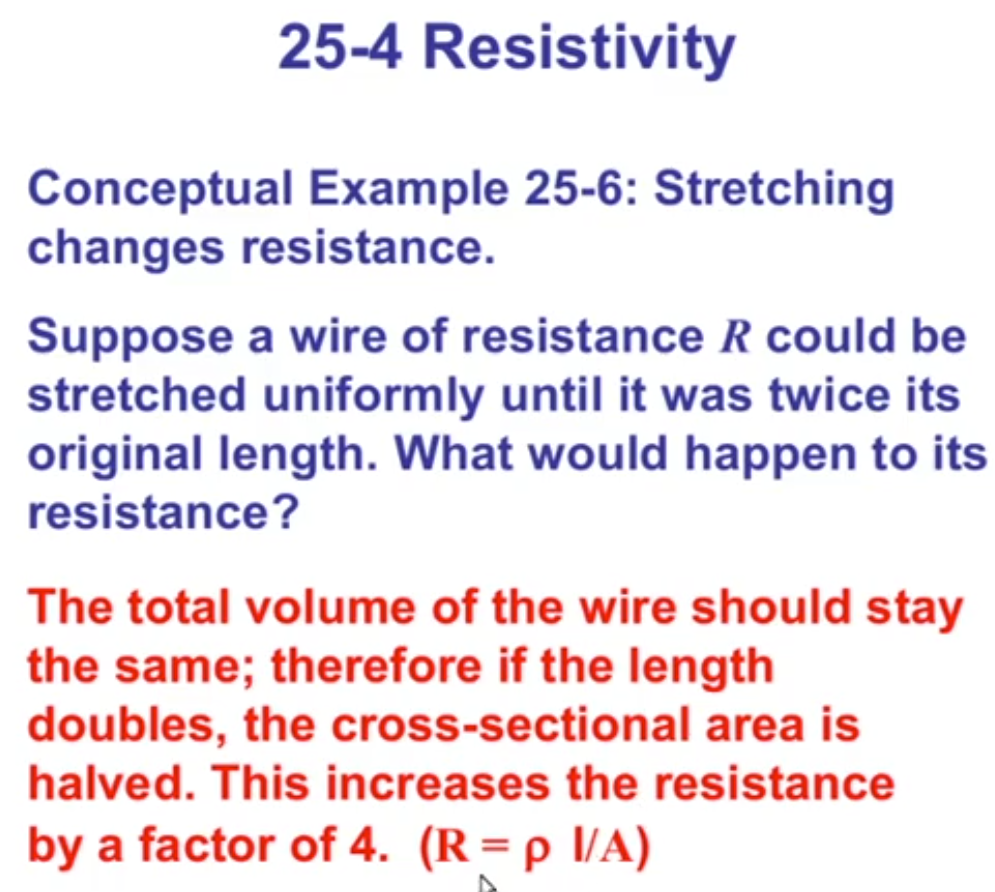
Conceptual Example 25-6: Stretching changes resistance
A wire of resistance R is stretched to twice its original length.
The volume of the wire stays the same, so if length doubles, cross-sectional area is halved.
Resistance increases by a factor of 4 since .
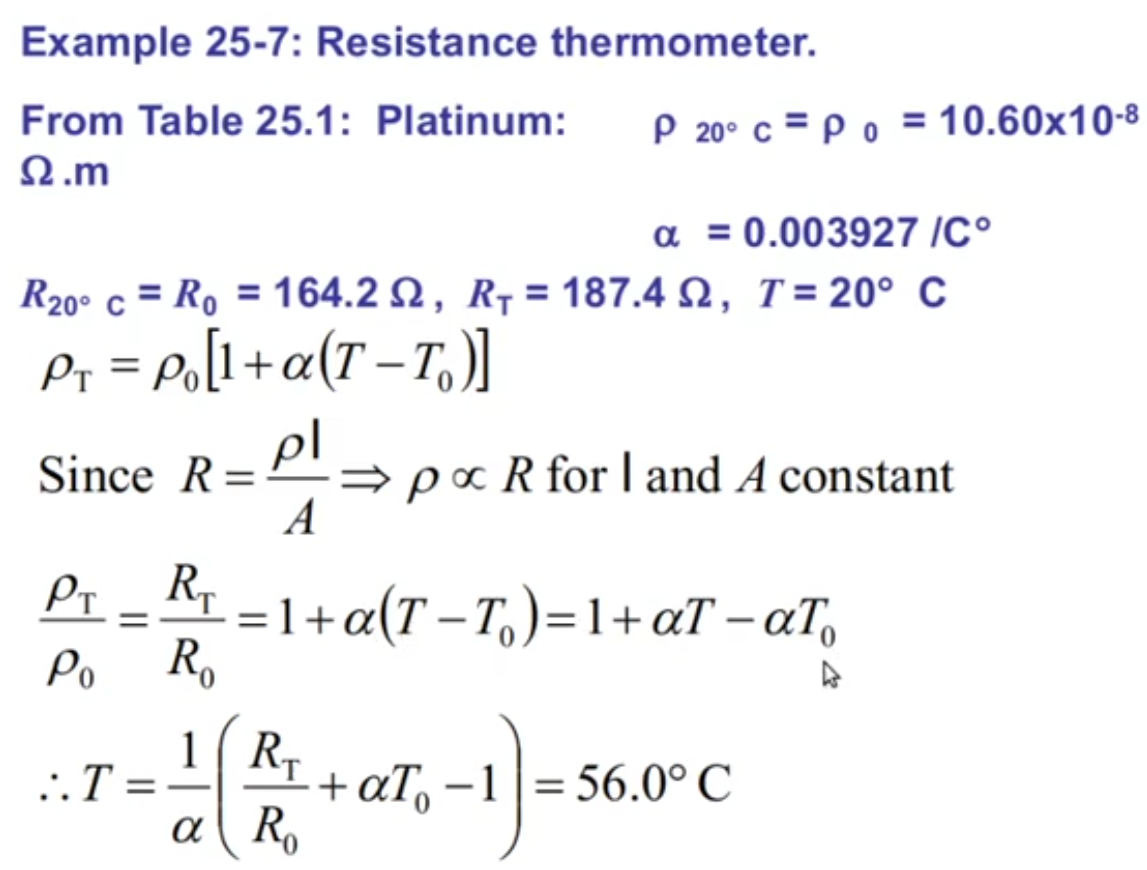
Example 25-7: Resistance thermometer
At 20.0°C, resistance of a platinum resistance thermometer is 164.2 .
When placed in a solution, resistance is 187.4 .
What is the temperature of this solution?
Solution:
Electric Power
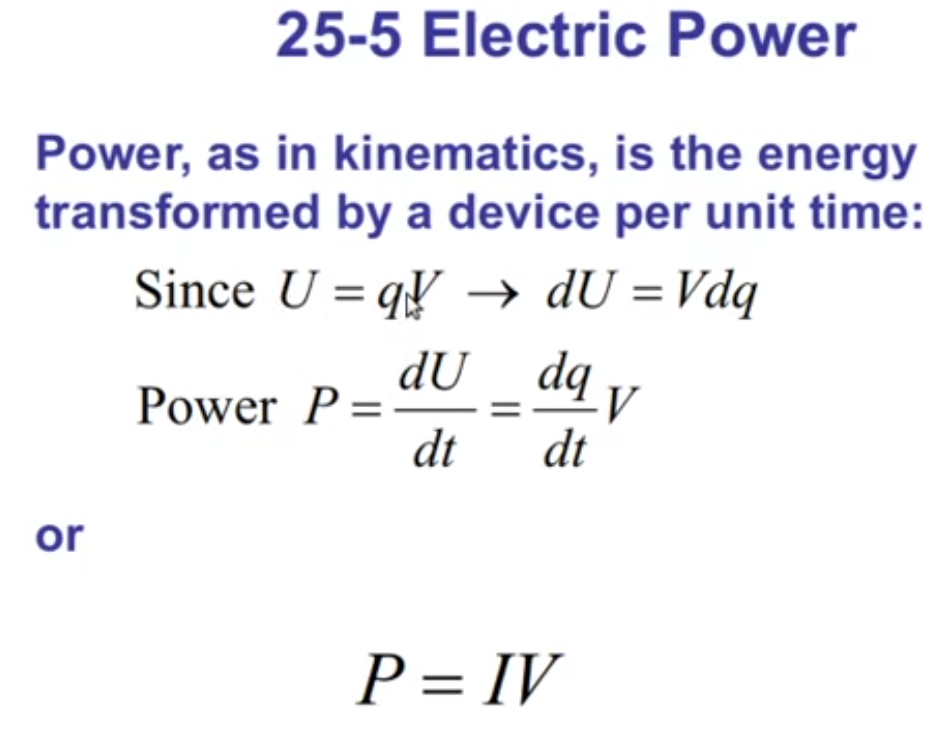
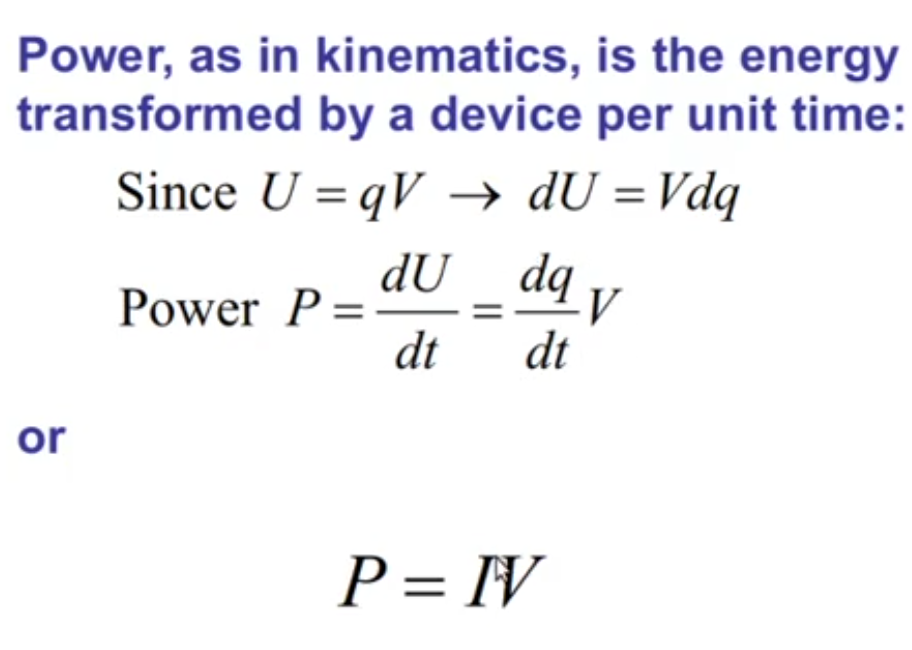
Power is the energy transformed by a device per unit time: .
Since , then
Unit of power is the watt (W).
For ohmic devices, we can make the substitutions:
Example 25-8: Headlights
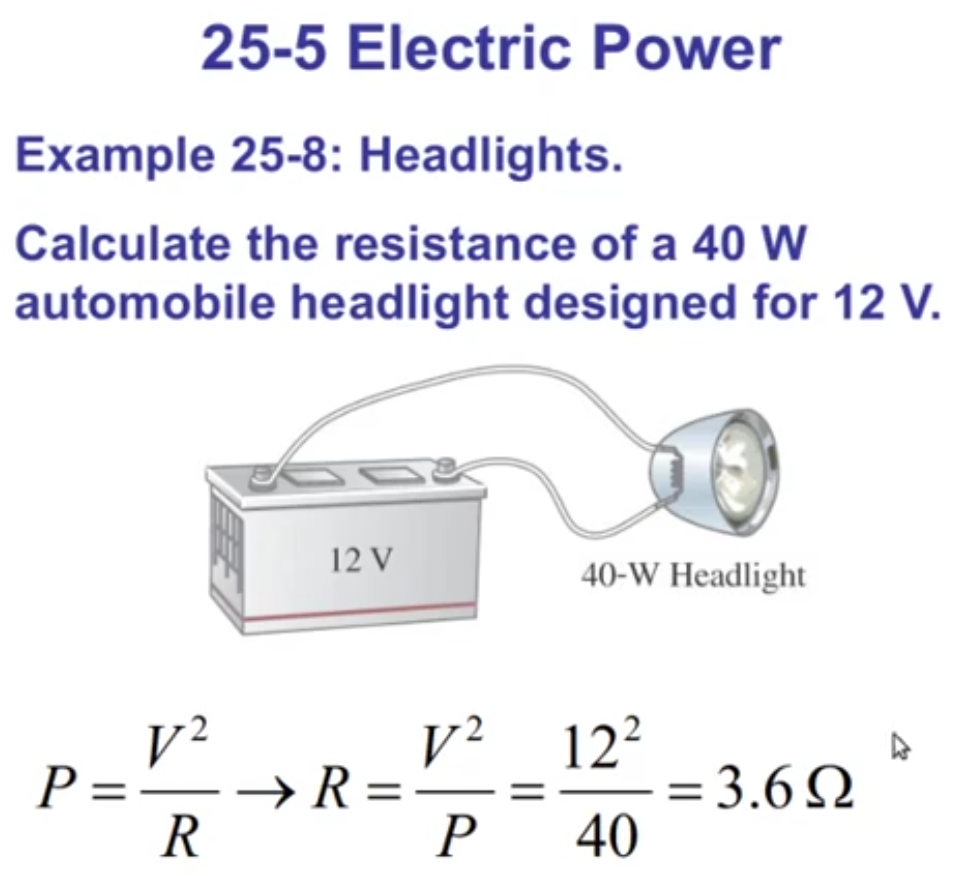
Calculate the resistance of a 40 W automobile headlight designed for 12 V.
Solution:
P = \frac{V^2}{R} => R = \frac{V^2}{P} = \frac{(12 V)^2}{40 W} = 3.6 \Omega
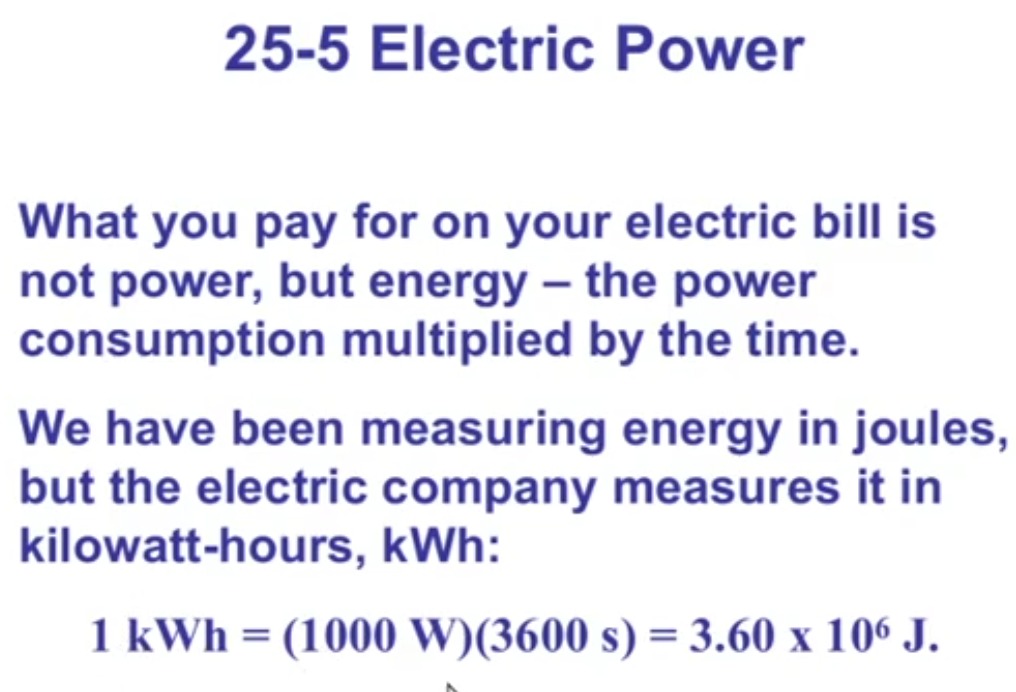
What you pay for on your electric bill is energy (power consumption multiplied by time).
Electric company measures energy in kilowatt-hours (kWh):
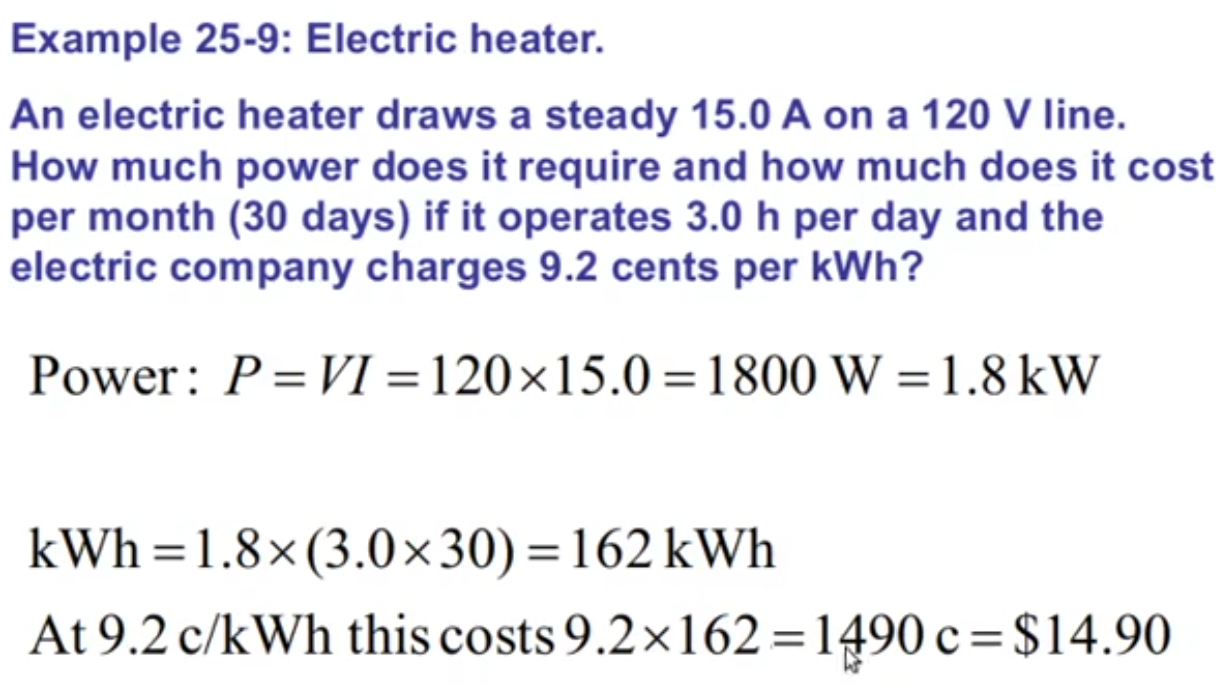
Example 25-9: Electric heater
An electric heater draws a steady 15.0 A on a 120 V line.
How much power does it require and how much does it cost per month (30 days) if it operates 3.0 h per day and the electric company charges 9.2 cents per kWh?
Solution:
Energy per month:
Cost per month: 162 kWh * 9.2 cents/kWh = 1490 cents = $14.90
Example 25-10: Lightning bolt
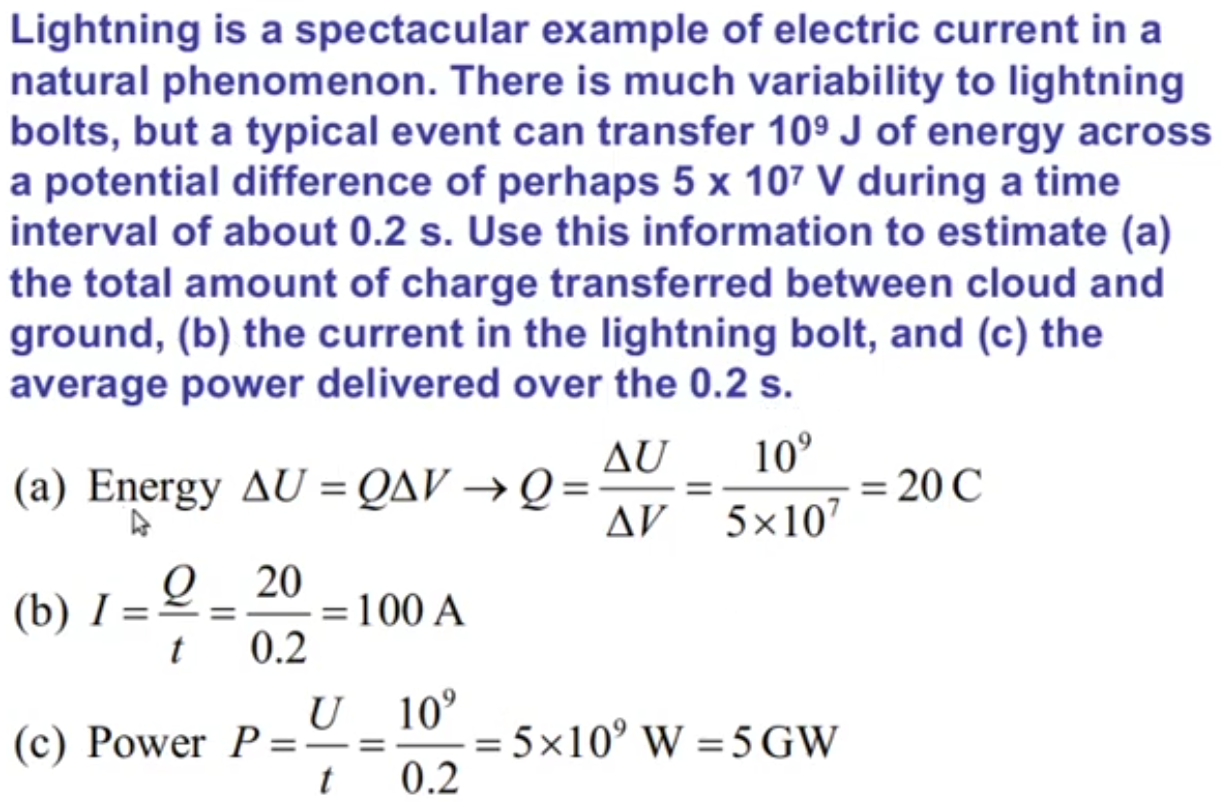
A typical lightning bolt transfers of energy across a potential difference of during a time interval of about 0.2 s.
(a) the total amount of charge transferred between cloud and ground
(b) the current in the lightning bolt
(c) the average power delivered over the 0.2 s
Solution:
(a) U = QV => Q = \frac{U}{V} = \frac{10^9 J}{5 * 10^7 V} = 20 C
(b)
(c)
Power in Household Circuits
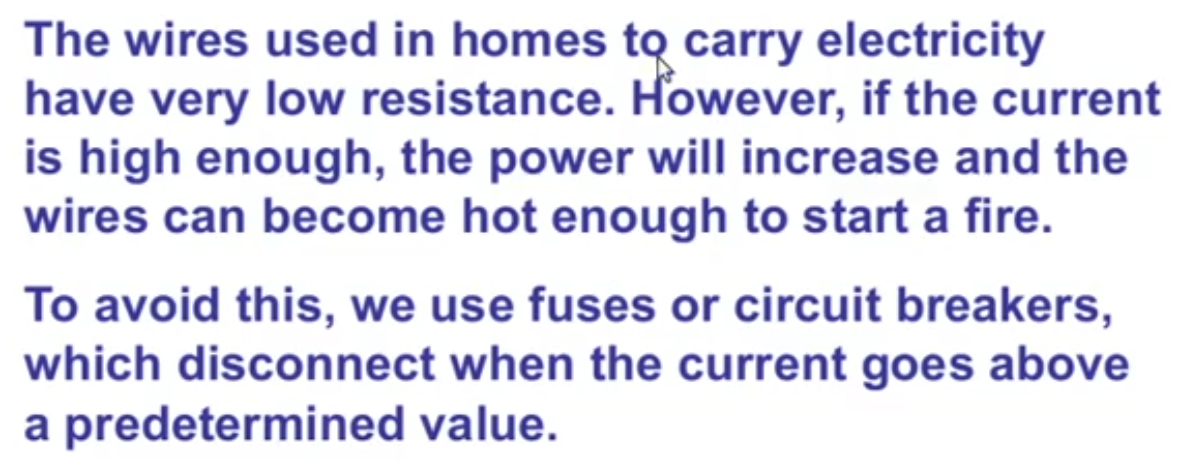
Wires in homes have very low resistance, but high current can cause wires to overheat and start a fire.
Fuses or circuit breakers disconnect when current exceeds a predetermined value.
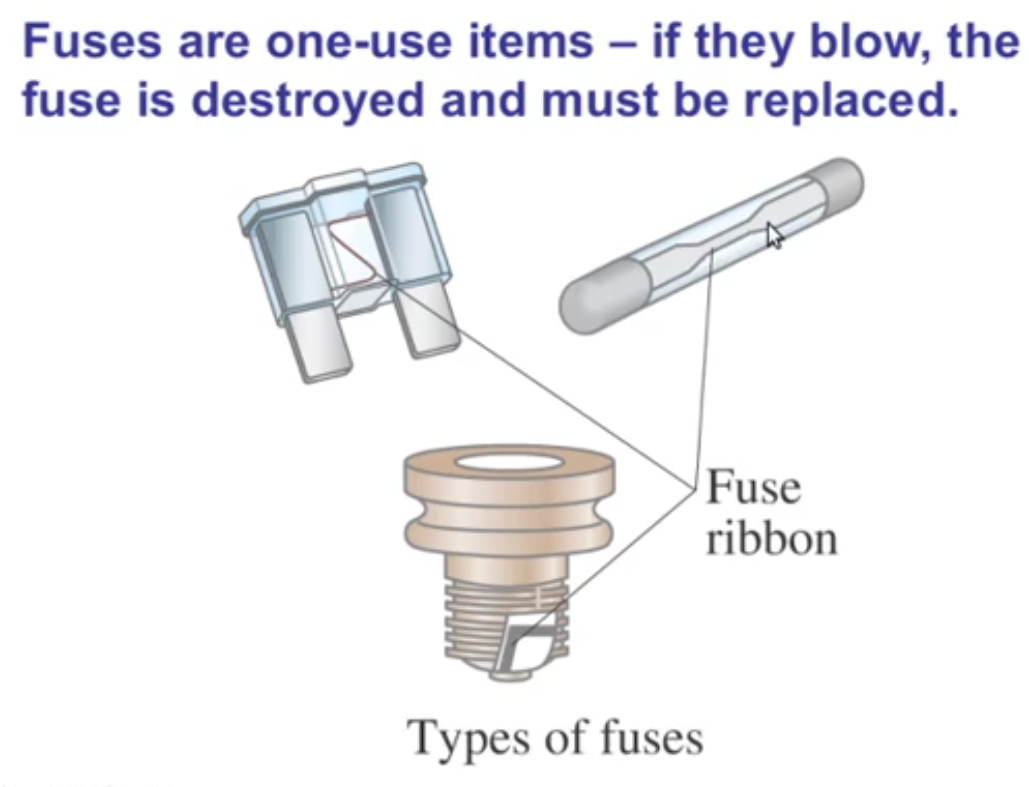
Fuses are one-use items; they are destroyed when they blow.
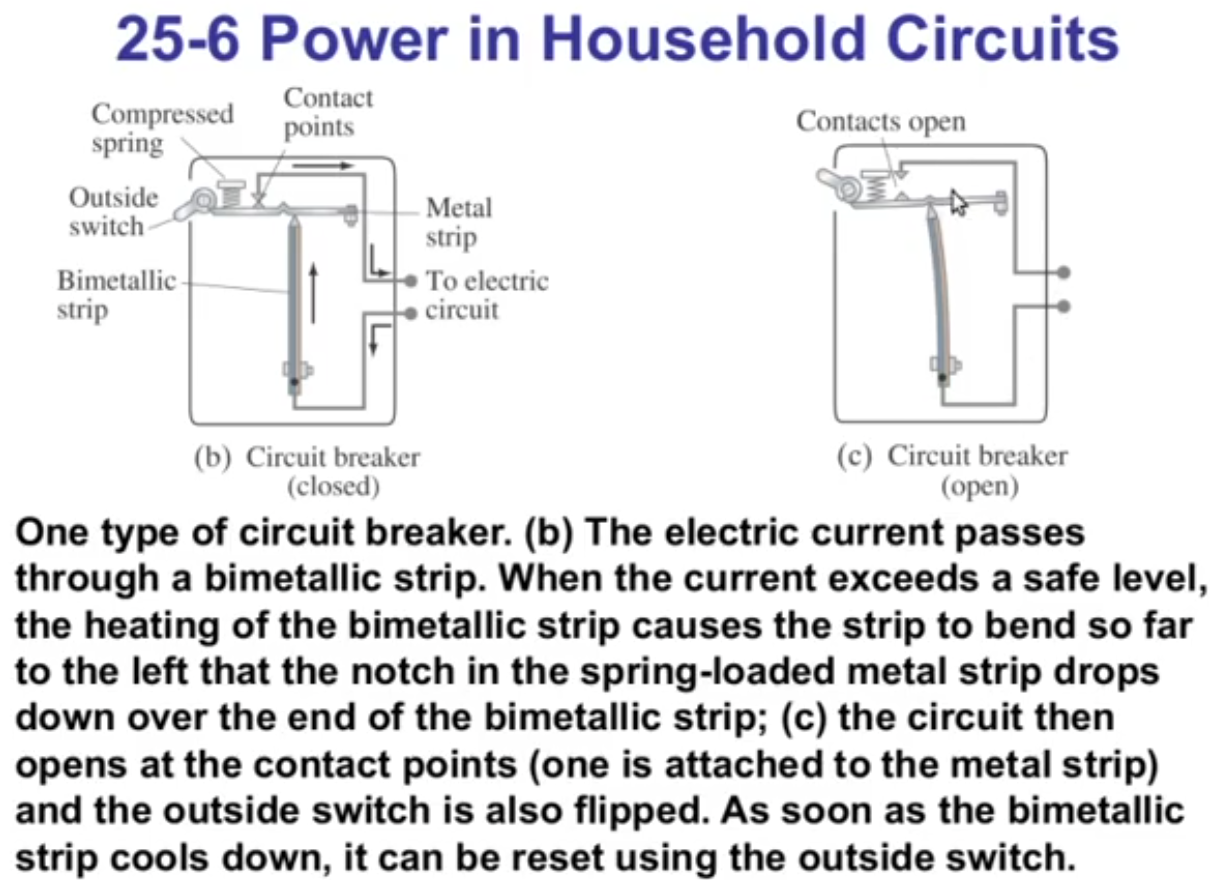
Circuit breakers are switches that open if the current is too high; they can be reset.
Circuit breakers use a bimetallic strip that bends when heated by excessive current, opening the circuit.
Example 25-11: Will a fuse blow?
Assume a 20 A fuse or circuit breaker.
Determine the total current drawn by all the devices in the circuit shown.
Devices:
Light: 100 W / 120 V = 0.83 A
Heater: 1800 W / 120 V = 15.0 A
Stereo: 350 W / 120 V = 2.9 A
Hair Dryer: 1200 W / 120 V = 10.0 A
Total Current = 0.83 A + 15.0 A + 2.9 A + 10.0 A = 28.7 A
The fuse would blow because the heater should be on a separate circuit.
Conceptual Example 25-12: A dangerous extension cord
An 1800-W portable electric heater is plugged into an extension cord rated at 11 A.
An 1800-W heater operating at 120 V draws 15 A of current, exceeding the extension cord rating, creating a risk of overheating and fire.
Alternating Current
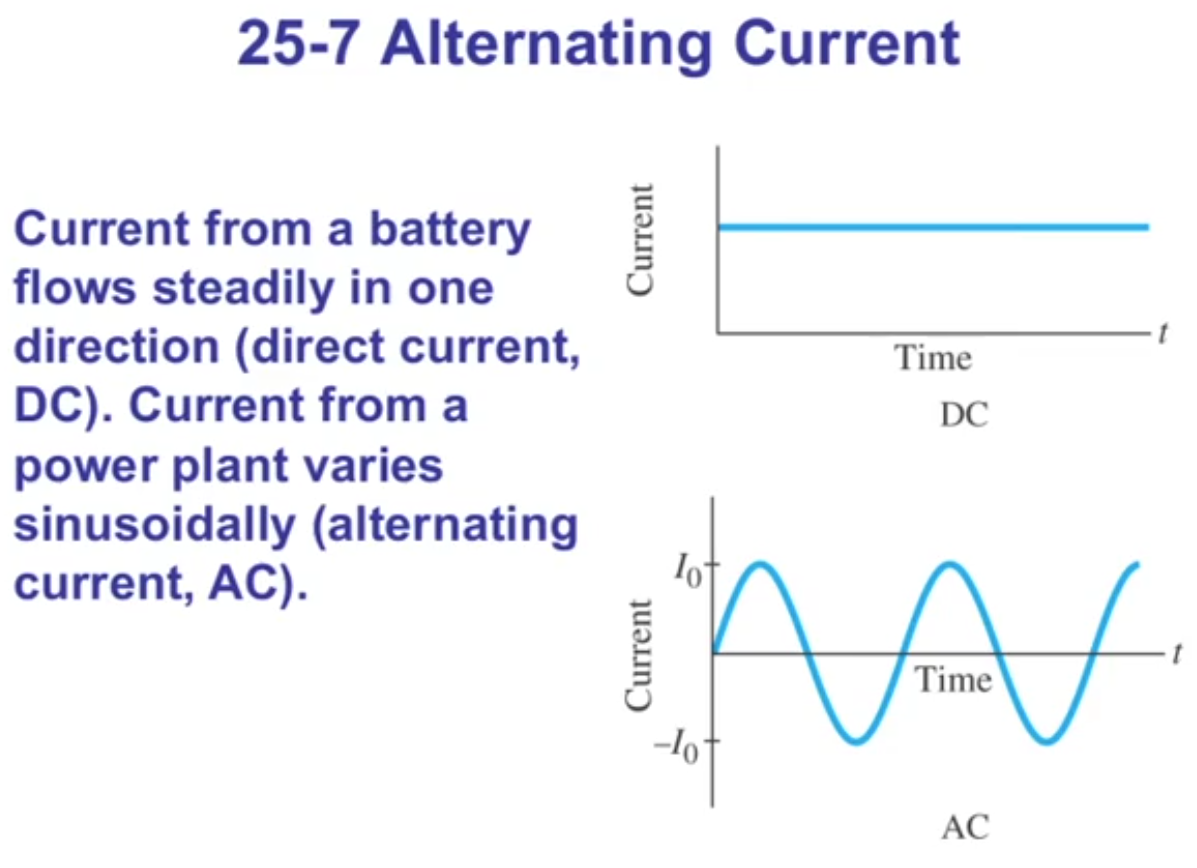
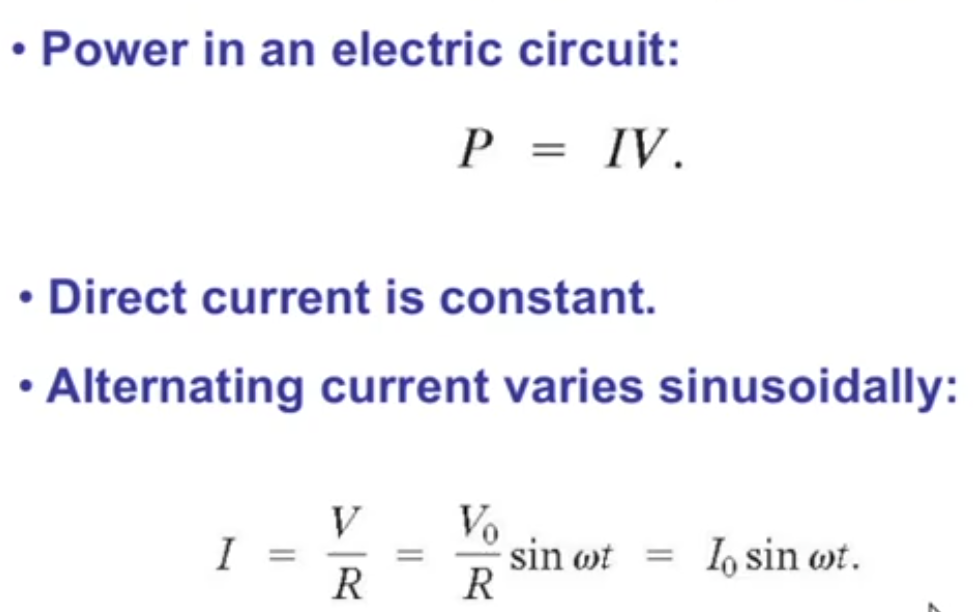
Current from a battery flows steadily in one direction (Direct Current, DC).
Current from a power plant varies sinusoidally (Alternating Current, AC).
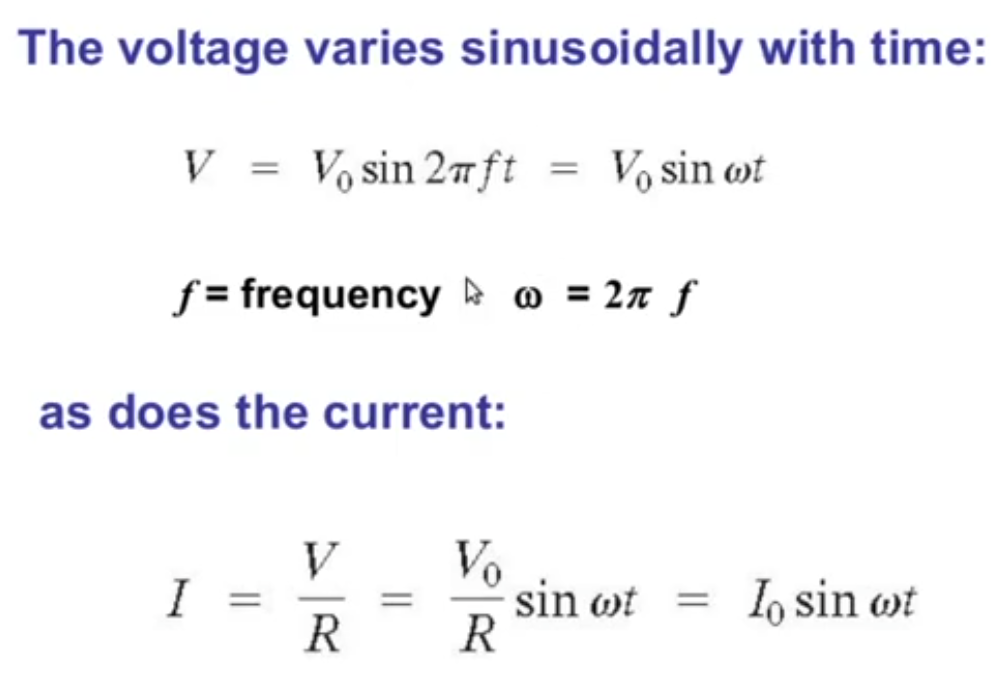
The voltage varies sinusoidally with time: , as does the current: .
= frequency,
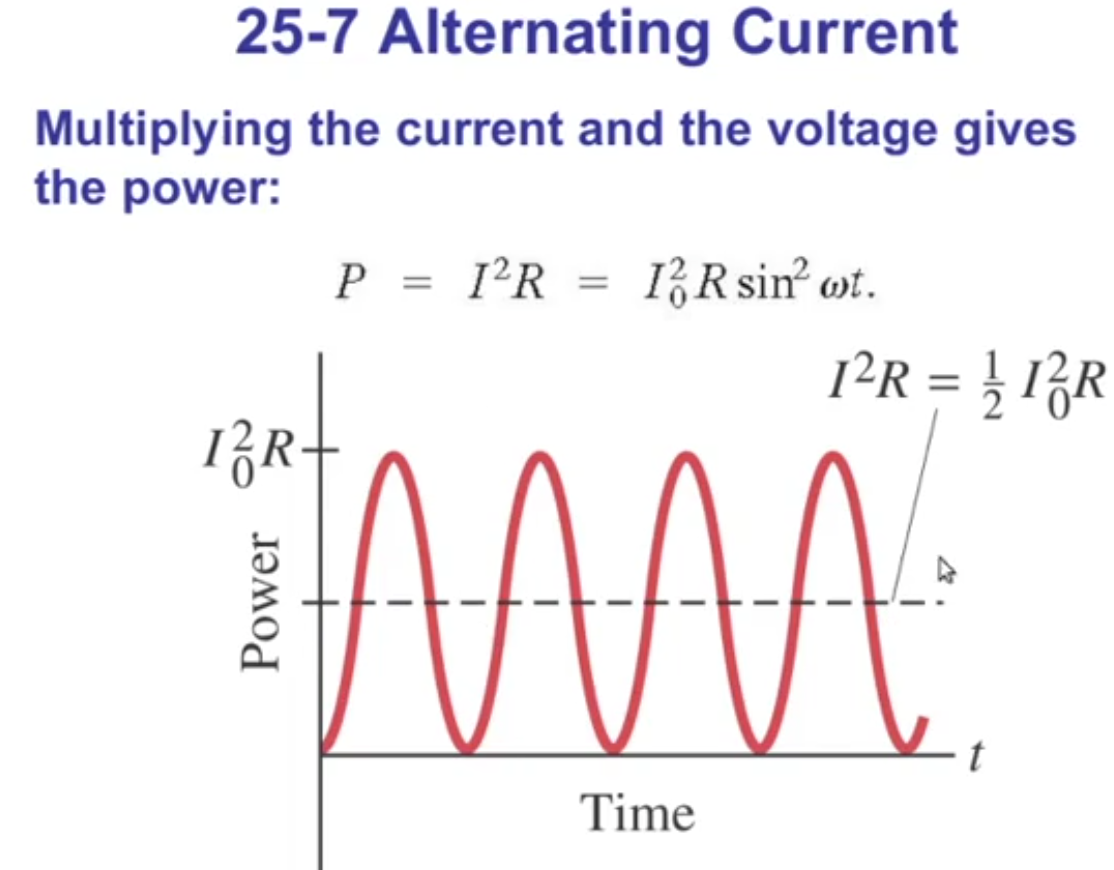
Multiplying the current and the voltage gives the power:
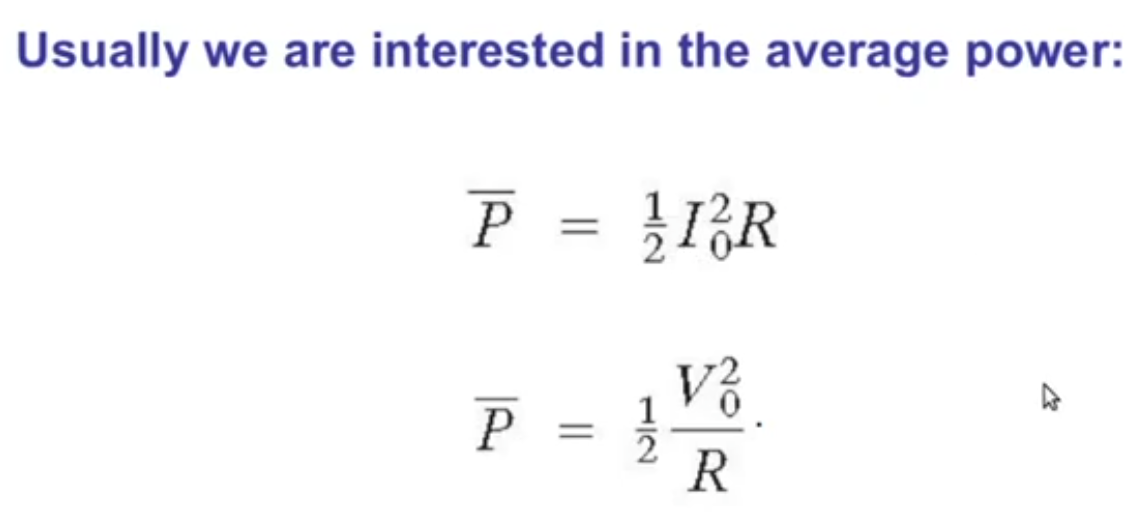
Usually we are interested in the average power.
Current and voltage have average values of zero, so we square them, take the average, then take the square root, yielding the root-mean-square (rms) value.
The rms value is the effective value of the current or voltage, i.e., the steady DC value that would result in the same energy dissipation.
Example 25-13: Hair dryer
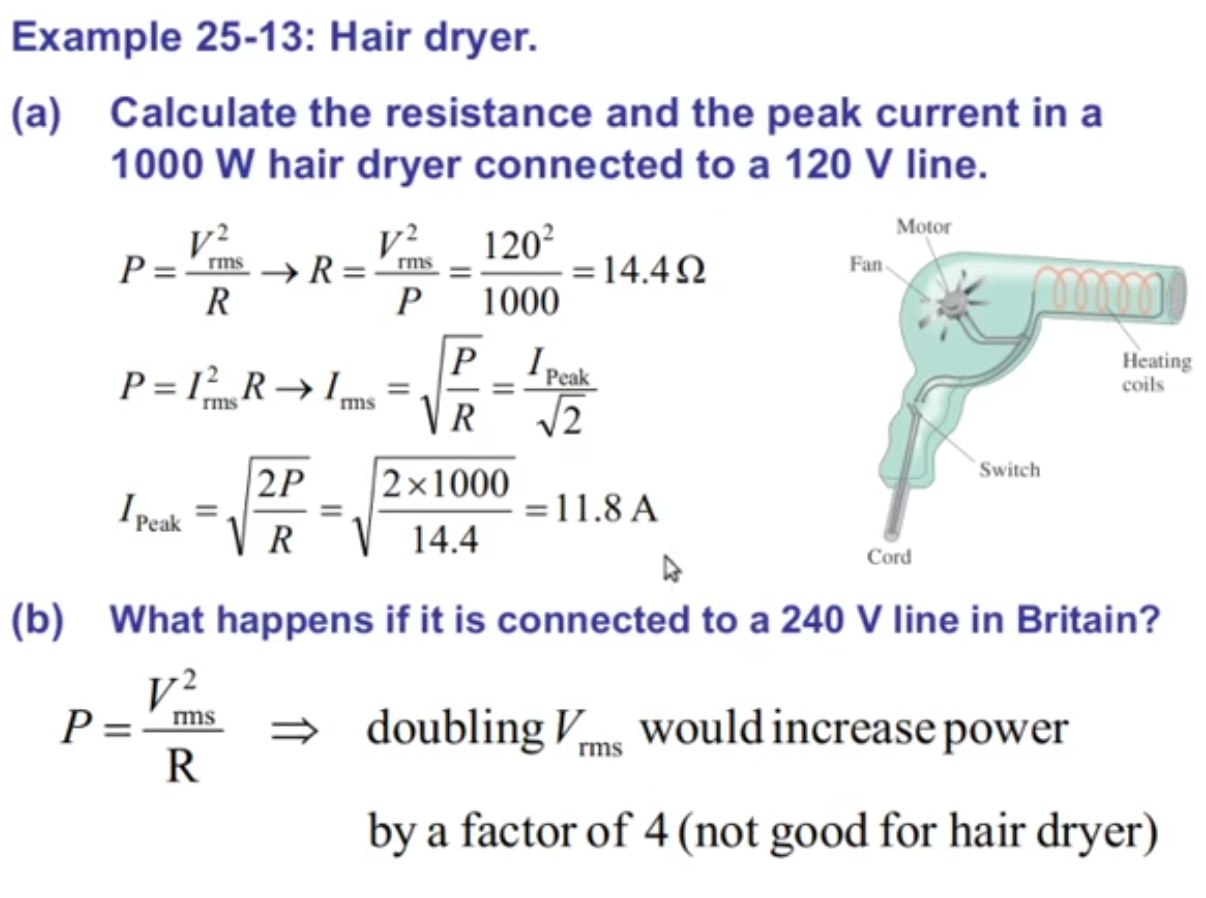
(a) Calculate the resistance and the peak current in a 1000 W hair dryer connected to a 120 V line.
(b) What happens if it is connected to a 240 V line in Britain?
Solution:
Summary
A battery is a source of constant potential difference.
Electric current is the rate of flow of electric charge.
Conventional current is in the direction that positive charge would flow.
Resistance is the ratio of voltage to current: .
Ohmic materials have constant resistance, independent of voltage.
Resistance is determined by shape and material: .
is the resistivity.
Power in an electric circuit: .
Direct current is constant.
Alternating current varies sinusoidally: .
The average (rms) current and voltage: , .