Existential Therapy
Definition (#f7aeae)
Important (#edcae9)
Extra (#fffe9d)
Views of Human Nature:
Focuses on what it means to be human.
Seeks balance between the limits and tragic dimensions of human existence.
Seeks possibilities and opportunities of human life.
Focuses on individual’s experience of being in the world alone and facing this anxiety of isolation.
Our existence is never fixed.
We continually recreate ourselves through our projects
What is existential therapy:
Philosophical approach in therapeutic practice.
Way of thinking than style of psychotherapy.
We are free, therefore responsible for our choices and actions.
We are authors of our lives, we design pathways we follow
Rejects deterministic view of human nature.
Psychoanalysis: Freedom restricted by unconscious forces, irrational drives, past events.
Behaviourists: Freedom restricted by sociocultural conditioning.
We have the freedom to choose.
We are what we choose to be
Dimensions of the Human Conditions:
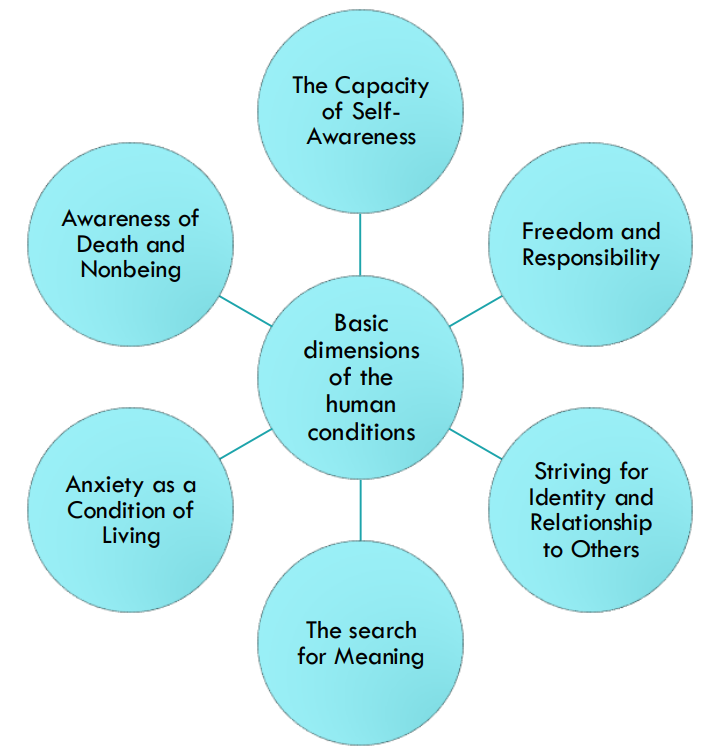
Capacity of Self-Awareness:
Freedom, choice, responsibility. We expand or restrict our awareness.
Increasing awareness can influence a person and their goals.
We choose our actions.
We are lonely.
Areas of growing awareness:
Learns that one is keeping self as a prisoner by their past decisions.
Learns one cannot change certain events in their lives.
Freedom and Responsibility:
Key terms:
Freedom
Existential guilt
Authenticity
Therapist helps clients:
Discovering how clients avoid freedom.
Encourage them to learn to risk using freedom
Striving for Identity & relationship:
The Search for Meaning:
Humans struggle for a sense of purpose.
Logotherapy: Helping clients find meaning in life.
Terms:
Meaningless: Lack of meaning is a source of existential stress.
Existential vacuum: Emptiness
Existential neurosis: Experience of meaningless.
Anxiety as a Condition of Living:
Existential anxiety: The unavoidable result of being confronted with the givens of existence.
Rises as we realise:
The realities of our morality.
Our confrontation with pain and suffering.
Therapist should:
Help clients recognise that learning how to tolerate ambiguity and how to live without props can be necessary phase in the journey from dependence to autonomy.
Help clients explore new possibility.
Awareness of Death & Non-being:
Does not view death negatively:
Basic human condition in which gives significance to living.
Death should not be considered a threat.
Therapists should talk to clients about the reality of death:
The fear of death percolates beneath the surface and haunts us throughout life.
Confronting this fear can help client transform an inauthenticity mode of living into a more authenticity one.
Existential therapy focuses on exploring the degree to which clients are doing what they value.
Clients can develop a healthy awareness of death as a way to:
Evaluate how well they are living.
Evaluate what changes they want to make in their lives.
Clients will realise more clearly that their actions do count, they have choices and they must accept the ultimate responsibility for how well they are living.
Therapeutic Process:
Goals:
Help clients face anxiety and engage in change.
To face difficulties with courage instead of avoiding life struggles.
Invite client to realize how they allowed others to decide for them.
Invite client to choose for themselves.
To create a meaning of existence aspiring to self-actualization
Therapist Role and Function:
Concern at how client avoid responsibility.
Invite clients to accept personal responsibility.
When client complain about their problem and blame others.
Therapist ask, what had you contributed to the situation?
What are you doing to change this problem?
To understand subjective worldview of client:
Help them come to new understandings and options.
Assist client to see how they restrict their awareness.
What are the cost of such restricted view of life?
Through time, clients start to confront themselves:
Client starts to see how they become the way they are.
How they can change the way they live.
They can accept responsibility for changing their future
Techniques:
No specific techniques. Therapeutic journey is creative and different for each client.
Techniques from other model may be incorporated to better understand subjective world of clients.
Relationship between Client & Therapist:
Client relationship is most important:
Quality of therapeutic relationship is the stimulus for positive change.
Attention is given to the client’s immediate, ongoing experience.
Therapy is viewed as social microcosm of client’s interpersonal and existential problem.
Phenomenological view:
Therapy is a journey taken by therapist and client.
See world as perceived and experienced by the client.
Therapist need to be in contact with their own phenomenological world.
Core of therapeutic relationship:
Have faith in clients’ potential to cope with their troubles and find alternative ways of being.
Therapists share their reactions to clients with genuine empathy.
If therapists hide themselves, client will persist in inauthentic living.
Modelling authentic behaviour to clients.
Therapist’s presence is the condition and goal of therapeutic change.
Being in the present reconnects people to their pain & opportunity to change.
Contributions:
Helped bring the person back into central focus.
Contributed a new dimension to the understanding of anxiety, guilt, frustration, loneliness.
Encourage people to live life by their own standards & values.
Emphasize on the human quality of therapeutic relationship.
Emphasize on freedom, responsibility and awareness
Limitations of Existential Approach:
Lacks a systematic statement of the principles & practices of psychotherapy.
Existential concepts are lofty and elusive.
Practitioners who prefer a counseling practice based on research does not have a clear framework.
The level of maturity, life experience & intensive training required of practitioners.