Chemical reactions
Synthesis reactions
if a synthesis reaction happens with a metal or an element with a charge, the answer must have a specific charge. if one of the elements in a synthesis reaction is As, Sn, Fe, Hg, Cu, or Cr, you use the higher oxidation number(charge). Co, Ni, Mn, Pb, Sb, and Bi all use the smaller oxidation number.
Metal oxides plus water always equals metal hydroxide, and vise-versa is true too
Decomposition reactions
decomposition is the opposite of synthesis, and is when a compound breaks down to make simpler compounds. this is only done with an energy source such as light, heat electricity or mechanical shock. If in a synthesis reaction, C + O2 —> CO2, then in a decomposition CO2 —> C + O2
Combustion
Combustion reactions tend to happen with the burning of fuel. The product of a combustion reaction is always carbon dioxide(CO2) and water(H2O). in these kinds of reactions, fractions can be used as subscripts, because no matter what the answer needs to be carbon dioxide and water, and this often happens in Incomplete combustion. Any kind of combustion reaction creates some kind of energy, weather the energy is heat, light(burning), mechanical energy, etc. They tend to include hydrocarbons, and the coefficients can be larger than in other kinds of reactions.
Replacement reactions
Also known as displacement reactions, there are chemical reactions that replace an element in a compound. There are two types, single replacement reactions and double replacement reactions.
Single replacement reactions
In a single replacement reaction, the atoms of only one element are replaced with another element. Here is a generic equation that can be used to represent most single replacement reactions:
A + BX —> AX + B
here are some good rules of thumb:
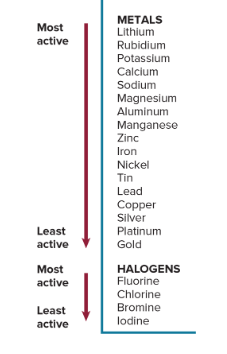
a metal will replace hydrogen or another metal
a metal won’t always replace another metal in a compound dissolved in water though, because metals tend to vary in reactivity(how much they will interact with each other). single replacement reactions are used to help determine a metal’s place on the list.
Double replacement reactions
Double replacement reactions involve an exchange of ions between two compounds, this generally causes a change in the state of matter. In these reactions, the positive and negative ions of two compounds swap places. In this kind of reaction, you first need to identify the atoms with charges(i.e. ions), and then identify what the charges are. A negative ion(anion) will bond with a positive ion(cations).
Double replacement reactions
When writing a double replacement reaction:
write the components of the reactants in a “skeleton equation”: Al(NO3)3 + H2SO4
Identify the cations and anions in each compound: Al(NO3)3 has Al3+ and NO3-, H2SO4 has H+ and SO4-2
Pair up the ions in each compound: Al+3 pairs with SO4 -2 because Al+3 is a cation(+) and SO4-2 is a anion(-), and H+ pairs with NO3- because they are oppositely charged just like the others, but their charges are closer in value
Write the formulas for the products using the pairs from step three: Al2(SO4)3 and HNO3
Write the complete equation for the double replacement reaction: Al(NO3)3 + H2SO4 —> Al2(SO4)3 + HNO3
Balance the equation accordingly.
mind you that double replacement reactions make two different compounds as a product, and they can be any state of matter.
Other notes
-Metal oxides plus water always equals metal hydroxide, and vise-versa is true too
-If the charges of the two elements balance out( +1 and -1 ), then you don’t write subscripts for the products(usually for decomposition)