LEC 7
Q1) Why are cockroaches used for circadian physiology instead of Drosophila, and how did eye-painting and brain-lesion experiments pinpoint the master clock's location?
Drosophila are too microscopically small to easily dissect or extract hormones from, making cockroaches better for physical surgical tracking.
Painting the eyes black forces the clock to free-run. Cutting the Optic Lobes (OLs) away from the brain completely destroys the locomotor rhythm, proving the master clock lives in the OL structures.
Q2)How do optic lobes communicate their timing outputs to the cockroach's legs, and what does the 56-day optic lobe transplantation timeline prove?
Communication relies on nervous connections running through the Suboesophageal Ganglion (SOG); cutting before or after the SOG destroys the rhythm.
Swapping OLs between cockroaches restores the rhythm matching the donor's original periodexactly after 56 days, proving the clock is autonomous and requires that time for nerve pathway regeneration.


Q3) Describe the actogram profile of a "split-brain" cockroach and explain what happens when the tissue undergoes an autopsy a month later.
Slicing the brain midline splits the single daily activity block into 2 separate activity blocks each running on a unique period length, proving both optic lobes contain independent clocks.
After a month, the two blocks fuse back into one because the nervous connections across the midline regenerate, restoring electrical coupling.

Q4) Explain the universal neural mechanism showing how an optic lobe clock that peaks during the daytime (photophase) controls a nocturnal animal that is active at night (scotophase).
The SOG contains Command Neurons that trigger movement.
During the day, the clock fires inhibitory signals to suppress these neurons. At night, the clock stops firing inhibitory signals, letting the command neurons activate locomotion.


Q5) What are the two master clock neuron groups in the insect brain, where do they live, and which one contains the direct light input pathway?
LNs (Lateral Neurons): A small group of \(\text{\sim }\)8 cells at the base of the optic lobe. They contain CRY, serving as the Direct Light Input Pathway.
DNs (Dorsal Neurons): A larger group of \(\text{\sim }\)150 cells sitting behind the mushroom bodies (mb).
Q6) What is "PDF" [Pigment Dispersing Factor], where is it expressed, and how does its wiring explain the integrated insect timing network?
PDF is a crucial neuropeptide messenger manufactured exclusively by LNs, not DNs.
Its axons travel medially across the brain midline to couple the left and right clock lobes, and shoot branches to couple with the DNs, forming an integrated Timing Network.


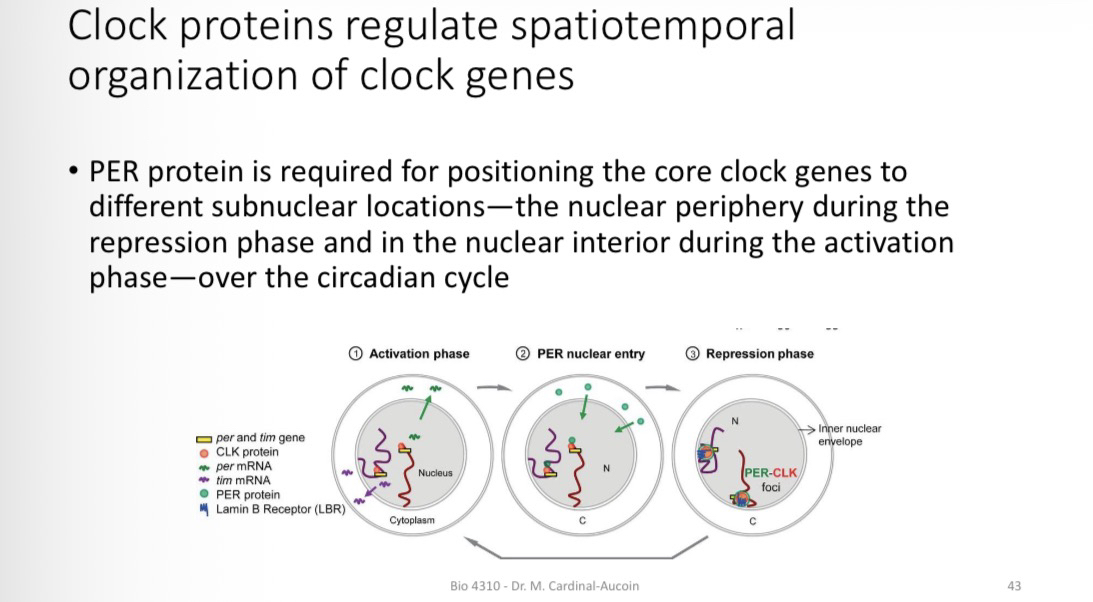
Q7) What did Yangbo et al. (2021) discover using CRISPR-Cas9 protein tags regarding the localization of PER and CLOCK inside live clock neurons?
They discovered that during the circadian repression phase, PER and CLOCK assemble into tight clusters called discrete foci located directly at the nuclear envelope wall.

Q8) Contrast Euchromatin and Heterochromatin, and explain how the PER protein utilizes them to achieve spatiotemporal gene regulation.
Euchromatin is loose and open in the nuclear center for active gene expression. Heterochromatin is dense and packed at the nuclear wall for gene silencing.
During the repression phase, PER physically repositions the core clock genes out of the center and drags them to the periphery into the silenced Heterochromatin zone to turn them off.