2.1.1 - Retail store design
Store exterior designs definitions
Store exterior - how the outside of a retail space like window displays, storefront facades and landscaping influences a shoppers emotions, perception and likelihood of entering a store.
Patronage intentions - readiness and willingness to repeatedly visit, interact and purchase form a specific sore or brand rather than switching to a competitor
Storefront:
storefronts include entrances, exits and windows displayed as well as properties of the buildings such as height, size and colour.
Aspects of the surrounding area include other shops and facilities such as a store.
Creating an appealing storefront that invites shoppers in to find out more about what is on offer is central to creating a positive first impression.
Window display:
Windows displays are critical for attracting potential customers.
Shoppers use these displays to make quick judgements to form an overall impression about whether the store is likely to meet their needs and preferences.
It may be expensive or impractical to alter the building itself, an attractive window display provides a quick, cost effective way to change the overall look of the shop, leading to a increase in customers and sales.
Landscaping:
Landscaping refers to any plants and other vegetation outside the store, which adds to the overall impression formed.
Research suggests that plants create positive emotional responses when introduced into urban settings, improving mood and perceived quality of life.
Sales and distance traveled were greater in shopping areas that included trees and other vegetation and customer spent longer and more money in stores that included landscaping.
Chebat and Morris found that shoppers rated the quality of the environment and products as higher in stores that used flowers, plants and trees to introduced colour to their decor.
Store:
Storefront - the front façade of a store —> including signage, entrance design, exterior lighting and overall architectural style
Signage - clear , visible brand signage signals store identity. Consistent with brand image to attract target consumers
Entrance design - open, inviting entrances encourage approach behavior. Barriers (steps, narrow doors) can deter entry
Exterior lighting - lighting draws attention after dark and highlights the storefront. Warm lighting creates welcoming atmosphere
Architectural style - premium stores use distinctive architecture (eg. Marble, glass) to signal quality and exclusivity
Window display:
Congruence with self image - displays matching consumer self image are more effective than purely promotional / style only displays
Window size - larger windows attract more consumer attention compared to smaller ones
Sales effect - stores using window displays show higher sales than those without any display
Aesthetics & theme - most effective displays are aesthetically pleasing, have a clear theme and use warm colors
Perspective & lighting - drawing customers ’into’ the scene using perspective, using lighting to highlight key areas.
Landscaping:
Retail landscaping - plants, trees, paving, water features and outdoor décor around the store exterior
Pleasantness cues - green, natural elements increase perceptions of store pleasantness and quality
Slowing down - attractive landscaping encourages consumer to slow their pace, increasing dwell time near the store
Brand signaling - well maintained landscaping signals that the retailer cares about their environment — implies product quality.
Example study - Mower et al
Aim:
To investigate the influence of window displays on shoppers intention to enter a store and make purchases.
Method:
participants read descriptions of store window displays
The of was the presence or absence of window display and / or landscaping.
Then they answered a questionnaire measuring pleasure and arousal, liking of the store exterior and patronage intentions.
Findings:
Presence of landscaping and windows displays did not have a significant effect on pleasure and arousal but did increase liking and patronage intentions
Conclusion:
Landscaping and windows displays are importantly determinants of positive consumer responses as higher liking of the store exterior was associated with higher patronage intentions
Evaluation (strengths):
Practical application —> findings an be directly applied by retailers to improve landscaping and windows displays - supporting a real world application of psychology
Quantitative data —> rating scales provide objective, measurable data that can be statistically analyses and compared across conditions
Evaluation (weakness):
Artificial task —> reading descriptions lack the full sensory context of actually standing outside a store —> low ecological validity got the method itself
Subjective ratings —> self report ratings of ‘intentions to enter’ may not predict actual behaviors, participants may respond in socially desirable ways
Cultural differences —> window display preferences may vary across cultures —> findings from one cultural group may not generalised universally. Global chain stores should adopt the store exterior in different parts of the world in line with local cultural norms.
Store interior design definitions
Store interior - inside the store which can have a significant impact on consumer attitudes and behaviours
Layouts - the way that the shop floor is organised, including the arrangement of the stock and the routes that customers take around the store.
It can have a significant effect on many aspects of consumer behaviour, from price acceptability and purchase intentions to average time in store, amount spent on planned and unplanned purchases, customer satisfaction, ongoing preferences, repeated trade and recommendations to other potential customers.
Grid layouts:
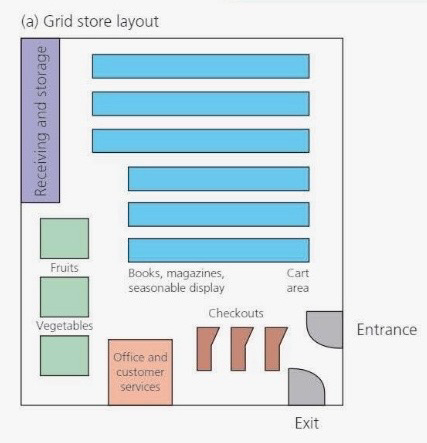
In a grid layout, displays are organised into a rectangular arrangement, including long parallel aisles.
Common in supermarkets where efficiency is often key, shoppers move around relatively swiftly, selecting predetermined item as firm their shopping list.
Shoppers often are familiar with the location of their regular products having visited the store multiple times.
Racetrack layouts:
The racetrack layout provides an unusual, interesting and entertaining shopping experience where shoppers follow a designated route through a number of individual themed areas
Freeform layouts:
Favoured by large departments stores, customers move in any direction among the displays, the majority of which are different styles, sizes and shapes
Shoppers enjoy browsing among the displays, which are organised in an asymmetric manner, often spending longer in stores with freeform layouts than grid or racetrack layouts
Virtual store layouts:
What it is:
Virtual store layouts is the organisation and design of an online shopping website.
It is similar to a physical store layouts but applied to websites.
Designed to influence how consumers browse and purchase goods.
Growth of online shopping:
E-commerce have grown rapidly due to Covid.
Many consumers now begin product searches online so creating a user friendly website is increasing important for retailers.
Why are they important:
Can increase the number of visitors to a website.
Can increase customers’ willingness to make purchases.
Affect how consumers navigate and interact with the website
May influence time spent browsing and overall shopping experience.
Types of virtual store layouts:
Virtual Freeform layout
Virtual grid layout
Virtual racetrack layout
Research findings from survey (551 retail websites took part):
Most (51%) used a virtual freeform layout
Some (21%) used virtual grid layout
Very few (1.5%) used virtual racetrack layouts
Many websites (26%) did not fall into any of the conventional categories
Example study - Vrechopoulos et al
Aim:
To investigate the effects of 3 different virtual store layouts on consumer behaviour when shopping for groceries.
*more specific —> they aimed to examine how the layouts affected planned purchases, ease of navigation within the store, perceived entertainment and time spent within the store.
Hypothesis:
The grid layout would be the most useful, the freeform layout would be the easiest to use but also lead to the longest time shopping, but the racetrack layout would be the most entertaining.
Research Method:
Laboratory experiment
Research design:
Independent measures —> each participant interacted with only one of the virtual store layouts
Variables:
Independent variable —> the type of layout
Dependent variables —> perceived as usefulness, ease of use and entertainment
Each variable was measured via self report rating scales and time spent online, measured by the computer system
Method:
They manipulated the virtual layout by its background colour, display techniques, products, prices and promotional banners being controlled across the 3 different virtual layouts.
All 120 participants were allowed the same amount of money to spend online $20 (or 12,000 GRD)
Participants were given blank shopping lists and access to a list of available products in the online store so that they could plan their purchases.
Products included well known brands of cola, lager and crisps as well as own brands products
The researcher delivered the actual groceries ordered by the participants from 2 well known supermarkets in London and Athens
Sample:
The participants were 120 academic, students, employees, business executives and researchers from universities in London, Uk and Athens
All were experienced internet users and shoppers
20 participants from each country were allocated to each of the 3 store layouts
Results:
Freeform layout was perceived as significantly more useful and entertaining than the grid or the racetrack
This contrasted with the researchers expectation that the grid would be most useful and racetrack most entertaining
Grid was perceived as significantly easier to use then freeform and racetrack, with freeform easier than racetrack, which contrasted with the expectation of Freeform would be the easiest to use.
The longest amount of time spent shopping was the racetrack layout which was unexpected as it was predicted that freeform layout would lead to the longest time.
Conclusion:
The results suggest that different virtual grocery store layouts do lead to significant differences in perceived usefulness, ease of use, entertainment and duration of online shopping, but these differences do not follow the same patterns seen in conventional stores.
Evaluation (strengths):
High ecological validity —> researchers attempted to make the online shopping experience as similar to a real life situation as possible
High generalisability —> sample were collected from different countries
Evaluation (weakness):
Quantitative data —> researchers only collected quantitative data using rating scaled and this doe not provide insight into why certain score were assigned for perceived usefulness, ease of use and entertainment.
Self report —> self report were used and since they were in a lab, scores are open to demand characteristics
Cultural differences:
Different cultures may prefer different virtual store layouts and shopping experiences
Racetrack layouts may encourage implies buying in some cultures but frustrate consumers in others
There finding about the best layout may not apply to all cultures
Reductionism vs Holism:
Research is reductionist because it focuses only on store layout when consumer behaviour is influenced by many factors
Factors such as culture, personality, age, gender, socioeconomic status and product type can also affect shopping behaviour
Businesses should take a holistic approach and consider all factors before redesigning expensive websites