Dual nature of light and the electrons
Dual nature of light
De Broglie described the discrete energy levels of electrons in an atom to be as a result of wave phenomenon. His idea was based on the consideration that light can act:
==as a wave;== propagation of oscillating electric or magnetic fields.
==or as a particle==; stream of photons with fixed energy determined by f (E = hf = mc2).
Wave nature of light
It was proven by the fact that light can undergo: ==Interference, Diffraction and Polarization.==
Waves
Wave is a periodically repeated propagation of disturbance in space and time.
Parameters:
Amplitude; A(max. displacement)
wavelength (distance of two peaks)
Period; T(time to complete a cycle)
frequency; f(number of periods in a certain time)
Higher f — lower wavelength
Characteristics of wave
- Refraction: change in propagation direction when light travels from one medium to another.
Described by snells law;
sin𝛼/sin𝛽 = c1/ c2 = n2/n1
𝛼 is angle of incidence, 𝛽 is angle of refraction, c is speed of light , n is refractive index.
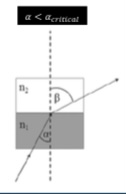
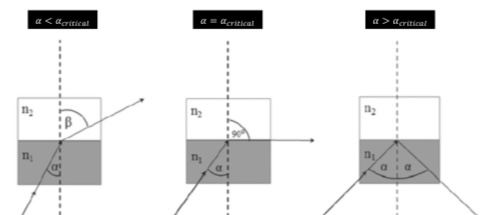
- Reflection: when the critical angle is less than the angle of incidence.
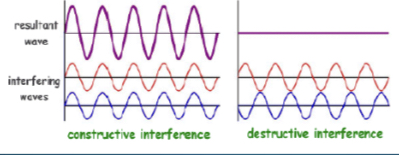
- Interference: waves acting together. If they are in the same phase it is Constructive interference but if they are in different phases it is called Destructive interference.
- Diffraction: The way the waves bend is diffraction.
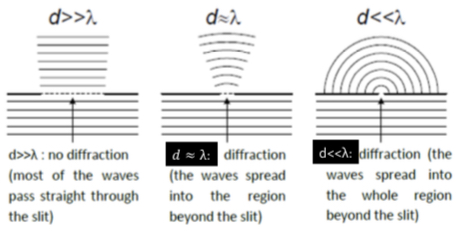
==Huygens Fresnel principle states that from every point where a wave passes secondary elementary waves are created that travel in 3D everywhere.==
- Polarization: if Electric field (E) is oscillating in one plane only.
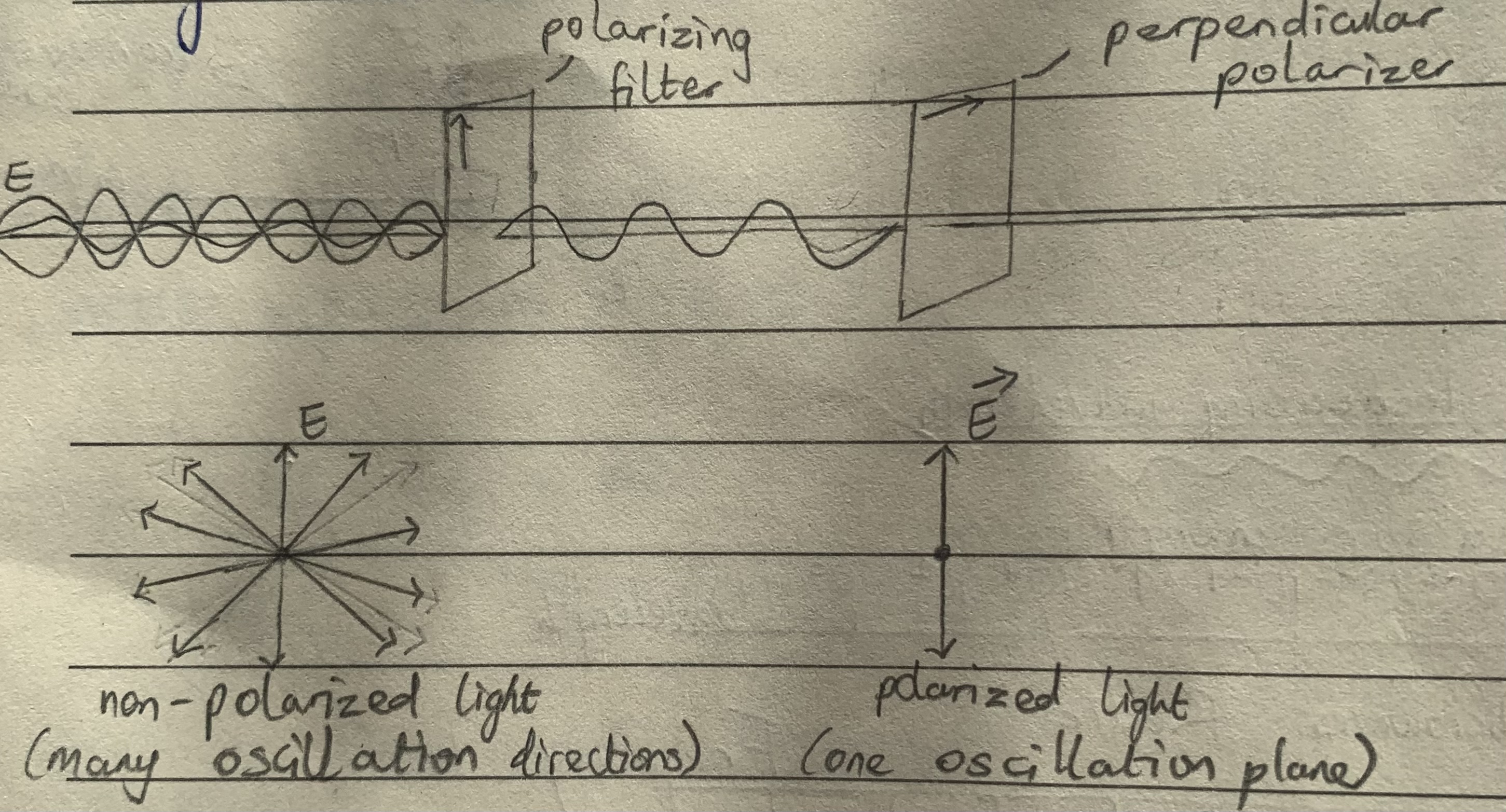
If light is not linearly polarized we can use a polarizer and choose a plane that only allows waves that oscillate in that plane through. A second polarizer(analyzer) can be used to check.
Polarization does not occur in longitudinal waves.
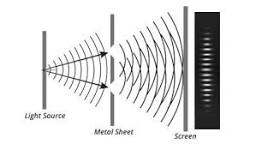
Double-split experiment
Demonstration by Thomas Young that light and matter display characteristics of wave and particles ==. Light was passed through a plane with two slits in it and struck a screen behind, the lighter bands show constructive interference and the darker bands show destructive interference. The width of the band is a function of frequency== .
De-Broglie
Einstein solved the problem of photoelectric effect by assigning wave assigning particle nature to light, wave-particle duality of light. De-Broglie proposed that particles also display wave like behavior by showing matter as a wave and particle.
The experiment was like the double slit and showed a beam of electrons exhibiting diffraction and interference.
E= hf = hc/wavelength , wavelength= h/mc = h/p
p is momentum.
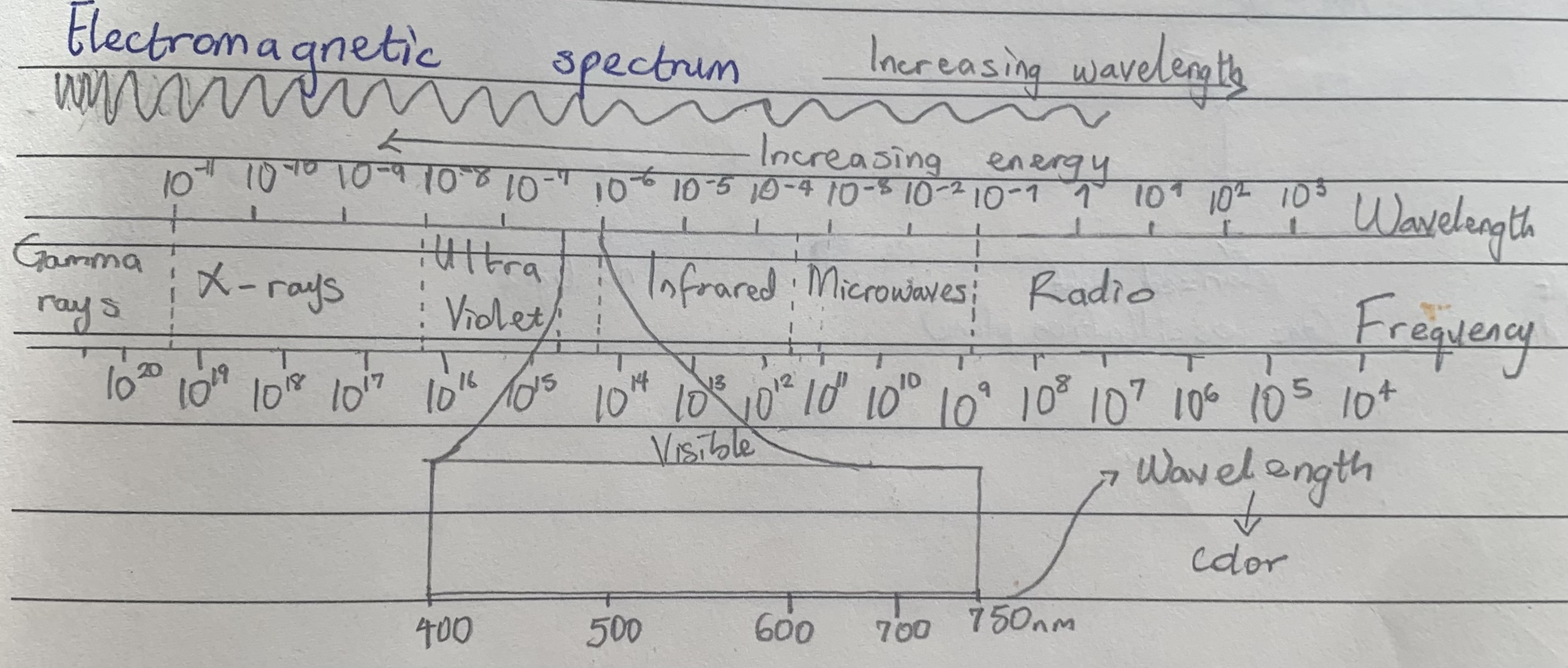
Electromagnetic waves
They are an effect of oscillating charged particles creating an electric field(E) which creates a periodically changing magnetic field(B) and creates a periodically changing electric field…etc.
Order of reducing wavelengths and increasing energy:
Radio waves; emitted by stars 10^3
Microwaves; emitted by oven 10^-2
Infrared waves; emitted by warm things 10^-4
Visible light; emitted by bulbs 400nm - 700nm
Ultraviolet waves; by sun 10^-6
X-rays; emitted by atoms 10^-8
Gamma rays; emitted by atomic nuclei 10^-12