ANTH 204
Textbook: How humans evolved Boyd R & Silk J. B (2023). 10th edition
What is anthropology?
The study of humans, our closest relatives, and our ancestors
Diff between psych and anth is that anth focuses on relatives and ancesors, rather than just humans
Anthropology umbrella
Archaeology
Cultural anthropology
Cultural perspective
Understanding language
Biological anthropology
This class focuses on this
Primatology
Molecular Anthropology
Human genetics
Paleoanthropology
Fossil records of humans
Starts with earliest primates
Forensics Anthropology
Human Biology
Bioarchaeology
Linguistic anthropology
All of these subsections combined makes up Applied Anthropology
Lec 3
Adaption by Natural Selection
Natural Selection
Allows an indiviudal to maximize fitness
survival
reproduction
These could be structural, physiological, behavioral
Process that produces adaptation
Heritable traits that are favorable increase in freq in successive generations
Natural Selection Terms
Evolution-biological change over time via descent with modification
Trait-inherited feature acted upon by NS (adaptation)
Species group means animals that breed with each other
Charles Darwin
First planned to enter the clergy
Educated at Cambrdige
5 year voyage on H.M.S Beagle
Galapagos Islands
First to look into natural selection
He looked into Galapagos Finches
Many species
Occupied differnet niches
different beak shapes, otherwise similar
On the island of Galapagos these birds are all different but they all share a common ancestor
Darwin’s Theory of Adaptation
Species have changed over time
Evolution now a new idea
Darwin’s contribution was mechanism
Natural selection
Darwin’s Postulates
There is a competition for existence
There is varaiton in features related to survival and reproduction
This variation is heritable (passed from generation to generation)
Differential selection
Survival and reproduction of the fittest
Fitness
But not like speed or strength but more like an animal’s ability to reproduce and make sure your off-spring survives
Galapagos Islands, Ecuador
Darwin’s finches
Medium ground finch
Peter and Rosemart Grand, Princeton
This entire study was documented in The Beak of the Finch
Postulate 1: Competition
1976 - 1978
1400 birds reduced to 180
A drought occured during their experiment and so as the seeds went down because its dry, the bird’s numbers went down too
Variation
Morphology
An organism’s size, shape, and composition
The bird’s beak’s depths started changing in correlation to the drought
When the drought happened, the seeds get harder and so this makes it that the birds who survived, they have deeper beaks
Heritability
Beak depth passed from parent to offspring
Parents had deeper beaks which made it so that their kids also had deep beaks
Histograms provide us the average when looking at the middle of the graph
The smaller the bars the less the population, but where the bars lie is where the actual measurements/depth come in
Individual selection
Selection operates on level of individual
Example: blue monkey
High vs low fecundity (ovulate frequently, want sex often) females
High fecundity favored even at species expense (overpopulation)
Natural Selection operates at the level of the individual (not the species)
Stabilizing Selection
Average phenotype is favored while extreme variations are selected against
If you’re too good or too bad you get left behind
Upside down U curve
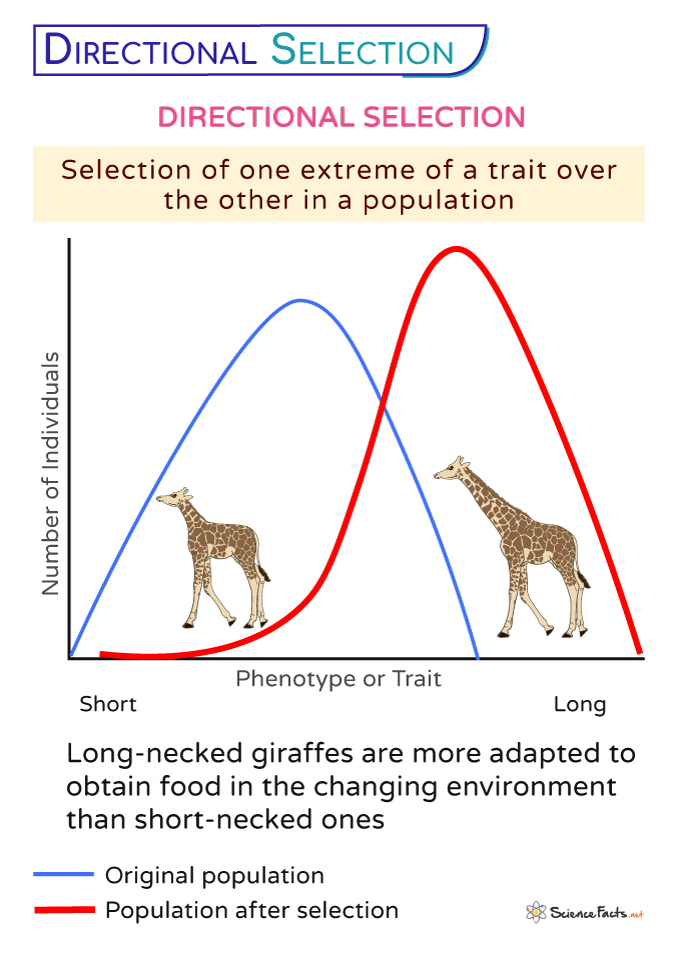
Directional Selection
Larger favored individuals are in favor when peak shifts in one direction
If the U curve goes to the left, then the people already on the extreme left will be safe since now they’re average
If the U curve goes to the right, then the people already on the extreme right will be safe since now they’re average
Types of variation
Continuous
variation in traits (weight, beak size, skin/hair color) that are distributed on a continuum
Discontinuous
variation in which types can be grouped into discrete categories with no intermediates