FW 404 Structure and Composition 8/28, 9/2
Scale
Within-stand (Alpha) diversity/richness
Among-stand (Beta) diversity/richness
Management can influence each
Stand-level Management
Plant composition influences wildlife
Plant structure influences wildlife
vertical structure
horizontal patchiness and edges
Plant Succession
Succession is the continual change in plant communities over time
Seral Stages: temporary stages of succession
Defined by composition
Herbs → shade intolerants → shade tolerants
Shade-tolerance
Shade-tolerant—survive under low light
slow growth and persist under overstory
released by canopy gaps
e.g. American beech and sugar maple
Shade-intolerant—do not
rapid growth in full light
e.g. loblolly pine, sycamore
Succession
Different animals persist in different seral stages
Because different structure/composition
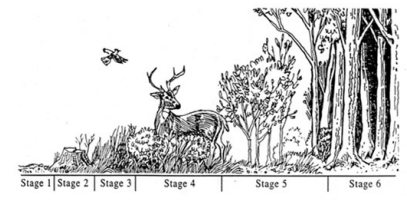
Various stages
Early Succession (Stage 2)
perennial herbaceous plants
Not Early Succession (Stage 3)
some trees mixed in
defined by composition
Importance of Vegetation Composition
Trees, shrubs, vines, grasses, frobs
tall and short
evergreen (pine) and deciduous (hardwood)
High plant richness =
buffer foods
seasonality
Butterflies are host plant species specific—only lay their eggs on specific plants! e.g. spicebush butterflies
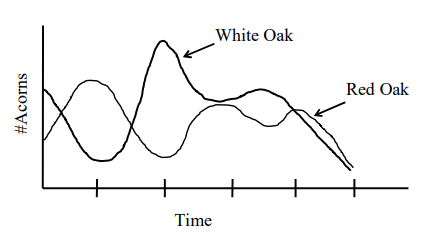
Buffer Foods
white oak acorns take 1 year to mature
red oaks take 2 years
Seasonality—soft mast
mulberry in spring
black cherry in summer
dogwood in fall
holly in winter
Mast—hard or soft fruits (hard are nuts like acorns, soft are berries and drupes)
redbud in spring
butterflyweed in summer
aster in fall
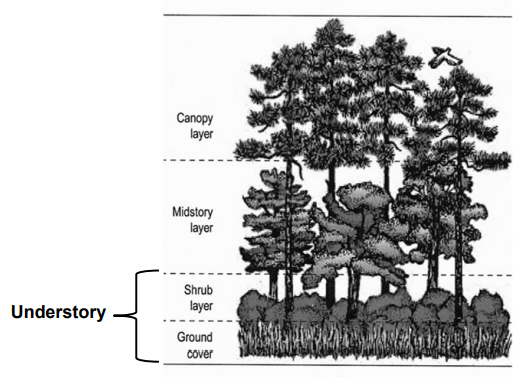
Vertical Structure
also, foliage height diversity (FHD)
how many forest layers?
birds segragate vertically
ground/shrub cover important (gravity)
deer, quail, rabbits
shrubland birds
box turtles, lizards, garter snakes
FHD and Birds
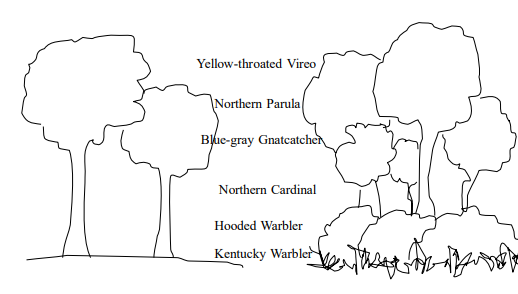
Max and Mac (1961) in temperate forests
Positive relationship because more niches
Exceptions to the rule
tropical forests
certain species—ovenbird (like closed canopies)
fire-maintained vegetation types
Burned longleaf forests have 2 layers.
Poor vertical structure
no cover in the understory (in an overstocked pine stand)
monoculture (species resistance is low, food diversity is low)
Within-stand Patchiness
Within a stand, there can be openings in the canopy that create gaps (treefall gaps as an example)
Ups and downs like stair steps are gaps in the tree cover
Other Elements Contribute
Snags
Downed logs
Brush piles
Oak groves (in a pine monoculture)
Ephemeral Pools
Blackberry thickets
Among-stand Patchiness
Beta Diversity/Richness
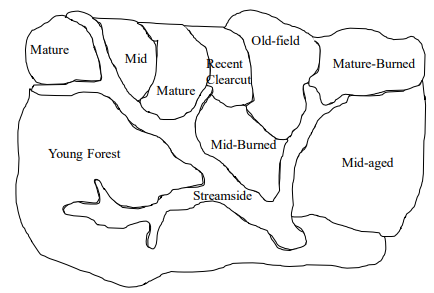
could miss out on species that require a large range of only one condition
More on Among-stand Patchiness (horizontal structure)
Edge = where two landcover types meet
two stand ages (seral stages) meet
two land uses meet
Ecotone = transition zone
conditions of 2 adjacent areas overlap
harbors conditions unique from adjacent
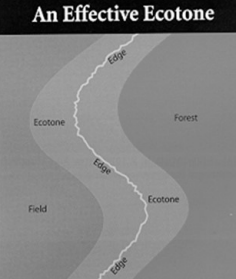
in the ecotone area, these conditions are mixed, allowing species from both areas to interact
the light is heavier in the ecotone area of the forest meeting a field
makes soil drier
Leopold’s “Edge-Effect”
Greater abundance of wildlife at edges
Simultaneous access to 2 vegetation types
increased structure
require the unique conditions (ecotone)
example: deer bedding down in old stand during the day, eating acorns in the forest at night… you’d put your deer stand on the ecotone since they are passing between the two
Is Edge Important?
Only as an artifact of land use and the structure provided
Any importance of edge is determined by the quality of adjacent vegetation types
Can use prescribed burning to create “edge” everywhere
Edge Types
Abrupt edge—narrow ecotone
Soft edge—broad ecotone
Inherent edge—long-term feature, where pond meets forest for example (permanent) (negative edge effect)
Induced edge—short-lived, disturbance, edge of timber harvest for example (1 year old forest vs 100 year old forest) (not associated with negative edge effects)
If Edge, Make it Soft
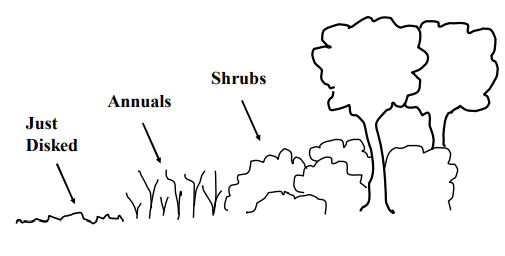
costly for land managers to reduce overstory (timber harvest) so they often just place shrubs on the edge
Small Stand = Edge *
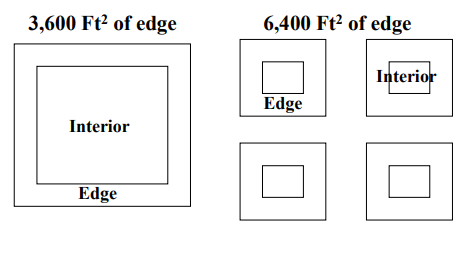
Can manage by breaking land into various zones
perimeter is larger
center is smaller
Irregularly-shaped Stands*
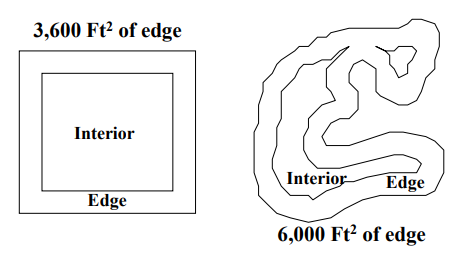
Two ways to increase edge: irregular stands and smaller stands. Opposite for decreasing edge.
Tophat:
Which of the following is a true statement?
A
in temperate hardwood forests, bird richness increases with increased foliage height diversity
B
early seral stages are dominated by woody plants
C
early seral stages are dominated by shade-tolerant plants
D
all of the above
E
none of the above