The Origin of Planet Earth
Otto Yulyevich Schmidt
The Accretion Theory that Earth and the other terrestrial planets formed from meteoric material was proposed in 1944
This theory he published in his 1949 book Four lectures on the theory of the origin of the Earth
Accretion
One of the leading scientific idea for the formation of planet Earth
it is a process that occurs when gravity attracts tiny bits of matter towards an object.
Condensation
the process of forming solid particles from the solar nebula, to form the entire solar system, including the sun and planets.
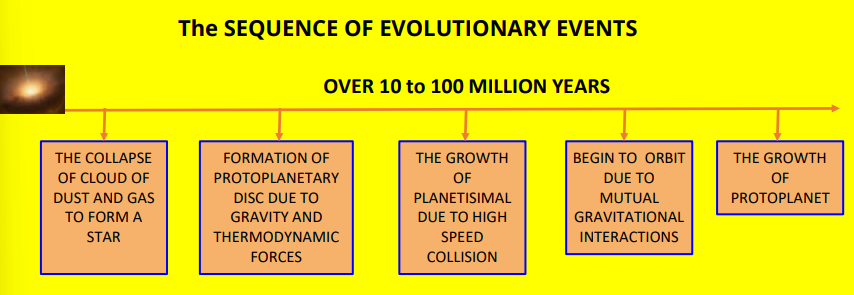
Sequences of Events
The collapse of molecular cloud
a portion of a molecular cloud collapses to form a star and a protoplanetary disk, while more dust condenses from the gas phase within the disk
The formation of the protoplanetary disc
dominated by gravity from the star and aerodynamic forces from the gas, including turbulence
the growth of planetesimals
Aerodynamic forces remain dominant until bodies grow to 1- 100 km in size. Such bodies, referred to as planetesimals
Small particles also physically embed themselves in larger aggregates during high-speed collisions
Begin to orbit the central star
their subsequent evolution is dominated by mutual gravitational interactions and collisions as they orbit the central star
The growth of the protoplanet Earth
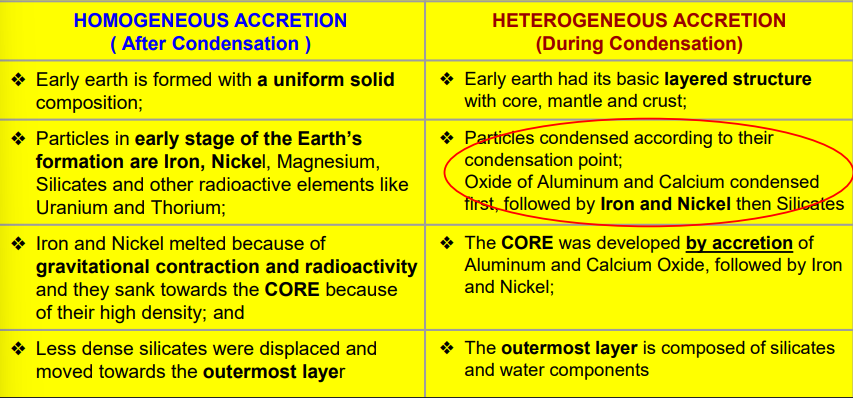
 2 Types of Accretion
Homogeneous
It is when Earth accreted from materials of the same composition after condensation
Heterogeneous
It is when Earth accreted during condensation, forming a differentiated planet as it grew in size