Marginal Analysis
At the end of the last lesson, we talked about trade-offs—a decision where we give up one thing in order to get something else. We pointed out that some trade-offs are all-or-nothing decisions, but many are not. You can usually split your resources between different options. In this case, the economic choice you have to make is whether to do a little more or a little less of something. The government might provide a little more funding for education or a little less. Pepsi might make a few more cans of soda or a few less. You might decide to study for a few more minutes or a few less.
We can make these "how much" decisions using the process of marginal analysis—a comparison of the marginal benefits and costs of taking a particular action. Marginal analysis lets us determine the effects of having a little more or a little less of something.
Marginal benefit is the change in total benefit resulting from a particular action, and marginal cost is the change in total cost resulting from a particular action. When the marginal benefit is greater than the marginal cost, we are better off doing more of a particular action. When the marginal cost becomes greater than the marginal benefit, we're better off doing less.
Neither marginal benefits nor marginal costs have to be monetary (i.e., relating to money or currency). Enjoying a concert is a marginal benefit. The marginal cost of that concert might be partly monetary (the money you spent on the ticket), but it also costs you time. If you went to too many concerts, another marginal cost could be hearing loss. When conducting marginal analysis, you must take into account both monetary and non-monetary benefits and costs.
Marginal analysis can be used whenever a trade-off has to be made:
The Benefit and Cost of a Candy Bar (or Four)
Almost everyone loves candy. But no matter how much you love candy, you can't eat an unlimited amount of it. Eventually, the marginal cost will outweigh the marginal benefit.
For example, for the first candy bar you eat, the greatest your marginal benefit is and the smallest your marginal cost is. You have a great marginal benefit of satisfying your sweet tooth, and one candy bar won't cost much money and isn't likely to give you a stomachache. However, each additional piece you eat increases these marginal costs. Not only does it cost you more money, but it will also eventually give you a stomachache. Meanwhile, each piece you eat will be a little less satisfying to your sweet tooth. The candy might still be delicious, but it won't taste quite as good as those first few bites. The marginal benefit will decline with each piece.
Let's do a marginal analysis to determine how many candy bars you should buy. We'll assume that each candy bar costs $1.00. This means that the marginal cost for each candy bar equals $1.00. Next, we'll have to assign a dollar value to how much pleasure each candy bar gives you. Since the pleasure you get from eating the candy is a non-monetary benefit, we'll have to estimate how much it's worth to you! This will be the marginal benefit of each candy bar you eat.
The first candy bar really satisfies your sweet tooth, so we'll say that the marginal benefit of that first bar was $5.00. So, your first candy bar has a marginal benefit of $5.00 and a marginal cost of $1.00. Not bad!
The first candy bar was so good that you quickly open up another. This one is still delicious, but the marginal benefit is down to just $2.00. Then, your third candy bar only gives you $0.80 of marginal benefit. It still tastes good, but it's starting to be a bit too sickeningly sweet.
The fourth candy bar? That provides only $0.20 of marginal benefit because at this point, you've just had too much sugar. Also, you now have to add to your marginal cost because four candy bars are going to give you a stomachache. You figure that the marginal cost of getting a minor stomachache is $1.00, so your marginal cost for the fourth candy bar is $2.00 ($1.00 in "dollars" and $1.00 in "minor stomachache").
The fifth candy bar only gives you $0.05 of marginal benefit, and it's going to give you a major stomachache, which you figure will add $3.00 to your marginal cost. This means that for your fifth candy bar, you'll only get $0.05 of marginal benefit, and you'll have $4.00 of marginal cost. Not worth it!
Review the table below to see our marginal benefits and costs mapped out.
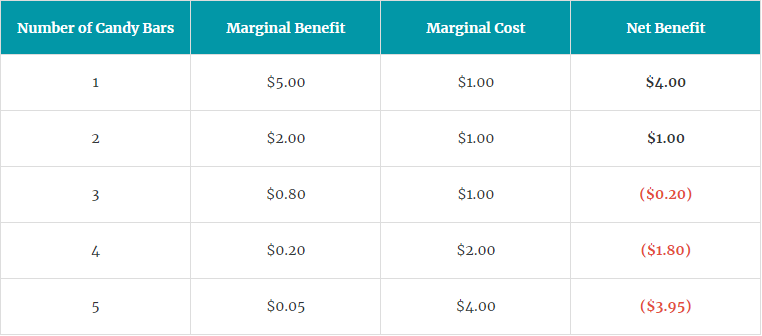
In the fourth column of our table, we've added the net benefit—the difference between marginal benefit and marginal cost—of each option. This makes it even easier to make our decision. When the net benefit becomes negative, that means that the marginal cost is higher than the marginal benefit. By looking at the table, we see that you should buy two candy bars. That's because the third candy bar provides a marginal benefit ($0.80) that is lower than the marginal cost ($1.00). Whenever the marginal cost of doing something exceeds the marginal benefit (or, in other words, when the net benefit is negative), we shouldn't do it.
It's also important to note that both marginal benefit and marginal cost can change in our marginal analysis. The marginal benefit you got from eating the candy bars went down with each subsequent candy bar, and the marginal cost went up as you ate more. This happened because you had multiple costs to consider—the dollar cost stayed consistent at $1.00, but you had to add in the second marginal cost of the stomachache.
Impact of Changing Costs
So, we've determined the ideal number of candy bars to eat when they each cost $1.00. But what if there's a sale and candy bars only cost 50 cents? What if you're at your friend's house and your friend is giving you the candy bars for free? Or what if the unthinkable happens and a blight devastates the world's cocoa crop, doubling or tripling the price of candy bars? Use the slider below to see how changing the price of the candy bars affects how many candy bars you should eat.
Don't Forget about Opportunity Costs
It's important to remember that we have to consider opportunity costs in addition to marginal costs. Even if the marginal analysis says that you should buy two candy bars, if doing so prevents you from buying a bag of chips that will provide an even greater marginal benefit, then you should buy the bag of chips instead.
For example, let's say you only had two dollars. You could buy the two candy bars, which would give you a marginal benefit of $7 compared to a marginal cost of $2. But—if buying a bag of chips for $1 would provide a marginal benefit of $3, then you're better off buying the chips instead of the second candy bar. That would make the marginal benefit $8 ($5 for the first candy bar and $3 for the chips). You'd have the same marginal cost of $2. Under this scenario, your net benefit is $6 ($8 – $2) instead of the net benefit of $5 ($7 – $2) that you'd get from two candy bars.
Review of Key Terms
marginal analysis: a comparison of the marginal benefits and marginal costs of taking a particular action
marginal benefit: the change in total benefit resulting from a particular action
marginal cost: the change in total cost resulting from a particular action
net benefit: the difference between marginal benefit and marginal cost
When deciding how much of something to consume or produce, we use marginal analysis to determine the right levels of consumption or production. Marginal analysis is essential for businesses to make the most efficient use of their resources and maximize profits. Individuals can also benefit from using marginal analysis to aid spending and investment decisions.