Engineering Anthropometry - Comprehensive Study Notes
OBJECTIVES
Define anthropometry
Discuss the importance of anthropometry
Identify the necessary anthropometric data for a given design
Differentiate static to dynamic measurements
Accurately measure body dimensions (in steady and action state)
Identify the best design principle for a specific application
Correctly compute for the necessary statistics in an anthropometric design
Identify the effects of poorly-designed systems
Identify real-life applications of engineering anthropometry
BRIEF HISTORY
An outgrowth of Physical Anthropometry
Initially an attempt to differentiate among fossils to distinguish among races and ethnic groups of humans, identify criminals and aid in making medical diagnoses
More recently used in industrial settings
Development of engineering requirements and evaluation of vehicles, worksites and clothing
WHY ANTHROPOMETRY?
To design workplaces, equipment and the physical environment to fit the characteristics and capabilities of most people in a complex task
Poorly designed equipment or environment may lead to injuries
EXAMPLES OF POORLY DESIGNED WORKPLACES
Sinks that are too low
Handrails that are too high
Pants that fit the hips but are too loose at the waist
Falling face shields
Hand rails in MRT
ANTHROPOMETRY
The science of measurement and the art of application that establishes the physical geometry, mass properties, and strength capabilities of the human body
Derived from the terms anthropos (human) and metrikos (pertaining to measurement) – Adolphe Quetelet
One of the basic tools for the analysis and development of engineering design requirements
Analysis of forces and torques during manual material handling, accommodation, comfort and general human performance
Influences many Human Factors and Ergonomics aspects of physiology and psychology of comfort
ANTHROPOMETRIC CONSIDERATIONS
Sizes
Proportions
Mobility
Strengths
Other factors that define human beings physically
USES OF ANTHROPOMETRY
Evaluate postures and distances to reach controls
Specify clearances separating the body from hazards such as surrounding equipment
Identify objects or elements that constrict movement
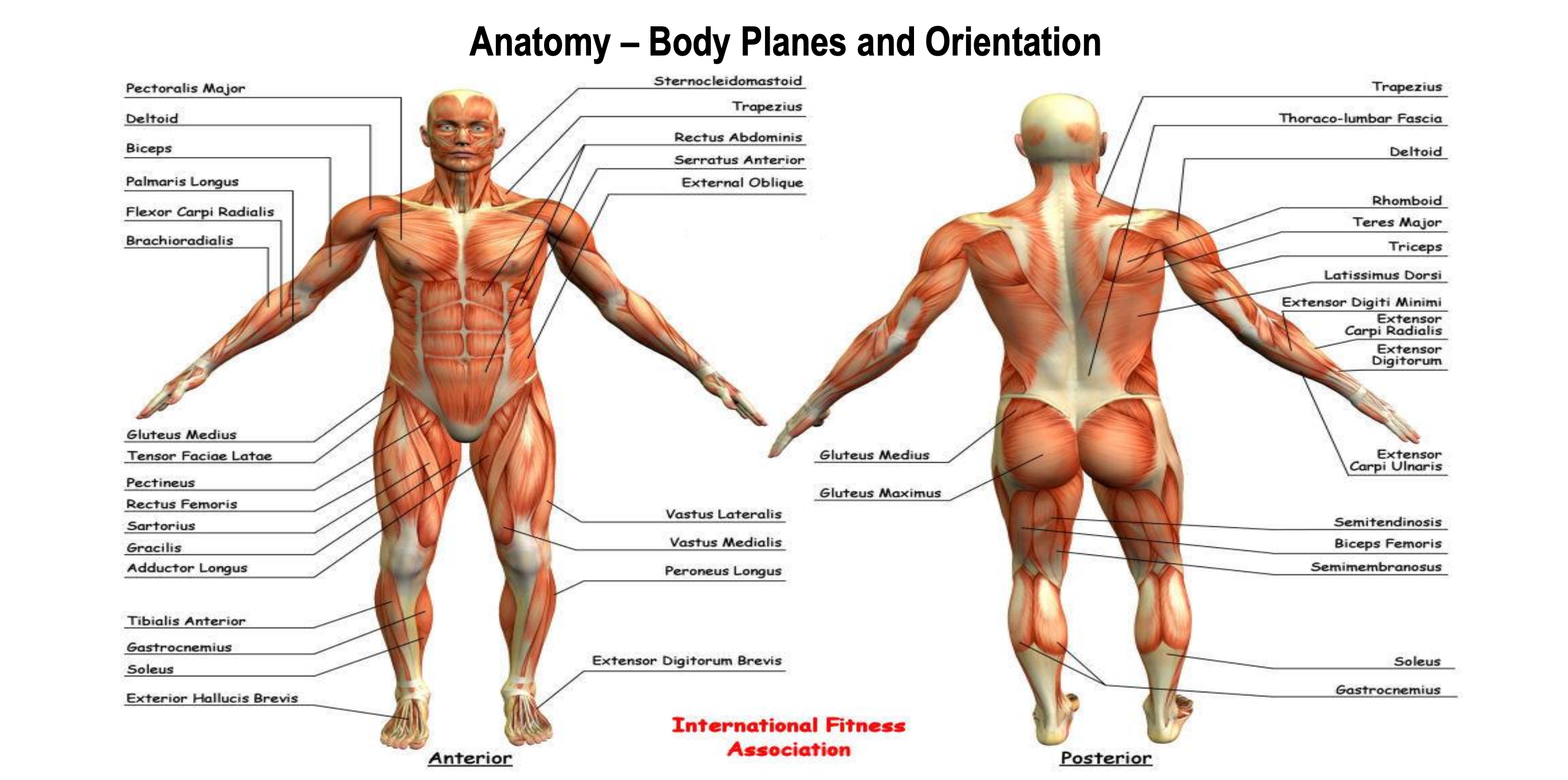
KNOWLEDGE AND SKILLS REQUIRED – ANATOMY
Locations, names and shapes of bones and muscles
How to read measurement scales, measure weights and how to handle instruments
For advanced technologies, understanding of principles of electronics, lasers, photography, and video devices
KNOWLEDGE AND SKILLS REQUIRED (Anatomy – Body Planes and Orientation)
KNOWLEDGE AND SKILLS REQUIRED – ADDITIONAL
Statistical principles and methodologies
Mathematics, concepts of mass properties, forces and torque
Planning and organizing time and processes
Good language skills and facility in writing scientific material
ANTHROPOMETRIC MEASURES
Static (Structural Dimensions)
Dynamic (Functional Dimensions)
BASIS OF MEASUREMENTS
Baseline Definitions
Body segment lengths and heights
Breadths, depths and circumferences
Surface contours
Body volumes, densities and areas
Envelopes of reach
Postures
Standard sitting and strength
Standard upright sitting
Leaned against a wall with back flattened and buttocks facing the wall
Lying on the back
Other postures depending on task being analyzed
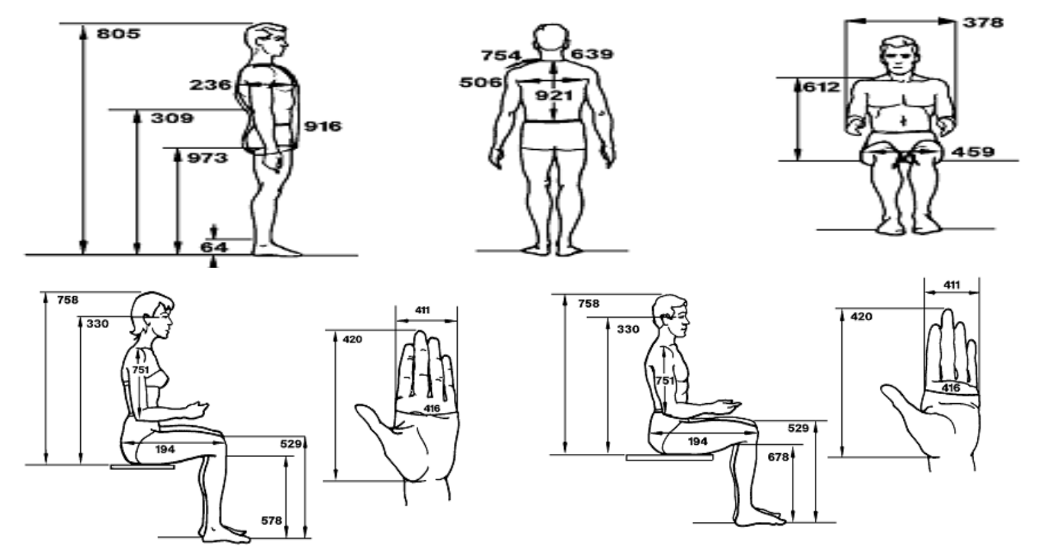
BASIS OF MEASUREMENTS (posture examples)
Posture definitions include standard sitting, upright sitting, leaning against a wall, lying on the back, and other task-specific postures.
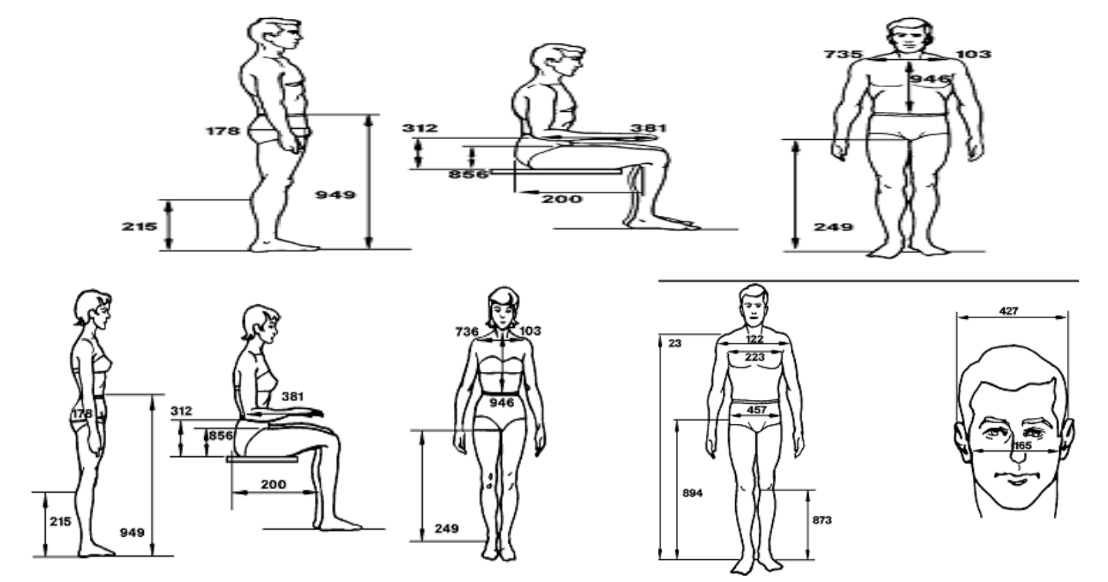
DEVICES AND PROCEDURES
Manual Anthropometrical Instruments
Grip board and blocks
Anthropometers
Calipers
Flexible tapes
Goniometers
Indirect Methods
Photography
Video Recording
Lasers and Optical Surface Scanning Methods – Internal Imaging
X-rays
Methods of measuring mass properties
Weighing Scales
ANTHROPOMETRIC INFORMATION
US Soldiers were measured extensively for uniforms, armor and equipment
Represents one of the most extensively documented human groups
Studies have been done in other Asian countries such as Taiwan, Japan, Hong Kong, etc., most of which are industry-specific
STATISTICS AND ANTHROPOMETRY
Most data are normally distributed
Most parametric statistics procedures are applicable
Issues on variability include:-
Measurement
Intra-individual
Inter-individual
Secular
Heavy use of percentiles
Establishes exclusions
Selection of subjects for fit tests
Any dimension can be located exactly
Selection of users of products
ANTHROPOMETRIC DESIGN PRINCIPLES
Design for All
Design for Adjustment
Design for Several Sizes
Design for Extreme Individuals
KNOWLEDGE AND SKILLS REQUIRED – THE SKELETAL SYSTEM
The human skeleton is normally composed of 206 bones, with connective tissues and articulations
The skeletal bone provides an internal framework for the whole body
THE SKELETAL SYSTEM
Connective Tissues
MUSCLES are the organs that generate force and movement
TENDONS are strong elastic tissues connecting muscles to bones
LIGAMENTS connect bones and provide capsules around joints
CARTILAGE is a translucent, viscoelastic, flexible material, as articulation surfaces at the joints
Joints are body links that determine the human mobility
Maximal displacements of the body define the range of motion
RANGES OF MOTION
Flexion
Hyperextension
Extension
Outward rotation
Abduction
Adduction
Inward rotation
Outward rotation
Inward rotation
(Additional entries listed in the transcript cover variations like dorsal flexion, ulnar/radial deviation, pronation/supination, plantar flexion, lateral flexion)
RANGES OF MOTION (expanded)
Extension, Hyper-extension, Dorsal flexion, Ulnar deviation, Supination, Flexion, Radial flexion, Pronation, Plantar flexion, Lateral rotation, etc.
THE SKELETAL SYSTEM – SPINAL COLUMN
The spine consists of 24 movable vertebrae arranged in fused groups of rudimentary bones
The spine protects the spinal cord
The spine is capable of withstanding loads, yet flexible enough to allow a large range of motion
BACK PAIN
The spinal column is often the location of injury, pain and discomfort because it continuously transmits internal and external strains
Back pain results from a combination of repetitive trauma and the normal aging process
Overexertion injuries have been traced to the compression of spinal discs, particularly the lumbar area
HUMAN STRENGTH
Muscle Strength – maximal tension or force that a muscle can develop voluntarily between its origin and insertion
Body Segment Strength – force or torque that can be applied by a body segment to an object external to the body (e.g., hand, elbow, shoulder, back or foot)
HUMAN STRENGTH ASSESSMENT
Strength is influenced by motivation and the physical conditions under which it is exerted
Body strength is measured using analog or digital dynamometers
Example reference: Digital Hand Dynamometer
RECENT TRENDS IN ANTHROPOMETRY
Use of computer modeling to model humans; shift in measurement goals
New electronic imaging technology impacting anthropometric methods
Determination of true percentage accommodation is favored over common percentile manikins
APPLICATIONS OF ENGINEERING ANTHROPOMETRY
Automotive Vehicle Interiors: body posture selection and foot location; eye position; reach envelopes; human and cabin dimensions
Airplane Cockpits: design specification layout; clearance and adjustment envelopes
Aircraft Passenger Accommodations: shin clearance for seating; shoulder clearance; design of lavatories for handicapped people
Computer