Face Processing Development
Why faces?
Faces hold special perceptual significance in human development.
They possess neural specificity; specific brain networks are activated during face perception.
There is profound social relevance to face processing, including emotions and intentions conveyed through facial expressions.
Special Perceptual Significance
Fetuses display an ability to follow face-like patterns (top-heavy three-blob pattern).
Newborns demonstrate a tendency and preference for looking at faces shortly after birth, compared to anything else.
Infants can recognize their mother’s face within minutes of birth.
Note: the more ecological tests are, the more confounders there can be
Infants generally show a preference for faces over non-face objects.
Visual attention towards faces is prioritized significantly earlier than for objects.
The salience of faces persists throughout an individual's lifespan:
Questions arise regarding the origins of this early salience:
Is there an existing primitive representation of faces with adaptive value? Something has to be kickstarting, even though there is a maturational rhythm
Is there a pre-existing neural mechanism?
Elizabeth Spelke: core knowledge theory — not blank state, there is core knowledge about categories of stimuli, e.g., human movement
Neural Specificity: Cognitive Specialization
Interactive Specialization Model (Johnson)
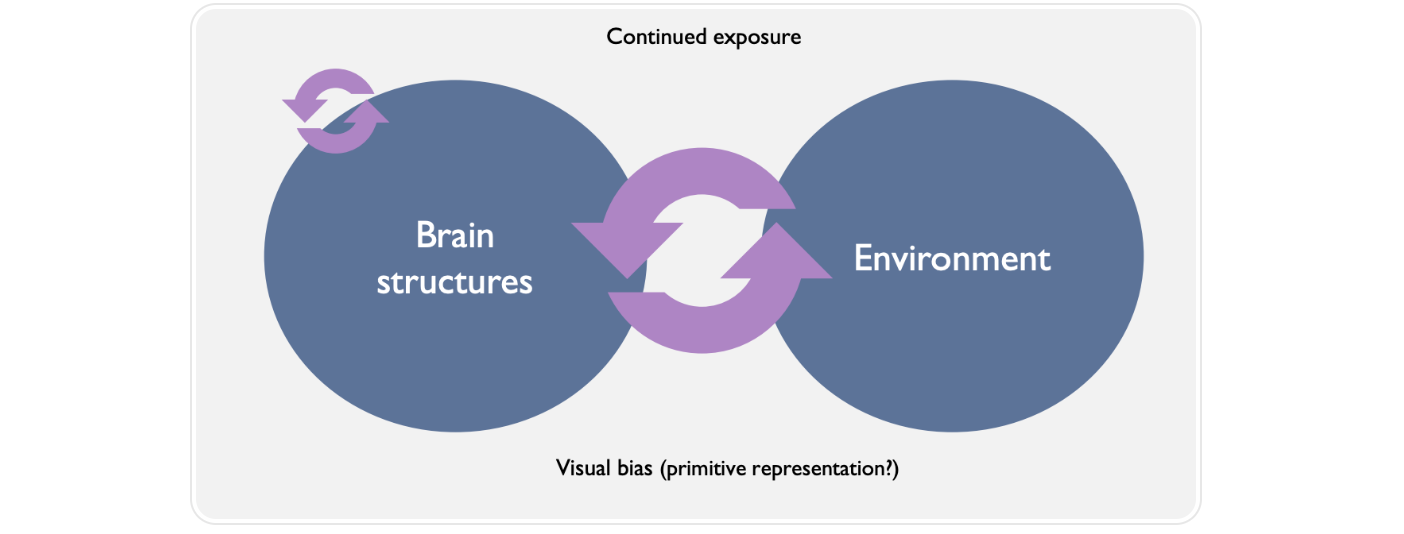
This model posits a domain-general theory of cognitive specialization that accounts for the development of face processing. It emphasizes a reciprocal relationship between the environment and brain structures.
In order for the brain to specialize in a process, we need:
Healthy interregional connections
Area with visual bias, sensitivity, potentially linked to a primitive representation of faces (will make brain engaged more actively with that stimuli in environment)
Continued exposure to faces across developmental stages
How things can go wrong:
Missing healthy interregional connections
Congenital cataracts
Even after removal of cataracts: long-term, irreversible lack of specialization in faces
FFA was waiting to specialize, but some part of this network was not sending information there, not allowing the brain to engage with this stimuli
The FFA will be used for something else
No functional specialization in faces
Missing visual bias of a structure for faces => lack of salience for face, lack of drive
Social deficits in autism
Impairments in eye contact and face processing (not interested, faces not unique to them, like other objects)
Nothing driving these children to pay special attention to faces
Lack of primitive representation (top-heavy three-blob pattern)?
Note: maybe they are uncomfortable and avoid faces, making them less engaged => we could fit this into the model as well — reliance on cognitive, sensory things only
No functional specialization in faces
Missing continued exposure to faces across development
Social deprivation (e.g., the Budapest orphanage)
Lack of exposure, rarely saw humans, also when they did there was no variability
If not adopted before 2 years, the areas predetermined for faces never gained specialization
Expectations for the three groups:
The brain will probably look similar — no specialization, impairment
Social presentation: really interesting but probably so diverse, hard to say
Left-right specialization
Early development: Both right FFA and left homologue activate for faces
After learning how to read or write: Right specialized for faces, the left homologue specializes in visual symbols of language
Illiterate adults: Both right FFA and left homologue activate for faces (not better at facial processing)
Fine-tuning structures, more areas doesn’t mean better, in fact it might mean more effort — important! Accuracy, response time, effort of the brain, areas — all important facts that explain interactive specialization
Two-process theory of face processing
Conlern = role of the environment
Conspec = visual bias (primitive representation)
Neural Specificity: Visual Pathways
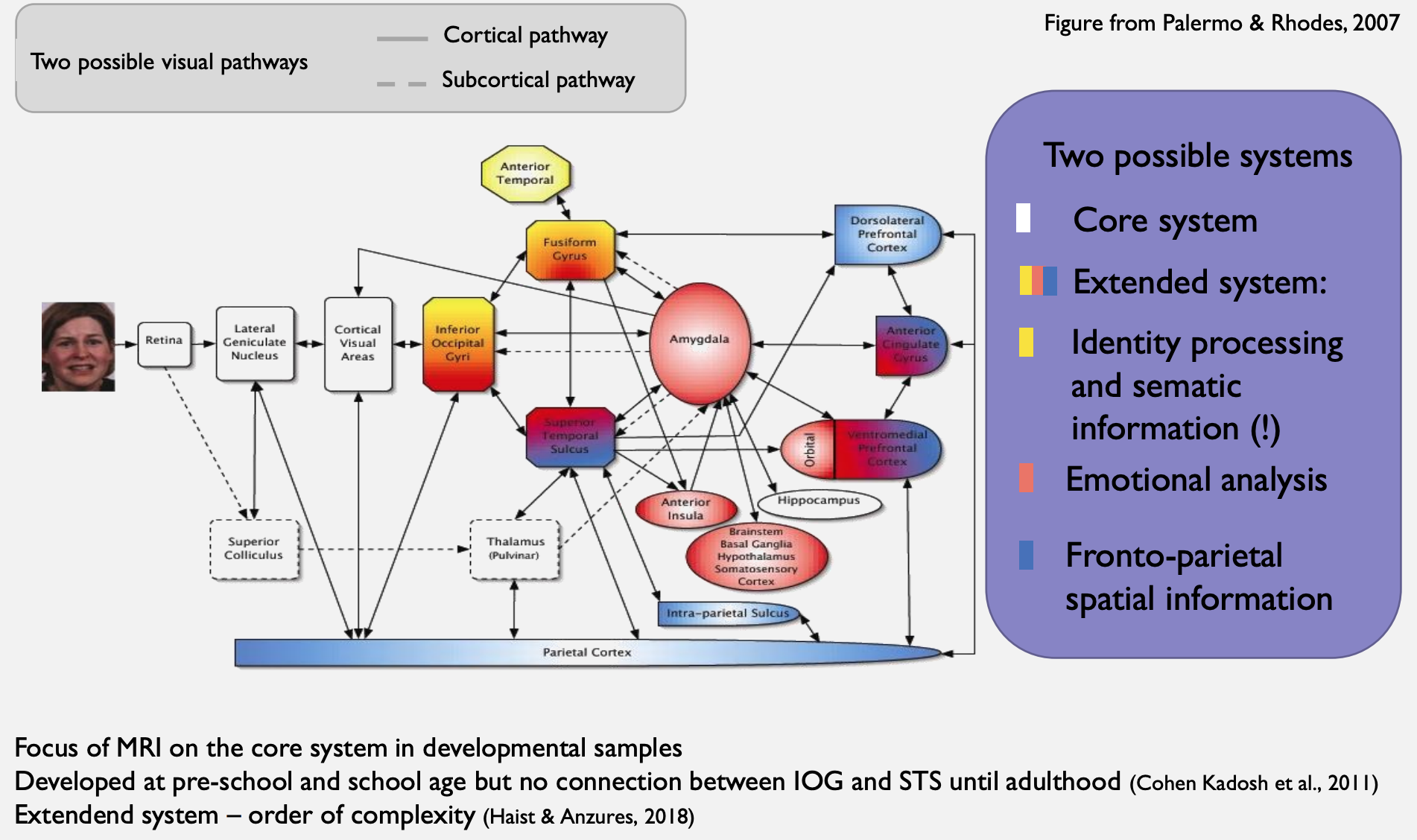
Lots of areas are not just for faces, but they support this process
Subcortical Pathway
Retina => Superior colliculus => Thalamus (Pulvinar) => Amygdala
Quicker and automatic
Sensitive to low spatial frequency images and luminance (this is important, because you can potentially weave out these pathways by controlling for stimuli)
Makes sense: Infants can’t see very well
Origin of conspec
Developed first
In infants: Innate tendency to detect and process faces
In adults:
Social-emotional information and facial expressions of emotion even in subconscious stimulation
Fear and threat processing
Emotional deficits associated with impaired processing of LSF — highly psychopathic patients weren’t processing the low SF emotions with this pathway or at all
Cortical Pathway
Retina => Lateral Geniculate Nucleus (LGN) => Cortical Visual Areas => all other full lines in the diagram, goes around the houses
Slower
Sensitive to high spatial frequency processing
Later development => cortical specialization needs environment
Abused vs. not abused children: difference is seen here
Detailed analysis of the visual stimuli: feature perception + changeable and also invariant aspects of faces
More to do with environment
Origin of conlern
In infants: Activation of the core cortical areas in newborns and 2-month-olds
In adults: Specialized, dependent on experience, and cortical compensation
If subcortical pathway is not working, this one can compensate, but it’s slower
Event-Related Potentials
The N170 and N290 event-related potential markers indicate face processing activity:
N170: Negative deflection that occurs approximately 170ms after stimulus presentation in adults, and detectable as early as 3 months in infants (Halit et al., 2004).
P400: A positive deflection around 400ms, potentially precedes the N170 and is impacted by emotional responses (Halit et al., 2003).
Perceptual narrowing occurs with experience, impacting the ability to recognize faces of different ethnicities or familiarities (Kobayashi et al., 2018; de Haan et al., 2003).
Social Relevance
Cliff experiment and still face experiment
Social relevance — infants:
Bilateral communication tool
Establishment of the first attachment relationships
Understand the rules of the world (e.g., social referencing)
Facial expressions of emotion!
Social relevance — adults:
Recognition of various aspects
Infer other’s feelings and intentions
Behavior modulation in social interaction
Basis of multiple social cognition processes
Facial expressions of emotion!
Development of Face Processing
Face processing
Newborns
Existence of primitive face representation
Orientation to faces
Preference for face-like stimuli
Holistic/configural processing: see faces as whole rather than detail
Infants
Specific brain activity to faces (already some specialization)
Importance of eye gaze (directed to us — we process more)
Preference and discriminative ability (caregiver’s face, ethnic group, gender) — habituation effect, familiarity
Feature importance (scan faces for details)
12 months: sensitivity to inverted faces
Perceptual narrowing! — fully done interactive specialization (not with impaired children, those three ways)
Babies at 9 months can discriminate different faces of monkeys — so much better than adults — because a bit after that perceptual narrowing happens and they loose this ability
Childhood, adolescence
Until 10: featural processing — external features impact on face recognition
Around puberty (after 10): holistic/configural processing: go back to holistic, important for social processing
Pubertal dip? — because of this reorganization? — some studies show that adolescents are worse at discriminating very small changes vs. before/after
From there… we only become better
Things to consider…
Processing of Facial Expressions of Emotion
Infants, toddlers
3 months: ability to discriminate expressions — don’t understand the meaning yet (they don’t change their affective reaction to different faces, just visual discrimination)
7 months: happiness vs. others — they mostly see happy faces — contextual effect
Happiness vs. fear, neutral, and anger
Depressed mother and neglect and abuse — will effect that timeline!!
9-10 months: positive vs. negative — valence, regardless of arousal
Discrimination of faces with different valence (positive vs. negative)
2-3 years: categorization as happy (+) and angry (-)
Study: habituation to a face => mismatch in valence and/or arousal!
Preference for novel face established — saturates at 12 months
Increased preference for arousal-mismatch displays
Note: amount of information in the face could be unsettling for some cultures
Behavioral changes to the expressions differ across the first 2 years — from perceptual to affective differences
We start with valence, arousal — only with language we make specific categories
Very activated faces — babies would cry
Need for neuropsychological studies!
Childhood, adolescence
Until 7 years: Progressive discrimination of several negative emotions
Late childhood: still hard to recognize surprise and neutral faces
Adolescence: Discrimination of all emotional categories
Things to consider… face processing not in isolation (impacts and is impacted)
Attachment
Emotional understanding and regulation
Cognitive skills
Later PI to positive emotions => enhanced N170 for negative emotions
Adults
Activation in face areas — N170 modulation by arousal, regardless of the emotional category
Important…
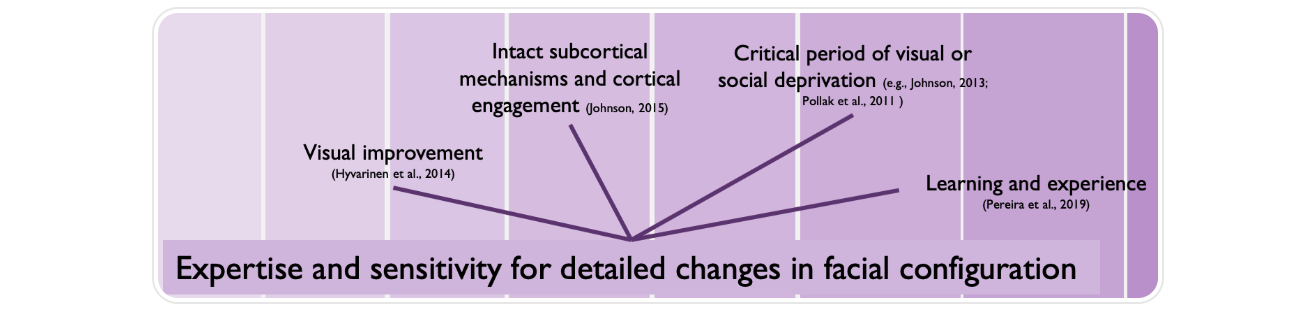
Neural and visual integrity, but most of all — early experiences — type of stimulation and emotional processing skills in general
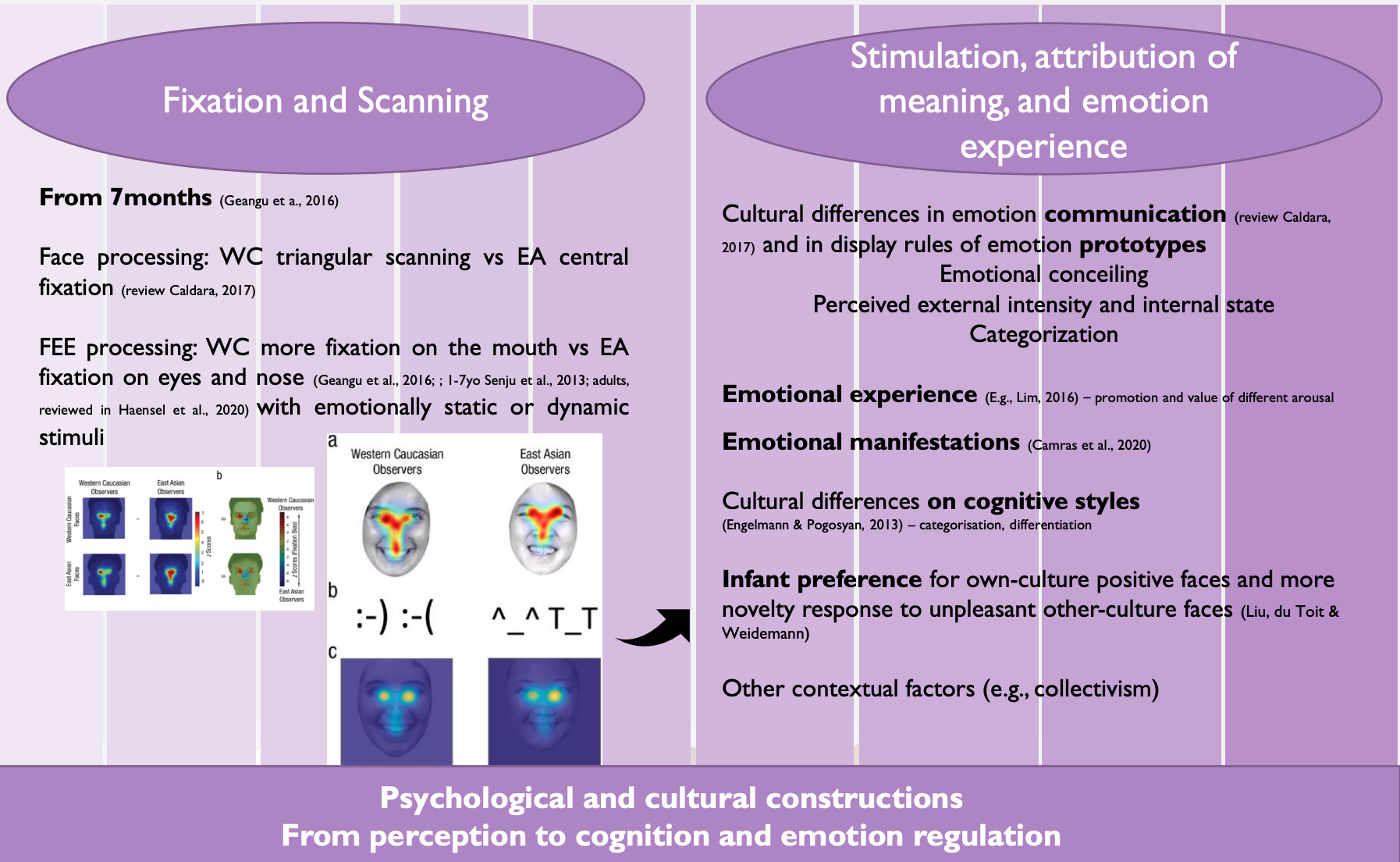
Culture