Notes on 'Faire' Conjugation
French Verb Conjugation: Faire
1. Vouloir (To want)
This verb expresses a wish, a desire, or a willingness to do something.
· Meaning: To want, to wish
· Key Idiom: "Vouloir bien" means "to be willing" or "to gladly accept."
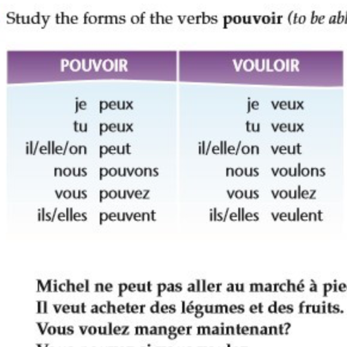
Present Tense Conjugation:
· Je veux (I want)
· Tu veux (You want - informal)
· Il/Elle/On veut (He/She/One wants)
· Nous voulons (We want)
· Vous voulez (You want - formal/plural)
· Ils/Elles veulent (They want)
Examples:
· Je veux un café. (I want a coffee.)
· Nous voulons apprendre le français. (We want to learn French.)
· Voulez-vous danser ? (Do you want to dance?)
---
2. Pouvoir (To be able to / Can)
This verb expresses the ability, the possibility, or the permission to do something. It is the equivalent of "can" in English.
· Meaning: To be able to, can, may
Present Tense Conjugation:
· Je peux (I can / I am able to)
· Tu peux (You can - informal)
· Il/Elle/On peut (He/She/One can)
· Nous pouvons (We can)
· Vous pouvez (You can - formal/plural)
· Ils/Elles peuvent (They can)
Examples:
· Je peux parler français. (I can speak French.)
· Est-ce que je peux ouvrir la fenêtre ? (Can I open the window? / May I open the window?)
· Tu peux venir demain ? (Can you come tomorrow?)
---
Overview of the Verb 'Faire'
'Faire' is a French irregular verb that means 'to do' or 'to make.'
Present Tense Conjugation of 'Faire'
The conjugation of 'Faire' in the present tense is as follows:
Je fais - I do / I make
Tu fais - You (informal singular) do / make
Il fait - He does / makes
Elle fait - She does / makes
On fait - One does / makes
Nous faisons - We do / make
Vous faites - You (formal singular or plural) do / make
Ils font - They (masculine) do / make
Elles font - They (feminine) do / make
Notes on Usage
'On' as a Subject:
The subject 'on' is often used in French to mean 'we' in a more informal or generalized way.
Gendered Conjugation:
The distinction between 'ils' (masculine) and 'elles' (feminine) in the plural form indicates the gender of the subjects.
Application of 'Faire'
*Common Phrases:
"Je fais mes devoirs" - I do my homework.
"Nous faisons un gâteau" - We are making a cake.
"Ils font du sport" - They do sports.
Passage 1:
It’s Tuesday today. At ten in the morning, like every morning, except Monday when the shops are closed, Mme Lelong leaves her apartment. She has her bag and she is going shopping. She shops in different small stores. She buys bread every day. She goes to the bakery where she buys a baguette. If she wants meat, she goes to the butcher shop. If she wants fish, she can go to the fish market, but it is very far. For a jar of jam or a bottle of mineral water, the grocery store is not far. After lunch, if she doesn't have enough bread for the evening, she can buy another baguette. But not before 4 PM. Small shops are closed every day from 1 PM to 4 PM, and of course on Sundays!
Passage 2:
French people like to go to local small shopkeepers—the grocer, the butcher, the baker, etc. Their prices are a little more expensive than at the supermarket, but the quality of their products is very good. There is also the human dimension. French people like to chat (converse) a little with the shopkeeper (male or female). They find it nice.