Ointments and Solutions (Week 3)
Ointments → greasy, semi-solid preparation intended for external use w/o feeling gritty, and should spread easily across the skin and melt upon application by body temperature.
what are the types of the ointment?’
medicated → contain active ingredient to relieve skin conditions (infections/inflammation/itching)
non-medicated → protectants forming barrier against irritants or act as lubricants that are meant to hydrate and reduce friction against the skin
advantage (LAPH)
easy application and retention
lubrication and emollient (soften and smoothen the skin)
prolonged drug action upon the skin → used continuously and regularly
hydrophobic nature and suitability for mucosal use → not easily washed away by bodily fluids.
disadvantage
greasy and difficult to remove
staining of clothing → bleaching etc.. (benzoyl peroxide)
not suitable for exudating sites → not suitable for places where there is excessive discharge of fluid like sweat etc..
drug release limitations → those that are water soluble and released from an oil base (water-in-oil) can have a slower onset of action as hydrophobic nature of the ointment might not transfer well onto the aqueous surface of the skin.
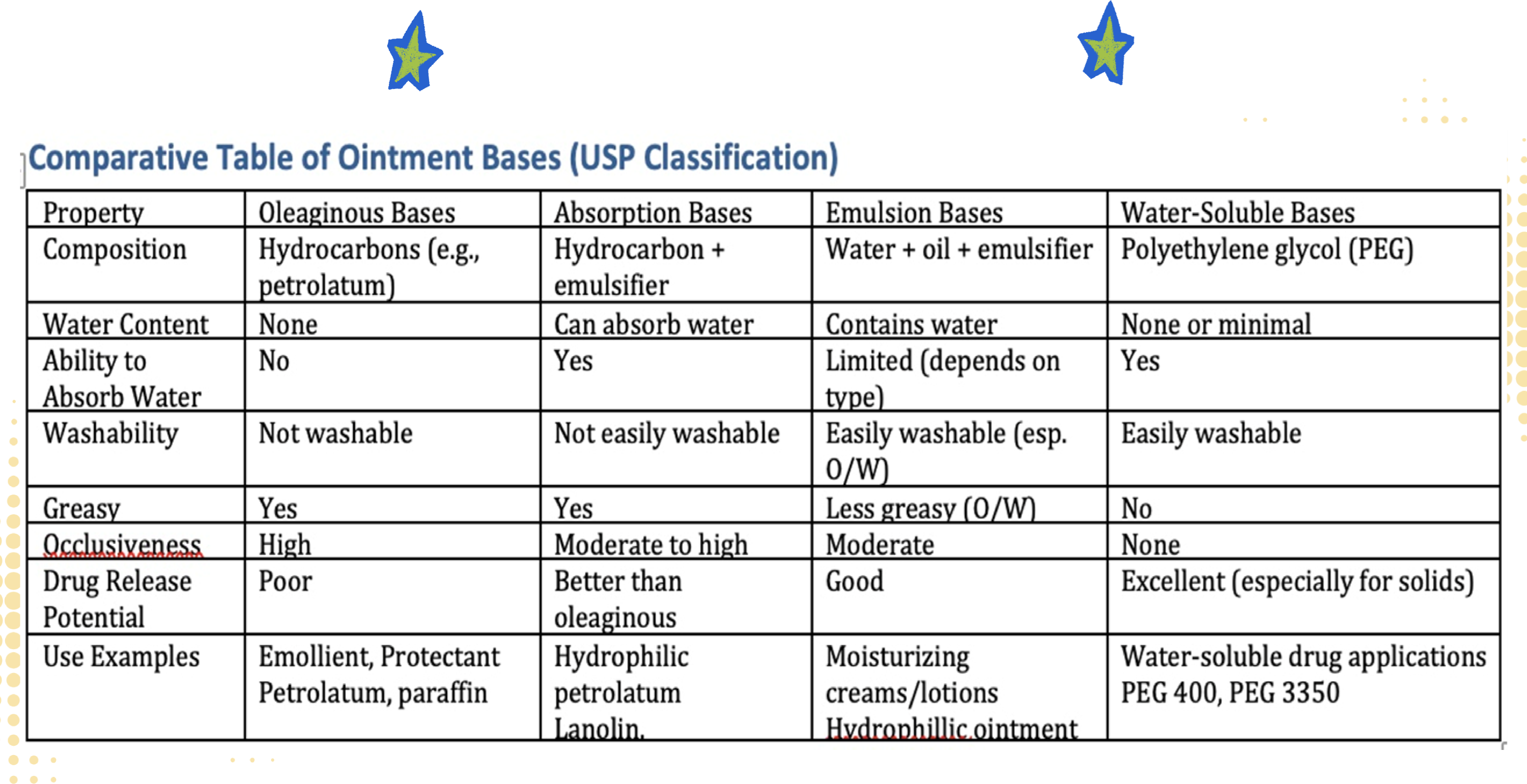
types of bases for ointments
oleaginous base
→ primary composed of oils and fats to provide moisture and lubricating properties to the skin
→ does not contain water (all oil) → can limit drug release
→ creation of barriers → retain heat which aids in absorption
→ occlusive to prevent water from evaporating from the skin to provide hydration and soothing effect
→ poor drug release potential (fully oil) for drugs that need to partition out of the base to exert its active ingredient effect.
emulsion base
absorption base
water-soluble base
Old Apples Eat Worms
Clever Whales Always Wash Greasy Oil During Underwater-trips
Preservatives — why are they needed?
prevent microbial contamination
extend shelf-life
maintain product safety from repeated uses.
when? → Water Content, Multi-dose Containers, High risk of microbial contamination during use
what is considered high risk? — ointments/creams being applied to infected/broken skin or mucous membranes.
e.g. Parabens and Phenols → Propylparabens, methylparabens (involves hydrocarbons)
so what is the difference between ointments and creams then..?
appearance
occlusiveness → ability of a substance to form barrier on skin surface to prevent evaporation of water from it.
water content
skin penetration
application suitability → different skin types
ease of spread
cosmetic acceptability
drug release
Acronym to remember this:
All Ointments Will Stop All Cutaneous Damage
The comparisons between them..?
appearance (translucency): ointments (thicker & heavier) < creams (thinner & lighter)
occlusiveness: ointment > creams
water content: ointments < creams
skin penetration: → depends on clinical context
application suitability → dry, flaky chronic skin conditions, needs to remain in place/position (ointments), moist, wet chronic skin conditions/to be applied on face (creams)
ease of spreading: ointment < creams
cosmetic acceptability: ointments < creams (more easier to use & absorbs faster and better into the skin in shorter time)
drug release: creams > ointments (creams can partition easily/better into the aqueous environment of the skin to exert its effect compared to oily, thick ointments.)
depends on clinical context
Solutions
pharmaceutical solution → homogenous, one phase system consisting of 2 or more components (solvent + solute) that is completely uniform throughout which is important for doing accuracy
basic characteristics
advantages
easier to swallow
faster onset of action → already dissolve and disintegrated → faster therapeutic effects
taste-masking → flavoring can masking components can be added to make it more palatable
consistent/uniform drug distribution → accurate dosing regimens
less irritation on the gastric mucosa → allows for higher doses to be given without high irritation → this is due to solutions being immediately diluted by stomach contents, compared to solid tablets which have to be locally disintegrated and dissolve first, leading to localized irritation
Acronym to remember:
F - faster onset of action
A - accurate dosing (uniform drug distribution throughout)
S - easier Swallowing
T - Taste-masking (adding flavoring)
ER - Eased Gastric IRritation (lesser irritation on gastric mucosa)
disadvantage
bulky → product loss if container is broken
shorter shelf life → when dissolved, oxidation can occur
risk of microbial growth
accuracy of dosage is patient-dependent → the amount that people apply will differ from person to person.
Unpleasant Taste → taste-masking is not always easy, it might even end up with a worse tasting drug in general
BLAST → Bulky, shelf LIFE, dosage ACCURACY, microbial SUSCEPTIBILITY (risk of microbial growth) , unpleasant TASTE
different types of solution → elixirs, eye drops/wash, ear drops/wash, nose drops/wash, syrups, lotions , IV and IM injections → this is why they are such a important dosage form
solubility considerations
Formulation of Solutions
choice of solutions → aqueous/non-aqueous solutions
solubility considerations
formulation additives → buffers/preservatives/sweetening agents/coloring agents/flavors and fragrances → natural: fruit juice/aromatic oils or synthetic: artificial citrus.
synthetic colouring can come from sodium salts of sulphonic acids
natural → carotenoids, chlorophyll, anthocyanins
what are the different types of solvents used?
potable water → dissolved salts and other impurities (suitable for very general preparations)
purified water → distillation → oral solutions and syrups (boil and cooled before use)
water for injections → sterilized distilled water → water goes through deionization, distillation or reverse osmosis → for all parenteral injections — highest grade of purified water when contamination risk is very high (reduce risk of pyrogens → cause fever)
advantages of using water/purified water
lack toxicity
physiological compatible with bodily fluids with minimal side effects
ability to dissolve wide range of material
howver -. lacks selectivity → since it dissolves almost everything, impurities and contaminants can also be readily absorbed into the solution if not handled properly with care
Approaches to the improvement of aqueous solubility
co-solvency (water/ethanol blend)
pH control
Solubilization
improving aqueous solubility
complexation → using cyclodextrin → combining poorly soluble drug, with a soluble material to enhance dissolution rates and bioavailability in formulations.
particle size reduction → increasing surface area
chemical modification → create more water soluble deriatives → converting into salt forms
when to use non-aqueous → when cannot ensure complete solution of ingredients at storage temperature & instability in aqueous systems
advantage → depot therapy (IM) → allow for slow drug release into surrounding tissue → can hide as discrete entity/reservoir within muscle tissue till needed compared to aqueous solution that diffuse readily
e.g. propionate esters of testosterone
alternative solvents ..?
depends on..
toxicity , irritants, sensitizing potential (ability to trigger allergic reactions) , stability, cost and compatibility with other excipients
classifications → fixed oils (veg origin: almond/arachis) , alcohol (low conc in IV and in salicylic acid) and polyhydric alcohol (PEG400 topical solutions , Digoxin (propylene glycerol with water/glycerol), phenobartbital injections