chapter 6: vocal anatomy, acoustic communication, and echolocation
graded calls - not exactly definite …
communication
simple communication: in organisms that lack a nervous system, without cognitive abilities, e.g. bacteria
non-informative communication: lack of cognition, e.g. tungara frogs
passive communication: swim movement, splashes, exhaling, bubbles, flipper strokes
auto-communication: echolocation
informative communication: including cognition: alarm calls, waggel dance, language, but also aerial displays like breaching in humpback whales
complex communication
Groups with complex social systems require more complex communication systems. group size, social networks, and pair bonds in societies
Acoustic communication in the sea
acoustic sensory modality is favoured:
speed of sounds approx. 5 times faster than in air, 1500 m/s (air 340 m/s)
compared to light, which only travels 100 m in water - 10 km in air
sound travels > 100 km in water - 1 km in air
sound production/vocal anatomy
sound production in marine mammals
aquatic marine mammals
(cetaceans, sirenians, phocids, walrus) specialised in sound communication and exploration of sea
= 2-3x more auditory versus optic nerve fibres (than land mammals)
semi-aquatic marine mammals
(otariids, sea otter, polar bear) communicate mainly in air but phocids in air and underwater
sound production larynx
pinnipeds (figure below)
well developed larynx, used for repsiration and sound production
differences between
species
males/females
young/older individuals
adaptations for diving
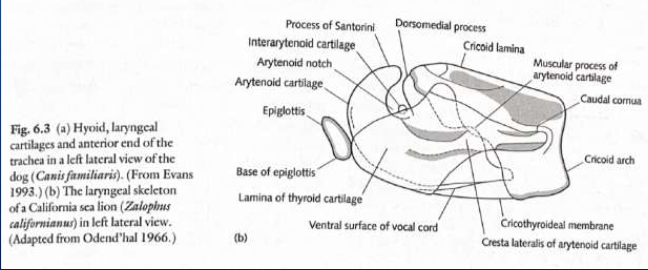
cetaceans: mysticetes unusual laryngeal sac - diverticulum: resonator for sound production
odontocetes have beak like structure - separated respiratory tract from mouth and esophagus
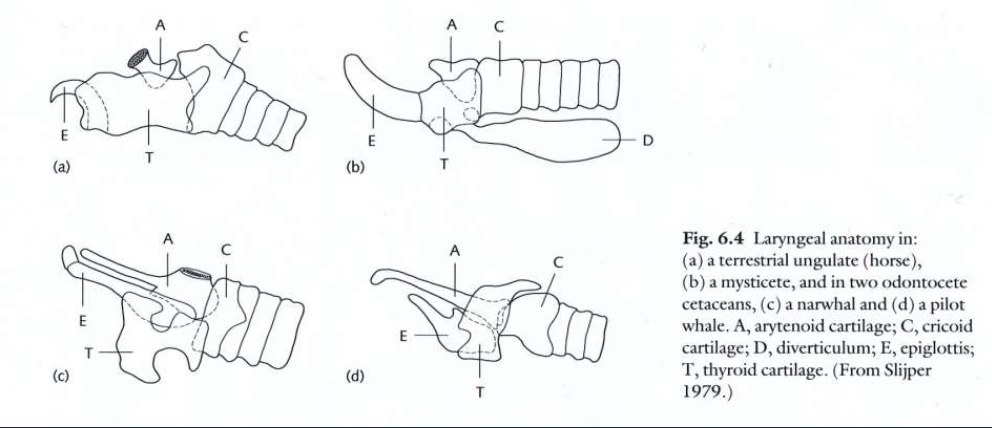
blue whale - sound resonator:
in Mysticeti, the skull is modified to accommodate palatal baleen plates as a feeding adaptation
unusual laryngeal sac (diverticulum) and nasal passages act as resonator
auditory bullae of mysticeti are wedged against the skull
bone and soft tissue conduction of low-frequency sound
two blow holes
dolphin - larynx
toothed whales: different than terrestrials - artenoid and eppiglottal cartilages elongated to beak-like structure, which separates the respiratory tract from the mouth/oesophagus - reduces risk of choking: breath and swallow at same time
dolphins may produce sounds also in larynx for communication
but most sound production in nasal passages
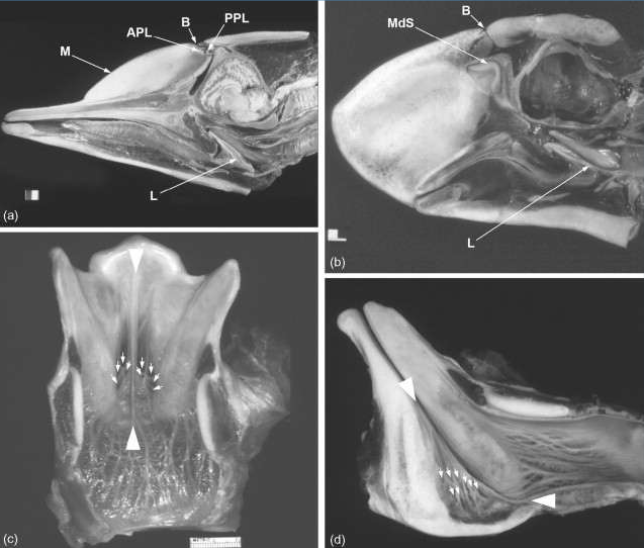
sound production odontocetes
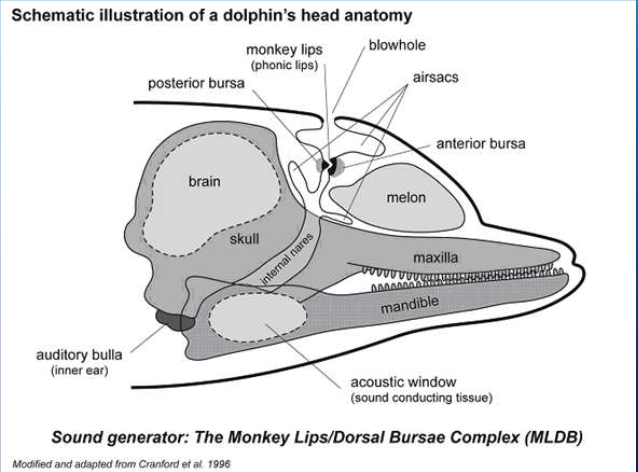
the skull of odontoceti is shaped is shaped to accommodate a melon (or junk in sperm in whale), facial muscles, the monkey lips/dorsal bursae (MLDB) complex, and nasal sacs for directional sound generation associated with echolocation and social interaction
only one blow hole
the bullae are not fused to the skull but suspended in a spongy mucosa (peripullar plexus) by ligaments - no bone conduction
dolphins nasal passage
whistles, calls and click are produced in head by bilaterally MLDB and nasal sacs in soft tissue nares
air is forced between a pair of MLDB - rapidly open and close (vibrate) → produce sounds (clicks and whistles)
the phonic lips are two parallel ridges of transverse, keratinized tissue with fine grooves that direct flow into the vestibular air space for recycling (i.e. not expelled through the nares)
airflow is under voluntary control - variety of sounds is possible
the two MLDBs can function independently → two different sounds simultaneously (= two voced calls)
also clicks are produced independently from whistles
the melon contains lipids that are impedance-matched to sea water - sounds are produced by air moving past the vibrating monkey lips acoustically separated form the melon, which focuses and directs sounds into water.
higher frequencies are more focused than lower frequencies
sound production sperm whales
loudest sound in animal kingdom
junk homologous to melon
spermaceti organ like right posterior dorsal bursa in other odontoceti
single pair of phonic lips located in right nasal passage beneath blowhole
produces high-intensity sonic clicks (400 hz to 15khz and up to 235 db)
clicks several paths in head:
part of sound - put the front of the head, remainder travels backward through spermaceti organ to air sac adjacent to skull reflected back through the junk - focuses the beam out the front of the head
part of this sound beam is reflected a 2nd time by distal air sac at front of the head
it travels 2nd time to frontal air sac - reflected through junk - out the front of the head
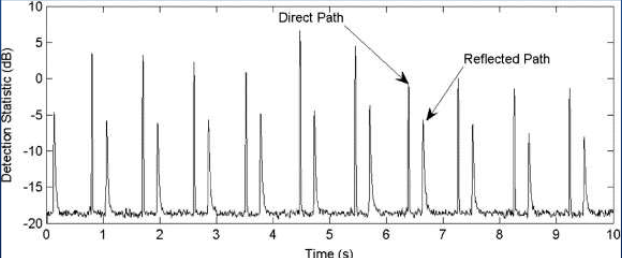
hunting and prey detection, clicks 1-2s intervals - increase in repetition → whale approaches potential prey at very close range, repetition rate so fast that individual clicks cannot be distinguished (buzzing, → creak
sound production pinnipeds
pinniped vocalizations are sonic, diverse and vary by species, sex, age and season - social communication
in air - often roars, growl, barks, snorts, whimpers, and whistles - exhaling through larynx, vocalizations → pursed lips or nostrils
underwater vocalizations - moving air between the lungs and oharynx, which causes membranes in trachea to vibrate without expelling air through the mouth or nostrils
there is sound variation between species:
larynx, two voiced, movements in mouth and tongue, lips (whistle/walrus), pharangyeal sac in their necks (gong/walrus)
phocids: tracheal mechanisms, vocal folds (weddel seals)
vibration of dorsal tracheal membrane (bearded seals)
air sacs on right side (ribbon seals)
hooded seals: inflatable nasal hood and septum (balloon): visual and acoustic display
sound production sirenians
sirenians - vocal folds in larynx → variety of sonic vocalization
manatee class (e.g., chirp-squeaks, squeals, and creams)
0.5-18 khz
peak frequencies of 1-8 khz social communication and mother calf recognition
sounds are acoustically coupled to the water through fat pads in the neck
dugong calls (chirp-squeaks, barks, and trills)
frequency range of 2-18 khz
peak frequencies of 1-8 khz
sound production sea otter and polar bears
polar bear: laryngeeal mechanisms of terrestrial mammals, lip vibration - no underwater vocalisations
sea otters - no underwater vocalisation
aerial vocalizations short - range communication (e.g. scremas, whistles, whines, hisses, snarls, coos, grunts, squeals, squeaks)
new-bord pups routinely - high-frequency cry in distress or seeking attention
adults produce hih-intensity long distances (up to 1 km) screams, when distressed or female / pup separated
territorial males produce high-intenisty screams when interacting with females
echolocation
autocommunication
signals/sounds are sent out to create a returning echo form obstacles
echo is transformed in auditory cortex into map
information about location, size, and composition of the environment / prey
mostly high frequency clicks and sweeps
animals explore and orient in dark environments
animals: bats, odontocetes, shrews, birds ( swiftlets and oilbirds)
bottlenose dolphin
first studies by Witlow Au (1993) described accurate echolocation by bottlenose dolphins using high-frequency clicks
narrow sonar beam - directional click to detect small objects
high frequency clicks (>100khz) broad-band (30-40 lhz), high oeak (> 220 db) short (50-80 µs)
detection range 72 m, detection size 2.5 cm
brain is capable of very rapid auditory processing, integrating 0.25 ms interval inputs
inter click interval (ICI) equals round trip and lag time: wait for echo to return and process before emitting new signal
search (ICI) internvals slow and regularly - when closing in on target ICI intervals are shorter - buzz
ICI = RT (round trip - echo) + LT (lag time / processing time, targets 20-12 m → LT 19—45 ms)
special cases
belugas ICI’s less than return time: process whole click trains in brain
porpoises 5-10x longer (150-600 µs) but half bandwidth (10-20 khz), less loud (150-170db), very high frequencies (above 100 khz), inner ears that are specialized for high frequency audition
sperm whale
clicks lower frequency (8 khz), detect bottom and squid at depth > 400m
Mysticetes ?
low frequency echolocation?
bowhead whales use echoes from calls to detect ice obstacle
do seals use echolocation?
experiments with captive hooded and harp seals showed some high frequency clicks but echolocation was not proven
instead found cod clicks
vocal communication and vocal learning
vocal repertoires (VR)
what is a vocal repertoire?
it refers to the range and variety of sounds an animal species or individual is able to produce for communication
it can be in the form of clicks, whistles, or moans, sometimes specific calls with patterns
what do specific calls mean?
how many kinds of utterances and calls are there? what do they sound/look like?
challenges of large data sets of analysis with vocal repertoires: example: Norwegian pilot whales and norwegina killer whales (vester PhD 2017)
VR driving factors
phylogeny, habitat; geographical separation; sexual selection; predator pressure
social complexity hypothesis of communication
“groups with complex social systems require more complex communication system”
group size, social networks and pair bonds in societies
context: e.g. food association calls, manipulation / arousal / information about food
VR driving factors in the sea
habitat: favourable sound transmissions in the sea versus air
speed of sound 1500 m/s (340 m/s), transmission loss 60 times less, low light conditions
echolocation development in toothed whales
social whales: large and complex group structures
large repertoires: signature whistles bottlenose dolphins
complex repertoires:
sperm whale codas
humpback whale songs
killer whale dialects
form calls to repertoires - acoustic structures
vocal classes - spectrogram: clicks, pulsed calls, whistles, other calls distinguished by their frequency harmonics, sidebands, noisy parts, etc.
problems with naming - often arbitrary and anthropocentric
but vocalisations are context. and situation dependent: coarse behavioural categories such as feeding, socialising, travelling; these give rough vocalisation patters - fine scale behaviour needed but difficult to observe underwater (drones and D-tags give new data possibilities)
long distance calls are loud, stereo typed, simple structure, repetitive and temporally patterned (rhythm, strong ordering) - low frequency calls of fin whales and blue whales suited to travel thousands of kilometers
short range signals - acoustically more complex, encode information through subtle variations - multimodal: information to receiver, distance, direction, identity, experience…
repetition or increased amplitude and frequency against noise
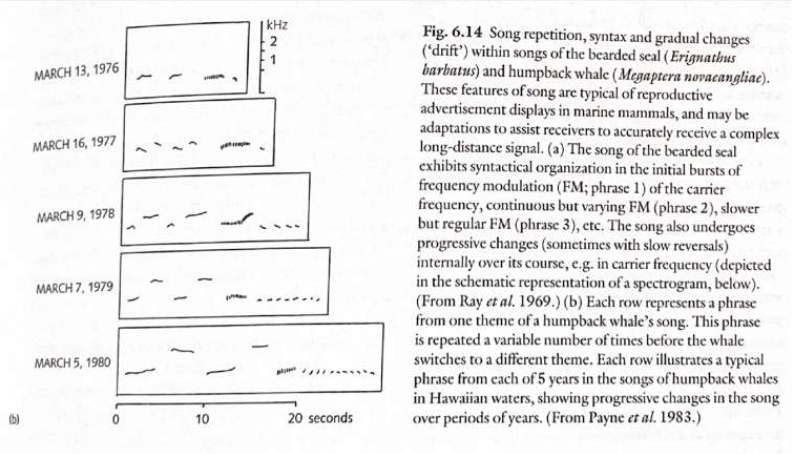
syntactical rules in humpback whale songs:
“song drift” or cultural evolution of whale songs → the shape and pitch (frequency) of the phrases changes gradually year by year, even though the over structure (duration and rhythm) remains fairly consistent.
these vocal patterns show syntax, repetition, and gradual changes
the same phrase type progressively year to year. Each year’s song builds on the previous one, creating a slow cultural drift in the population’s song
the spectrograms are a visual representation of how a specific humpback whale song phrase evolves over 5 years.
the phrase stays recognizable, but gradually shifts in frequency and structure, demonstrating how cultural transmission and vocal learning shape whale song over time.
this applies to the whole population. the song kind of gets remixed
individual differences in marine mammals vocalisation
differences in vocal tracts lead to vocal differences “voice cues” but underwater high pressure changes vocal signals - need for vocal control and vocal learning in marine mammals
vocal learning is well documented for odontocetes, myticetes and pinnipeds
but there are also differences due to geographical separation, or sex and age related
examples:
acoustic mimicry:
a captive beluga whale was able to mimic the voice of its trainer, confusing people around it
vocal learning:
dialects of resident orcas in BC
signature whistles in bottlenose dolphins
humback whale song
geographical variances: most seals
humpback songs = reflects cultural change
VR odontocetes
odontoceti produce species-specific, frequency-modulated sonic and ultrasonic sounds such as whistles (1-120 khx), pulsed sounds “calls” (1-60 khz) and click (10-300 khz) for communication and echolocation
VR types
whistles
tonal whistles: variable structures all dolphins
stero-typed whistles: re-occuring stable structure bottlenose dolphins, all dolphins
ultrasonic whistles: main energy 20-60 khz (>90 khz) killer whales and long-finned pilot whales
stereo-typed pulsed calls
tonal calls, simple to complex calls
combination of calls
two voiced calls
a type of vocalisation where the animals produces two different sounds simultaneously, often at different frequencies.
dolphins and some whales have two sets of sound producing structures in their nasal passages called phonic lips. these can work independently, allowing the animal to produce two distinct tones at once.
distinct calls (e.g. signature whistles, dialects)
pulsed calls
variations of call- graded information may carry information on emotional state, alertness, excitement, hierarchy, danger, food…
other calls without distinct structures such as buzzes, grunts, squeaks
combination of calls and other utterances
calls are oten compromised as patterned combinations (weddel seals, humpback whale songs, pilot whales…) and often combined with other displays (e.g. hooded seals, jaw clapping dolphins…)
killer whale call type combinations:
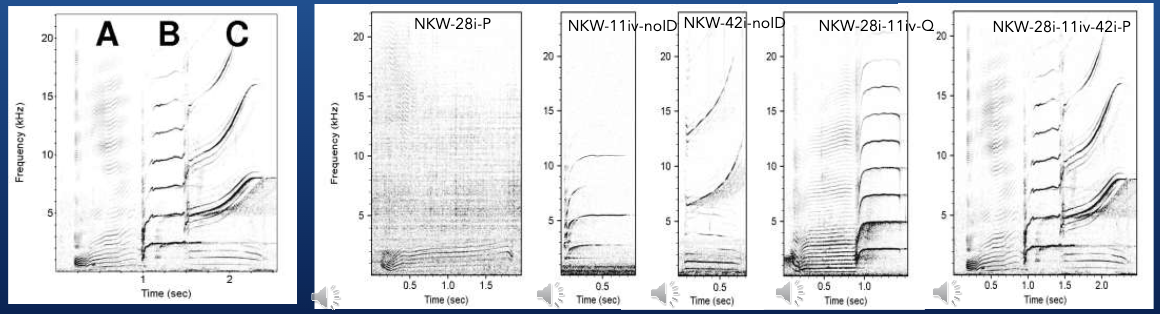
call types/sub-types
Norwegian killer whales: 88 call types, 36 sub types
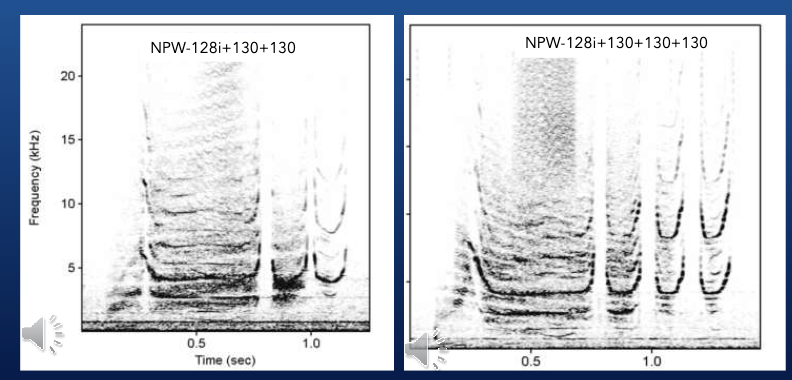
norwegian long-finned pilot whale: 129 call types, 25 subtypes
combination of call types
pilot whale call combinations
graded vocalisations and distinct structures
clicks
main vocalisation
echolocation
but also communication
buzzes - e.g. killer whales
help to herd herring?
part of calls
not well studied
sperm whales examples of “click communication”
echolocation clicks
clusters (3-20) of clicks called codas - social communication, reflect dialects of female groups
large males make a “slow click” or “clang” to announce themselves to female groups
vocal repertoires - context
group signature - dialects
sperm whale codas - context sensitive and combinatorial vocalisation
clans have their own set of codas
killer whale group dialects: in Canada, each group has its own call type set, related groups share call types
avoid inbreeding
pilot whale group dialects: first results show group specific call types but under investigation
communication - dolphin groups
recognition of the individual signature whistles
new borns learn mothers signature whistle (SW), within 3 months develop their own SW
announce themselves
addressed by others
used in the absence of the owner of the SW
communication - behavioural context
Norwegian killer whales: salmon feeding and carousel feeding
carousel feeding:
it is when (in this scenario killer whales) a group of orcas swims in circles around a school of fish, driving them into a dense, rotating ball called a bait ball, near the surface or against the shore
some orcas may blow bubbles or slap the surface of the water to keep the fish disoriented and confined.
the orcas then take turns swimming through the bait ball to eat, usually in an organized manner, hence the name carousel
this method requires high levels of coordination and social communication among group members
icelanding carousel feeding orcas similar to Norwegian orcas
mother-calf communication
contact calls
distress calls
mother contact call for calves in long finned pilot whales
male-male competition
aggressive calls
distress calls
often accompanied with aerial displays such as clapping, inflated hoods, jaw claps, etc
vocal repertoires mysticetes
they produce a variety of amplitude-and frequency modulated calls-moans, growls, or simple songs
frequency range is 7 hz in the blue whale to 24 khz in humbpack whale songs
communication - long distance
sounds that have wavelength longer than the whale and maybe used for long-distance (thousands of km) communication
fin whale and blue whale low frequency calls travel more than 1000 km
signals are loud, stereotypes, spectrally simple, long repetitive, and temporally patterned = shaped by sexual selection (complex)
noise pollution
communication - conservation
most marine mammals only visible 1-10% at surface = acoustic monitoring useful tool to estimate distribution and abundance
man made noise can interfere and become a problem for marine mammals
in the past 50 years, there has been an increase in the noise in the ocean 20 x
seismic surveys, noise from boat traffic