Glycogen
Carbohydrate Storage and Synthesis in Liver and Muscle
Glycogenesis and Glycogenolysis
Glycogenesis: Process of forming glycogen from glucose for storage.
Glycogenolysis: Breakdown of glycogen to release glucose.
Introduction
The brain and red blood cells (RBCs) have an absolute requirement for blood glucose.
Between meals, the liver serves as a key source of glucose from glycogen.
Liver Glycogen: Approximately a 3-hour supply for blood glucose needs.
Liver Gluconeogenesis: The process of producing glucose from non-carbohydrate sources.
Source of Blood Glucose During a Normal Day
Dietary sources, gluconeogenesis, and glycogenolysis contribute to blood glucose levels.
Graphical representation shows glucose sources around meals (Breakfast, Lunch, Dinner).
Glucose and Glycogen Stores in the Body (for a 70 kg Adult)
Tissue: Amount of glycogen and glucose in various tissues.
Liver:
Type: Glycogen
Amount: 75g (3-5% of liver mass)
Calories: 300 kcal
Muscle:
Type: Glycogen
Amount: 250g (0.5-1.0% of muscle mass)
Calories: 1000 kcal
Blood:
Glucose: 10g, Calories: 40 kcal.
Structure of Glycogen
Glycogen is composed of alpha-1,4 and alpha-1,6 linkages.
It has a branched structure that facilitates rapid digestion and energy release.
Entrance of Glucose into the Liver
Glucose Transport: Enters via the Glut-2 transporter, which is freely permeable to glucose.
Role of Glucokinase: Converts glucose to glucose-6-phosphate (G6P).
Inducible with increased activity after high carbohydrate meals.
Replenishment of Glycogen: Prepares glycogen storage followed by glycolysis and triglyceride synthesis.
Glycogenesis Pathway
Core Steps:
Glucose enters liver through Glut-2 transporter.
Glycogen synthase adds glucose molecules to form glycogen.
Branching occurs via branching enzyme, creating more accessible glucose storage.
Enzymes in Glycogenesis
Hexokinase (Glucokinase): Converts glucose to glucose-6-phosphate.
Phosphoglucomutase: Converts G6P to glucose-1-phosphate.
UDP Glucose Phosphorylase: Converts glucose-1-phosphate to UDP-glucose.
Glycogenin: Serves as a primer in glycogen synthesis.
Glycogen Synthase: Main enzyme in glycogen synthesis.
Branching Enzyme: Responsible for creating branches in glycogen.
Hormonal Regulation of Glycogenesis
Insulin Effects:
Activates glycogen synthase.
Inhibits glycogen phosphorylase.
Stimulates glucose uptake in muscle and adipose tissue.
Induces gene expression for enzymes, enhancing Glut-4 transporter activity.
Glucagon Effects: Opposes insulin’s action to increase blood glucose.
Glycogenolysis
Pathway Overview:
Glucose leaves the liver via the Glut-2 transporter.
The enzyme glucose-6-phosphatase is crucial for glucose export and exists only in the liver.
Enzymes in Glycogenolysis
Glycogen Phosphorylase: Catalyzes the breakdown of glycogen into glucose-1-phosphate.
Specific for alpha-1,4 bonds.
Debranching Enzyme: Needed for processing alpha-1,6 linkages, allowing glycogen phosphorylase to continue activity.
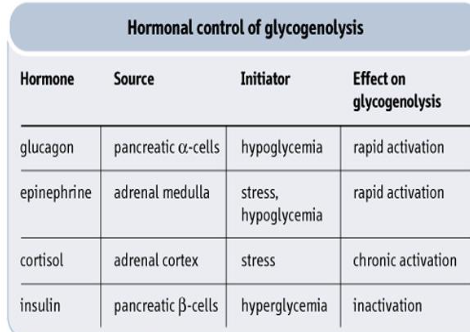
Hormonal Control of Glycogenolysis
Hormones regulating glycogenolysis include:
Glucagon: Stimulates glycogenolysis during hypoglycemic states.
Epinephrine: Activates glycogenolysis as a response to stress, hypoglycemia, and during exercise.
Cortisol: Contributes to chronic activation of glycogenolysis.
Insulin: Promotes inactivation of glycogenolysis during hyperglycemia.
Mechanism of Epinephrine Action on Glycogenolysis
Epinephrine binds to beta adrenergic receptors, activating a cascade that increases phosphorylase kinase.
This leads to the activation of glycogen phosphorylase, facilitating glycogen breakdown.
Stress Response and Glycogen Breakdown
During prolonged exercise or stress, epinephrine stimulates rapid glycogenolysis, ensuring a continuous glucose supply.
Calcium Ion Influence on Glycogenolysis
-Calcium-Calmodulin Complex: Activates glycogen phosphorylase kinase, promoting glycogen breakdown independent of hormonal signals.
High AMP levels also activate phosphorylase kinase and relieve inhibition on PFK-1, promoting glycolysis.
Summary of Glycogen Regulation
Glycogen Phosphorylase: Exists in inactive (b) and active (a) forms. Activation leads to glycogen breakdown, while phosphorylation inactivates it.
Insulin promotes the dephosphorylation and activation of glycogen synthase, balancing glycogen synthesis and breakdown.