ecology section C
Competition
Competition- the struggle between organisms for a resource that is in short supply
intra-specific competition
takes place between members of the same species
inter-specific competition
takes place between members of different species
role of competition
1. controls or restricts the size of population
2. allows natural selection to occur
contest competition:
a struggle for limited resources in low supply where only one organism wins and one organism loses e.g. stags for a mate and blackbirds for territory
scramble competition:
a struggle for resources where each organism gets some of the limited resource
-for example: rabbits are in scramble competition for grass
-there is no direct opposition with scramble competition leads to a serve drop in population numbers e.g. rabbits in grassland
Outline one adaptive technique to survive competition:
Dandelion and grass are in scramble competition for water and minerals in the soil ~ so their roots are adapted to enable both to survive
grasses have shallow-rooting fibrous roots to absorb water with dissolved minerals from just beneath the soil surface
dandelions have long tap roots to absorb water with dissolved minerals from deeper levels within the soil
Predation
predation: the act of catching killing and eating another animal for food
predator: an animal that catches, kills and eats another animal for food
prey: an animal that is hunted and killed for food by the predator
Adaptations:
structural or behavioural features that help organisms to survive and thrive in a habitat
organism adaptations
are structural features
or behavioural features
which increase chances of survival → e.g. rabbits have large ears and good hearing to detect predators
An example of a Predator-prey relationship from a grassland ecosystem
Predator | Matching prey |
fox | rabbit |
ladybirds | greenfly |
blackbird | earthworm |
Examples of any 3 adaptation of predators and prey
Structural adaptations of predator:
fox have long sharp canines → to kill its prey and rip through flesh
blackbirds have strong beak → to catch and kill its prey
Ladybirds have strong mouthparts → to chew prey like greenfly
structural adaptions of prey
greenfly have good camouflage → to avoid being spotted by predators
rabbits have good hearing → to detect predators
earthworm has a streamlined shape → to move easily through soil, away from predators
behavioural
a fox will creep through grass → to surprise prey
an earthworm retreats from light → to avoid predators in daylight
rabbits dig burrows underground → to hide from predators
population dynamics
the study of changes within a population and the factors that cause these changes
predator-prey relationships
human population growth
Predator - Prey relationships
food availability ~ increases predators numbers when prey numbers are high
predator numbers are dependent on the number of prey:
a large number of prey can cause an increase number of predators
but as the number of prey decline, there is a food shortage, and the number of predators will decline
2. movement of predators to a more abundant location
predators move to new areas when prey numbers are low to find food or can switch prey
as a result, the number of prey remaining can increase in numbers again
concealment
some prey survive by hiding from their predators
allows the prey to subsequently re-establish itself, preventing extinction.
predator-prey curve
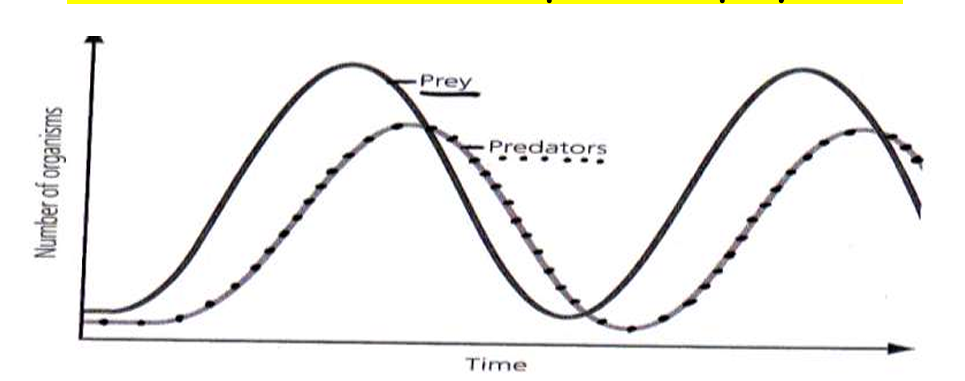
explaining the predator-prey graph
an increase in the prey population allows an increase in the number of predators
prey reproduce faster, hence their bigger numbers
eventually the number of predators decrease due to a lack of prey/food ~ predators die or move to others areas in search food
there is a time lag for predator numbers to respond to lower number of prey
effects of predation on an ecosystem
effect 1 ~ population control & natural selection
predation maintains the prey species at a sustainable level, by eliminating the less well adaptedeffect 2 ~ biological control
ladybirds are used to control the number of greenfly
important to control the number of herbivores as greenfly can transmit viral diseases to crops such as potatoes, melon, cucumber, lettuce Viral diseases of plants cause stunted growth of plant
Explain fluctuations in graph
a. an increase in the prey population attracts predator and so the predator population increases
b. as the prey numbers decline, the predator numbers also
c. there graph shows a time lag as predators respond to lower prey numbers
roles in nature of the predator - prey relationship
population control
Symbiosis & Parasitism
symbiosis- a close relationships between two species where at least one benefits
mutualism- two species living in close association where both benefit:
e.g. symbiotic bacteria in human colon ~ bacteria supply vitamins to human, human host provides food shelter
e.g. lichens ~ a close relationship between a blue green alga and a fungus, where alga gains shelter and nutrients, fungus gains glucose from photosynthesis of alga
parasitism- a close association between two species where on species, the parasite benefits, and the second species, the host is harmed
parasite- a species which lives in or on the body of the host causing harm
ectoparasites- organisms which live on the outside of the host, causing e.g. fleas on fox, greenfly on rose bush, lice on crows
endoparasites- organisms which live inside the host, causing harm e.g. liver fluke in sheep and cattle
parasites differ from predators as follow
-parasites are smaller than the host
-parasite are dependent on one host
-parasites usually do not kill the host quickly, to ensure the parasite has a food source and shelter
factors which affect Human Population Growth
war
war decreases populations
afterwards the birth rate usually increases to compensatedisease
decreases populations if it is virulent and widespreadcontraception
decreases the birth rate and aids in family planningfamine
decreases populations through starvation, illness and emigration