P.6 - Molecules and Matter
Density
The density of a substance is defined as it's mass per unit volume
density = mass / volume
ρ = m / V
ρ is Greek letter ‘rho’ (not ‘P’)
density is measured in kilograms per metre cubed (kg / m3)
state of matter | arrangement | particle movement | density | intermolecular forces | compressed? | flow? |
Solid | regular structure/ lattice | vibrate about fixed positions | high | strong | no | no - keeps shape |
Liquid | irregular structure particles are close | free flowing | medium | weak | no | yes - fills container’s shape |
Gas | random arrangement far apart | range of speeds in random directions | low | very weak | yes | yes - fills whole container |
Changes of State
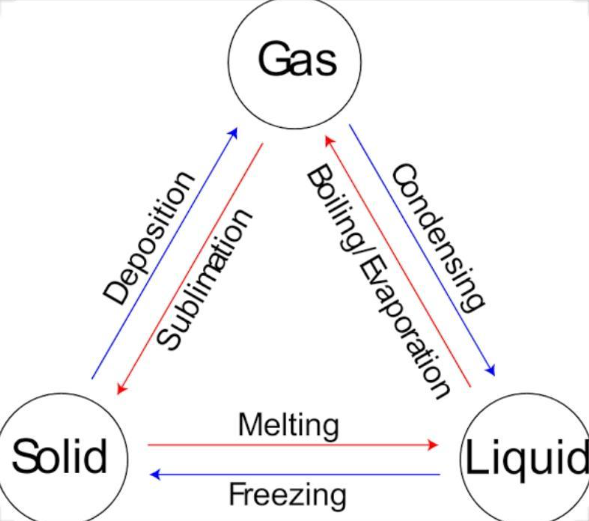
Impurities can change the melting and boiling point of substances e.g. melting point of water can be reduced by adding salts
Evaporation is different to boiling as it happens below the substance’s boiling point
Internal energy
Internal energy is the total kinetic energy and potential energy of all the particles (atoms and molecules) that make up a system
The kinetic energy of all the particles is due to their individual motion relative to each other
The potential energy of the particles is due to their individual position relative to each other
change in thermal energy = mass x specific heat capacity x temperature change
ΔE = mcΔθ
Specific Latent Heat
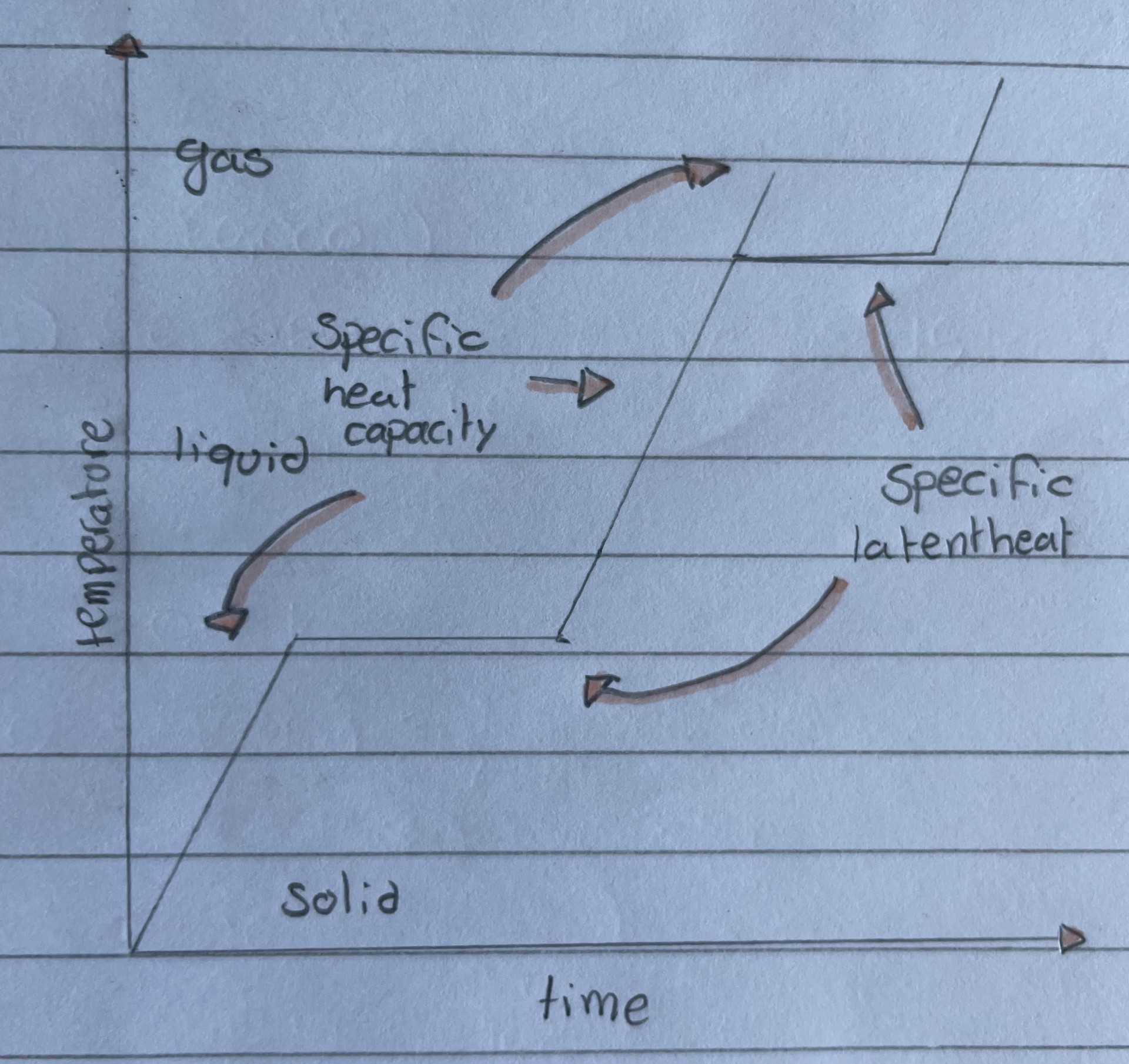
Energy is required to melt or boil a substance. The temperature does not rise during these changes of state
Different substances need different amounts of energy, and the energy required can be calculated using the substances specific latent heat
The amount of energy required depends on:
o The mass of the substances
o It’s specific latent heat (s.l.h)
Specific latent heat is the amount of energy that must be supplied to melt or boil 1kg of a substance without changing temperature
Specific latent heat of fusion - the amount of energy required to change the state of 1kg of solid to liquid
Specific latent heat of vaporisation - the amount of energy required to change the state of 1kg of liquid to gas
change in energy = mass of substance x s.l.h
ΔE = mL
measured in J / kg
Gas Pressure and Temperature
The pressure in fluids causes a force to be exerted normal (at right angles) to any surface
Gas pressure arises as a result of the following:
o The particles in the gas move randomly and collide with the inside surface of the container
o Each of these collisions exert a force on the surface of the container
o This results in gas pressure which is the total force exerted per unit area of the surface
Work is the transfer of energy by a force
Doing work on a gas increases the internal energy of the gas and can cause an increase in temperature of the gas
When higher temperature:
o More frequent collisions
o Higher rate of collisions
o More collisions per second
Gas Pressure and Volume
Pressure is inversely proportional to volume because when the volume is decreased, there will be more frequent collisions between the particles and the walls of the container as they don’t have to travel as far between collisions. Therefore, in a given time, the particles will exert a greater total force, and hence the pressure will be greater
This is only relevant at a constant temperature
If a gas is compressed quickly, the work done will increase the internal energy of the gas
If the gas is compressed slowly, the gas loses energy to the surroundings at the same rate that it gains it
The temperature of a gas can increase if it is compressed rapidly. This is because work is done on it, and the energy is not transferred quickly enough to the surroundings
pressure x volume = constant
pV = constant
pressure is measured in pascals (Pa)