Sampling-Time Jitter
 Call Kai
 Learn
Learn Practice Test
 Spaced Repetition
 Match
Match Flashcards
 Knowt Play
1/37

There's no tags or description
Looks like no tags are added yet.
Name | Mastery | Learn | Test | Matching | Spaced | Call with Kai |
|---|
No analytics yet
Send a link to your students to track their progress
38 Terms
Sampling-Time Jitter
Random variations in the actual sampling instant relative to the ideal sampling instant.
Aperture Jitter
The uncertainty in the exact time at which a sample is taken.
Clock Jitter
Timing fluctuations in the sampling clock that cause sampling instants to vary.
Sampling-Time Error
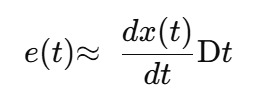
The difference between the actual sampling instant and the ideal sampling instant (Dt)
Jitter-Induced Amplitude Error
The amplitude error produced when a signal is sampled slightly earlier or later than intended.
Jitter Error Mechanism
Jitter causes larger amplitude errors when the signal is changing rapidly and smaller errors when the signal changes slowly
Signal Slope Dependence
The magnitude of jitter-induced error is proportional to the slope of the input signal.
Worst-Case Jitter Sensitivity
Maximum jitter error occurs at the points where the signal slope is greatest.
Zero-Slope Condition
Jitter produces negligible error when the signal slope is approximately zero
RMS Jitter
The root-mean-square value of timing uncertainty (S_t)
RMS Timing Error
A statistical measure describing the spread of sampling-time variations.
Jitter Noise
Noise generated by random timing variations during sampling
Jitter-Limited Performance
The condition in which system performance is determined primarily by clock jitter rather than quantization noise.
Jitter-Induced Noise Power
The average power associated with sampling errors caused by timing uncertainty
High-Frequency Sensitivity
Higher input frequencies are more sensitive to sampling jitter.
Low-Frequency Sensitivity
Lower-frequency signals are generally less affected by timing jitter.
Jitter Noise Scaling
Jitter noise increases as signal frequency increases
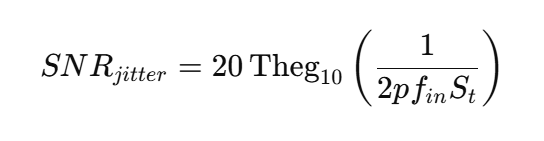
Jitter-Limited SNR
The maximum achievable signal-to-noise ratio imposed by clock jitter
Jitter-Limited SNR Equation
f_in
Symbol in Jitter-Limited SNR Equation that represents input frequency
S_t
Symbol in Jitter-Limited SNR Equation that represents RMS jitter
Frequency Dependence of Jitter SNR
For fixed jitter, increasing input frequency decreases achievable SNR
Clock Quality Requirement
Higher-frequency ADC applications require lower clock jitter
Jitter-Limited Dynamic Range
The maximum dynamic range achievable before timing noise dominates
Equivalent Noise Source
Jitter can be modeled as an additional noise source added to the sampled signal
Deterministic Timing Error
Predictable timing variations caused by periodic disturbances
Random Timing Error
Unpredictable timing variations characterized statistically using RMS values
Sampling Clock
The timing reference that determines when samples are taken
Clock Phase Noise
Frequency-domain representation of timing instability in an oscillator
Phase Noise Relationship
Phase noise in the sampling clock contributes directly to sampling jitter.
Input Frequency Limitation
As input frequency increases, clock jitter increasingly limits ADC performance.
Jitter-Limited ADC Design
ADC design in which clock stability becomes as important as converter resolution.
Higher-Nyquist-Zone Jitter Effect
Signals sampled in higher Nyquist zones are more vulnerable to timing jitter because of their higher frequencies.
Undersampling and Jitter
and
Jitter-Dominated Region
The operating region where further increases in converter resolution provide little improvement because jitter already dominates noise performance
How many
The operating region where converter performance is limited primarily by quantization noise rather than timing uncertainty
Yes, it is true
Very small timing errors can significantly reduce achievable SNR at high frequencies.
Jitter Error Approximation
Equation explains why larger signal slopes create larger jitter-induced errors.