CH. 25 - urinary system
 Call Kai
 Learn
Learn Practice Test
 Spaced Repetition
 Match
Match Flashcards
 Knowt Play
1/127

There's no tags or description
Looks like no tags are added yet.
Name | Mastery | Learn | Test | Matching | Spaced | Call with Kai |
|---|
No analytics yet
Send a link to your students to track their progress
128 Terms
Where does gluconeogenesis occur in the body?
kidneys
The kidneys secrete what two substances responsible for bodily endocrine functions?
renin
EPO/erythropoietin
What is the function of renin?
bp regulation
What is the function of erythropoietin?
regulates RBC production
What are the 4 urinary structures superior → inferior?
kidneys → ureters → bladder → urethra
The kidneys are __________lly located, being between the body’s dorsal wall + this layer
retroperitoneal
The ____ kidney is lower in the abdominal cavity due to presence of the ____
right
liver
What functionally unrelated gland(s) lie atop each kidney?
adrenal
What is the innermost, fibrous connective tissue layer encasing the outer surface of each kidney?
renal capsule/fascia
What 3 structures pass through the indentation of the renal hilum?
renal artery
renal vein
renal pelvis/ureter
Superficial region/tissue of a kidney anatomy?
renal cortex
Inner region of kidney housing the pyramids?
renal medulla
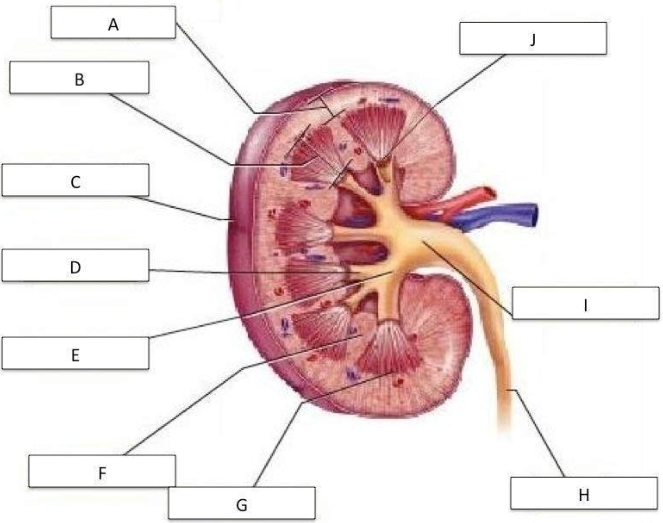
Identify A?
renal cortex
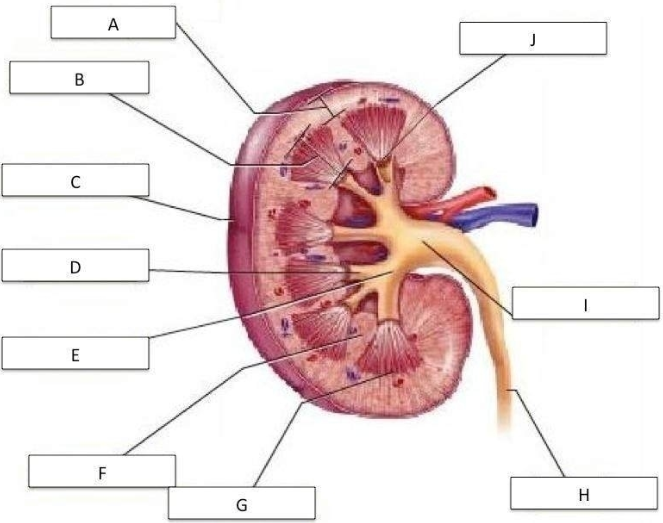
Identify B?
renal medulla
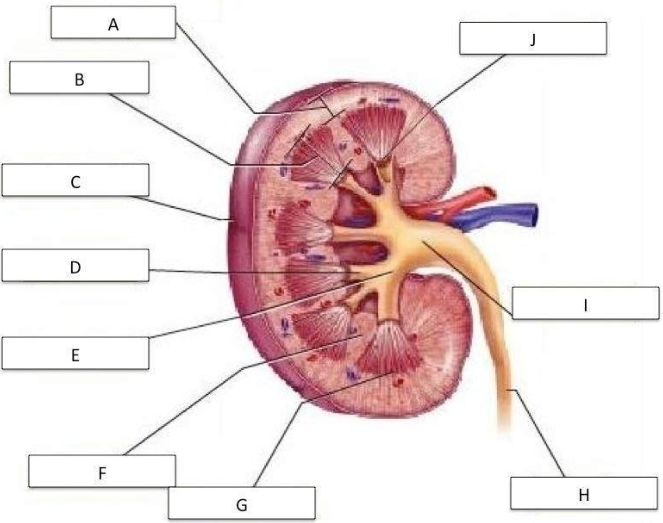
Identify C?
fibrous capsule
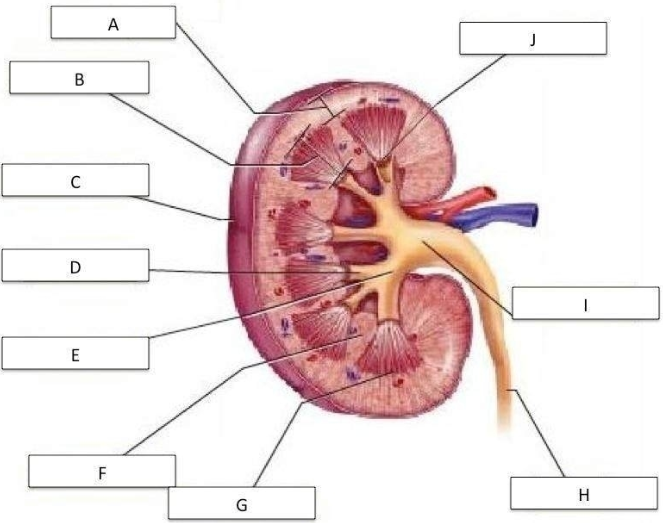
Identify D?
minor calyx
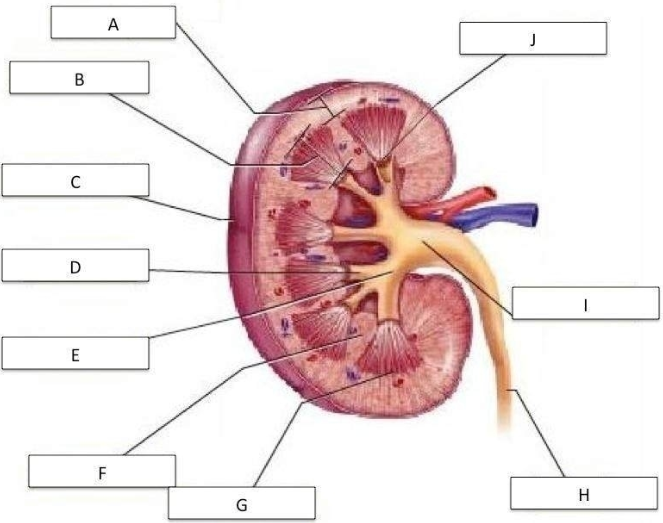
Identify E?
major calyx
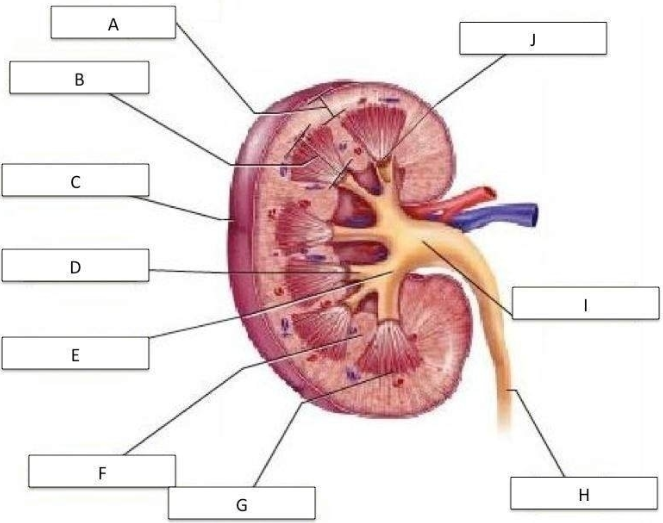
Identify F?
renal column
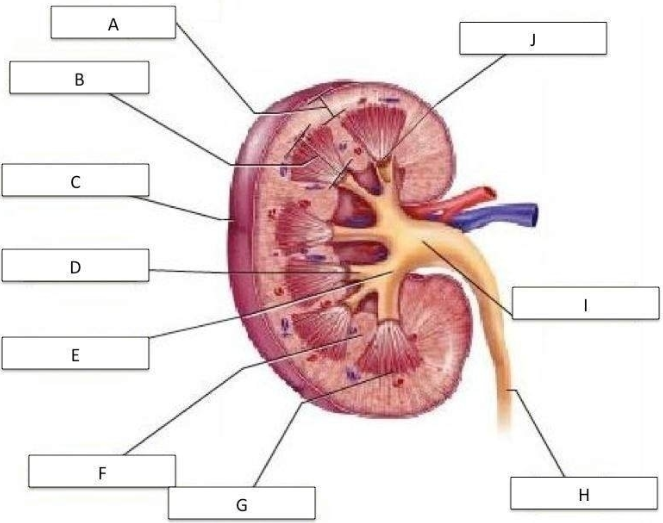
Identify G?
renal pyramid
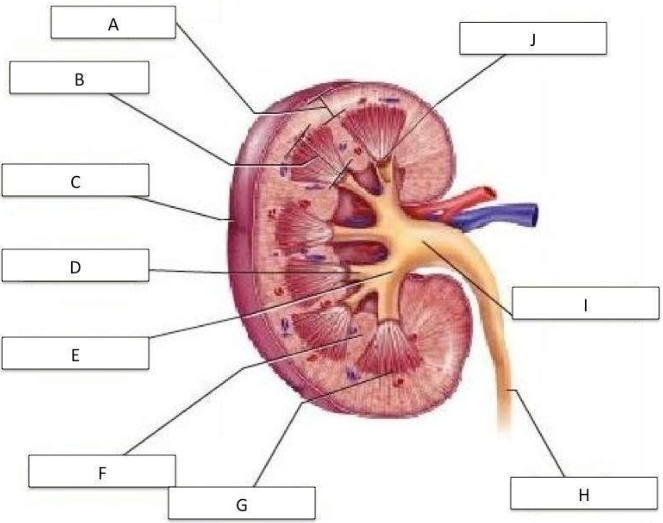
Identify H?
ureter
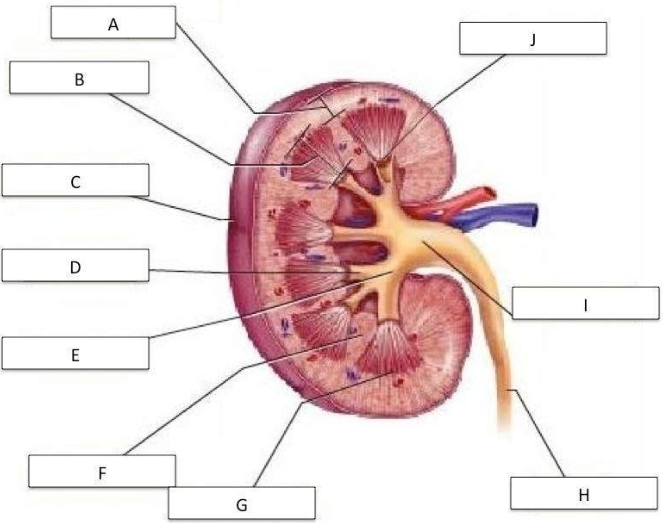
Identify I?
renal pelvis
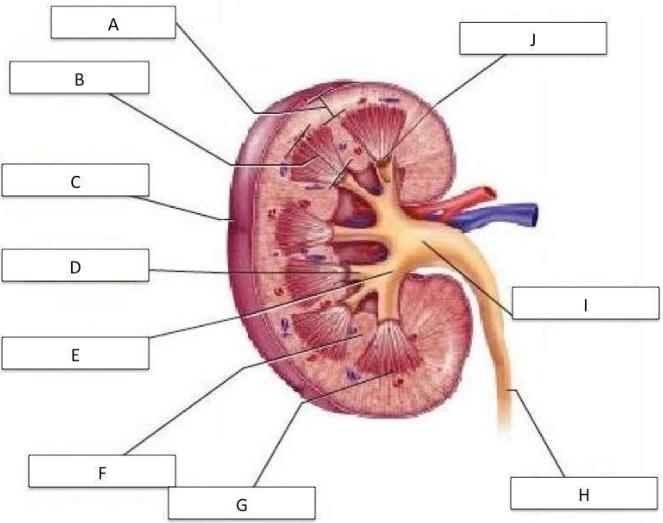
Identify J?
papilla of renal pyramid
What is the order in which renal pyramids drain?
papilla → minor calyx → major calyx → renal pelvis → ureters
Branching from the aorta, what structure brings blood into the kidney via the hilum?
renal artery
Branching from the IVC, what structure takes blood away from the kidney via the hilum?
renal vein
What blood vessel leads into glomerulus?
afferent arteriole
What blood vessel leads away from/out of the glomerulus?
efferent arteriole
Trace the pathway of blood flow from the aorta through the renal blood vessels to the IVC
aorta → renal artery → afferent arteriole → glomerulus → efferent arteriole → peritubular capillaries → renal vein → IVC
structural + functional units of kidneys that form urine
nephron
What substance do the nephrons work to create?
urine
Where in the nephron is filtrate made?
glomerulus
The glomerular capillaries are ________, making them highly porous
fenestrated
What cells does the glomerulus contain, specialized for the regulation of what can exit + enter?
podocytes
What cup-shaped structure surrounds the glomerulus?
Bowmans capsule
The _____ arteriole is wider/thicker than the _____ arteriole
afferent
efferent
The class of a nephron is determined by what?
location within the kidney
The majority of nephrons are what class?
Cortical
Class of nephrons located majority in the cortex, with only certain sections of tubule entering medulla?
cortical
Class of nephrons that produce concentrated urine & have long nephron loops with thin + thick segments?
juxtamedullary
Nephron capillary bed specialized for filtration, drained + fed by both afferent and efferent arterioles
glomerulus
The peritubular capillaries + vasa recta both originate from what blood vessel?
efferent arteriole
What capillary beds are used by the cortical nephrons?
peritubular
What capillary beds are used by the juxtamedullary nephrons?
vasa recta
The juxtaglomerular complex of the nephron is a region where the __________ of the tubule lies against the ______ arteriole
ascending limb
afferent
What two things is the juxtaglomerular complex of the nephron responsible for the regulation of?
blood pressure
rate of filtration formation
Chemoreceptor cells of the JGC found in the ascending limb of the nephron
macula densa
Macula densa cells monitor levels of what in the blood?
NaCl
Mechanoreceptor cells of the JGC located in walls of the afferent artiole?
granular cells/JG/juxtaglomerular
Granular cells
Granular cells detect changes to _____ _______
blood pessure
What enzyme do granular cells of the JGC contain in their secretory granules?
renin
In response to high bP, what cells of the nephron will constrict?
granular cells
What percentage of all oxygen used by the body is used by the kidneys?
20-25%
What is the makeup of filtrate?
blood plasma WITHOUT PROTEINS
water
ions
waste
glucose
What fluid contains metabolic wastes + unneeded substances?
urine
At which point of the nephron is the fluid called urine?
distal convoluted tubule
Amount of total fluid processed daily by the kidneys? Amount leaving body as urine?
180 L
1.5 L
What are the 3 processes in urine formation?
glomerular filtration
tubular reabsorption
tubular secretion
Process of hydrostatic pressure forcing fluids + solutes through a membrane?
glomerular filtration
What are the 3 layers of the filtration membrane (in the glomerular capsule) from deep → superficial
fenestrated endothelium
basement membrane
podocytes with filtration slits
What layer of the filtration membrane is fenestrated, allowing fluid, solutes, and plasma proteins to pass while blocking red + white blood cells?
endothelium (innermost)
What layer of the filtration membrane is a negatively charged gel that prevents large plasma proteins from entering tubule?
basement membrane
What layer of the filtration membrane is highly selective and most superficial?
filtration slits of podocytes
What is the equation for Net Filtration Pressure?
HPgc - (OPgc + HPcs)
NFP is calculated subtracting the ______ pressure from ______ pressure
outward
inward
Chief force pushing water + solutes out of the blood across filtration membrane?
hydrostatic pressure in glomerular capillaries
Where in the glomerulus is the blood pressure highest?
glomerular capillaries
What are the two inward forces inhibiting filtrate formation?
osmotic pressure in glomerular capillaries
hydrostatic pressure in capsular space
GFR is the volume of _____ formed per min by ____ ____
filtrate
both kidneys
What three factors is GFR directly proportional to?
NFP
surface area available for filtration
filtration membrane permeability
Normal/average volume of GFR ml/min?
120-125 ml/min
An increase in glomerular filtration rate results in what changes regarding urine output, BV + BP?
urine output increases
BV decreases
BP decreases
GFR being too ___ would cause dehydration + electrolyte depletion
high
GRF being too ____ would cause reabsorption of wastes
low
In cases of GFR being too high, _____ ____ cells detect and trigger constriction of what blood vessel?
macula densa
afferent arteriole
Intrinsic controls/renal autoregulation utilize the ______ to maintain _____?
kidneys
GFR
The myogenic mechanism is a an _______ control
intrinsic
In terms of the myogenic mechanism, an increase of BP would translate to a stretch in what blood vessel? and prompt it to respond how?
afferent arteriole
constrict
Regarding the tubuloglomerular feedback mechanism, what triggers the macula densa cells?
high NaCl concentration/flow rate (GFR)
In the tubuloglomerular feedback mechanism, how do macula densa cells respond to high NaCl concentration?
release vasoconstrictors to afferent arteriole
The extrinsic controls of the urinary system utilize nervous + endocrine mechanisms to regulate GFR to maintain?
blood pressure
In terms of the extrinsic controls of GFR, if the extracellular fluid volume is low, what is released by adrenal medulla?
epinephrine
What does epinephrine do when released by adrenal medulla?
cause vasoconstriction/increase BP
(afferent arterioles also constrict)
In terms of the extrinsic controls, constriction of the afferent arterioles _______ (decrease/increase) GFR? How does this affect BV + BP? (decrease/increase)
decrease
increase
The renin-angiotensin-aldosterone mechanism activates in response to _____ blood pressure
low
In response to low BP what do granular cells secrete?
renin
What three things/pathways activate granular cells?
sympathetic nerves/low blood volume detected by baroreceptors
low NaCl detected by macula densa cells
reduced BP/stretch
In addition to systemic vasoconstriction, Angiotensin II acts on what two areas of the body? and causes the release of what two hormones?
posterior pituitary + adrenal medulla
ADH + aldosterone
How does ADH + aldosterone act on the kidneys/what does it cause?
retention of NaCl + H20
Route of tubular reabsorption in which substances travel through the cell body, active transport!
transcellular
Route of tubular reabsorption in which substances travel between the cells, passive transport!
paracellular
The first step of tubular reabsoprtion, NaCl is pumped from tubule to tubule cell by?
facilitated diffusion
The first step of tubular reabsoprtion of sodium involves NaCl symport with what molecule? or exchanging of what molecule?
glucose
H+
For the second step of tubular reabsorption of sodium, what mechanism allows NaCl to be transported into interstitial fluid?
Na-K pump
For the 3rd step of tubular reabsorption of sodium, how is NaCl transported from interstitial space into peritubular capillaries?
bulk flow, passive
Where are aquaporins always present in the nephron?
PCT
Where in nehphron does ADH cause insertion of aquaporins?
collecting ducts
What hormone causes insertion of aquaporins
ADH
solvent drag is the function of solutes following ____
water
Transport maximum is determined by number of ____ carriers
protein