Chapter 35 - Plant Water Balance
 Call Kai
 Learn
Learn Practice Test
 Spaced Repetition
 Match
Match Flashcards
 Knowt Play
1/28

There's no tags or description
Looks like no tags are added yet.
Name | Mastery | Learn | Test | Matching | Spaced | Call with Kai |
|---|
No analytics yet
Send a link to your students to track their progress
29 Terms
Water Potential (Ψ): Determining Water Movement
Measure of the potential energy of water in a system relative to pure water under standard conditions
Movement: HIGH (less negative) → LOW (more negative)
Occurs via osmosis across membranes and bulk flow thru vascular tissues
A continuous gradient exists from soil to atmosphere in plants to drive water transport
From soil (highest Ψ) to atmosphere (lowest Ψ)
Water Potential as Potential Energy
Water potential represents stored energy that determines the ability of water to move within a system.
Water with higher potential energy has a greater capacity to perform work by moving to lower energy regions.
The addition of solutes decreases the free energy of water, making its potential more negative.
This energy gradient is what drives all passive water movement in plants.
Components of Water Potential
Calculation: Ψ = Ψs + Ψp.
Solute potential (Ψs) reflects the effect of dissolved solutes and is always negative relative to pure water.
Pressure potential (Ψp) reflects physical forces acting on water and can be either positive or negative.
The combined effects of solute and pressure potential determine the overall direction of water movement
Solute Potential and Pressure Potential: Influence on Water Movement
HIGH solute concentration = LOW solute potential
Causes water to move TOWARDS low solute potential because that high concentration of solutes will lower the free water availability
Pressure potential causes water to move from areas of higher physical pressure to areas of lower pressure.
Positive pressure (i.e. turgor pressure in cells) resists additional water entry
Negative pressure (i.e. tension in xylem) actively pulls water upward through the plant.
Moving from Low → High Solute Concentration
Water moves across a selectively permeable membrane by osmosis from regions of low solute concentration to regions of high solute concentration.
This movement occurs because regions with higher solute concentration have lower water potential.
The process continues until equilibrium is reached or opposing pressure balances the gradient.
Solutes effectively create a “pull” that attracts water into the region
Water Movement in Response to Pressure Differences
Water moves from high → low pressure thru bulk flow
Xylem: water is pulled upward due to negative pressure (tension) generated by transpiration
Phloem: water is pushed along due to positive pressure created by sugar loading
These pressure-driven movements allow long-distance transport of water and solutes.
Calculating Water Potential
Adding solute potential and pressure potential
Water always moves from the region with the higher (less negative) to the region with the lower (more negative)
Cell has Ψ = -1.5 MPa and the surrounding solution has Ψ = -2.0 MPa
So, water will move out of the cell.
Water Obtaining in Salty Soil
Plants growing in salty soils accumulate solutes in their root cells to lower their internal water potential.
This allows the plant’s water potential to remain lower than the surrounding soil, enabling water uptake.
Specialized enzymes increase the concentration of organic molecules inside cells to maintain this gradient.
This adaptation prevents dehydration in environments where external water potential is very low
Plant Survival in Dry Habitats
Reduce their internal water potential by accumulating solutes as the amount of water available in the soil decreases
Allows them to maintain a gradient that continues to draw water into the plant
If the plant cannot maintain this gradient, turgor pressure drops and wilting occurs.
Extended loss of turgor pressure can lead to tissue damage and plant death.
Water Entering Plant Roots
Establishes the initial step in water movement through the plant.
Root cells actively transport ions into their cytoplasm, which lowering their internal water potential
Water is then pulled from the soil (where water potential is higher) into the root cells via osmosis
Root hairs significantly increase the surface area available for water absorption.
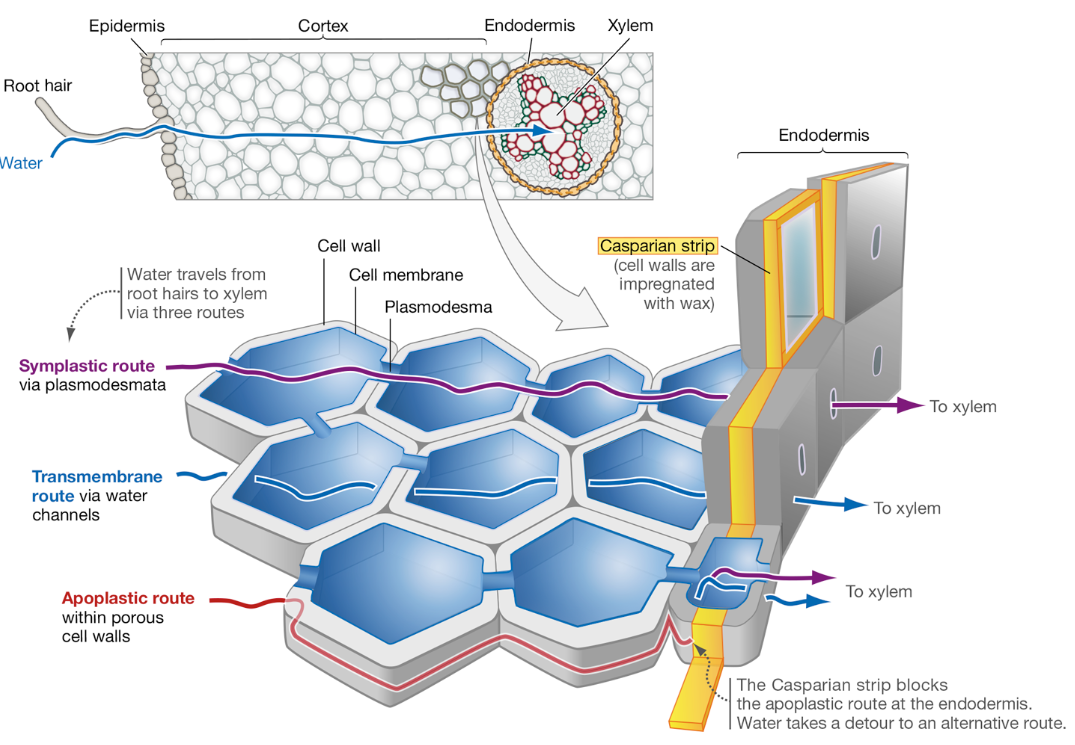
Three Water Pathways Through Roots
Symplastic route: water moves through the cytoplasm of cells connected by plasmodesmata.
Transmembrane route: water crosses cell membranes repeatedly, often using aquaporin channels.
Apoplastic route: water travels through cell walls and intercellular spaces without crossing membranes.
These pathways allow flexibility in how water reaches the vascular tissue
Functions of Casparian Strip
A waterproof barrier located in the endodermis of roots
Blocks the apoplastic pathway which prevents water from bypassing cell membranes.
This forces water and solutes to pass through selectively permeable membranes.
As a result, the plant can regulate which ions enter the xylem
Root Pressure Generated in Xylem
Root cells actively transport ions into the xylem, lowering its water potential
Water enters the xylem from surrounding cells by osmosis
The accumulation of water creates positive pressure within the xylem
This pressure can push water upward, especially when transpiration is low.
Guttation
The appearance of water droplets at the edges of leaves.
It occurs when root pressure forces water out of special openings called hydathodes.
This process is most common at night when stomata are closed and transpiration is minimal.
It demonstrates the presence of positive pressure in the xylem.
Capillary Action
Movement of water through narrow spaces due to intermolecular forces.
Adhesion causes water molecules to stick to the walls of xylem vessels.
Cohesion causes water molecules to stick to each other via hydrogen bonding.
Surface tension at the air-water interface contributes to upward movement.
Cohesion-Tension Theory
Explains how water is pulled upward through xylem from roots to leaves along a water-potential gradient via forces generation by transpiration
Cohesion between water molecules transmits this tension down the continuous water column
Allows water to move long distances without the use of metabolic energy
Evaporation: Creating a Pulling Force on Water
Water evaporates from mesophyll cell surfaces into the air spaces of the leaf.
This evaporation creates a curved meniscus that increases surface tension.
The resulting tension lowers the water potential in the leaf.
This tension pulls water upward through the xylem from the roots.
How Xylem Can Withstand Negative Pressures
Thick secondary cell walls reinforced with lignin that prevent vessels from collapsing under tension
Structural strength of xylem → important adaptation for the evolution of tall vascular plants
Allows plants to transport water to great heights
Structural Adaptations for Reducing Water Loss
A thick waxy cuticle reduces evaporation from leaf surfaces.
A multilayered epidermis provides additional protection
Stomatal crypts reduce airflow around stomata, slowing evaporation.
Trichomes help trap moisture and reduce water loss.
Needle-like leaves reduce surface area exposed to the environment.
Translocation
Movement of sugars through the phloem from sources to sinks.
Occurs via bulk flow driven by pressure differences within the phloem
Sugars produced in photosynthetic tissues are transported to areas of use or storage.
This process ensures distribution of energy throughout the plant.
Sources and Sinks
Sources = tissues where sugars are produced
I.e. mature leaves.
Sinks = tissues where sugars are used or stored,
I.e. roots or developing fruits
The direction of sugar movement depends on the plant’s developmental stage and needs, ensuring efficient allocation of resources
Main Cell Types of Phloem
Sieve-tube elements are elongated cells that transport sugars and lack a nucleus at maturity.
Companion cells are metabolically active and support sieve-tube elements.
Load sugars into the phloem and maintain cellular function.
These two cell types work together to enable efficient sugar transport.
Pressure Gradient: Est. in Phloem
At the source, sugars are actively loaded into sieve-tube elements, lowering water potential.
Water enters the phloem from the xylem, increasing turgor pressure.
At the sink, sugars are removed, increasing water potential.
Water exits, lowering pressure and creating a pressure gradient.
Pressure-Flow Hypothesis and Sugar Movement
States that sugars move from sources to sinks via bulk flow.
High pressure at the source pushes phloem sap toward areas of lower pressure at the sink.
This movement is driven by differences in turgor pressure created by sugar loading and unloading.
The process allows efficient long-distance transport of nutrients.
Sugars: Active Loading at the Source
Proton pumps use ATP to create a gradient of hydrogen ions across the membrane.
This gradient drives a sucrose-H⁺ symporter that transports sucrose into companion cells.
Sucrose then moves into sieve-tube elements through plasmodesmata.
This process lowers water potential and initiates pressure-driven flow.
Sugars: Unloaded at the Sink
Removed from phloem by either active or passive transport
Increases the water potential
So water enters back into the xylem/reduces pressure at the sink
Once inside sink cells, sugars are used for metabolism or stored
Water Movement Supporting Phloem Transport
Water enters phloem at the source b/c of low water potential created by sugar loading
Increases pressure and drives bulk flow of sap to the sink
At the sink, water exits the phloem as sugars are removed.
Maintains the pressure gradient necessary for continuous flow.
Xylem and Phloem: Functional Connections
Water moves from xylem into phloem at sources to generate pressure for sugar transport.
At sinks, water returns from phloem to xylem after sugars are unloaded.
This cycling of water helps maintain both transport systems.
The interaction ensures efficient distribution of both water and nutrients.
Big Picture: Driving Force of Water Movement Thru A Plant
Water moves along a continuous gradient from soil to atmosphere
Transpiration = primary driving force
Creates negative pressure in leaves
Cohesion and adhesion allow this force to pull water upward through xylem
Root pressure and capillary action contribute slightly but are not the main drivers