Crane Chemistry Equillibrium
 Call Kai
 Learn
Learn Practice Test
 Spaced Repetition
 Match
Match Flashcards
 Knowt Play
1/24

There's no tags or description
Looks like no tags are added yet.
Name | Mastery | Learn | Test | Matching | Spaced | Call with Kai |
|---|
No analytics yet
Send a link to your students to track their progress
25 Terms
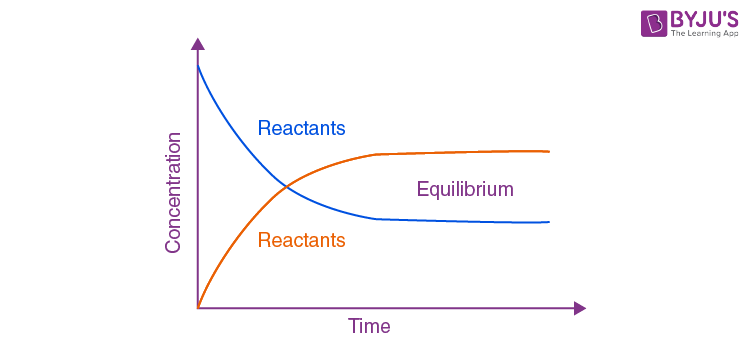
Equilibrium is reached when …
rate of forward reaction = rate of reverse reaction
concentrations of reactants and products are constant
Law of Mass Action
For reaction: e A + f B →← g C + h D
Equilibrium expression:
K = ([C]^g [D]^h) / ([A]^e * [B]^f)
K = equilibrium constant
Brackets unit is mol/L (M) (Molarity)
Magnitude of K
K>1
more products at equilibrium
Equilibrium lies to the right
K=1
No! check your math
K < 1
more reactants at equilibrium
equilibrium lies to the left
Calculating Kp from Kc
Kp = Kc (RT)∆n
where:
R = 0.0821
T = temperature in kelvin
∆n = moles of products - moles of reactants
Homogeneous Equilibria
all reactants / products are in one phase
Heterogeneous Equilibria
reactants / products are in more than one phase
Solids and liquids are
not included in K calculations
Manipulating K
Swapping products and reactants
take the reciprocal of K
example:
PCl5(s) →/← PCl3(L) + Cl2(g) ——- Kc=0.0239
turns into
PCl3(L) + Cl2(g) →/← PCl5(s) ——- Kc= 1 / 0.0239
Changing Coefficients
put K to the coefficient power
example:
PCl5(s) →/← PCl3(L) + Cl2(g) ——- Kc= 0.0239
turns into
2PCl5(s) →/← 2PCl3(L) + 2Cl2(g) ——- Kc = 0.0239²
Adding reactions
multiply k’s
example:
2CO2(g) + H2O(g) →← 2O2(g) + CH2CO(g)
K = 6.1 E8
CH4(g) + 2O2(g) →← CO2(g) + 2H2O(g)
K = 1.2 E14
6.1E8 * 1.2 E14 = 7.3 E22
Reaction Quotient (Q)
To determine if a reaction is at equilibrium, compare Q to a given K
For reaction: e A + f B →← g C + h D
Q = ([C]^g [D]^h) / ([A]^e * [B]^f)
Q = K
reaction is at equilibrium
Q < K
too many reactants, reaction must go forward / shift right
Q > K
too many products, must go in reverse / shift left
Lechatelier’s Principle
if a stress is applied to a system at equilibrium, the position of teh equilibrium will shift to alleviate that stress
3 ways to apply stress
change in amount
change in pressure (volume)
change in temperature
Change in Amount
1N2(g) + 3H2(g) →/← 2NH3(g)
add N2 - shifts right
add NH3 - shifts left
remove N2 - shifts left
remove NH3 - shifts right
if a component is added, the equilibrium shifts to lower the concentration of that component
Change in Pressure (Volume)
1N2(g) + 3H2(g) →/← 2NH3(g)
add an inert gas - no effect
change the volume of the container
Increase pressure → shifts toward the side with fewer moles of gas
in the reaction above, would shift right
Decrease pressure → shifts toward the side with more moles of gas
in the reaction above, would shift left
If both sides have equal moles of gas → no shift
Change in Temperature
1N2(g) + 3H2(g) →/← 2NH3(g) + 92 KJ
if heat is a product, it is exothermic (heat is produced) [like in the reaction above]
if heat is a reactant, it is endothermic (heat is required)
for exothermic:
If you add heat, it shifts left
If you remove heat, it shifts right
for endothermic:
if you add heat, it shifts right
if you remove heat, it shifts left
ICE Charts
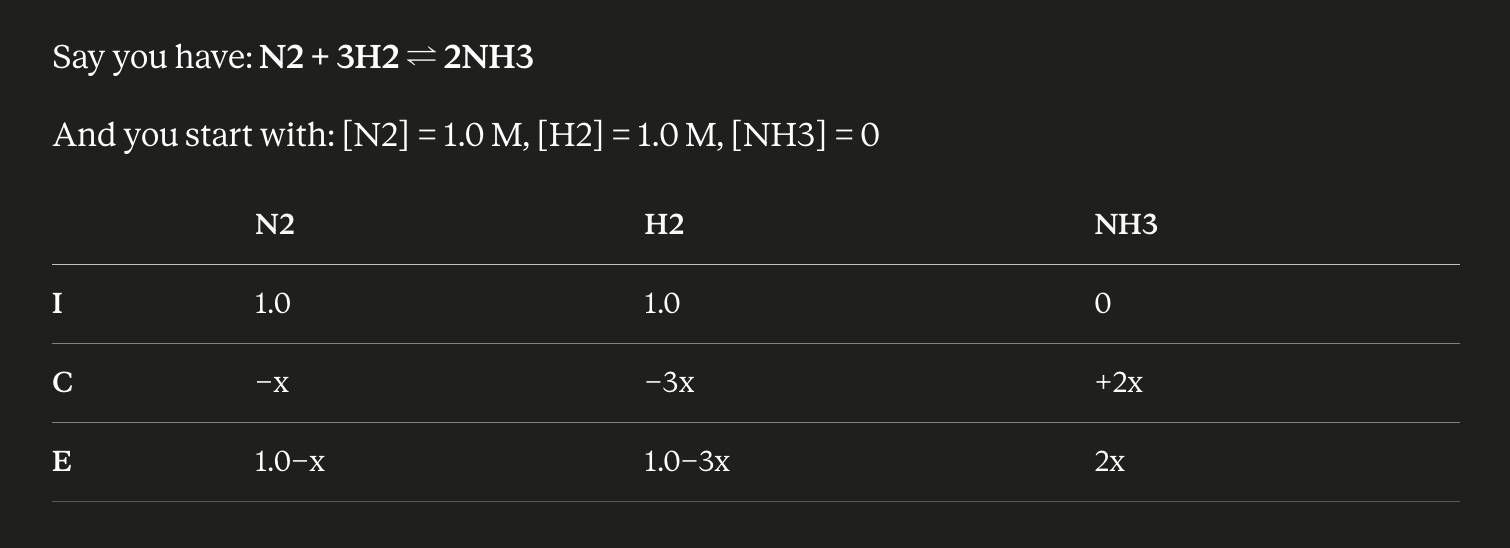
Approximation Method
First, check that the K value is E-3 or smaller
If that is true, you can ignore subtracting the x from the reactants at equillibrium
Then, calculate x
Lastly, use this formula to check
x / |initial| *100% < 5%