Paper 3 Section A - People and the biosphere
 Call Kai
 Learn
Learn Practice Test
 Spaced Repetition
 Match
Match Flashcards
 Knowt Play
1/29

There's no tags or description
Looks like no tags are added yet.
Name | Mastery | Learn | Test | Matching | Spaced | Call with Kai |
|---|
No analytics yet
Send a link to your students to track their progress
30 Terms
Define biome
A biome is a large-scale global ecosystem characterised by specific environmental conditions, vegetation and animal life
Define ecosystem
An ecosystem is the interaction of a community of living organisms (biotic) with the non-living (abiotic) parts of the environment
Define climate
Climate is the long term pattern of weather conditions in a specific area
What is the global distribution and characteristics of biomes influenced by?
Climate:
Temperature
Precipitation
Sunlight hours
Describe the pattern of the distribution of biomes around the globe and explain why there is this pattern
Biomes usually occur in latitudinal belts (the specific biomes across the globe are usually present at similar latitudes)
This is because the climate in these regions is similar due to atmospheric circulation (temperature, precipitation)
However there are some variations to this!
Why is there variation in the pattern of the global distribution of biomes occurring in latitudinal belts?
Local factors can alter the biome distribution locally
Local factors influence environmental conditions
Explain the global distribution, climate and characteristics of the tropical forest biome
Global distribution:
Along the equator (0°)
South America
Climate:
Climate is the same all year round, no definite seasons
Warm, moist climate, around 26°
Extremely high precipitation (2000mm a year)
12 sunshine hours
Characteristics:
Dense forest with very tall evergreen trees
Layered vegetation
Very high biodiversity
Nutrient poor soil:
Very fast nutrient cycling, so nutrients are not stored in the ground; plants grow rapidly and shed leaves all year round (due to high temperatures, large amounts of sunlight and high precipitation) due to high temperatures there are high rates of decomposition, allow the shallow-rooted plants to reabsorb nutrients immediately, leaving little to stay in the soil
Heavy rainfall causes rapid leeching
Explain the global distribution and characteristics of the temperate forest biome
(UK’s biome)
Global distribution:
Around 40-60° N and S of the equator
Eastern USA, UK
Climate:
Have four distinct seasons; warm summers cold winters
Mild temperature
Moderate precipitation year round
Days are shorter in winter and longer in summer
Characteristics:
Deciduous trees (lose their leaves in winter/ autumn to reduce water loss by transpiration — frozen ground makes it harder to absorb water)
Seasonal climate: colder winters
Moderate biodiversity
Moderate precipitation
Nutrient rich soils
Four distinct seasons: as deciduous trees shed their leaves, they decompose to create a thick, nutrient-rich layer
What are:
Deciduous trees?
Coniferous trees?
Deciduous: trees that lose their leaves annually
Coniferous: evergreen trees with needle-shaped leaves
Explain the global distribution and characteristics of the boreal forest biome
(Also known as the taiga forest)
Global distribution:
50-70° N and S
Russia, Scandinavia
Climate:
Short summers and long winters
Very cold winters and mild summers
Low precipitation
Lots of sunlight hours in summer months, but little or none in winter
Characteristics:
Coniferous trees (remain evergreen, needle-shaped leaves)
Retain green leaves all year to maximise photosynthesis, reduce water loss and allow snow to fall off easily
Low biodiversity
Cold temperatures and long winters make it hard for all species to survive
Thin, nutrient poor acidic soils
Cold temperature so slower rates of decomposition, so fewer nutrients are released into the soil
Explain the global distribution and characteristics of the tropical grassland biome
(Also known as the savannah)
Global distribution:
15-30° N and S
Eg. Kenya
Climate:
Precipitation is very seasonal, but overall yearly precipitation is low
Short wet season, long dry season
High temperatures year round
Many sunlight hours all year round
Characteristics:
Tall grasses with few scattered trees
Wet season allows grass to grow quickly, however the long dry season prevents many trees from growing + wildfires
Large grazing animals
Open grassland provides large areas of food for herbivores
Drought resistant plants
Plants are adapted to survive long dry periods
Thin and not very fertile soil
High temperatures cause rapid decomposition of plants, however heavy rain in the wet season causes leeching
Rapidly taken up by vegetation
Explain the global distribution and characteristics of the temperate grassland biome
(Also known as prairies)
Global distribution:
30-40° N and S
Eg. central USA
Climate:
Hot summers and cold winters
Low precipitation
Varying sunlight hours throughout the year
Characteristics:
Grasses dominate, very few trees
Rainfall is not high enough for trees to grow
Fertile soils
High temperatures in the summer cause high rates of decomposition, so soils are nutrient rich
Large open landscape
Limited rainfall prevent dense vegetation from forming
Explain the global distribution and characteristics of the desert biome
Global distribution:
30° N and S of the equator
Eg. north Africa
Climate:
Very low rainfall
Very hot temperatures in the day and very cold at night
Many sunlight hours during the day (due to low cloud cover)
Characteristics:
Very sparse vegetation
Very low precipitation
Plants have very small leaves/ spines
To reduce water loss
Very low biodiversity
Nutrient poor soil
Sparse vegetation means that there is little leaf litter to decompose; dry climate means organic matter is slow to decompose
Explain the global distribution and characteristics of the tundra biome
Global distribution:
Far north arctic circle 60°-70° N and S
Canada, Northern Russia, Norway (sunlight hours)
Climate:
Two main seasons: long very cold winter, short cool summer (layer of soil thaws and plants grow rapidly)
Overall very low temperatures
Low precipitation
Near-continuous daylight in the summer and little during winter
Characteristics:
Permafrost
Due to very cold temperatures; limits root growth so reduces biodiversity
Low-growing vegetation (shrubs, grasses, mosses)
Roots cannot grow deep in the soil (permafrost)
Nutrient poor soil due to cold, dry climate,
Organic matter decomposes slowly
Explain how and why the climates of different biomes varies
Sunlight hours
Depends on proximity to equator
Depends on precipitation levels (atmospheric circulation cells - 0° and 60°), and thus cloud cover
Temperature
Proximity to equator
Precipitation
Atmospheric circulation cells
Describe the influence of climate on biomes
Precipitation
High precipitation allows forests, low only allows grasses and deserts
Can cause leaching, reducing nutrients in soil
Temperature
Increases photosynthesis and thus plant growth — more vegetation and biodiversity
Increases rates of decomposition: nutrients in soil
Sunlight hours
Less sunlight hours reduce plant growth and shorten growing season
Explain the local factors that can limit biome distribution locally (4)
Altitude
At higher altitudes it is colder, so fewer plants grow there which also limits the number of animal species
Precipitation increases with altitude
Rock type
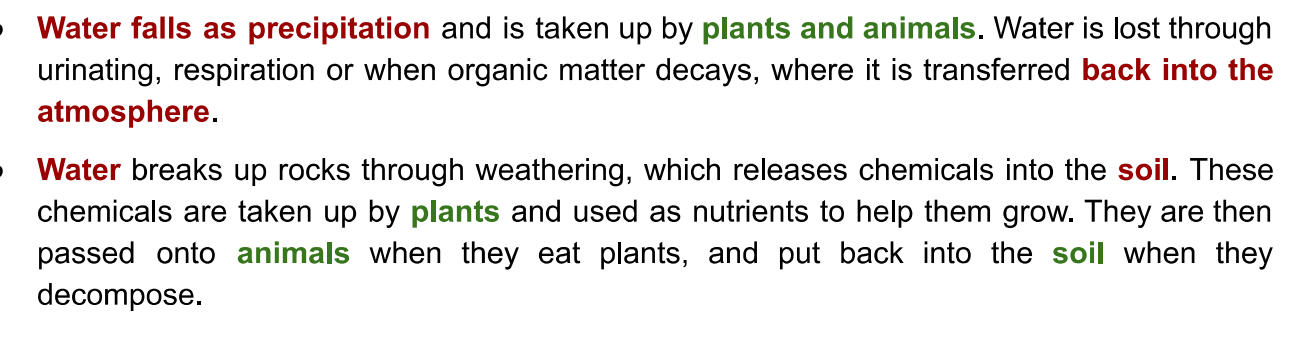
Some rocks are easily weathered, which releases nutrients and chemicals into soil - nutrient rich soil
Different rock types contain different nutrients and chemicals
Permeability of rocks affects how wet or dry the surface of the land is, which affects the distribution of organisms as they need to be by water sources to survive; some plants prefer wet soil, some prefer dry
Soil type
Soils can be neutral, acidic or alkaline which affects the types of plants that can grow there
Drainage (+ water availability): drainage is how fast water enters and leaves the soil
Some plants prefer wet soil, others dry soil
If soil becomes waterlogged, marshes can form where there is very little vegetation
Define biotic and abiotic
Biotic: the living parts of the ecosystem (eg. fauna (animals) and flora (plants))
Abiotic: the non-living parts of an ecosystem (eg. soil, water, rock atmosphere)
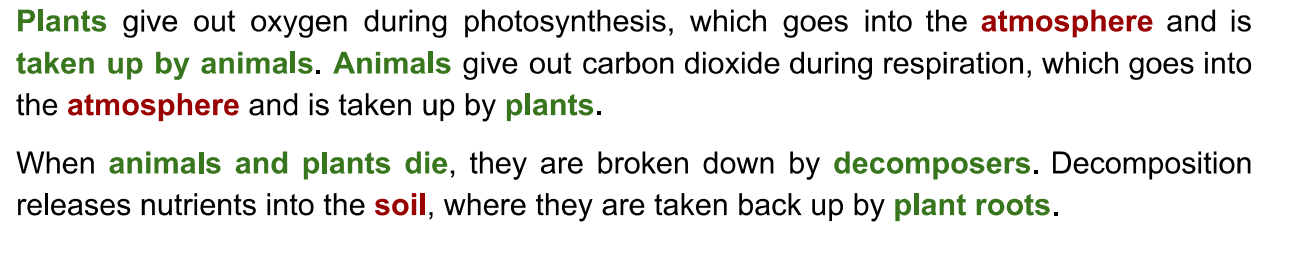
Give examples of how biotic and abiotic components of biomes interact

Define the biosphere
The biosphere is the layer of the Earth occupied by living organisms, between the atmosphere and the lithosphere where all plants, animals etc. are found
Name some of the resources that the biosphere provides for indigenous and other local people
Food
Fruits, vegetables, hunting, catching fish
Medicine
Lots of plants have medicinal properties
Building materials
Wood
Fuel
Wood, dried grass, dried animal dung
What is the biosphere increasingly exploited commercially for?
Energy
Large areas of land are deforested to make space to grow crops to use as biofuels, or for coal mines or for power stations
Drilling for oil and gas in the tundra is damaging the biosphere
Oil spills
Pipelines can act as obstacles and disrupt animals’ movements to feeding and nesting grounds
Heat from pipelines melt permafrost; this is bad as as permafrost thaws it decomposes, releasing greenhouse gases (permafrost acts as a massive carbon sink)
Water
Aquifers (groundwater stores) are being depleted
Lakes and rivers are being depleted, destroying habitats for many
Mineral resources
Eg. gold, iron, metals are being depleted at a much faster rate than their formation (for consumer goods, construction, electrical appliances)
Mines are responsible for large amounts of deforestation
Toxic chemicals from mining are washed into streams and rivers, killing wildlife
State the globally important services the biosphere provides, acting as a vital life support system (4 categories)
Provisioning services (goods)
Locally: food, medicine, fuelwood, building wood
Global: timber construction, wood for paper, biofuels, aloe vera cosmetics
Supporting services
Photosynthesis
Nutrient cycling
Biomass is broken down, releasing nutrients back into soil for future plant growth
Soil formation
Weathering processes of rock, releasing minerals to form soil
Regulating services
Hydrological cycle
Trees purify and regulate (interception, infiltration, storage, transpiration) the flow of water throughout the cycle
Regulation of composition of atmospheric gases
Forests release oxygen
Carbon cycle
Forests are carbon sinks
Cultural services
Education
Tourism
Science
Well-being
State the three main globally important services that the biosphere provides
Regulation of composition of gases in the atmosphere
Respiration
Photosynt
Carbon sequestration/ storage
Soil health
Decomposers
Interception
Roots
Movement of earthworms and plant roots
Regulation of hydrological cycle
Infiltration
Transpiration
Interception
Animals storing water in bodies
Describe how the biosphere regulates the composition of the atmosphere
Photosynthesis
Plants absorb carbon dioxide from the atmosphere and releases oxygen
Respiration
Organisms respire by absorbing oxygen from the atmosphere and releasing carbon dioxide
Carbon sequestration/ storage (capturing and storing atmospheric carbon)
Plants store carbon in biomass
Dead plants and animals become fossil fuels, storing carbon; or their dead biomass ends up in the soil creating a carbon sink
Describe how the biosphere maintains soil health
Decomposers break down dead biomass, releasing nutrients into the soil
Plants absorb nutrients from the soil; when they die or shed their leaves, the nutrients return to the soil, creating a continuous nutrient cycle
Vegetation intercepts rainfall before it reaches the ground, preventing leaching
The roots of vegetation hold soil together and maintain soil structure, allowing plants to grow
Animals (eg. earthworms) spread nutrients throughout the soil, allowing them to reach plants and therefore allowing them to grow
Describe how the biosphere regulates the flow of water within the hydrological cycle
Interception
Less surface run off, prevents flooding and soil erosion, allowing soil to retain water; crucial for maintaining soil moisture levels
Transpiration
Releases water vapour into the atmosphere
Living organisms store water in their bodies
Infiltration
Plant roots create pathways in soil, increasing infiltration; increases groundwater supplies, reduces surface runoff
Explain why there is increase demand for food, energy and water resources
Population growth
More people require more resources
Rising affluence
Wealthier people have more disposable income, which increases resource consumption
People can afford higher level technology and cars which require large amounts of energy to manufacture and run
Afford showers and toilets, increases water use
Urbanisation
Cities require more resources for construction
Requires more energy to transport food and water long distances from rural areas to meet the increased demand in cities
Requires energy for street lights, traffic lights
Industrialisation
Increasing numbers of factories, which require energy to run
Manufacturing goods requires large amounts of resources and energy
Describe the optimistic theory on the relationship between population and resources
Boserup theory
No matter how large the population grows, we will always discover more ways to sustain food and resource supplies
If resource supplies become limited, people will come up with new ways (eg. through technological advances, new agricultural technologies) to avoid hardship
Describe the pessimistic theory on the relationship between population and resources
Malthusian theory
Theorised that population increases exponentially, but resources only increase linearly, meaning that the population will eventually run out of food and resources
He believed that when this happened, people would be killed by catastrophes such as famine, illness and war until the population returns to a level that could be supported by the resources available