Ch 7-2 Earths Interior
 Call Kai
 Learn
Learn Practice Test
 Spaced Repetition
 Match
Match Flashcards
 Knowt Play
1/28

There's no tags or description
Looks like no tags are added yet.
Name | Mastery | Learn | Test | Matching | Spaced | Call with Kai |
|---|
No analytics yet
Send a link to your students to track their progress
29 Terms
how is the interior structure of Earth determined?
from geophysics, specifically study of Seismic waves
what are seismic waves?
mechanical waves that can be produced by artificial sources (explosive, vibrators) or by natural source (earthquakes)
travel through mediums such as solid, liquid, and gas (causes particles to obsolete and moving the mantle
what does wave speed of seismic waves depend on?
the density of the material through which they travel
can artificially create i.e. explosions
pressure waves (p-waves, primary waves)
longitudinal and will travel through liquids, solids, and gases
1st type of wave to arrive at monitoring station after earthquake
interior
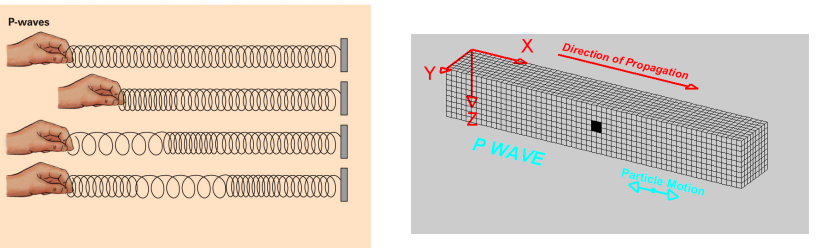
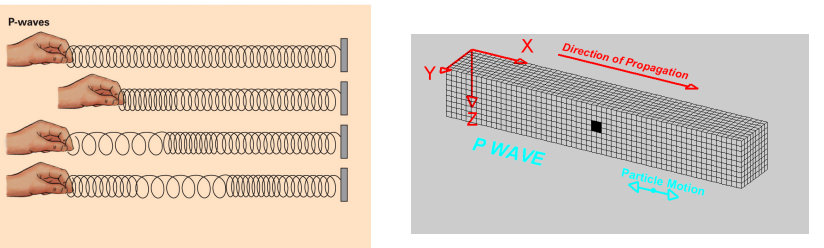
how do p-waves travel?
by compressing and expanding material parallel to the direction the wave is travelling
fast
what are shear waves (s-waves, secondary waves)
transverse and will only travel through solids, not through liquids or gas
arrive at monitoring stations after p-wave (slower than p waves)
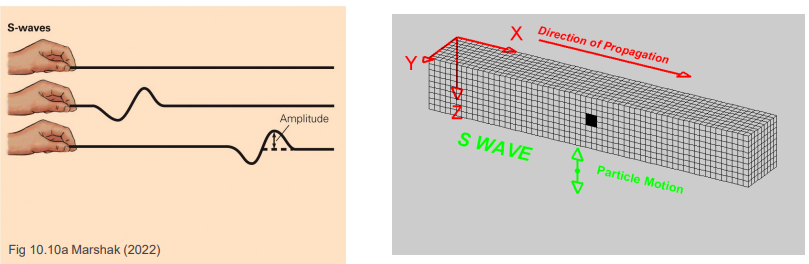
how do s-waves travel?
by moving material back and forth perpendicular to wave direction
how can we use the pattern of reflections during earthquakes?
deduce the interior structure of the Earth
travel through interior of Earth
when liquid → doesn’t transmit to other side of the globe
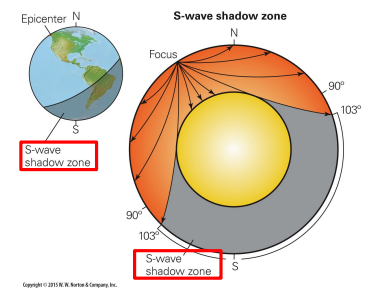
How do scientists determine the internal structure of Earth?
By studying how seismic waves from earthquakes travel, reflect, and refract through Earth's interior.
Why are seismic wave reflections useful?
They reveal the locations and properties of Earth's internal layers.
What is the S-wave shadow zone, and what does it tell us about Earth's interior?
The S-wave shadow zone is the region on Earth where no S-waves are detected after an earthquake. Because S-waves cannot travel through liquids, this proves that Earth's outer core is liquid.
What is the P-wave shadow zone, and what causes it?
The P-wave shadow zone is a region where no direct P-waves are detected because they are strongly refracted (bent) when they enter the liquid outer core.
Earths interior
composed of several layers
crust, mantle, core
Earth’s Internal Layer: Crust
thin, outermost layer, rigid rock
where we started
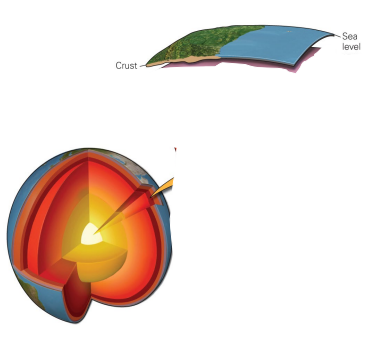
how thick is the crust?
5-10km (oceanic, dense) to 30-50km thick (continental, less dense)
what is the crust constantly changing from?
plate tectonics, earthquakes, volcanism
how deep is the deepest hole dug into Earth’s crust?
~12.2 km deep
Earth’s Internal layer: Mantle
largest layer of Earth’s interior
mostly solid
~2900 km thick
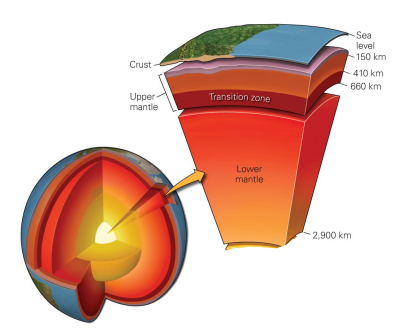
what are the 3 sublayers of the mantle?
upper mantle
transition zone
lower mantle
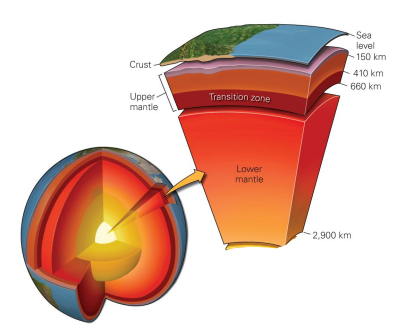
describe the upper mantle
from crust to ~410 km deep, mostly solid but more malleable regions contribute to tectonic activity
lithosphere: very upper portion of mantle and crust
describe the transition zone
410-660 km; rocks become much more dense
prevents/limits exchange of material from upper and lower mantle
describe the lower mantle
660-2900 km deep; hotter and more sense but solid because of intense pressure
surface of mantle plumes
large volumes of magma that break through crust and form volcanoes
Earth’s internal layer: core
very hot, very dense, metal rich
Ni, Fe
younger than Earth
describe the outer core
liquid Fe and Ni 4500-5500C; low viscosity, constant violent convection = magnetic field
swirling of this liquid metal causes our magnetic field
describe the inner core
mostly Fe; pressure nearly 3.6 million atm. = solid
heart
chunk of iron
high pressure that solidifies iron
How did Inge Lehmann discover Earth's inner core?
By studying seismic (earthquake) waves and noticing unexpected P-wave behavior that could only be explained by a solid inner core.
What major contribution did Inge Lehmann make to geology?
She demonstrated that Earth is composed of a liquid outer core and a solid inner core.
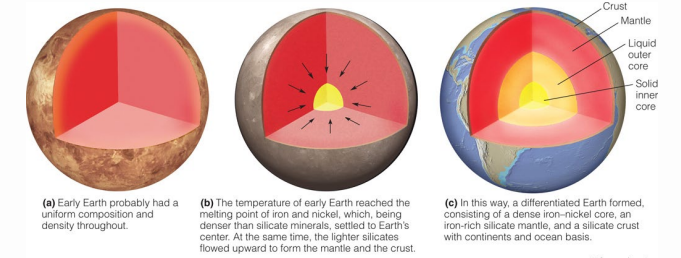
what is the Homogeneous Accretion Theory?
Earth condensed into its body by solar nebula 4.6 billion years ago
uniformed composition and density
internal heat of planet increases to melt Fe and Ni
more dense than remaining silicate metal
sunk to middle of planet
lighter silicate metal floated towards surface
create Earth’s internal layers