syscon part 3 topic 2
 Call Kai
 Learn
Learn Practice Test
 Spaced Repetition
 Match
Match Flashcards
 Knowt Play
1/22

There's no tags or description
Looks like no tags are added yet.
Name | Mastery | Learn | Test | Matching | Spaced | Call with Kai |
|---|
No analytics yet
Send a link to your students to track their progress
23 Terms
What is subjective (internal) good faith
Acting with a genuine and sincere belief; unaware of someone elses righ
What is objective (external) good faith
a standard of conduct used to measure what reasonable and honest peopl would deem to be fair and just in a given situation. Is good faith a standard, rule or value
explain Roman law and good faith
had strict contracts, for example stipulatio (that exact oral contract)
contracts could be consensual for example sale, lease, partnership, mandate
Exceptio doli generalis was a defence used in strict contracts but by middle ages all contracts were consensual so no need for generalis.
Bank of Lisbon Facts
De Ornelas Fishing company got an overdraft facility from the Bank of Lisbon
To secure the overdraft they mortgaged their homes, signed suretyships, and gave additional security.
Everyone intended the security to cover only the overdraft debt.
The bank drafted the contracts in extremely wide terms
The documents said the security covered any money owed to the bank from any cause whatsoever, not just the draft.
The company paid off the overdraft completely and closed the account. The brothers asked the bank tp cancel the mortgage bonds, suretyships, and return the certificate.
The bank refused because there was still another possible debt: a forward purchase of dollars transaction.
The bank argued the broad wording meant the security still covered that liability too.
Brothers said that its bad faith for the bank to keep holding our houses and unrelated debts. Issue of good faith and exceptio doli generalis
Bank of Lisbon case legal question
whether the exceptio doli generalis of Roman law has survived in South African law as defence based on the absence of good faith or the presence of bad faith in the process of enforcing rights?
Bank of Lisbon case ratio
Majority- refused to acknowledge substantive contractual defence based on good faith.
Joubert JA focuses on the wording of the deed of suretyship= sureties liable for the due payment for any sum of money now or at anytime thereafter, whatsoever cause or causes arising. Good faith is an informative norm that influences substantive rules and principles.
Minority- not clear if formed oart of RDL law. its inclusion in SA law is therefore not clearly mistaken and even if it was, so many decisions relied on it.
Expectio does not form part of Roman-Dutch law. Legal uncertainty and court should not descend to arena to settle conflict.
Bank of Lisbon case criticisms
court used weak Roman-Dutch historical sources to claim it never existed.
Some texts were translated from Latin or Dutch into English badly or too narrowly.
certainty matters but fairness and justice also matters and courts should sometimes stop abusive enforcement.
Law was left with a vacuum meaning there was no direct doctrine to stop contractual abuse.
Ordinary people would see that as unfair or exploitative.
The customers gave lots of security to get the overdraft so the bank already had strong protection.
banks have more bargaining power than ordinary clients so the contract was not negotiated equally.
The documents were standard-form contracts.
the bank took more security than necessary
Ubuntu 1998
Mokgoro says Ubuntu is the individuals’ whole existence in relative to the group.
The interim constitution talks about Ubuntu but the Final Constitution does not mention it.
Mokgoro says Ubuntu is dynamic and is careful not to limit it by defining it.
A person can only be a person through others.
limitations of english?
Brisley v Drotsky case
Facts: contract of lease; CNA contract; appellant argued the clause should not be enforced because that would be unreasonable, unjust and in conflict with the principle of bona fides.
Linking bona fide to public policy - Clause as against public policy
On Good Faith:
Ideas of good faith, reasonableness, and fairness are fundamental values
But not independent substantive rules
Good faith and Co. cannot be sued upon directly
Courts cannot rely on GF to intervene in contractual relationships
Legal certainty going forward??
Barkhuizen v Napier case
Barkhuizen v Napier NO 2007 (5) SA 323 (CC) - para 51 only
Short-term insurance policy, concluded between the appellant (the insured) and a Lloyds syndicate (the insurer), represented by the respondent
The insured suffered loss resulting from damage to his BMW, and he claimed the sum insured on the policy.
The insurer repudiated the claim on the basis that cover was provided for private use of the vehicle, but that the loss was suffered while it was being utilised for business purposes.
The insurer alleges being released from liability because of a time limitation clause in the policy.
The clause meant that a claim by the insured would lapse if the insured failed to serve summons on the insurer with 90 days of being notified of the insurer's repudiation of the claim.
The insured conceded non-compliance with the clause, but contended that the provision could not be enforced against him because it contravened the Constitution.
Court upheld the cause as not unconstitutional/unreasonable.
Takeaways (1998- 2007)
Some broader trends to take note of in this series of cases:
Tension between the conservative SCA and the CC
Good faith
Unclear standing - Underlying principle or Independent criteria?
Ubuntu & The Influence of the Constitution
Context: Transformative Constitutionalism and Restorative Justice
Concern with power dynamics and protecting the vulnerable
Where does this leaves 39(2) of the Constitution?
Is Ubuntu a constitutional value under s 39(2)?
What is good faith in contract law
expectation that parties act honestly, fairly, reasonably in both a) forming contracts and b) performing contracts.
It is not a fixed rule but an open-ended standard, creating built in tension between and legal certainty.
Courts can adapt good faith to unfair situations with flexibility while legal certainty means parties must be able to predict whether contracts will be enforced.
explain the tension in good faith
Modern contract law is therefore shaped by a fundamental tension between two value systems:
(1) on one side – freedom of contract, certainty, and enforcement of agreements;
(2) on the other – good faith.
(As well as fairness, public policy, and constitutional values such as ubuntu)
The central legal debate is whether good faith is merely an underlying value that operates indirectly through doctrines such as public policy, or whether it should function as a free-standing basis for refusing to enforce unfair contracts.
South African courts have generally adopted the former position, although constitutional values increasingly place pressure on the law to recognise a broader role for fairness.
This tension is reflected in the key cases we will examine today: Everfresh v Shoprite and Mohamed’s Leisure v Southern Sun.
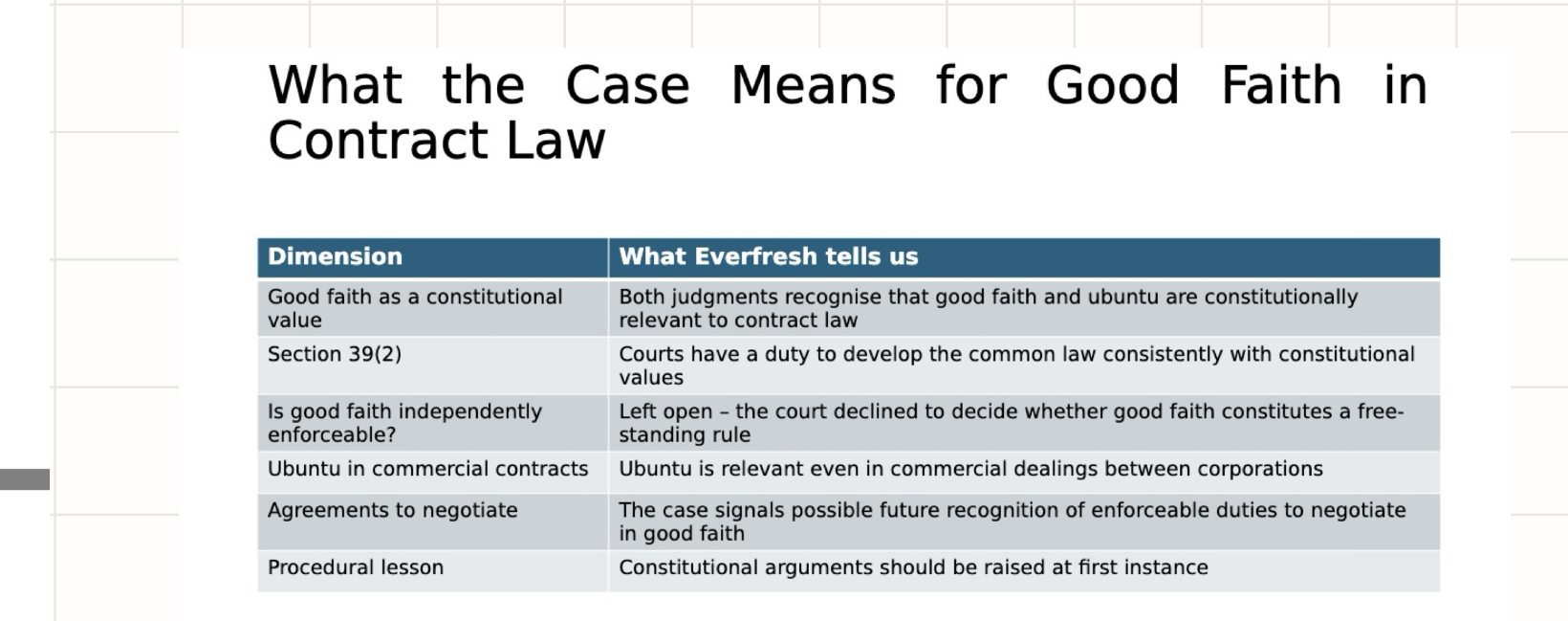
Everfresh v Shoprite raises, but ultimately does not resolve, the constitutional potential of good faith and ubuntu in contract law.
Mohamed’s Leisure v Southern Sun, by contrast, reinforces the traditional position that pacta sunt servanda prevails where contractual terms have been freely and clearly agreed upon
Everfresh market case facts
A commercial lease was concluded between Everfresh Market Virginia (Pty) Ltd (the lessee) and H.R. Geeringh C.C. (the original lessor) in respect of premises in the Virginia Shopping Centre in KwaZulu-Natal.
The lease ran for five years, from 1 April 2004 to 31 March 2009.
During the lease period, Shoprite Checkers (Pty) Ltd purchased the shopping centre. By acquiring the property, Shoprite stepped into the shoes of the original lessor and became bound by the lease on the same terms.
A dispute arose concerning clause 3 of the lease, which granted Everfresh an option to renew the lease for a
further four years and eleven months, subject to two conditions:
(1) Everfresh had to give written notice of its intention to renew at least six months before the lease expired; and
(2) The parties had to agree on the rental for the renewal.
In July 2008, Everfresh gave written notice of its intention to renew, and proposed a rental of R93 600 per month with an annual escalation of 10.5%.
In September 2008, Shoprite refused to negotiate. It contended that clause 3 did not create a legally binding renewal right and stated that it intended to redevelop the shopping centre.
Significantly, Shoprite’s predecessor had previously honoured a similar clause. Indeed, the very lease before the court had itself resulted from earlier negotiations conducted in good faith. Shoprite’s refusal therefore represented a marked departure from the manner in which the clause had historically been treated.
After the lease expired on 31 March 2009, Everfresh remained in occupation of the premises. Shoprite then instituted eviction proceedings.
Everfresh opposed the eviction application, arguing that Shoprite could not evict it without first making a genuine attempt to negotiate the renewal rental in good faith.
Both the High Court and the Supreme Court of Appeal refused leave to appeal. The matter eventually came before the Constitutional Court.
Everfresh market case legal issue
The issue before the Constitutional Court was whether an agreement to negotiate in good faith is enforceable.
More specifically, the court had to determine whether Shoprite could simply refuse to engage in the renewal process altogether, or whether clause 3, interpreted in light of constitutional values, obliged the parties to at least attempt to negotiate in good faith.
This raised a broader constitutional question: should the common law of contract be developed, in terms of section 39(2) of the Constitution (which mandates courts to develop the common law in accordance with the spirit, purport and objects of the Bill of Rights), to recognise and enforce a contractual duty to negotiate in good faith where they have contractually undertaken to do so?
Everfresh market case judgements
Minority: Yacoob J held that good faith, informed by ubuntu, should play a central role in South African contract law.
In his view, a contractual clause requiring parties to negotiate is more consistent with constitutional values than one permitting a party to walk away without engagement.
He suggested that constitutional values such as ubuntu may require the common law to recognise and enforce duties to negotiate in good faith.
He therefore proposed that the matter be remitted to the High Court for proper development of the common law under section 39(2)
Majority: The majority did not reject Yacoob J’s substantive views regarding good faith and ubuntu.
In fact, Moseneke DCJ made similar observations about the importance of constitutional values in contract law.
However, the majority dismissed the appeal because Everfresh had failed to raise the constitutional development argument in the High Court or Supreme Court of Appeal.
The constitutional issue was introduced explicitly for the first time in the Constitutional Court.
The majority held that this procedural defect made it inappropriate for the Constitutional Court to decide such a far-reaching issue as a court of first and final instance
Southern Sun case facts
Mohamed’s Leisure Holdings (Pty) Ltd leased commercial property in Cape Town to Southern Sun Hotel Interests (Pty) Ltd, which operated a hotel on the premises.
The lease relationship began in 1982 and was later replaced by a written agreement in 2001, which was renewed until 2021.
Two important clauses governed the lease:
(1) Rent had to be paid by the 7th day of every month.
(2) Clause 20 provided that if rent was not paid on time, Mohamed’s Leisure could immediately cancel the lease and retake possession without giving notice to remedy the breach
First breach (June 2014):
Southern Sun failed to pay rent on time because of a banking error by Nedbank.
Mohamed’s Leisure allowed Southern Sun to remedy the breach but warned that any future late payment would lead to immediate cancellation.
Second breach (October 2014):
A second late payment occurred, again due to a banking error by Nedbank.
After waiting 12 days for payment, Mohamed’s Leisure then cancelled the lease and sought Southern Sun’s eviction.
Good faith attempt:
Southern Sun attempted to demonstrate good faith by paying interest on the overdue rent and argued that eviction would be unconstitutional
Southern Sun case legal issue
Whether enforcing the cancellation clause and evicting Southern Sun would be so unreasonable that a court should refuse to enforce the contract despite the principle of pacta sunt servanda (agreements must be honoured).
More specifically, the court had to decide whether constitutional values such as ubuntu, fairness, and good faith justified developing the common law to limit enforcement of the cancellation clause
Southern Sun case arguments
Lessor arguments: Mohamed's Leisure argued that enforcement of the cancellation clause was not unreasonable because:
• It had a clear contractual right to cancel the lease;
• Southern Sun had already been warned after the first breach;
• It waited 12 days before cancelling the lease; and
• Refusing enforcement would allow courts to impose their own notions of fairness and effectively rewrite contracts for parties (i.e., removing the cancellation clause).
Lessee arguments: Southern Sun argued that enforcement would be manifestly unreasonable because:
• The breaches resulted from factors beyond its control;
• The contract should be interpreted in light of good faith;
• Stdicidualrement was contrary to public policy, ubuntu, fairness, and justice between
• Pacta sunt servanda should not override all constitutional considerations; and
• Cancellation would cause disproportionate hardship, including significant business disruption and job losses.
Southern Sun case High Court and SCA decision
The High Court accepted that Southern Sun had technically breached the lease but refused to grant the eviction order.
• The court held that enforcing the cancellation clause would be manifestly unreasonable and contrary to public policy. It reasoned that the common law principle of pacta sunt servanda should be developed in accordance with constitutional values such as ubuntu, fairness, and good faith.
• Mohamed Leisure took the High Court's decision on appeal to the Supreme Court of
Appeal.
The Supreme Court of Appeal overturned the High Court's decision and upheld the cancellation of the lease.
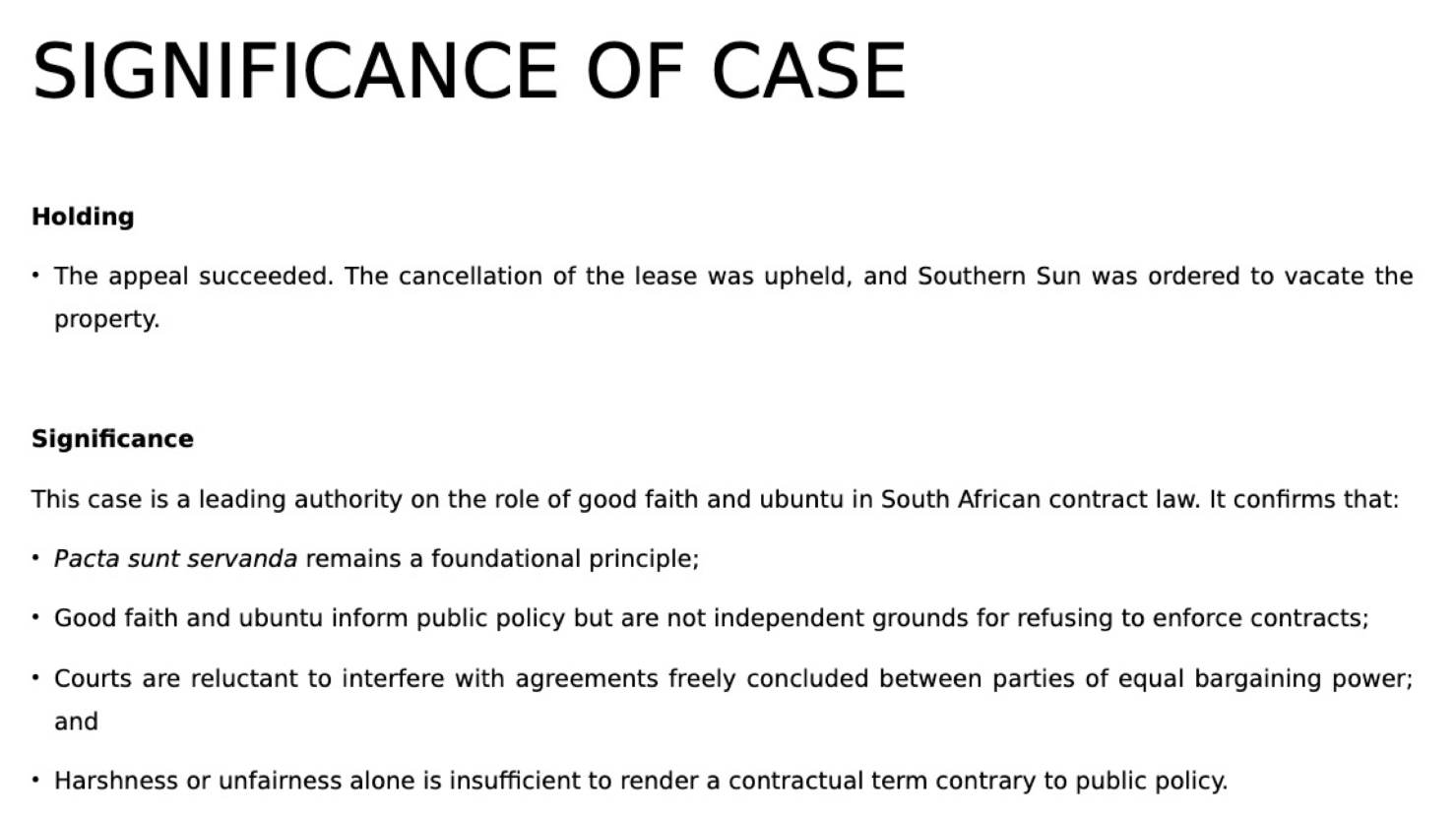
The court reaffirmed that pacta sunt servanda remains a foundational principle of South African contract law.
Contractual certainty and freedom of contract are themselves constitutional values linked to dignity and autonomy.
The court applied the test from Barkhuizen v Napier (discussed in your previous lecture):
1. Objective inquiry
Was the clause itself contrary to public policy?
The court held that it was not. A clause requiring punctual payment in a commercial lease was ordinary, commercially reasonable, and not inherently unfair.
2. Subjective inquiry
Would enforcement in the specific circumstances be so unfair or unreasonable that it offended public policy?
The court held that it would not, because:
• The parties were sophisticated commercial entities with equal bargaining power;
• The agreement had been freely concluded;
• Performance was not impossible, as Southern Sun could have used alternative payment methods or monitored payments more carefully after the first breach;
• Nedbank acted as Southern Sun's agent, meaning Southern Sun bore the risk of the bank's errors;
• Mohamed's Leisure had expressly warned Southern Sun after the first breach; and
• The lessor did not cancel immediately, but waited 12 days before enforcing the clause.
The court stressed that good faith and ubuntu are important constitutional values, but they are not free-standing rules that permit courts to ignore or rewrite valid contractual terms merely because enforcement appears harsh.
Although the court acknowledged the potential hardship and possible job losses caused by cancellation, these considerations were insufficient to override a valid contractual right.
Beadica case facts
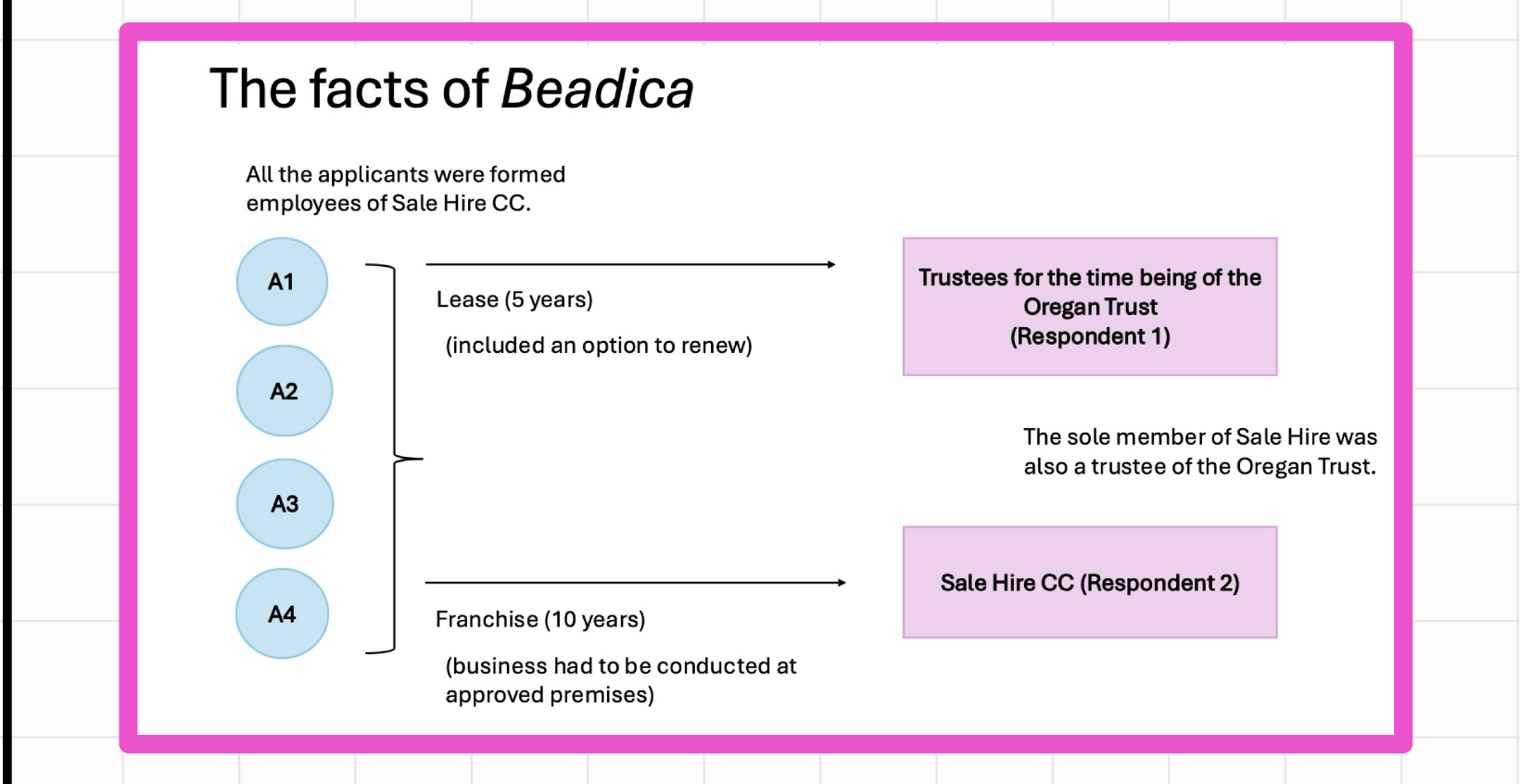
Three judgments: majority of Theron J, the minority of Froneman J and the minority concurrence of Victor AJ.
This case is situated within many complex jurisprudential debates, some of which include: the correct interpretation of section 39(2), the relationship between the common law and the Constitution, and the correct interpretation of several seminal cases including Barkhuizen and Botha, and most importantly for our purposes, the weight afforded to “free-standing” notions of good faith, fairness, reasonableness and ubuntu in the law of contract.
It is a relatively complex case, but the judgment of Theron J does nicely summarise the development of the jurisprudence on the particular issue of the role of good faith/ fairness/ ubuntu in the law of contract
Beadica case legal issue
Would the strict enforcement of the renewal clause of the lease agreements would be contrary to public policy, embodied by the values of the Constitution, or in other words unconscionable in the circumstances of the case?
(and for our purposes, what does the Court say about ubuntu?)
Beadica case judgement
minority: For Froneman J, a minority judgment is required for three reasons (1) that the regulation of fairness in contract law is never simply a legal issue, and always has inherent value considerations; (2) that it is necessary to consider how these value considerations translate into practical application; and, (3) that he believes the appeal should have been upheld (para 106-109).
Further, Froneman J is concerned that the majority tries too hard to reconcile prior jurisprudence and read the SCA and CC in agreement with each other (para 107).
Froneman J considers, extensively, the different values which can give content to ideas of fairness in contract law and discusses three main approaches.
• Equality in exchange. (para 114-115).
• The rise of unfettered freedom of contract (para 116-119).
• The decline and transformation of freedom of contract (para 120-
127).
Further, Froneman J makes the point that freedom of contract is not absolute in our law and our courts often interfere with the parties' freedom of contract for various reasons (para 136-139).
• Froneman then moves to his interpretation of Barkhuizen and Bredenkamp.
In relation to Barkhuizen, he disagrees with the majority judgment. For Froneman, when a constitutional right or value is raised, then notions of fairness/ justice/ reasonableness/ ubuntu are independent basis upon which the enforcement of a contractual term can be determined. In other words, he takes issue with the extent to which the majority judgment holds that there is always an intermediary rule between a constitutional right or value and the enforcement of a contractual term - namely the legal rule that contractual terms that are contrary to public policy will not be enforced (para 141-153).
• Froneman also believes that the majority misunderstands Bredenkamp. He held that Bredenkamp must be read that
"fairness is not a free-standing requirement for the exercise of a contractual right" where no constitutional right or value as contained within public policy is implicated (para 153-155).
• The primary issue with the role of fairness/ justice/ reasonableness/ ubuntu in contract law is that the content of these notions is relatively uncertain. However, for Froneman, this is not an issue which warrants the avoidance of these values but rather an issue which can be solved by giving content to these values. He makes the point that the problem of 'uncertainty' arises as well in terms of the other principles which can be used to guide determinations of when the enforcement of contractual terms would not be appropriate (para 160).
Finally, Froneman J explicitly notes ubuntu at various points in his judgment and stresses its importance and significance as a constitutional value and a component of any determination of public policy (para 175). Importantly, Froneman J seems to distinguish good faith from fairness/ justice/ reasonableness/ ubuntu, but holds that both inform public policy (para 175-176).
• Victor AJ endorses Froneman J's judgment but feels it is necessary to afford greater attention to ubuntu in the the discussion of the enforcement of contractual terms. He is centrally concerned with making sure that ubuntu is afforded the same status as notions of fairness/ justice/ reasonableness in determinations of whether or not to enforce a contractual term (para
206).
• For Victor AJ, the scope of ubuntu is significantly wider than fairness (para 207).
• Victor AJ refers specifically to the High Court judgment of Davis J and endorses his approach to ubuntu and its role in the enforcement of contractual terms (para 215-216).
• Davis J held that contractual certainty is, arguably, never really possible so it is misplaced to use it as a reason to not make use of notions such as ubuntu in determining whether contractual terms should be enforced. If a contract is never 100% certainly going to be enforced, we should at least make use of the notion of ubuntu as part of that determination.
• And, finally, Victor Al highlighted the fact that the case arose in circumstances surrounding the implementation of a BBBEE initiative. For him, this is an important consideration, and one which makes adherence to a 'transformative constitutionalism' all the more important (para 221-228).
It’s worth noting that Beadica itself is jurisprudentially controversial. It was handed down on the same day as the Court’s judgment in Pridwin and, in some senses, fundamentally disagrees with the judgment in Pridwin (particularly about the role of section 39(2)).
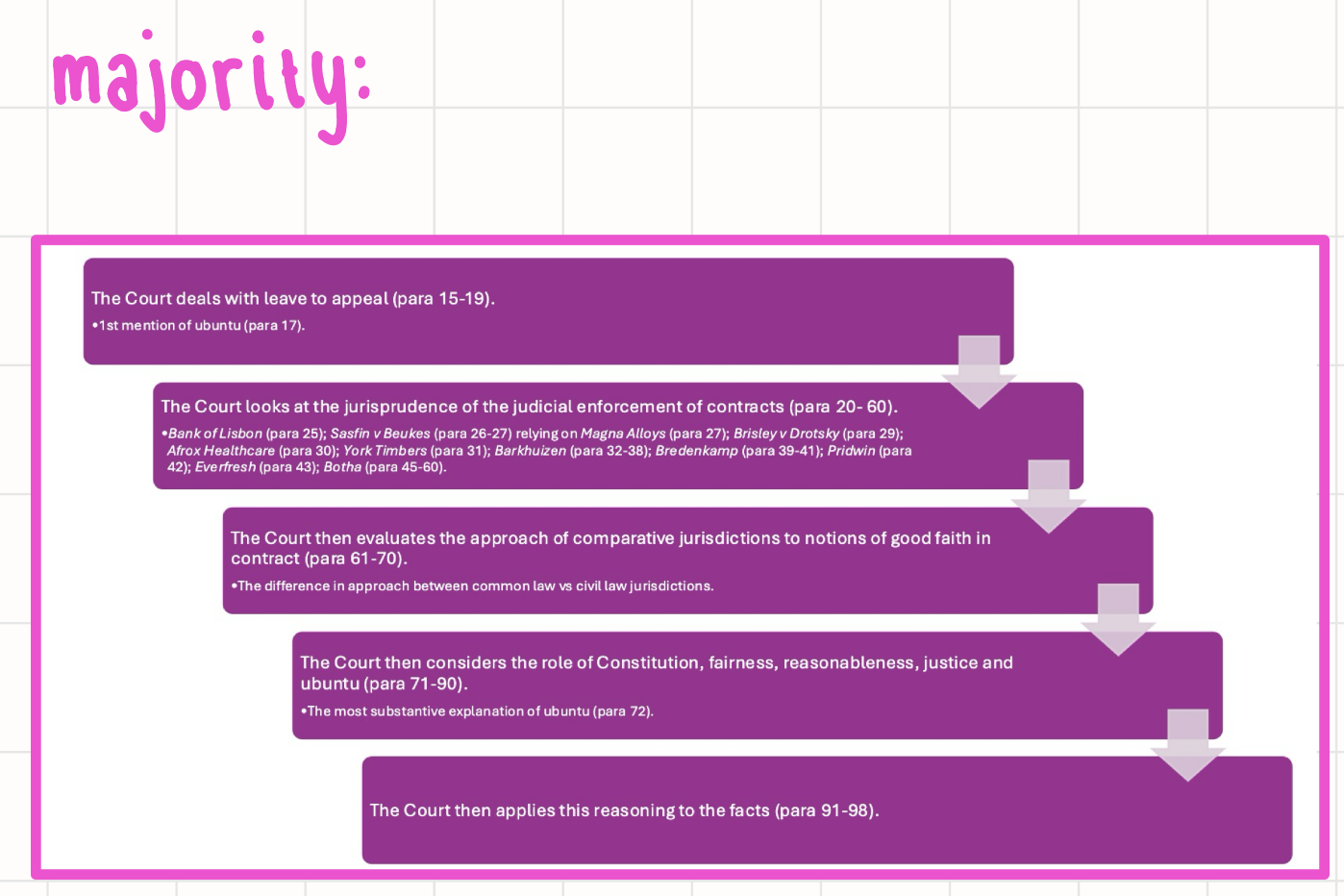
But, in terms of the role of good faith in contract, the majority in Beadica determines that notions of good faith/ fairness/ reasonableness/ ubuntu in the law of contract are not freestanding notions upon which the enforcement of contractual terms can be challenged (para 80). These notions are given effect to through intermediary rules of the law of contract.
The majority held that notions of good faith/fairness/ ubuntu contribute to the content of public policy, which is the legal rule through which the enforcement of contractual terms can be challenges. But, for the majority, the assessment of public policy is a careful balancing exercise between many constitutional values including that of pacta sunt servanda and that of good faith/fairness/justice/reasonableness (para 82-86)