Characteristics of Bacteria causing Disease in Host
 Studied by 0 people
 Call Kai
 Learn
Learn Practice Test
 Spaced Repetition
 Match
Match Flashcards
 Knowt Play
1/25

There's no tags or description
Looks like no tags are added yet.
Name | Mastery | Learn | Test | Matching | Spaced |
|---|
No study sessions yet.
26 Terms
Describe Koch’s Postulate (principal)
Identify suspected agent in all cases of the disease
Isolate and grow the agent in pure culture on artificial media
Introduce the pure culture into a healthy host to see if same disease appears
If it does, re-isolate the same agent from the experimentally infected host to make sure
Bacteria
Compare size and self sufficiency to viruses
Types of shape
How many sets of chromosomes
How do they reproduce
How mutations affect bacteria
Can bacteria acquire genes from other bacteria
How does bacterial evolution allow them to do
Compare size and self sufficiency to viruses:
Size = 10 - 100 larger
Self sufficiency = More self sufficient
Types of shape:
Cocci (spherical)
Rods (bacilli)
Spirochetes (spiral)
How many sets of chromosomes: One set (haploid)
How do they reproduce: Binary fission producing clones
How mutations affect bacteria: Enhance survival
Can bacteria acquire genes from other bacteria: Yes, through horizontal gene transfer
How does bacterial evolution allow them to do: Adapt to new or existing environments to increasing survivability
What are the 2 types of bacteria?
Intracellular bacteria
Extracellular bacteria
Intracellular Bacteria
How do they enter host cells?
How they survive inside host cells?
Examples?
How do they enter host cells: By various pathways such as =
Macrophagess
Phagocytes
Epithelial/endothelilal cells
Hepatocytes
How they survive inside host cells: They evade the host’s immune response and replicate within mononuclear phagocytes
Examples:
Brucella abortus
Listeria monocytogenes
Chalmydia trachomatis
Coxiella brunteii
Mycobacterium tuberculosis
Salmonella enterica
Extracellular Bacteria
Where do they multiply
How do they evade immune system
Can they enter host cells
Examples
Examples of diseased caused by extracellular bacteria
Where do they multiply: In extracellular spaces like mucosal surfaces, vascular and lymphatic fluids, body cavities
How do they evade immune system: They evade humoral immunity and phagocytes causing multiplication outside host cells
Can they enter host cells: Sometimes but most stay attached to epithelial surfaces and release toxins without penetration
Examples:
Staphylococcus aureus
Streptococcus pyogenes
Pseudomonas aeruginosa
Escherichia coli
Examples of diseased caused by extracellular bacteria:
Wound infections
Osteomyelitis
Pneumonia
UTI
Pathogenicity of Bacteria
What
What does virulence mean
Difference between avirulent and virulent bacteria
What are bacterial virulence factors
What does bacterial pathogenicity depend on
What: The ability to cause disease and symptoms depending on virulence
What does virulence mean: How dangerous the bacteria are
Difference between avirulent and virulent bacteria:
Avirulent: Little impact on health
Virulent: Actively express virulence genes and cause health problems
What are bacterial virulence factors:
Toxins
Surface coats
Surface receptors
What does bacterial pathogenicity depend on: Pathogen’s resistance to host defenses and host susceptibility to bacterial virulence factors
What are exotoxins and endotoxins?
They are virulence factors that help bacteria cause disease
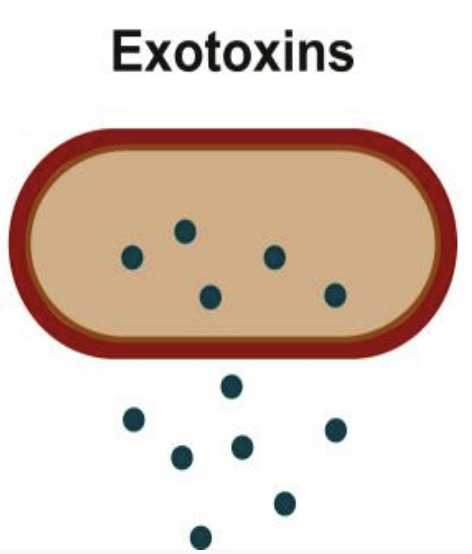
Exotoxins
How they cause disease
Are they diffusible or cell bound
What type of molecules are exotoxins
Which bacteria produces exotoxins
Are they species specific
How dangerous are they
Are they stable
Can they be converted to a safe form for vaccines
How they cause disease: Directly damage host cells or interfere with normal cellular functions
Acts extracellulary or on cell membrane
Attack intercellular substances by enzymatic mechanisms (hemolysins, leukocidins, hyaluronidase)
Proteins enter cells and disrupt cellular processes enzymatically
Are they diffusible or cell bound: Diffusible (can move away from bacterial cell that produces them and spread to surrounding tissues)
What type of molecules are exotoxins: Proteins or polypeptides
Which bacteria produces exotoxins: Both Gram-positive and Gram-negative bacteria
Are they species specific: Yes
How dangerous are they: Lethal in small amounts (nanograms)
Are they stable: No they are liable to heat, chemicals and storage conditions
Can they be converted to a safe form for vaccines: Yes, they can be converted to toxoids that initials antitoxin production
Endotoxins
How they cause disease
Are they diffusible or cell bound
What is the toxic component
Which bacteria produce endotoxins
Are they species specific
How dangerous are they
Are they stable
Can they be converted to toxoids
How they cause disease: Trigger strong immune responses
Enter host cells in macrophages
Stimulates the secretion of mediator substances such as interleukin-1, tumor necrosis factor (TNF) and complement components
Are they diffusible or cell bound: Cell bound (part of bacterial cell wall)
What is the toxic component: Lipid A of lipopolysaccharide (LPS)
Which bacteria produce endotoxins: Only Gram negative
Are they species specific: No, they are structurally similar and have similar effects regardless of bacterial species
How dangerous are they: Lethal in large amounts (micrograms)
Are they stable: Yes, very stable to heat, chemicals and storage
Can they be converted to toxoids: No, they cannot be converted to toxoids

What is pathogenic action?
The specific way the microorganism causes disease in the host
(different from pathogenicity which means the ability of a microorganism to cause disease)
What are the 2 types of pathogenic action of bacteria?
Direct damage to host structures and functions by exotoxins
Damage occurred as a result of host immune responses following exposure to endotoxins
What is immune mediate damaged by endotoxins?
Tissue damage occurs due to immune reactions
Acute: Inflammation resembling immediate type allergy
Chronic: Granulomatous infections cause cell mediated responses that intensify inflammation and tissue destruction
Antibiotics:
What bacterial mechanisms do antimicrobial agents target?
Inhibition of cell wall synthesis
Disruption of protein synthesis
Impairment of nucleic acid synthesis
Interference with metabolic pathways
Antibiotics:
How can bacteria resist antimicrobial agents?
Prevent drug entry
Deactivate drugs
Alter drug targets
Actively expel drugs
Antibiotics:
How does mutation and natural selection lead to antibiotic resistance?
Susceptible bacteria die
Mutations create resistant bacteria that survive.
Resistant bacteria reproduce, dominating the population.
Antibiotics:
What is horizontal gene transfer in antibiotic resistance?
Bacteria acquire resistance genes from other bacteria instead of through mutation
Antibiotics:
What is conjugation?
Transfer of DNA (usually plasmids) from one bacterium to another via direct contact
Antibiotics:
What is transduction?
A bacteriophage transfers resistance genes from one bacterium to another
Antibiotics:
What is transformation?
Bacteria pick up free-floating DNA from the environment, often from dead bacteria, acquiring resistance genes
Pathogenesis
What is the first step in bacterial pathogenesis?
Exposure – the host comes into contact with bacteria via skin, mucosa, inhalation, ingestion, or other routes
Pathogenesis
What happens after exposure in bacterial pathogenesis?
Colonization – bacteria attach to host surfaces (epithelial cells, mucosa) and start multiplying.
Pathogenesis
How do bacteria evade the host immune system?
Immune evasion – bacteria avoid detection or destruction via capsules, toxins, biofilms, or intracellular survival
Pathogenesis
What is the result of successful immune evasion?
Infection – bacteria multiply, spread, and cause tissue damage, leading to disease.
Pathogenesis
What is the symptomatic phase of bacterial disease?
Bacterial exposure
Colonisation
Immune evasion
Pathogenesis
What is the asymptomatic phase of bacterial disease?
Infection
What are the factors affecting bacterial pathogenesis?
Host immune system
Host genetics
Age
Host microbiota
Coexisting infections
Pathogen virulence
Pathogen resistance