Innovation and technology
 Studied by 0 people
 Call Kai
 Learn
Learn Practice Test
 Spaced Repetition
 Match
Match Flashcards
 Knowt Play
1/91

Earn XP
Description and Tags
Definitions and concepts
Name | Mastery | Learn | Test | Matching | Spaced |
|---|
No study sessions yet.
92 Terms
Innovation
Short: A useful and novel match between problem and a solution
Long: Practical implementation of an idea into a new device or process
Significance of innovation
Drives competitive advantage
Challenge of renewal = innovation
innovation is crucial to survive
technology trajectory
evolve
improve
diffuse
Tech change is, what?
cumulative and evolutionary (based on prior generations)
Why there are dominant designs?
efficiency
standardisations for mass production
outsourcing
availability of complementary goods
standardised consumer habits
Technology Cycle (Utterback & Abernathy)
Fluid Phase
Dominant Design
Specific Phase
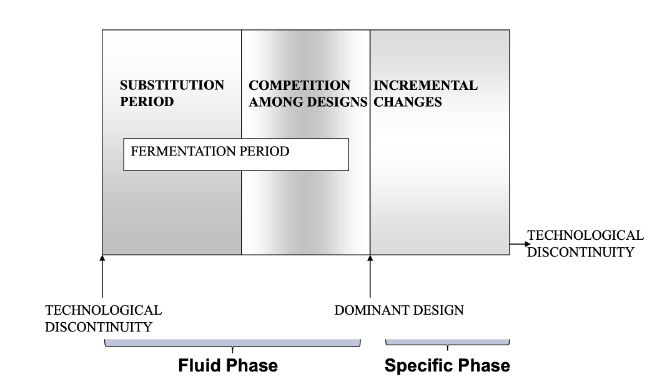
What are the characteristics of Fluid Phase?
uncertainty and experimentation
product/architectural innovation
more entry than exit
more product than process innovation
What are the characteristics of Dominant Design?
a dominant design emerges as standard
What are the characteristics of Specific Phase
process improvements
incremental and component innovations
more exit than entry
more process than product innovation - design already established
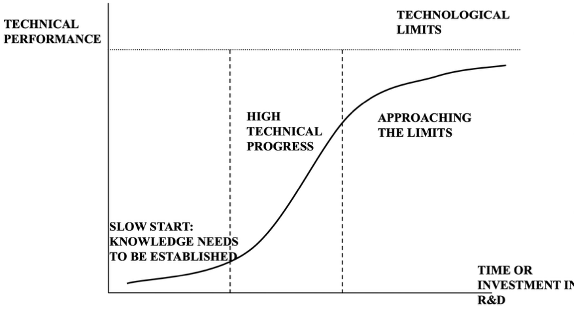
What are the Stages of Technology S Curve ( R. Foster)?
Slow start → Knowledge (scarce) needs to be established +experimentation
Rapid improvements → clearer architecture + narrow challenges
Approaching limitations → physical/ technical constraints (due to key architectural choices)
Performance vs effort in R&D
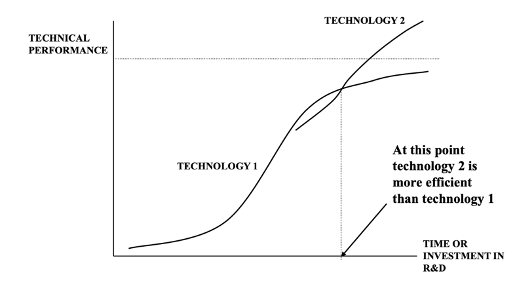
Technological discontinuities
Managerial use
Technological discontinuity
a discontinuous technology fulfils the similar market needs by means of entirely new knowledge base
What is the diffusion S-curve used for?
It tracks adoption of technology over time (% of adoption)
New technology improves with time in what 2 regards?
Price
Technology
What are the explanations for diffusion?
Word of mouth
Diffusion in demand
Network effects
How does word of mouth work?
Proximity has big impact
Mass media reduced its impact
Why differences in demand?
Due to different adaptors categories (Roger)
Tolerance for poor performance
Uncertainty and risk-attitude
Knowledge, ability and skills
What are the different categories of adaptors?
Innovators (2.5%) → adventurous, resourceful.
Early adopters (13.5%) → opinion leaders, influencers.
Early majority (34%) → pragmatic, slightly ahead of average.
Late majority (34%) → sceptical, pressured by peers, resource constrained.
Laggards (16%) → traditionalists, risk-averse, last to adopt.
What are the types of network effect?
Direct → more users = more value (e.g., phones, social apps)
Indirect → complements drive adoption (e.g., app stores)
What are the positive externalities of consumption?
direct network effect
indirect network effect
What is the direct network effect?
The utility derived from consumption of a network good is affected by the number of other people using the same or a compatible product
What is the indirect network effect?
System goods, where the utility derived from the consumption of a good depends on the availability of complementary goods, which in turn depends on the number of other users
What are two-sided (multi-sided) markets?
Markets in which a platform enables interactions between separate groups and actively tries to increase installed bases on all sides of the market.
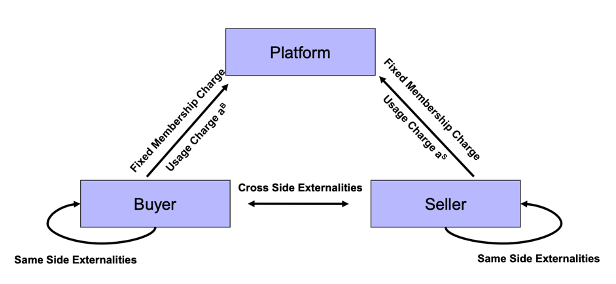
What are the types of externalities in a two-sided market?
Cross-side externality
Same-side externality
What re cross-side externalities?
Positive externality (indirect network effect): Users on one side of the market benefit from users on the other side of the market
Negative externality: One side would prefer only few users on the other side of the market. (e.g. TV advertising)
What are same side externalities?
Positive externality (i.e., direct network effect): Increasing the network on one side, makes it more valuable for other users on this side (e.g., game consoles that support online gaming)
Negative externality: Users on the same side rival for the other side (e.g., career platforms)
Explain the food delivery example for two sided markets
Cross-side:
More restaurants → better for customers (more choice, lower waiting time etc.)
More customers → better for restaurants (greater reach, more orders)
Same-side:
More consumers → more restaurants or longer delivery
More restaurants → greater choice or fierce rivalry
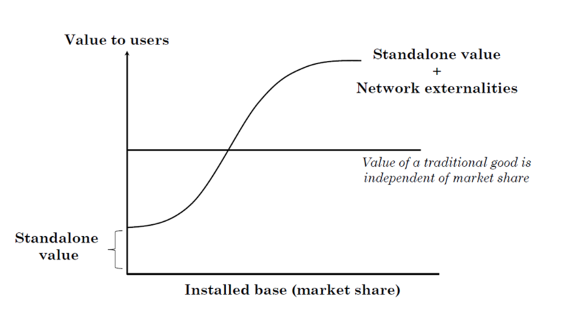
Product with network effect
start of almost worthless → the utility is barely above the standalone value (early adaptors almost gain nothing)
more users → value accelerates
once network becomes big → becomes almost unbeatable (once everyone is using one platform)
What happens if there is network effect in the market?
Markets tend to be dominated by one company → winner-take-all markets
Network effects are great until a company gets so big it becomes dangerous → keep it in check
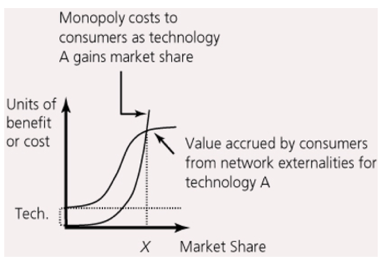
Advantages of winer-take-all markets
Possibility of huge profits
Disadvanatges of winer-takes-all market
difficult to predict → randomness play a crucial role
difficult to reverse→ huge lock-in and switching costs
Is dominance of a single technology unavoidable? (network effect)
different standards may co-exist
What are the factors promoting multiple competitions in the market?
Low multi-homing costs (consumers can subscribe to multiple platforms)
Network effects are weak
Consumer preferences are heterogenous (standalone value may be more important)
What is a standard?
A specification that allows for interoperability, i.e. a standard makes it possible for different components of a system to work together
How are standards created?
De jure standards (set by authorities)
De facto standards (set by the market)
Sponsored standards: created and controlled by a firm (e.g., Sony’s CD format).
Unsponsored standards: develop naturally due to mass adoption (like languages)
Strategies for winning the war in network market
Move Fast (typically very small window of opportunity)
Identify and court early adapters
Necessary availability of complementary goods
Role of expectations → can be manipulated
Credibility + alliances → making the market believe it’s tech. is in a winning position
What is creativity?
It is the ability to produce something useful and novel
What are the drivers of creativity?
Knowledge
Intellectual abilities
Style of thinking
Personality
Motivation
Environment
Sources of Ideas
Individual creativity
Cross-disciplinary thinking
The four phases of the ideation process
Idea Generation → Inspiration and cognitive flexibility
Idea Elaboration → Support and feedback
Idea Championing → Influence and advocacy
Idea Implementation → Shared vision and execution
Factors influencing inventorship
Socioeconomic class
Ethnicity
Gendre
Access to exposure and resources
What are the challenges female investors face?
Women inventors produce higher quality patents but earn less and hold fewer leadership roles.
They face systemic barriers despite stronger performance in some areas.
What can be done to reduce the innovator gap?
Raise awareness of unequal opportunities.
Expand mentoring programs and exposure.
Promote visibility and leadership of women in tech.
Achieve a critical mass of women in top positions to change signals for future generations.
Basic research
increases unerstanding without commercial purpose
Applied research
targets solving specific need
Internal sources of innovation
Formal R&D → labs: structured, large-scale research efforts
Informal R&D: small, bottom-up projects aimed at problems employees encounter in daily work
Methods of encouraging organisational creativity
Idea collection systems
Creativity training programs
Culture encouraging creativity
Demand Pull
innovation from unmet consumer need
Science Push
innovation starts with new scientific or technological solutions
Closed Innovations
firms generate and control ideas internally, owning the full Intellectual Property.
Open Innovation
firms combine internal and external ideas and use multiple paths to market
External sources of innovation
Customers → best understand performance needs
Suppliers
Universities
Governments -→ Conducts R&D and grants, tax breaks, subsidies
Environments and clusters → ex. Software, internet in Silicon Valley
Richard Foster
Diffusion Curve
Eric von Hippel
User innovation
H.W. Chesborough
Open innovation
evolutionary process
variation
selection
retention
Type 1 error
(false positive): choosing an idea that fails (apple newton)
effect on firms: high costs, reputational damage, wasted time
effect on individuals: being stuck with incremental work
Type 2 error
(false negative): rejecting an idea that becomes successful (Harry Potter rejected 12 times)
effect on firms: missing valuable opportunities
effect on individuals: fewer opportunities, slower career development
Innovation funnel
Thousands of raw ideas narrow down through multiple stages until only one becomes a successful product
stage-gate process
The time and cost of projects escalates with each stage → stage-gate processes only permit a project to proceed if all assessments indicate success.
What are the stages of “stage-gate process“
Discovery (idea generation)
Scoping → brief
Building the business case → more detailed research
Development
Testing and validation
Launch → selling, marketing production
Post-launch review → evaluation
Stage process gates
Idea screening
Approval for further research
Business case evaluation
External testing approval
Commercial launch approval
What is portfolio balancing
Firms must balance their projects based on:
Degree of technological change (incremental/radical)
Market impact (low/high)
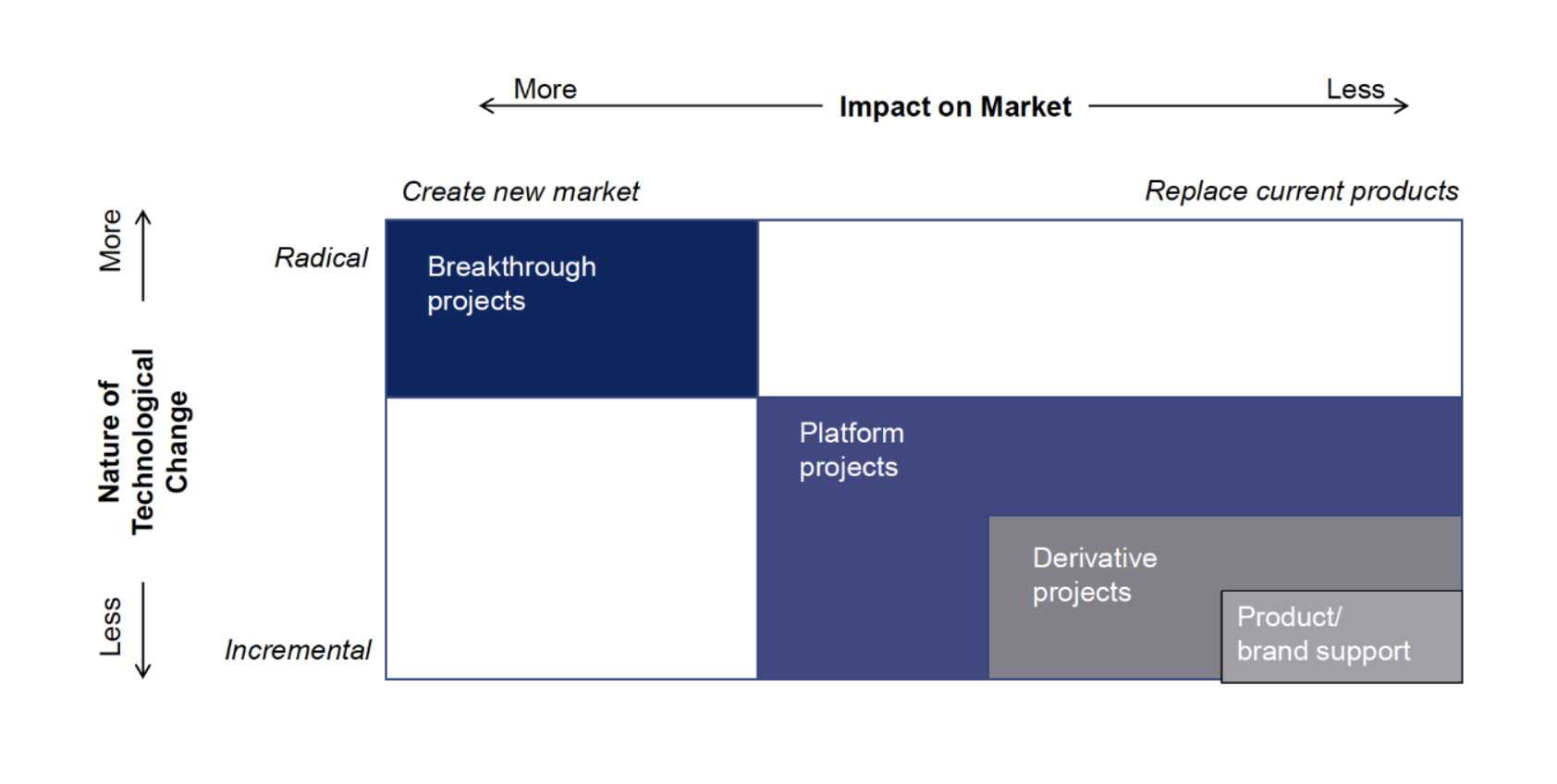
Tools for Selecting Innovation Projects
Qualitative Methods
Quantitative Methods
Which Tools to Use?
Research-stage projects → qualitative methods.
Pre-development projects → option-based methods.
Development-stage projects → financial/DCF methods.
Who captures the value form innovation?
Innovator captures small proportion
Consumers high proportion
Capturing value of innovation (Teece)
Building Block 1 → Appropriability regimes - extent to which the idea is protected
Building Block 2 → Dominant design - innovations are better protected in later stages of innovation
Building block 3 → Complementary assets
Generic: early acquired → different application
Specific: developed jointly with the innovations -→ owners of these capture the biggest value
Strategic options of commercialising innovation
Profiting form product market (going solo)
Benefits: control, chance of market leadership
Risks: No complementary resources, convincing consumers, uncertain and scarce resources
Profiting form markets for ideas (collabaret)
Benefits: No sunk costs, Sharing costs and risks, Knowledge (partners), easy product competition
Risks: risk of expropriation, leakage, cost of contract
Ken’s paradox of disclosure
To sell an idea you must reveal it → once you reveal it the buyer might copy it → your idea is worth less -. patents help but not always
What are the positions of the matrix and their characteristics?
Atackers’s Advantage → enter, tech determines winner, real threat, incumbents must reinvent
Idea factory → contracting, safe market, start-ups fuel incumbents
Greenfield competition → enter or contract, constant tech advantage to stay on top, both must innovate constantly
Reputation based Ideas trading → contract, incumbents reputation is key, stable market position, start-ups only if incumbents let them
types of collaborations
joint venture
licensing
Strategic alliances
R&D contracting
What is licensing?
contractural agreement that lets an organisation use other’s IP
Reasoning behind licensing
If already max capacity selling -→ completion won’t matter → additional cash flows form royalties
Revenues effect: net CF from royalties
Profit dissipation effect: increased competition → licneser’s profit reduces
Types of licenses
Exclusive vs non-exclusive
Output/price restrictions
Payment conditions: fixed fee vs royalties
Cross-licensing
Why royalties work best?
Moral hazard - motivation for the licenser’s to help out the firm to improve profits
Adverse selection - those who know their product is good will offer royalties
Why protect Innovation?
R&D extremely → reproduction cheap
Without protection → underinvestment in R&D → no motivation → imitator’s free ride
IP tools
Patent - official registration of new tech → IP rights
Copyright - automatic: protects expression of creative/artistic works (including software)
Trade secret - protection through secretive measures
Trademark - protect signs/logos/slogans distinguishing smth through use or registration
Registered designs - protect the external appearance of a product through registration
What Patents?
Without no motivation to invent → market would under-produce
Patent
Government-granted right to exclude others form making, using or selling invention for 20 years
Negative right: block rather then grant permission to produce
In exchange for monopolistic right inventors must disclose how it works
Can be sold, licensed or used in negotiation
What cannot be patented?
Scientific discoveries without industrial application
Aesthetic creations
Only EU/UK
Software alone if not part of a tech innovation
Business model unless tech. novel
New Plants/Animals
Issues with patents?
takes 2-4 years but the innovation becomes public in 18 months
it works only in the country it was granted
breach is impossible to detect
competitions can easily create around the patent → better to publish defensively
Even nespresso’s 1,700 patents cannot stop imitation
Treaties trying to synchronise patents
The Paris Convention - enables priority rights and equal treatment across member countries
Patent cooperation treaty (PCT) - allows a single filing reserving rights in 100+ countries for up to 2½ years ( same application date)
Why patent?
Prevent copying
Block competitors
Prevent lawsuits
Used in negotiations
Enhance reputation
Revenue streams form licensing
Measure R&D performance
Patent strategy
Build large portfolio to defend market position (dell with 42 patents or Amazon’s single click) → ENTRY BARRIERS
Patent trolls
Enforce patents without producing anything
Defences against patent trolls
design around
patent-watch
clearance searches
early settlement
infringement insurance
Copyright
Protect EXPRESSION against coming and distributing copies
Work must be fixed in tangible form; © optional
authors or +70 years and firms for 90 years
Trademarks
Distinguishing firms gods'/services → form legitimate use though registration required to sue
Includes logos, names, slogans, shapes, sounds, scents
Protection lasts as long as it is used (lost after 5 years of no use)
New product announcement hurts rivals profits
New trademark improves improves everyones profits → investment into the category
Registred designs
Protect appearance features such as lines, shapes, colour, texture.
Must be new and with individual character
Protection lasts up to 25 years with renewal every 5 years
Trade Secrets
Protect information not generally known that gives competitive advantage with reasonable secrecy measures → nuns and the stones
Violations include breach of confidentiality, NDAs, and industrial espionage
Weak enforceability → spillovers and mobility
Treaties simplifying application for trademarks
Madrid Protocol
Madrid Agreement Concerning the International Registration of Marks
Invention to be patented must be
new to the world
have a industrial application
have an inventive step → can’t be obvious