Pathology Assignment: Bones of Head and Neck
 Studied by 0 people
 View linked note
 Call Kai
 Learn
Learn Practice Test
 Spaced Repetition
 Match
Match Flashcards
 Knowt Play
1/18

Earn XP
Description and Tags
A set of flashcards covering key vocabulary and concepts related to the bones of the head and neck, including anatomy and pathology information.
Name | Mastery | Learn | Test | Matching | Spaced |
|---|
No study sessions yet.
19 Terms
Osteology
The study of bones.
Articulation
An area of the skeleton where the bones are joined to each other, which can be either movable or immovable.
Sutures
Firm joining of two or more bones in the skull, appearing as 'cracks'.
Joint
The moveable junction of two or more bones.
Foramina
Holes in the cranium that allow major blood vessels to supply the brain with blood.
Cranium
The part of the skull that encloses the brain, consisting of 8 bones.
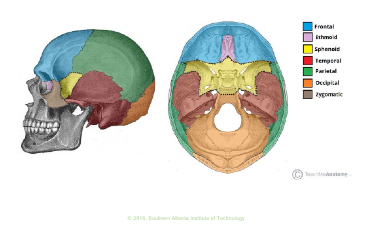
Frontal Bone
A single bone that forms the forehead, part of the cranium floor, and the roof of the orbits.
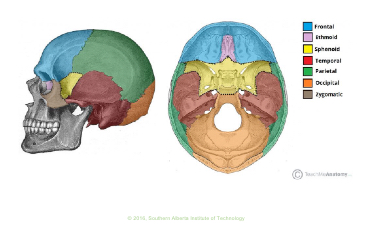
Parietal Bones
Paired bones that form most of the roof and upper sides of the cranium.
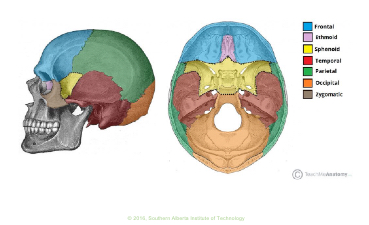
Occipital Bone
A single bone that forms the back and base of the cranium.
Temporal Bones
Paired bones that form the sides and base of the cranium and enclose the ear.
Sphenoid Bone
A single bone that forms the anterior portion of the base of the skull.
Ethmoid Bone
A single bone that forms parts of the cranium floor, the orbit, and the nasal cavity.
Maxilla
A paired bone that forms the upper jaw and part of the hard palate.
Zygomatic Bones
Also called the malar bones; they form the prominence of the cheek.
Mandible
The lower jawbone, which is a single movable bone of the skull.
Paranasal Sinuses
Air-filled spaces in the skull that lighten the skull bones and act as sound resonators.
Temporomandibular Joint (TMJ)
A joint allowing for movement of the mandible for speech and mastication.
Jaw Movement
Involves hinge and gliding actions for opening and closing the mouth.
Temporomandibular Disorder (TMD)
A condition characterized by pain and stiffness in the TMJ.