borne approximation, scattering and diffraction
 Call Kai
 Learn
Learn Practice Test
 Spaced Repetition
 Match
Match Flashcards
 Knowt Play
1/20

There's no tags or description
Looks like no tags are added yet.
Name | Mastery | Learn | Test | Matching | Spaced | Call with Kai |
|---|
No analytics yet
Send a link to your students to track their progress
21 Terms
what is the borne approximation?
set of assumptions that is used when mathematically modelling the scattering of an incident wave when passing through a heterogenous medium
sound speed heterogeneities: monopole point sources
density heterogeneities: dipole point sources producing wave parallel to the incident wave → little to no scattering perpendicular to incident wave
assumes that the:
scattered wave is much weaker (lower amplitude) as the incident wave
each wave is only scattered once
wave speed and absorption is homogenous throughout the medium
under what conditions are the assumptions in the borne approximation true?
true when the impedance missmatch of the target and the background is very low →
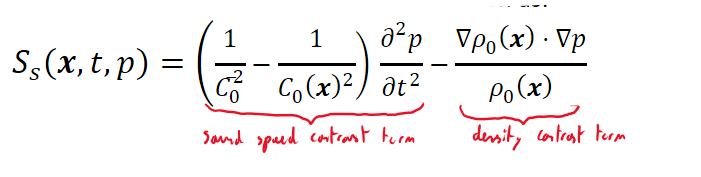
homogenous wave equation with contrast source terms originating from heterogenous medium
c02ˉ1∂t2∂2−∂x2∂2p=Ss(p)
where bar c_0 is the average sound speed
what is the total acoustic field composed of
total=small scattered+incident
how do we obtain the born approximation from the total pressure field
take the integral equation for the green function, since the field is the sum of your source with the scattered terms:
p(x,t)=∫0t∫volumeG(x−x′,t−t′)(S(x′,t′,p)+source)dtdx
if we take the convolution of the green’s function and the source term and bring it out of the integrals it now becomes our borne approximationpo → we can then plug it into our scatter terms to
p(x,t)=po(x,t)+∫0t∫volumeG(x−x′,t−t′)S(x′,t′,p0)dtdx
we can also write this as a heterogenous wave equation with contrast source terms
Ss(p0)(x,t)=(c02ˉ1−c02(x)1)∂t2∂2p0−ρ0(x)∇ρ0(x)⋅p0
implicit vs an explicit solution
explicit function → y variable is separated from the x variable on the other side → if we plug in a value for x we can find y
implicit solution → y appears on both sides or a function of x and y is equal to 0 → we need to have prior information of y to find an exact solution for y at x
what are the types of scattering
molecular/absorption → energy is converted into heat
diffusive
diffractive
specular
moving → doppler from moving RBC
explain diffusive scattering
occurs when the scatterer is smaller than the wavelength
scattering is frequency dependent
produces a spherical wavefront
responsible for speckling → grainy appearance in ultrasound images
diffractive scattering
occurs when when scatterers have a size between 0.1-1mm
produces a distorted spherical wavefront
what is specular scattering
occurs when the scatterer is much larger than the wavelength ex: organ surfaces
frequency independent
causes the waves to be reflected (specular reflection) appears as a bright white surface on US
what is a boundary
area where medium of one density meets a medium with another density
what do mediums of different densities have
different characteristic acoustic impedance (Z) =ρoco
impedance is always calculated normal to the boundary
what conditions must hold at the boundary
continuity of pressure: pressure on both sides should be the same so the boundary does not move: pi+pr=pt
continuity of normal particle velocity: particle velocity must be the same on both sides (fluid must stay in contact): ui+ur=ut
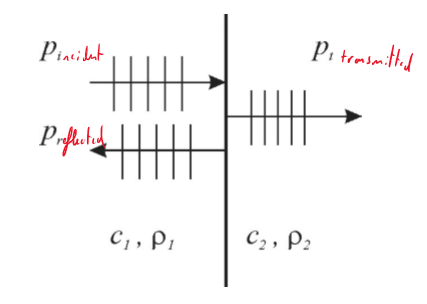
relationship between reflection coefficient and transmission coefficient
1+R=T
reflection coefficient
tells you the amplitude of a reflected wave compared to the incident wave
R=pipr=z2cos(θi)+z1cos(θt)z2cos(θi)−z1cos(θt) remember that you can replace z by ρ0co
if:
z2> z1 = wave is reflected back positively
z2 < z1: wave is reflected flipped (-ve)
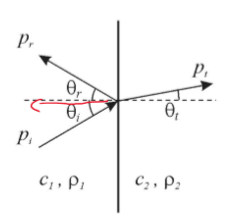
transmission coefficient
amplitude of the transmitted wave compared to the incident wave
R=pipt=z2cos(θi)+z1cos(θt)2z2cos(θi) remember that you can replace z by ρ0co
energy reflection coefficient
must follow the conservation of energy: Re + Te = 1
since intensity=zpressure2 Re=R2 and Te=1−R2
why is coupling gel required
large impedance missmatch between the PZT, air and the body(Water) → most sound is reflected
gel reduces this impedance missmatch

refraction and snell’s law
Refraction: change in wave direction when entering a medium with different sound speed
High to low density: wave speeds up and bends away from the normal
Low to high density: wave slows down and bends towards the normal
snell’s law: C1sin(θi)=C2sin(θt)
critical angle =sin−1(C2C1) it is when the refraction angle = 90 degrees
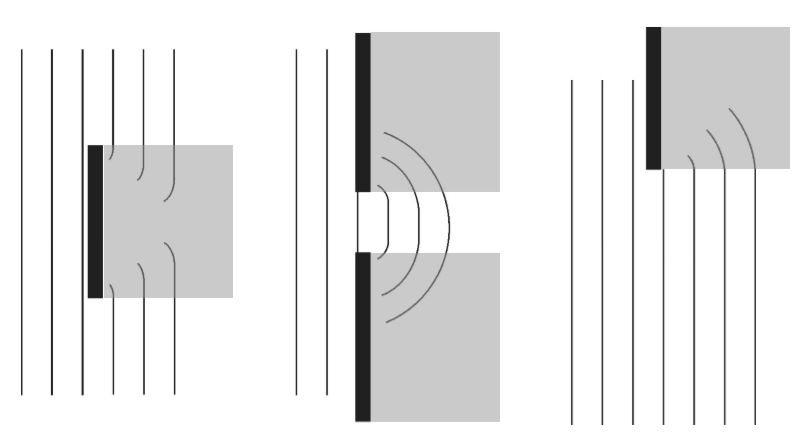
diffraction
based on hyugen’s principles:
every point on the wavefront acts as a source for a secondary wavelet
when these wavefronts pass through a small opening the wavelets spread out beyond the opening's edge and interfere with each other
This causes the wave to bend a spread out
smaller the slit the greater the diffraction