BV EM 6
 Call Kai
 Learn
Learn Practice Test
 Spaced Repetition
 Match
Match Flashcards
 Knowt Play
1/52

Earn XP
Description and Tags
OKR
Name | Mastery | Learn | Test | Matching | Spaced | Call with Kai |
|---|
No analytics yet
Send a link to your students to track their progress
53 Terms
Optokinetic Response (OKR) – classification
A gaze holding eye movement
it is a psychooptical reflex — a reflexive eye movement that requires visual input to function
“to follow a global motion in the visual scene”
Psychooptical reflex definition
A reflexive eye movement that requires visual input;
the OKR is psychooptical whereas the VOR is NOT (VOR works without any visual input)
OKR – primary stimulus
Movement of all or a large part of the visual field (global retinal image motion)
can also elicit it other ways by artificially moving large portions of the visual scene
Why OKR is a gaze-holding movement
Global visual-scene motion most commonly occurs when the observer moves and the VOR fails to fully compensate; the OKR evolved to stabilize gaze during self-motion
Real-world OKR example
Standing next to a large bus that fills your visual field and begins moving — the global retinal image motion reflexively drives an OKR tracking response
“ did i move or did visual scene move”
OKR vs VOR – key difference
OKR is a psychooptical reflex requiring visual input;
VOR is NOT psychooptical and functions fine with eyes closed or in total darkness
Optokinetic Nystagmus (OKN) – definition
An involuntary jerk nystagmus produced under certain conditions by the OKR; characterized by a sawtooth wave with a constant-velocity slow phase
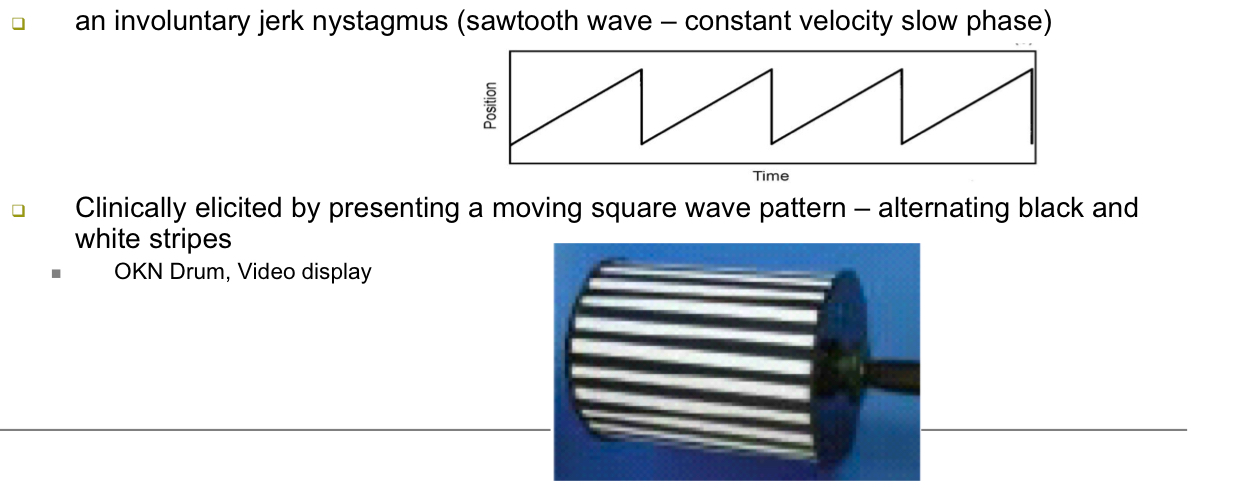
OKN waveform shape
Sawtooth wave with a constant-velocity slow phase — because the driving stimulus (stripes) moves at constant velocity
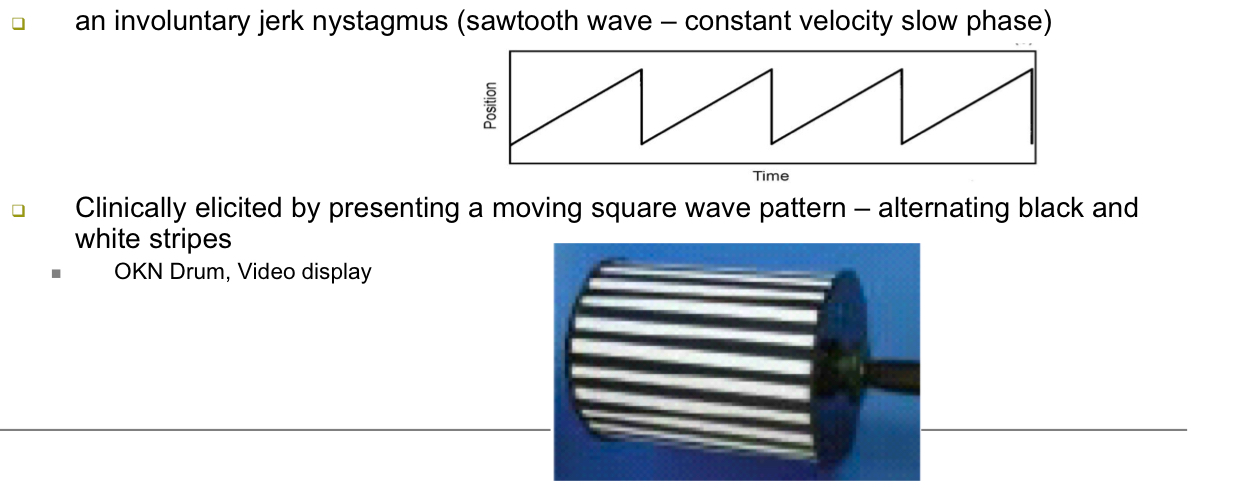
How OKN is clinically elicited
By presenting a moving square-wave pattern of alternating black and white stripes using an OKN drum or video display
OKN naming convention
Jerk nystagmus is named by the direction of the FAST phase (e.g. left-beat nystagmus = fast phase goes left)
What’s generating OKN slow phase and what direction does it move
Generated by the OKR (the tracking response); moves in the SAME direction as the moving stripes
What’s generating OKN fast phase and what direction does it move
A saccadic reset back toward primary gaze; moves in the OPPOSITE direction to the stripes
OKR latency
~140 ms — significantly slower than the rotational VOR (~16 ms) and translational VOR because visual processing of scene motion is required
Why does blur have little effect on OKN
Large stripes are used and peripheral vision (largely unaffected by blur) drives the response — a strong OKN response should appear even when central vision is poor
Clinical use of OKN to detect malingering
Patients truly blind would have no OKN; if OKN is present despite claimed blindness the patient cannot have complete visual pathway loss — revealing malingering
not talking about kids has talking about people who want money compensation lol
OKN Gain – formula
Gain = Response (eye) velocity ÷ Stimulus (stripe) velocity; perfect gain = 1.00
perfect gain would be if the eyes are moving at the same velocity as the drum
what happens to gain when you tell pt to Stare at OKN drum passively (stare OKN)
~0.80 — patient passively stares ahead without actively attending to the stimulus
what happens to gain when you tell a patient to pay attention to OKN drum (Look OKN)
~1.00 — patient is told to fixate/attend to a feature of the stimulus; voluntary attention improves accuracy
How to estimate acuity using optokinetic nystagmus? Who would this be good for?
Present OKN with progressively smaller stripes; smallest stripe angular size that still generates OKN = estimated VA; useful for infants
OKN and cortical blindness
OKN response requires occipital cortex input; absence of OKN can confirm cortical blindness
OKN asymmetry in newborns
Temporal-to-nasal OKR develops first; monocular nasal-ward (T→N) response is stronger than temporal-ward (N→T) at birth
When newborn OKN asymmetry resolves
By 2–6 months under normal binocular visual development
lots of visual function has developed at this point
When OKN asymmetry persists
When strabismus or amblyopia prevents normal binocular visual development — asymmetry (stronger nasal-ward than temporal-ward OKN) remains
OKN asymmetry as a clinical tool for amblyopia
In an amblyopic eye stripes moving nasally produce much stronger OKN than stripes moving temporally; symmetrical OKN in the normal fellow eye supports amblyopia diagnosis
OKN asymmetry as a clinical tool for strabismus
OKN is stronger for nasal-ward (T-N) than temporal-ward (N-T) stripe motion in the affected eye; can help screen for strabismus
OKN neurological pathway
Accessory Optic System (AOS) and Nucleus of the Optic Tract (NOT) in the midbrain; receives direct visual input from BOTH the retina AND the cortex — not the standard geniculo-striate pathway
seemed like an fyi… bless
OKR–VOR interaction during sustained rotation
VOR is strong initially but fades as endolymph catches up (constant velocity = no acceleration); OKR then takes over to track the still-moving visual scene and maintain clear vision
What happens to eye movement after an OKN-inducing visual scene stops moving?
After the visual scene stops moving the eyes continue to follow in the same direction for a period of time; this can partially cancel post-rotary vestibular nystagmus
What is the vestibular mechanism underlying post-rotary nystagmus?
When rotation stops the endolymph continues flowing in the original spin direction; the brain reads this as head turn in the opposite direction and drives a compensatory nystagmus
OKR after-effect vs VOR post-rotary nystagmus
OKR after-effect (eyes continue in original motion direction) is OPPOSITE to VOR post-rotary nystagmus — they partially cancel each other out
Clinical OKN Summary – three uses
Estimate VA (reduce stripe size until OKN stops);
Detect cortical blindness (need occipital cortex for response);
Screen for amblyopia/strabismus (nasal-ward OKN stronger than temporal-ward in affected eye)
OKR – voluntary suppression
The OKR is reflexive and difficult to voluntarily suppress; naïve observers generally cannot inhibit it when presented with a global motion stimulus
Pursuit eye movements – classification
Gaze-shifting eye movements (contrast with gaze-holding VOR/OKR)
Pursuit – basic description
Slow conjugate tracking eye movement in response to a moving target
Primary stimulus for pursuit
Target velocity; specifically a non-zero rate of change of oculocentric direction (dβ/dt)
Goal of pursuit
Match eye velocity to target velocity so the target is stabilized on the fovea (constant oculocentric direction β)
Oculocentric direction (β)
Direction of a target relative to the eye; a non-zero dβ/dt is the error signal that initiates or adjusts pursuit
Ocular direction (α)
The direction the eye is pointing; dα/dt is the eye velocity the pursuit system adjusts to minimize dβ/dt
Egocentric direction (χ)
Direction of a target relative to the observer (head/body); dχ/dt is the perceived spatial direction of the target
Pursuit latency
100 ± 5 ms; up to 25 ms longer for slow target velocities ≤5°/sec
Pursuit velocity range
Matches target velocity up to ~60–70°/sec; above that eye velocity is typically slower; some can approach 100–150°/sec targets
Vertical vs horizontal pursuit accuracy
Vertical pursuit is less accurate than horizontal pursuit
Catch-up saccade
A saccadic eye movement triggered when the eye falls behind the pursuit target; quickly reduces position error and returns gaze to target; happens frequently during normal pursuit
Pursuit and age
Pursuit performance declines progressively with age; error-correcting catch-up saccades become more frequent
Target prediction in pursuit
Knowledge of target behavior allows educated guesses about future position/velocity; predictable sinusoidal targets are tracked better than unpredictable ones
Pursuit Bode analysis – components
Two plots: (1) Gain (eye velocity / target velocity) vs. frequency; (2) Phase (lead or lag of eye relative to target) vs. frequency — same structure as VOR Bode plots
Pursuit Bode: predictable vs unpredictable targets
Gain is higher and phase error is lower for predictable (e.g. sinusoidal) targets; predictability allows feed-forward compensation
Effect of barbiturates on pursuit
Barbiturates (sedatives) can eliminate smooth pursuit while leaving saccades intact; patient then tracks targets with a series of saccades instead
Pursuit training
Pursuits can be trained; McHugh & Bahill (1985) showed learning within 7.5 min; Pittsburgh Pirates players had lower initial error but all subjects plateaued at the same final error level after training
Baseball and pursuit limits
During batting a player can only pursue the ball to within ~10 feet of the plate; beyond that the ball is too fast/close for smooth pursuit
Dynamic visual acuity (DVA) and pursuit
When VA is measured with a moving target the pursuit system stabilizes the retinal image; a stationary target with head movement uses the VOR and pursuit together
Pursuits and visual direction – before pursuit onset (within latency e.g. t=0.050s)
dα/dt = 0 (eyes stationary); dβ/dt = target velocity (retinal slip present); dχ/dt = target velocity (target moving in space)
Pursuits and visual direction – after pursuit onset (e.g. t=0.150s)
dα/dt ≈ target velocity (eyes tracking); dβ/dt ≈ 0 (target stabilized on retina); dχ/dt = target velocity (target still moving in space)