FMP: CHAPTER 7 Experimental Designs
 Studied by 0 people
 Call Kai
 Learn
Learn Practice Test
 Spaced Repetition
 Match
Match Flashcards
 Knowt Play
1/37

There's no tags or description
Looks like no tags are added yet.
Name | Mastery | Learn | Test | Matching | Spaced |
|---|
No study sessions yet.
38 Terms
Experimental research design
seeks to determine if a specific treatment influences an outcome.
The researcher assesses this by providing specific
treatment to one group and withholding it from another
and then determining how both groups scored on an
outcome.
Experiments include true experiments, with the
random assignment of subjects to treatment
conditions, and quasi-experiments that use
nonrandomized assignments (Keppel, 1991).
True experiments, random assignment, nonrandomized assignments
Experiments include ___, with the
___ of subjects to treatment
conditions, and quasi-experiments that use
___ (Keppel, 1991).
BASIC PRINCIPLES OF EXPERIMENTAL METHOD
To translate the Method of Difference into an
experiment, we need to formulate a specific, testable
question or hypothesis, such as, ‘Does stress impair
memory for events?’
To answer it, we manipulate one variable (the
independent variable, or IV), and measure the effects
of these manipulations on another variable (the
dependent variable, or DV), while keeping all other
variables as constant as possible.
independent variable or IV
Manipulated Variable
To answer it, we manipulate one variable ___ and measure the effects of these manipulations
dependent variable or DV
variable in a study or experiment that is observed and measured to determine the effect of changes or manipulations in another variable ___ while keeping all other variables as constant as possible
The Peril of Confounding Variables
In designing an experiment, the tricky bit is to ensure
that the independent variable is the only thing that
varies systematically between the groups.
Variables that have unwanted influences on our
experimental results are called confounding
variables.
confounding variables.
Variables that have unwanted influences on our
experimental results are called ___.
Between-groups design (between-subjects design)
is an experimental design in which each condition in
the experiment is performed by a different group of participants.
Within-subjects designs (repeated measures designs)
is an experimental design in which each participant
takes part in more than one condition of the study.
Matched-pairs design
is an experimental design in which participants are carefully matched on variables that might be relevant to the research (such as age, socioeconomic status, intelligence, etc.)
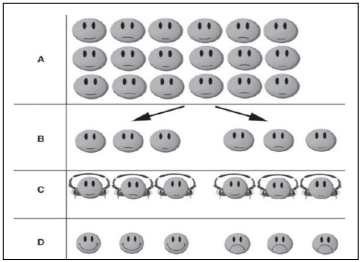
Post-test only/control group design
is an experimental design in which participants are allocated randomly to different conditions and given different treatments.
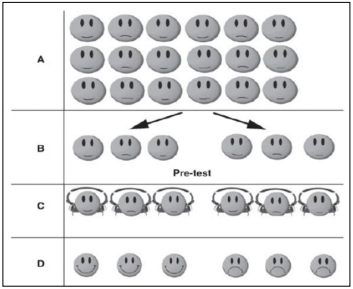
Pre-test/post-test control group design
the subjects are allocated to groups and are measured both before some manipulation and after the manipulation.
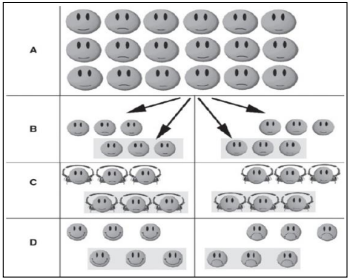
Solomon four-group design
is an experimental design in which participants are allocated randomly to different groups, given different treatments (different levels of an independent variable), and then tested in some way, in the expectation that the different treatments will have affected their behavior in some way.
ADVANCED EXPERIMENTAL DESIGNS
Longitudinal design
Cross-sectional design
Multifactorial design
Mixed design
Longitudinal design
is a repeated-measures design that is often used in developmental research. A group of participants is tested repeatedly over time (e.g. at different ages).
Cross-sectional design
is a between-groups design that involves using different groups of participants to represent different points in development (e.g. different ages).
Multifactorial design
is an experimental design in which the effects of more than one independent variable are investigated within the same study. ____ permit investigators to study how variables might interact with each other.
Mixed design
is an experimental design that combines within-subjects and between subjects (e.g. the effects of sex and alcohol on memory performance could be investigated with a mixed design.
COMPONENTS OF AN EXPERIMENTAL STUDY METHOD PLAN
Participants
Variables
Instrumentation and Materials
Experimental Procedures
Threats to Validity
The Procedure
Data Analysis
Interpreting Results and Writing a Discussion Section
Participants
Readers need to know about the selection, assignment, and the number of ___ who will take part in the experiment.
Often investigators aim to recruit a study sample that shares certain characteristics by formally stating specific inclusion and exclusion study criteria when designing their study.
Variables
1. Identify the IVs in the experiment and how they will be manipulated in the study.
2. Include a manipulation check measure that evaluates whether your study successfully manipulated the independent variable(s) of interest. A manipulation check measure is defined as a measure of the intended manipulated variable of interest.
3. Identify the dependent variable or variables (i.e., the outcomes) in the experiment.
4. Identify other ___ to be measured in the study. Three categories of ___ are worth mentioning.
Instrumentation and Materials
The experimental study plan calls for a thorough discussion
about the ___ used - their development, their items,
their scales, and reports of reliability and validity of scores
on past uses.
1. Thoroughly discuss the ___ used for the
manipulated variable(s) of interest.
2. Often the researcher does not want participants to know
what variables are being manipulated or the condition
they have been assigned to (and sometimes what the
primary outcome measures of interest are).
Experimental Procedures
The specific _____ also need to be identified.
1. Identify the type of experimental design to be used in the proposed study.
2. Identify what is being compared in the experiment.
3. Provide a diagram or a figure to illustrate the specific research design to be used.
Threats to Validity
Experimental researchers need to identify potential threats to the internal validity of their experiments and design them so that these threats will not likely arise or are minimized.
Internal validity threats
are experimental procedures, treatments, or experiences of the participants that threaten the researcher’s ability to draw correct inferences from the data about the population in an experiment. For example, history, maturation, testing, instrumentation, etc.).
External validity threats
arise when experimenters draw incorrect inferences from the sample data to other persons, other settings, and past or future situations. For instance, interaction of selection and treatment, interaction of setting and treatment and interaction of history and treatment.
The Procedure
Step 1. Administer measures of the dependent variable or a
variable closely correlated with the dependent variable to
the research participants.
Step 2. Assign participants to matched pairs based on their
scores on the measures described in Step 1.
Step 3. Randomly assign one member of each pair to the
experimental group and the other member to the control
group.
Step 4. Expose the experimental group to the
experimental treatment and administer no treatment or
alternative treatment to the control group.
Step 5. Administer measures of the dependent variables
to the experimental and control groups.
Step 6. Compare the performance of the experimental
and control groups on the post-test(s) using tests of
statistical significance.
Step 1.
Administer measures of the dependent variable or a
variable closely correlated with the dependent variable to
the research participants.
Step 2.
Assign participants to matched pairs based on their scores on the measures described in Step 1.
Step 3.
Randomly assign one member of each pair to the experimental group and the other member to the control group.
Step 4.
Expose the experimental group to the experimental treatment and administer no treatment or alternative treatment to the control group.
Step 5.
Administer measures of the dependent variables to the experimental and control groups.
Step 6.
Compare the performance of the experimental and control groups on the post-test(s) using tests of statistical significance.
Data Analysis
1. Report the descriptive statistics.
2. Indicate the inferential statistical tests used to examine the hypotheses in the study.
3. For single-subject research designs, use line graphs for baseline and treatment observations for abscissa (horizontal axis) units of time and the ordinate (vertical axis) target behavior.
line graphs
For single-subject research designs, use ___ for baseline and treatment observations for abscissa (horizontal axis) units of time and the ordinate (vertical axis) target behavior.
abscissa
For single-subject research designs, use line graphs for baseline and treatment observations for ____ (horizontal axis) units of time and the ordinate (vertical axis) target behavior.
ordinate
For single-subject research designs, use line graphs for baseline and treatment observations for abscissa (horizontal axis) units of time and the ___ (vertical axis) target behavior.
Interpreting Results and Writing a Discussion Section
Interpret the findings in light of the hypotheses or research questions and to draft a discussion section. In this interpretation, address whether the hypotheses or questions were supported or whether they were refuted.
Address whether the results might have been influenced by unique strengths of the approach, or weaknesses (e.g., threats to internal validity), and indicate how the results might be generalized to certain people, settings, and times.
Finally, indicate the implications of the results, including implications for future research on the topic.