ORGO CHAPTER 2 (EXAM 2) --> ACIDS & BASES
 Call Kai
 Learn
Learn Practice Test
 Spaced Repetition
 Match
Match Flashcards
 Knowt Play
1/63

There's no tags or description
Looks like no tags are added yet.
Name | Mastery | Learn | Test | Matching | Spaced | Call with Kai |
|---|
No analytics yet
Send a link to your students to track their progress
64 Terms
does an ACID lose or gain a proton
loses a proton
forms a conjugate base
does an BASE lose or gain a proton
gains a proton
forms a conjugate acid
reversible reaction
can go forward or backwards (shown by double sided arrow)
is a REVERSIBLE reaction strong or weak
a weak reaction
irreversible reaction
can only go foward (reactants to products) shown by one-sided arrow
is a IRREVERSIBLE reaction strong or weak
a strong reaction
strong acids
PRODUCTS are favored at equilibrium
the stronger the acid…..
the weaker the conjugate base
weak acids
REACTANTS are favored at equilibrium
the acid dissociation constant (Ka)
a measure of the extent of dissociation of an acid
acid dissociation constant (Ka) EQUATION
(product concentration) / (reactant concentration)
put the constants on the same side of the equation
Ka of strong acid
the stronger the acid, the LARGER the Ka
pKa of strong acid
the stronger the acid, the SMALLER the pKa
pKa equation
= -log(Ka)
pKa < 1
very strong acid
pKa = 1-3
moderately strong acid
pKa = 3-5
weak acids
pKa = 5-15
very weak acids
pKa > 15
extremely weak acids
pH
indicates the concentration of protons in a solution
pH equation
= -log[H+]
pH’s
pH 8-14 = basic
pH 7 = neutral
pH 6-0 = acidic
the most common organic acids
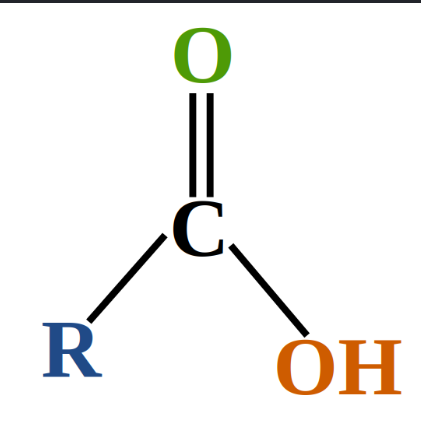
carboxylic acids
carboxylic acids
an organic compound containing a carboxyl group (−COOH) attached to a carbon chain or hydrogen atom
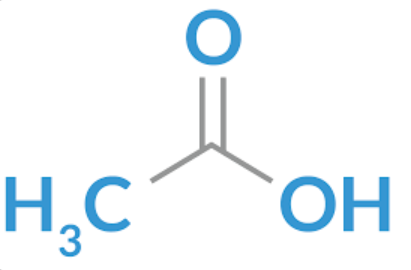
pKa of acetic acid
pKa = 4.76
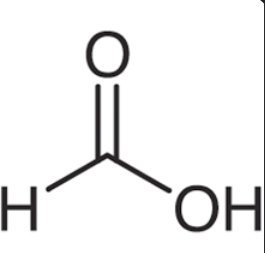
pKa of formic acid
pKa = 3.75
pKa of methyl alcohol
pKa = 15.5
CH₃OH
pKa of ethyl alcohol
pKa = 15.9
CH₃CH₂OH
what are amines
organic bases
organic compounds derived from ammonia (NH₃)
pKa of ammonia
pKa = 36
NH₃
pKa of methylamine
pKa = 40
CH₃NH₂
pronated amines
positively charged ammonium ion R₃NH+ formed when a neutral amine's lone pair accepts a hydrogen ion H+
pKa of pronated methylamine
pKa = 10.7
CH₃NH₃⁺
pKa of pronated ethylamine
pKa = 11
CH₃CH₂NH₃⁺
pKa of pronated methyl alcohol
pKa = -2.5
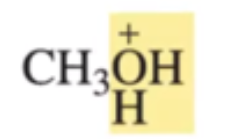
pKa of pronated ethyl alcohol
pKa = -2.4
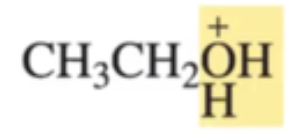
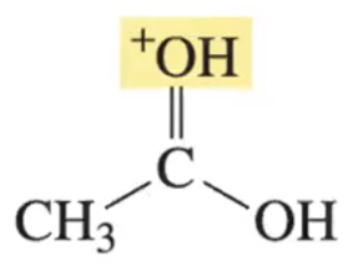
pKa of pronated acetic acid
pKa = -6.1
what can an alcohol behave as
an acid and as a base
how does the curved arrow point in proton donation in ALCOHOLS
points from the electron donor to the electron acceptor
how can a carboxylic acid behave as
as an acid and as a base
how does the curved arrow point in proton donation in CARBOXYLIC ACIDS
points from the electron donor to the electron acceptor
how can an amine behave as
as an acid and as a base
how does the curved arrow point in proton donation in AMINES
points from the electron donor to the electron acceptor
what compounds have approximate pKa values < 0
pronated alcohols
pronated carboxylic acids
pronated water
what compounds have approximate pKa values ~ 5
carboxylic acid
what compounds have approximate pKa values ~ 10
pronated amine
what compounds have approximate pKa values ~ 15
alcohol
water
how to choose what reactant is the acid
the stronger acids behaves as the acid
what does equilibrium favor
the formation of the weaker acid
equilibrium constant equation
pKeq = pKa (reactant acid) - pKa (product acid)
the more stabe the conjugate base….
the stronger the acid
are stable bases weak or strong
they are weak bases
how size affects pKa values
when atoms differ in size, the strongest acid has its hydrogen bonded to the largest atom
why are alcohols stronger acids than amines
because oxygen is more electronegative than nitrogen
OH vs NH
why are pronated alcohols stronger acids than pronated amines
because oxygen is more electronegative than nitrogen
OH2+ vs NH3+
hybridization and electronegativity
sp = most electronegative (triple bond)
sp²
sp³ = least electronegative (single bond)
what does the strongest acid have
the most stable (weakest) conjugate acid
how do substituents affect the strength of an acid
inductive electron withdrawl
inductive electron withdrawl
when an electronegative substituent is present on an acid, it pulls electron density away from the acidic site through the connecting sigma bonds
what does inductive electron withdrawl stabilize
stabilizes the base
what a substituents affect on pKa depends on
distance
stabilizing/destabilizing forces weaken rapidly as distance between substituent and acidic site increases
why is carboxylic acid stronger than alcohol
inductive electron withdrawl (carbon bonded to oxygen)
delocalized electrons (delocalized electrons are not stable)
summary → factors of acid strength
electronegativity increases = acidity increases
as size increases (down periodic table) = acidity increases