Law revision AUS
 Call Kai
 Learn
Learn Practice Test
 Spaced Repetition
 Match
Match Flashcards
 Knowt Play
1/48

There's no tags or description
Looks like no tags are added yet.
Name | Mastery | Learn | Test | Matching | Spaced | Call with Kai |
|---|
No analytics yet
Send a link to your students to track their progress
49 Terms
Differences between civil and criminal law?
Criminal law applies to all members of the public to protect society by punishing offenders, often through fines, imprisonment and community service, which the police take action upon on behalf of society. (Accused v Prosecution)
Civil law resolves personal disputes, by enforcing the rights of an individual when their rights have been infringed/breached. If found guilty compensation / remedy can be rewarded to the plaintiff. (Defendant v Plaintiff)
Which courts can hear civil cases?
Magistrates Court: Can hear minor civil disputes under $100,000 (eg. suing for property damage)
County Court: Processes intermediate claims over $100,000
Supreme: Handles more serious, complex civil disputes involving a large sum of money
Which courts can hear criminal cases?
Magistrates Court: Hears minor criminal matters that are summary offences (eg. theft, assault, etc.) Also does committal hearings which is when they look at more serious crimes and decided weather there is enough evidence for the case to trial in a higher court.
County Court: Handles Indictable offences (eg. armed robbery, burglary, etc.)
Supreme Court: Hears the most serious indictable offences (murder, murder related and treason.)
What does a court hierarchy mean?
A court hierarchy is when courts are arranged in levels based on the seriousness of cases they hear, and their authority to hear appeals. The higher courts will often deal with the most serious matters & can challenge decisions made in the courts lower than them.
Why do we have a court hierarchy?
It divided the cases allowing for lower courts (eg. Magistrates) to deal with a large amount of cases that are minor matters/disputes quicky and less expensively. Higher courts (eg. Supreme) can focus on handling complex, long serious cases that they can use specialized staff and more time to solve.
Dividing these disputes results in a better flow of system, where the courts aren’t being overrun with trials, smaller cases can be heard appropriately, and they don’t take up too much time/resources.
Types of cases heard in the Supreme Court?
Criminal; murder, murder related or treason matters
Civil; serious civil cases involving a large sum of money or class actions)
Appeals; Hears appeals from county and magistrates courts.
Process; Can have a jury and multiple judges
Types of cases heard in the county court?
Criminal; all other indictable offences not heard in supreme court
Civil; Serious civil matters with no monetary limit (money), unlimited claims involving personal injury
Appeals; Hears appeals from Magistrates.
Process; presides over by judge + usually a jury
Types of cases heard in the magistrates court?
Criminal; all summary offences, and committal hearings for indictable offences
Civil; smaller civil claims up to $100,000
Appeals; sometimes may hear appeals from tribunals
Process; no jury, presided by magistrate
What is the function/role of the Coroners’ court?
Investigates deaths and fires works to identify deceased, medical cause of death, & the circumstances on how this occurred.
Aims to reduce preventable deaths and to promote public health + safety. Doesn’t assign guilt or blame like the other courts rather prevent future tragedies.
Deaths investigated should be unexplained, unexpected, unnatural or violent.
What is the function/role of the Koori Court?
Koori court divisions in the children’s, county and magistrates courts.
Is a court for Aboriginals and Torres Strait Islanders who have taken responsibility + pleaded guilty to a criminal offence. Reflects cultural issues and runs in an informal way.
Allows Elders to provide cultural context in court, understand cause of defendant’s behavior and create a culturally supportive environment.
What is the function/role of the children’s court?
The Family Division of the Children's Court deals with cases relating to the protection and care of children/young people at risk, abused or neglected. The criminal division deals with matters of criminal offenses by children aged 10 to 17, with a heavy focus on rehabilitation rather than punishment.
What are the functions and cases of the High Court?
Hears disputes between the States and federal/state government. It is the final appeal from other courts. Resolves cases surrounding interpreting the Constitution, usually deals with cases if they are of major consequence to the public. Hears appeals from Supreme Courts.
What are the functions and cases of the Federal Court?
Resolves complex civil cases (eg. Corporations, bankruptcy, trade practices, etc.) that fall under Commonwealth laws. They deal with civil cases under migration, workplace, realtors, corporate, trade law, money troubles, human rights, etc. Some summary/indictable criminal matters that are under specific guidelines.
What are the functions and cases of the Family Court?
Resolves disputes around personal relationships, like divorce. Works to decide child custody (parenting orders), property/ financial settlements (dividing assets, debts, etc.) and family violence/safety (protecting adults and children against domestic conflict/abuse)
How many Justices typically serve on the high court of Australia?
There are 7 justices in the high court of Australia, including of the Chief Justice, all of them together is called a full bench/ court. The full bench is only typically used in cases of major public importance, challenges to previous High Court decisions or significant constitutional interpretations. For most appeals 2+ justices are used or even a single justice for certain matters.
What is the role/ jurisdiction of the high court?
Original Jurisdiction (cases directly brought to the high court); Cases that are constitutional disputes (eg. Challenges the constitutional validity of laws), matters of the Commonwealth or commonwealth officers.
Appellate Jurisdiction (reviewing/altering decisions of lower courts): Can hear appeals from supreme, federal + family courts. Can hear cases straight from lower courts with a ‘special leave permission’
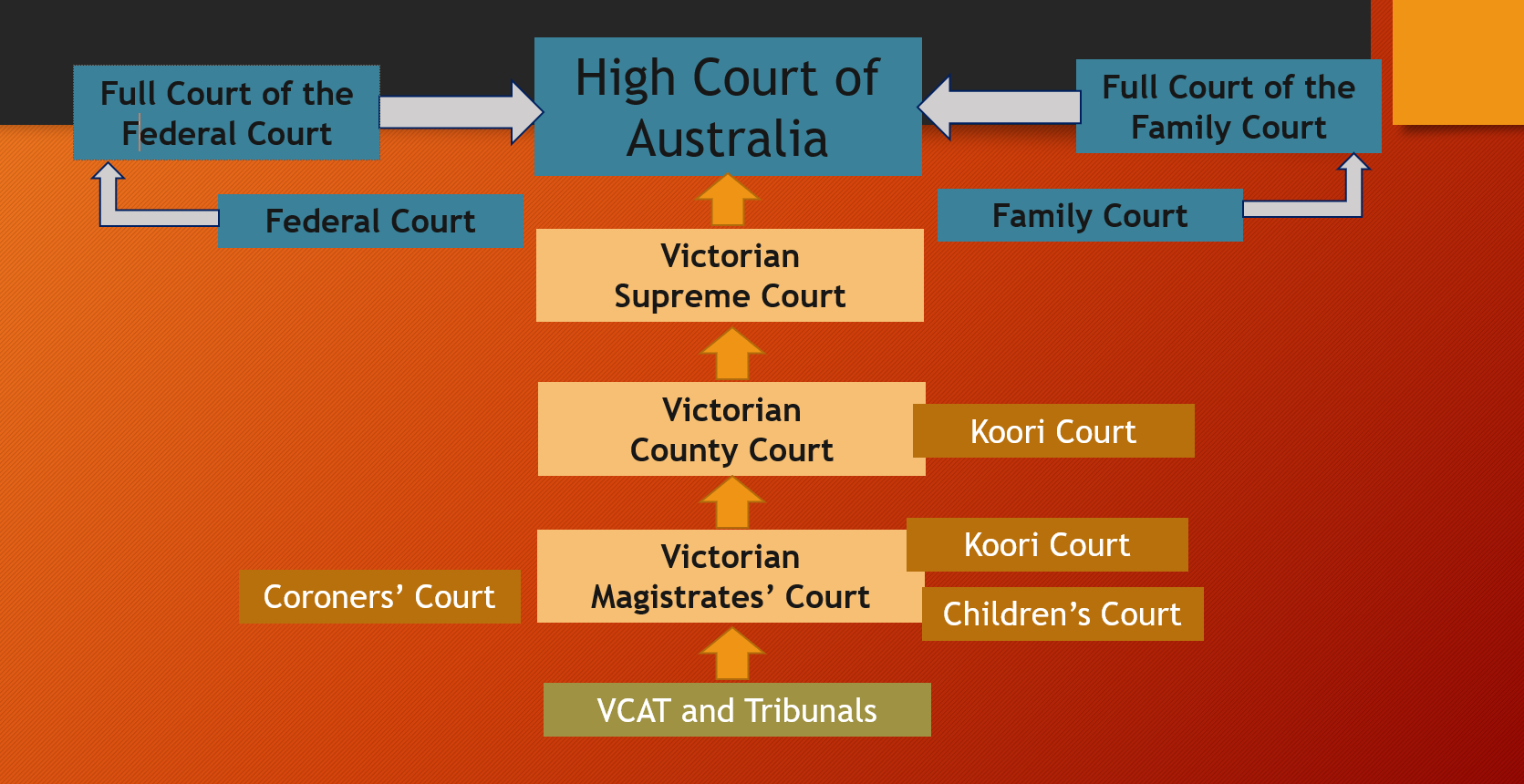
Court Hierarchy Highest to Lowest;
High court, supreme court, county court, magistrates court.
What role/power does the High court serve/have?
The High Court is the highest judicial authority, ultimate interpreter of Australian Constitution, final Court of Appeal in civil/criminal cases. Decisions are binding to all other courts, can invalidate laws. (Includes of the federal + family court)
What role/power does the Supreme court serve/have?
The Supreme Court interprets the law to resolve the most serious and complex civil and criminal cases. Has decisions to review appeals from lower courts, most cases heard are severe, indictable offences.
What role/power does the County court serve/have?
The county court is the intermediate trial court, which interprets laws in order to hear indictable offences, (not murder, or treason), and civil cases over $100,000 with no cap on damages rewarded. Can hear appeals from lower courts (Includes of a Koori Court)
What role/power does the Magistrates court serve/have?
The Magistrate's Court doesn't hear appeals but does committal hearings for cases that are serious crimes. The Magistrate's Court is the busiest court, handling 90% of all legal cases. Uses law to dissolve minor (summary) offences and civil disputes under $100,000. (includes of a Koori, Coroners’ and Children's court)
How can a decision of the high court be overturned?
There are two ways for a decision of the High Court to be overturned.
by the High Court itself, if it is proven that the earlier ruling was wrong and if it's important enough for the court to want to hear it again.
by the parliament by making a new legislation to change the law and override the court's ruling
When did the Franklin Dam case begin in the High court?
April 4th, 1983
When was the decision handed down? (Franklin Dam Case)
July 1, 1983
Who was the lead plaintiff in the Franklin Dam Case?
The commonwealth (led by prime minster Bob Hawke)
What was the outcome of the Franklin Dam Case?
The High Court blocked the construction of the dam by establishing legislation, where the Commonwealth could enforce international treaties to prevent states from doing actions against international commitments, (in this case it was the world heritage convention)
What legal principal did the Franklin Dam case establish?
The Franklin Dam case established the ‘external affairs’ power, where the Commonwealth Parliament could override state law if they involved Australia's international obligation.
How any justices sat on the Franklin Dam case + how many were in favor?
7 justices sat on the case, and 4 of them were in favor.
What is a plantiff?
A plaintiff is the person or entity a wrongdoing has been committed against; they are the ones who initiates a lawsuit or legal complaint. (civil)
What is a defendant?
A defendant is the person or entity who is being accused of the wrongdoing; they are the ones who defends themself against the charges or claims that are brought by the plaintiffs.
What is criminal law?
Criminal law applies to all members of society, protects members of the public, and punishes offenders. Criminal law follows crime or criminal acts; a person may appear to have committed an offence against society's rules where police can act on behalf of society.
What is Civil law?
Civil law provides an opportunity for individuals or groups to seek resolution; it protects our properties and rights and gives us the right to restitution.
Criminal law features
Criminal law features include of: crimes are considered to be against legislation, (all members of society). Crimes are divided into summary offences (small offences) and indictable offences (more serious crimes)
What is an ADR?
An alternate dispute resolution or ADR is resolving civil matters without going to court. An ADR can be mediated when a third party resolves the dispute. Negotiation. Direct communication between parties. Conciliation is like mediation, but the conciliators may offer suggestions for solution. Arbitration when an arbitrator makes the decision for the party.
what are damages?
Damages are compensation awarded by the court to a party that has suffered a loss, injury or breach of contract.
what is a verdict?
A verdict is a decision made in a trial.
what is it to preside?
A preside means to act as the person in charge or in control.
what is a committal hearing?
A committal hearing in the magistrate court is to determine if there is enough evidence to send a person to trial on an indictable offence.
what is a appeal?
An appeal is an application for a legal decision to be reviewed by a higher court.
What is prosecution?
In a criminal case, the prosecution tries to prove that the accused is guilty.
what is a judge?
A judge makes sure the court runs fairly and decides the sentence or judgment.
what is a magistrate?
A magistrate hears minor cases in the magistrate's court; they are a judicial officer who presides over lower courts.
what is an indictable and summary offence?
An indictable offence is a very serious crime.
a summary offence is a very minor crime
What is bail?
Bail is the word used to describe an accused person who has been released before their trial.
What is precedant?
A precedent is the notion that like cases should be decided in a like manner; lower courts are bound to follow the decisions of high courts in the same hierarchy.
What is jurisdiction?
Jurisdiction is the official authority of a court to hear a case, interpret law and make judgments.
What is a barrister?
A barrister is a specialized lawyer who primarily represents clients in court and provides expert legal advice.
what is a solicitor?
A solicitor is a qualified lawyer who is usually your first point of contact for legal issues. They handle the day-to-day work of a case, such as giving legal advice, drafting paperwork (like contracts or wills), and negotiating. If a case goes to court, a solicitor generally prepares all the evidence and hires a Barrister to represent you in front of the judge
summaries the Commissioner of Taxation v Bendal high court case; (Feb 19-Jun 12 2025)
The dispute is an appealed case from the Federal Court. It was about whether unpaid trust distributions, (which is when a trust legally gives income to a beneficiary but keeps the physical cash), could be treated as a loan for ‘tax’ purposes. The tax commissioner argued that leaving money in the trust and allowing the trustee to use it would count as the company making a loan, which then could be taxed. The Federal court disagreed, arguing it wasn't an actual loan as no money was transferred. The High Court has yet to make a judgment.