Topic 5 - Waves & Particle Nature of Light
 Call Kai
 Learn
Learn Practice Test
 Spaced Repetition
 Match
Match Flashcards
 Knowt Play
1/84

There's no tags or description
Looks like no tags are added yet.
Name | Mastery | Learn | Test | Matching | Spaced | Call with Kai |
|---|
No analytics yet
Send a link to your students to track their progress
85 Terms
Define Amplitude:
A waves maximum displacement from the equilibrium position (m)
Define frequency:
The number of complete oscillations passing through a point per second (Hz)
Define Period:
The time taken for 1 full oscillation (s)
Define speed:
The distance travelled by the wave per unit time (m/s)
Define wavelength:
The length of 1 whole oscillation (λ)
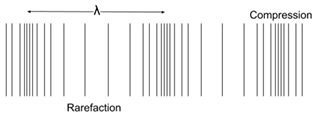
What are longitudinal waves?
Oscillation of particles is parallel to the direction of energy transfer
Made up of compressions & rarefactions and CANT travel in a vacuum
Can travel through solids, liquids and gases
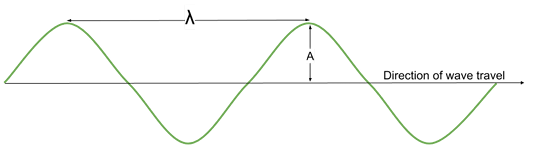
What are transverse waves?
Oscillation of particles is a right angles (perpendicular) to the direction of energy transfer
All EM waves are transverse and travel at 3×10ms-1 in a vacuum
Can travel only through solids
Made up of vibrations
Why can transverse waves travel through a vacuum but longitudinal waves can’t?
Transverse waves travel via self sustaining fields instead of relying on the compressions and rarefactions of particles like longitudinal waves
What does a displacement-distance graph show?
How the displacement of a particle varies with distance of wave travel & can measure wavelength
Longitudinal displacement-distance graphs only show dots of the “top down view of the wave” whereas transverse waves show the real shape
What does a displacement-time graph show?
How the displacement of a particle varies with time, they measure the period of a wave
What does superposition mean?
When 2 waves overlap the displacements of them combine
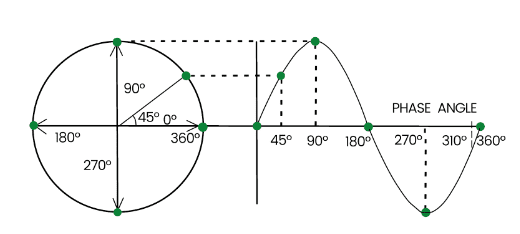
What does phase mean?
The position of a wave in its cycle, measured in radians, degrees or fractions
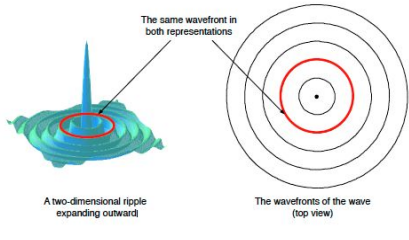
What is a wavefront?
A top down view of a wave where all points that have the same phase are connected
What is phase difference?
How much one wave lags behind another, measured in radians, degrees or fractions
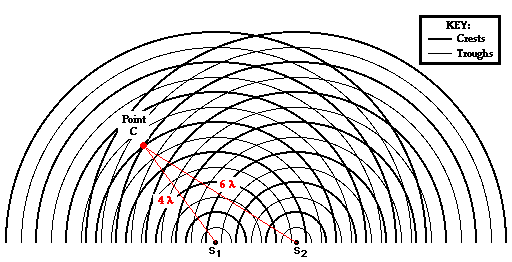
What is path difference?
The difference in distance travelled by 2 waves
What does coherence mean?
Same frequency, same wavelength, fixed phase difference
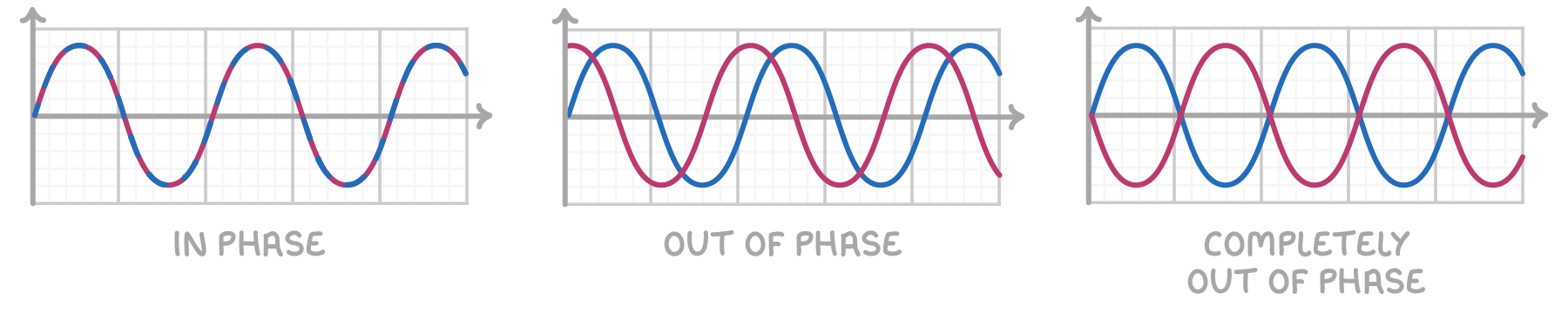
What does it mean if 2 waves are in phase?
They are at the same points in their cycle (same phase) so they have the same frequency & wavelength. Their phase difference is an integer multiple of 360°
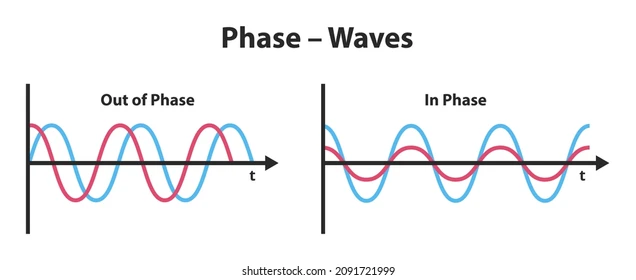
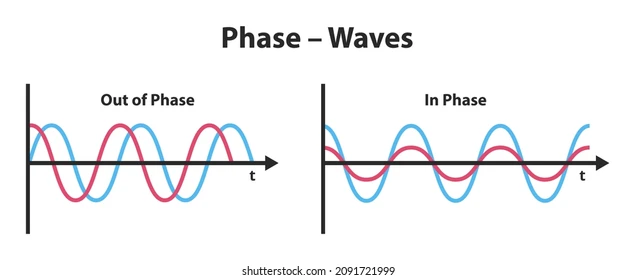
What does it mean if 2 waves are completely out of phase?
When they have the same frequency and same wavelength but their phase difference is an odd integer multiple of 180°
How do you workout phase difference?
In radians
2 waves are in phase if their phase difference is 2π, 4π, 6π, 8π etc
2 waves are out of phase if their phase difference is 1π, 2.4π, 19.99π

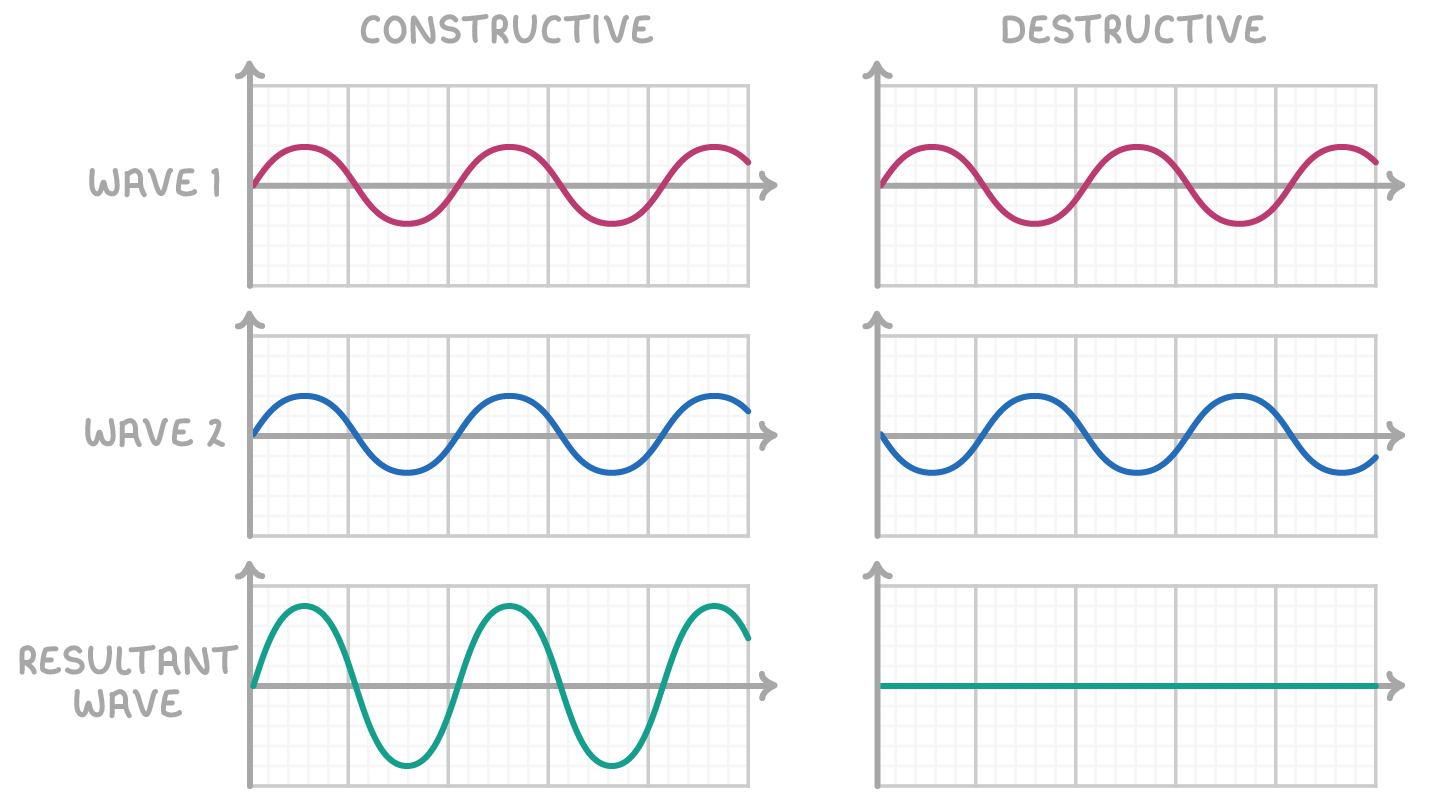
What does interference mean?
The phenomenon where 2 or more overlapping waves meet and combine to form a new, resultant wave which is superposed so their displacements are added
What is constructive and destructive interference?
Constructive interference - 2 waves are completely in phase so their displacements are added
Destructive interference - 2 waves are completely out of phase so their displacements are subtracted
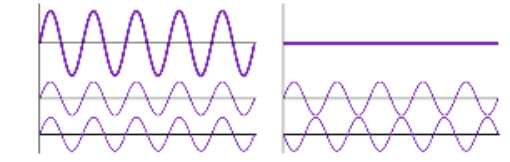
What is a stationary (standing) wave?
When 2 waves superpose each other when travelling in opposite directions, with the same frequency, wavelength and amplitude
What is the practical on standing waves?
Fix a string at one end and then the other to a driving oscillator
A wave travels down the string from the oscillator and is reflected at the fixed end
This wave travels back along the string which means it is travelling in opposite directions, with the same frequency, wavelength & amplitude so it superposes, making a standing wave
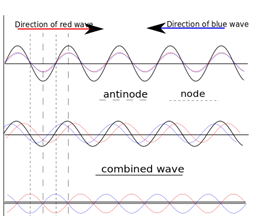
Where are the nodes & antinodes
Node - A point where there is 0 amplitude & 0 displacement
Antinode - Maximum displacement & maximum amplitude
How to workout speed of a transverse wave on string?
V - Speed
T - Tension
mu - Mass/unit length

How to workout intensity of radiation?
P - Power
A - Area
I - Intensity

What is refractive index?
A property of a material which measures how much it slows down light passing through it.
How do you calculate refractive index?
n - refractive index
c - speed of light (3×10^8)
v - speed of light in that substance

Why does refraction occur?
When a wave enters a different medium, causing it to change direction. If the material is denser then it bends more towards the normal and vice versa
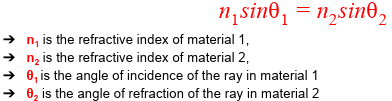
What is Snell’s law?
What does optically density mean?
How much a material or substance reduces the intensity of light passing through it
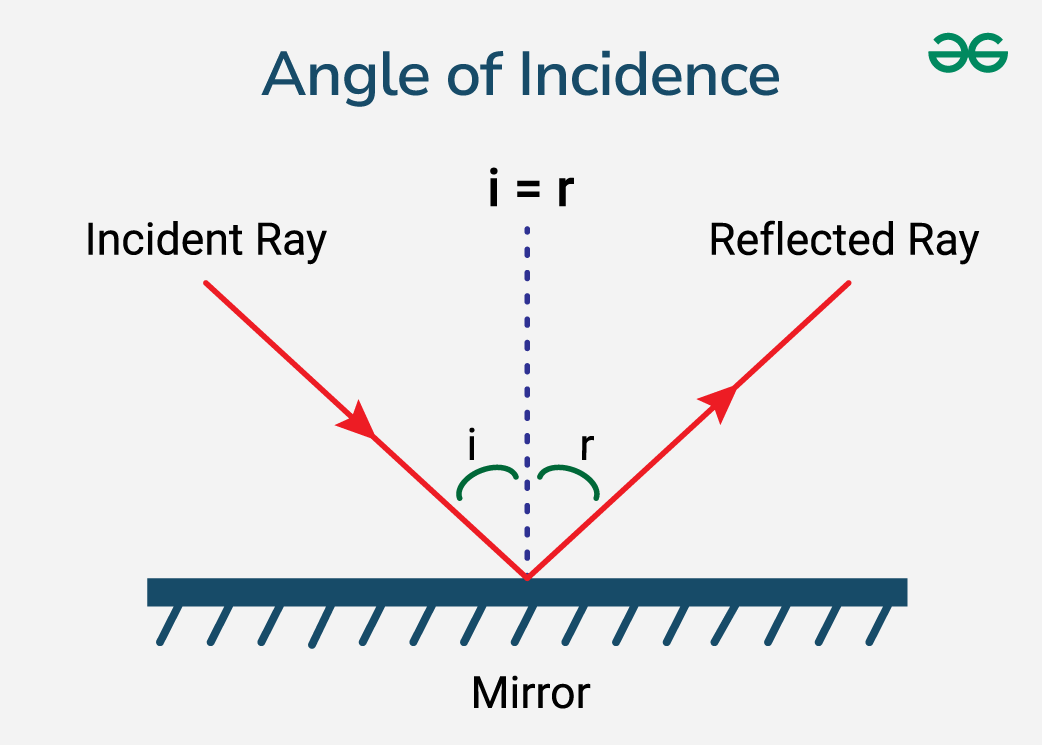
What is the angle of incidence?
The angle between the incoming ray and the normal line
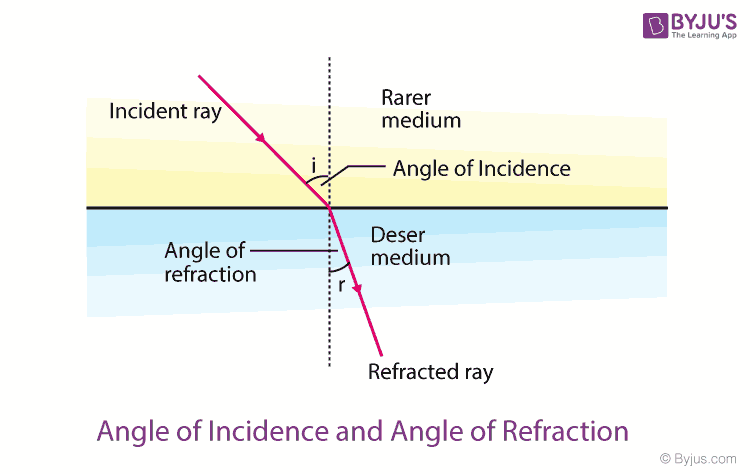
What is the angle of refraction?
The angle between the refracted ray and the normal line
What are the conditions for the critical angle?
The angle of refraction to be exactly 90° and refracted along the boundary

When can you use this formula?
When one of the materials (n2) is air snells law rearranges to his equation
What is total internal reflection?
When the angle of incidence is greater than the critical angle and the incident refractive index is greater than the refractive index of the other material. So for example going from water to air.
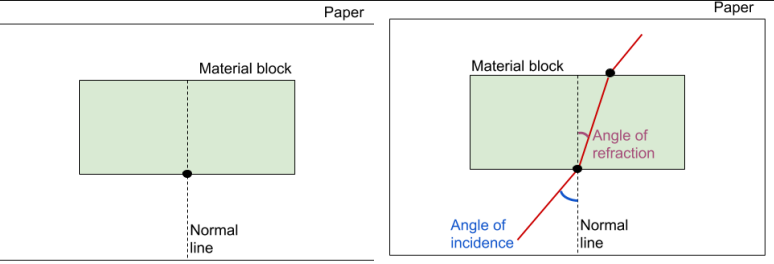
What is the practical on refractive index?
Place the material in the centre of a piece of paper and draw a perimeter around it
Put the material aside and mark a point on the outline in the centre, draw a perpendicular line to the other side of the point (normal line)
Make sure the line is exactly 90°
Then draw lines leaving the point you marked at 10° intervals (angle of incidence)
Put the material back & using a ray box shine a ray along the 10° line and mark when it leaves, do this 7 times
Join the point you just marked to the normal dot and using a protractor measure the angle between this line and the normal
Plot a graph of sin incident against sine refracted angles
Plot a line of best fit and the gradient will be the refractive index
Because the initial medium is air Snells law is just sinθ1 = n2sinθ which can be derived to sin i = n sin r which is y=mx
What do lenses do?
Refract light in order to change its direction
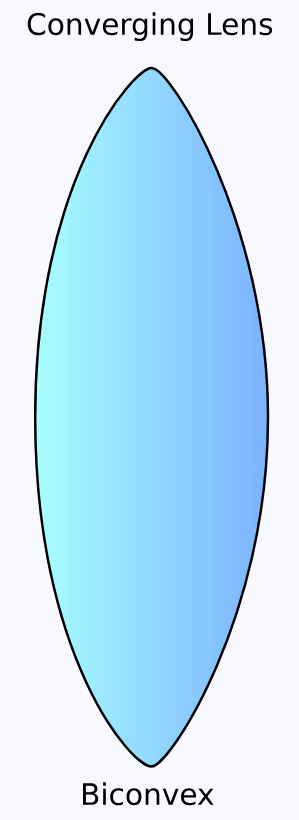
What do converging lenses do?
Cause parallel light rays to converge and move closer together
They are curved outwards & in an oval shape
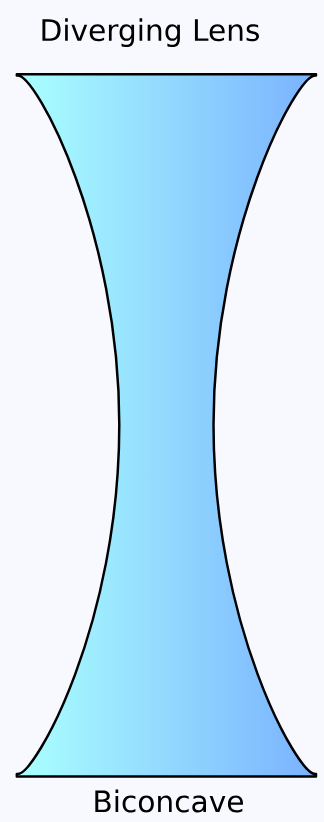
What do diverging lenses do?
Cause parallel light rays to diverge and move apart
They curve inwards in a hourglass shape
What type of lens is used to correct short sighted people?
Diverging (concave) lens as short sighted means you can only see close things because your eye converges light too much
What is the principal axis?
A straight line down the middle of a lens
What is the principal focus/focal point?
Converging - The point where light rays that are parallel are focused
Diverging - The point where light rays appear to come from
What is the focal length?
The distance from the centre of the lens to the principle focus
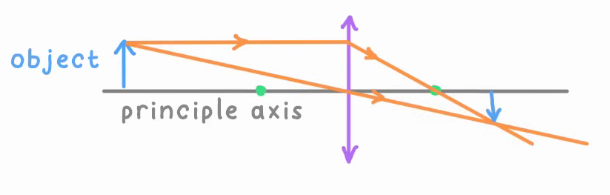
What does a ray diagram of a focusing convex (converging) lens look like?
Draw 2 rays from the top of the object
One going through the centre of the principle axis
One going parallel into the principle axis and then through the principle focus
Where these lines meet is the top of the real image which will be inverted
What does it mean if an image is diminished?
The real image is smaller than the object
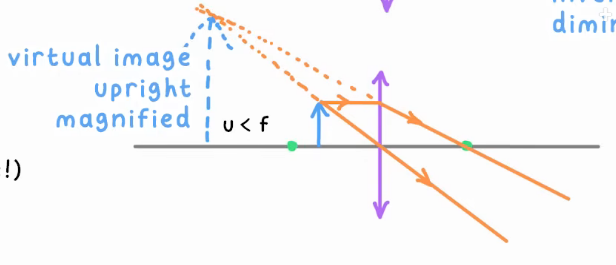
When and how is a virtual image formed?
When the object is within the lenses focal point (25cm for the adult eye)
How
We trace the lines backwards after drawing 2 coming from the object
One line going through the principle axis (centre)
One going through the principle axis parallel to the top of the object
Then we trace the lines backwards on the object side to make a virtual image
This virtual image is upright and magnified to appear bigger
What does the lens diagram of a diverging (concave) lens look like?
Draw 2 lines from the top of the object
One going through the principle axis
One going into the principle axis and then reflected back through the focal point on the side of the object
Where the 2 lines meet on the object side is where the virtual image is
This image is diminished (smaller) and upright
What is power of a lens?
A measure of how much the lens bends light, in converging lens this is +D whereas in diverging lenses this value is -D as a virtual image is always produced
How can magnification be calculated?
Magnification = The ratio of size of image created to size of object
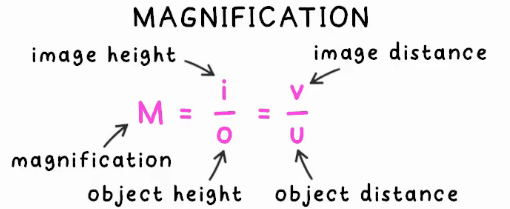
How can you calculate power of a lens?
Diverging is always negative as the focal length is always negative on the object side which is where its coming from
Converging is always positive as the reciprocal of a positive is still positive

What is a thin lens?
A lens that allows light to refract but doesn’t allow for dispersion (multiple wavelengths) or aberration (all light doesn’t converge)
Why would a thin lens ever be used?
As it is lighter for a telescope for example
How do you combine multiple thin lenses?

What is the difference between a real image and a virtual image?
A real image can be projected onto a screen whereas a virtual image can’t
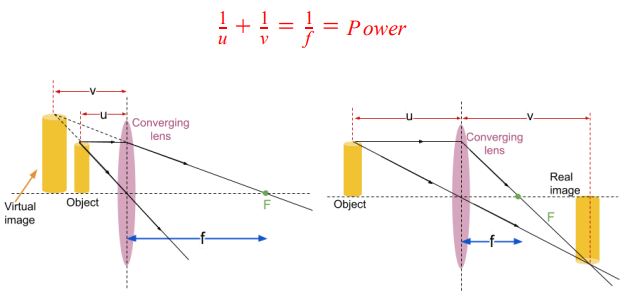
How do you measure the power of a lens?
u = distance between the object and principle axis
v = distance between the image and principle axis (positive if real and negative if virtual)
f = focal length
What is a polarised wave?
A transverse wave that only oscillates in 1 plane
What do polarising sunglasses do?
Block out partially polarised light and only allow oscillations in the plane of filter to pass through
What is diffraction?
The spreading out of waves as they pass through or around a gap
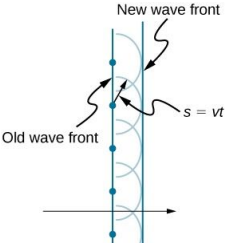
What is Huygens’ construction?
It states that every point on a wavefront is a point source to secondary wavelets which spread out to form the next wavefront
Why does light not fill up an entire room when it goes through a door but sound will?
Sound diffracts and it spreads throughout the entire room, each point on the sound wave is a source of more wavelets which spread out to form more circular wavefronts. Light doesn’t diffract as much because light waves have a small wavelength (4×10⁻⁷) whereas the door is big, sound waves have a larger wavelength (3m). This matters because at a small wavelength the waves will interfere with each other whereas a large wavelength will make the door 1 source of wavelets meaning it spreads in all directions
What is a diffraction grating?
A slide containing many equally spaced slits very close together, when light passes through it forms an interference pattern of light & dark fringes
What is order (n in the equation)?
The number of holes it is away from the zero order (direct middle)
θ is the angle to the normal, made by the 1st order maximum
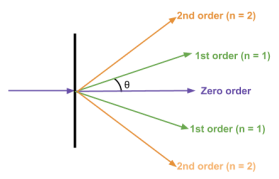
What is the diffraction grating equation?

What is the de Broglie relation?
Relating particles as waves and particles as the wavelength of any particle can be found using this equation

What is an interface in the context of waves?
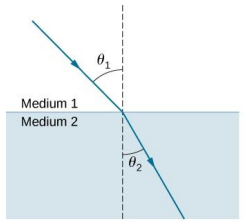
A boundary between 2 materials where waves can be transmitted or reflected
What does it mean when a wave is transmitted?
It passes into the next material and can refract if it is a change in medium or at an angle
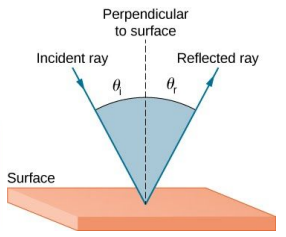
What does it mean when a wave is reflected?
It will bounce off the interface without passing through
What is the pulse-echo technique?
When an ultrasound wave meets a boundary between different materials it will reflect
How do you workout energy of a photon?

What is the photon model?
EM waves travel in discrete packets called photons that have energy directly proportional to their frequency (E=hf)
What is the wave model?
EM radiation can be described as a transverse wave
Is light a wave or a particle?
It is both because of reflection and refraction
A wave because of interference, diffraction and polarisation
A particle because of the photoelectric effect, it travels with energy
What is the photoelectric effect?
Where photoelectrons are emitted from the surface of a metal after light above the threshold frequency is shone on it
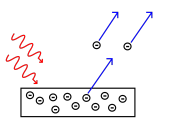
What are photoelectrons emitted in the photoelectric effect?
The electrons near the surface of the metal absorb a photon and gain enough energy to leave the surface
What is the work function of a metal?
The minimum energy required for electrons to be emitted from the surface of a metal
How do you workout maximum kinetic energy of emitted photoelectrons?

What is an electronvolt (eV)?
A unit of energy used to express very small energies
1eV = 1.6×10^-19J
1eV = kinetic energy of an electron across a potential difference of 1V
How do you convert between joules and electron volts?
Divide by 1.6×10^-19
Why is photoelectric effect evidence for the particle nature of EM radiation?
Wave theory says that any frequency of light can cause photoelectric emission as energy absorbed by each electron will gradually increase but it is not stored and threshold frequency exists
This also contradicts the photoelectric effect being immediate as energy is instantly supplied to electrons that reach the work function
Increasing the intensity of the light doesn’t increase the speed of photoelectric emission and more energy isn’t supplied to the electrons and then stored, instead intensity increases the number of photoelectrons released per second
Photoelectrons are also released with a range of kinetic energies so they don’t store energy
Why does the photon model explain that EM waves are released as particles due to photoelectricity?
When a photon interacts with an electron, all of its energy is transferred to it and an electron can only interact with a single photon, if this energy is below the work function, nothing happens
The photon energy is transferred immediately to the electron when they interact
Intensity is only equal to the number of photons released per second as more photons will be able to interact with more electrons
All electrons receive the same amount of energy from a photon but electrons deeper in the metal will lose energy through collisions so will have a lower KE
What is a line spectrum?
A spectrum where each line represents a different wavelength of light that passes through a diffraction grating or prism
How does the line spectrum show waves as a particle?
It is not continuous and there are discrete values of wavelength which photon energies correspond to
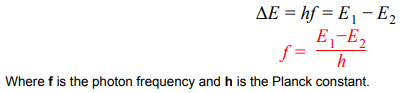
How do you workout the energy of an emitted photon using a line absorption spectrum?
As the difference in 2 energy levels is equal to a specific photon energy being emitted or absorbed

How do you find the frequency of a photon using photon energy and change in energy levels?