14.2.2, 20 Electrophilic Addition Mechanism, Addition Polymerisation
 Call Kai
 Learn
Learn Practice Test
 Spaced Repetition
 Match
Match Flashcards
 Knowt Play
1/9

There's no tags or description
Looks like no tags are added yet.
Name | Mastery | Learn | Test | Matching | Spaced | Call with Kai |
|---|
No analytics yet
Send a link to your students to track their progress
10 Terms
As there is a __ bond, there is a c__ e- density above/b__ the = bond
> so e__ can attack the = bond
pi, conc, below, electrophiles
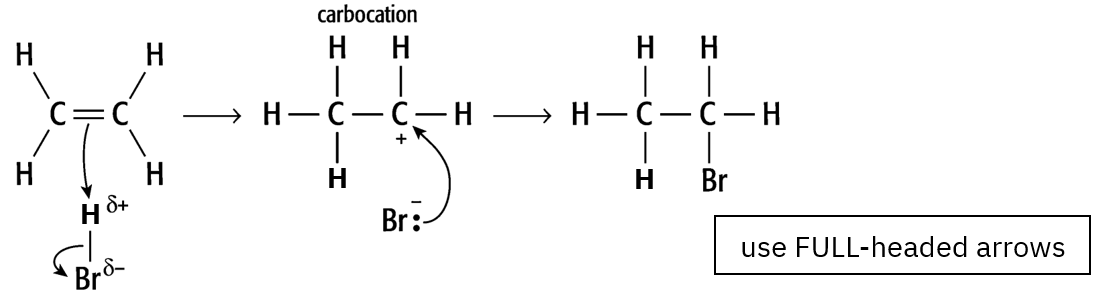
HBr + alkene
> HBr is p__ as H & Br have d__ e-n__; Br has a s__ pull so H has δ+, Br has δ-
> H is the e__ & accepts e- pair from C=C
> H-Br bond breaks h__ → :Br-
polar, diff, negativities, stronger, electrophile, heterolytically
Major/Minor
> c__ are +ve charged C w/ _ covalent bonds instead of 4
> a__ groups attached to C have an i__ e__: carbocation has l__ +ve charge = more s__
carbocations, 3, alkyl, inductive effect, lower, stable
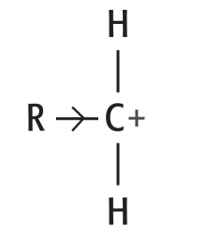
What type of carbocation?
primary
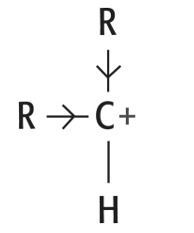
What type of carbocation?
secondary
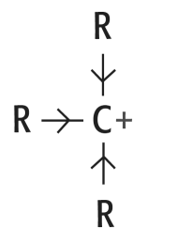
What type of carbocation?
tertiary
Markovnikov’s rule: the rich get richer.
> h__ goes to C w/ m__ a__ g__ attched
> ONLY applies to u__ alkenes
halogen, most alkyl groups, unsymmetrical
Mechanism for X2
> Br2 is n__-p__ as both atoms have s__ e-n__
> when Br2 gets c__ to = bond of alkene, the c__ e- density r__ e- pair in Br-Br
>> so the closer Br is δ__, the further Br is δ__,
> Br-Br bond breaks h__ → :Br-
non-polar, same, negativities, closer, conc, repel, +, -, heterolytically

Addition polymerisation
> many m__ (w/ C=C) form p__
> poly(ethene) made of __ ;; poly(chloroethene) (__) made of chloroethene
> when asked to draw multiple repeating sections, remove b__
monomers, polymers, ethene, PVC, brackets
Disposal of polymers & its difficulty
> poly(alkene)s are used in p__ & are very l__ & u__: r__ to c__ attack
> thus are n__-b__ & take 100s of years to d__ = long term p__
> if burnt, t__ gases (CO) released
plastics, large, unreactive, resistant, chemical, non-biodegradable, decompose, pollution, toxic