1.2) More band theory and hopping
 Call Kai
 Learn
Learn Practice Test
 Spaced Repetition
 Match
Match Flashcards
 Knowt Play
1/22

There's no tags or description
Looks like no tags are added yet.
Name | Mastery | Learn | Test | Matching | Spaced | Call with Kai |
|---|
No analytics yet
Send a link to your students to track their progress
23 Terms
Jahn teller effect
9 e: 6 fill t2g, then one in dz2 and one in dx2-y2; where does final one go as dz2 and dx2-y2 are degenerate: octahedron distorts to lower the energy of one of the orbitals: stretch in z axis (elongation) lowers z2; stretch in xy plane lowers x2-y2 (compression); which one occurs is determined by crystallography
What affects the strength of the Jahn teller effect
amount of orbital overlap between metal and ligand: more overlap = stronger effect
Mott Hubbard model
in narrow bands e-e repulsion is more significant causing the band to split into two: Lower and Upper Hubbard bands (LHB and UHB) separated by an energy gap U; if the width of the original band W>U there will be finite overlap and the material will conduct; if U>W there is no overlap so the material is insulating;
the energy gap between the bands is ~ U - W
How can W be modified
chemical doping (size/charge changes can change orbital overlap and therefore conduction properties)
Why is La2CuO4 (Cu d9) not a conductor despite having a partially filled dx2-y2 band (split up from the z2 band due to the Jahn teller effect)
Mott-hubbard splitting occurs splitting the dx2-y2 band into two bands, one is full (1 e) and the other is empty
What is a charge transfer insulator eg La2CuO4
Cu-O bonds are highly covalent; O 2p band and Cu 3dx2-y2 band mix to form a hybrid band the top of which rises above the LHB so Eg<U; for e to go from the lower band (Cu-O hybrid) to the UBH (in Cu) the e would have to move from the O = charge transfer insulator
Zaanen, Sawatsky and Allen (ZSA) introduced a charge transfer energy Δ, define it and state its value compared to U and W
it is the cost of exciting an e from a filled band in the highest occupied ligand state (O in oxides) to the UHB;
for CTI: U>Δ>W
for MHI: Δ>U>W
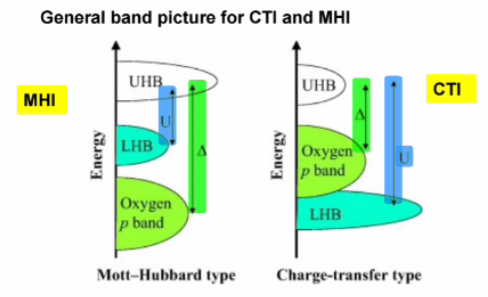
How are CTI and MBI appropriate
CTI description best for elements near the end of the series (Ni, Cu); MHI holds better for elements near the beginning (Ti, Nb)
Why oxides
ZSA parameters are close in energy for oxides so can be manipulated to get desired properties
Hope doping in MHI and CTI
NdTiO3 is a MHI but dope A site with alkaline earths (eg Sr2+) oxidises Ti3+ to 4+ creating holes in the LHB enabling conduction;
La2CuO4: dope Sr2+ for La3+ oxidises some Cu2+ to 3+ (d9 → d8) creating holes in the hybrid Cu3d/O2p band turning it from a AFM CTI to a metal
How does Sr content affect electrical properties
x=0: insulating at all T;
x=0.01: metallic at high T but insulating at low T;
x=0.03: metallic at high T, becomes superconducting below 30K
How does RE ion size affect properties (RE on A site of perovskite)
RE ion size decreases across the REs and resistivity increases 3 OoM; decreasing RE3+ radius causes increased stress in crystal structure, Ti-O-Ti bond bends to accommodate this reducing the width of the LHB (less orbital overlap); so this tunes the value of W while U remains constant
General requirements for high conductivity in TMOs
need mixed valence TMs (eg Ni2/3+, Ti3/4+, Cu2/3+)
How to get mixed valency in a TMO
Oxidising atmosphere: sample gains oxygen to become nonstoichiometric (get some Ni2+ →3+) (later in group);
Reducing atmosphere: sample loses oxygen to become nonstoichiometric eg some Ti4+ → 3+ (earlier in group)
Chemical doping: dope with aliovalent ion, dopant of lower valence = acceptor, higher valence = donor
Hopping semiconductors
in mixed valence materials e can hop between ions of same type but different valence; hopping is thermally activated (mobility is T dependent unlike in band model), σ=nqμ still holds
Oxidation of NiO
when heated in air O2 molecules adsorb onto surface, dissociate and pick up 2e to become O2-, these e come from oxidising Ni2+ to 3+; Ni2+ ions migrate to the surface to balance extra O2- leaving Ni2+ vacancies in the lattice; each O2- creates one Ni vacancy and two Ni3+; difficult to control the degree of oxidation and hence the conductivity (depends on oxygen partial pressure, T and solid/gas kinetics, can produce gradient of properties from surface)
Hopping in NiO
black NiO is a p type (e- have been removed rather than added) hopping semiconductor; e are localised to Ni2+ ions so no regular conduction bands; e move between edge sharing octahedra hopping from Ni2+ to Ni3+ (and reducing it to 2+); each hop requires activation energy so conductivity increases with temperature (-E/k slope); number of carriers = [Ni3+]
Control of oxidation using Li
dope with Li+ in place of some Ni2+ which reduces it to Ni3+; can carefully control carrier conc by amount of Li+ added; forms rocksalt Ni1-xLixO with Ni2+ Ni3+ and Li+ distributed at random over the octahedral sites
Polarons
quasi particles; an e on an Fe2+ ion repels surrounding O ions (increasing Fe-O bond length) and attracts other Fe ions; when it hops to a neighbouring Fe3+ (reducing it to 2+) it pulls this distortion with it; this increase m_eff (reducing mobility); the e requires energy to move, it can get stuck if it doesn’t have sufficient energy to hop
Polaron hopping
The e on the Fe2+ ion distorts the Fe-O bond compared to the neighbouring Fe3+ and must pass through the middle of the bond (effectively the delocalised state) to get to the localised state on the other Fe3+ (now 2+) where it distorts the other way; the distortion coordinate indicates how distorted the bond it and the activation energy is proportional to D²
How can be distinguish between M2+ and M3+ ions
crystallography / XRD
How does Fe3O4 behave (inverse spinel)
Fe3+ in tet sites, with half Fe2+ and half 3+ in octahedral sites; at high T all oct sites are equivalent Fe2.5+ -O bonds are all the same length so e hopping is easy and it behaves as a semiconductor;
At low T get distinct Fe2+ and Fe3+ O bonds, e hopping becomes more difficult, behaves as an insulator (lower T = less thermal lattice vibrations to even out bond differences)
Why is inverse spinel a semiC/metal at RT while normal spinel is an insulator
inverse has ions of different valence occupy octahedral sites which have a short separation so its easier for e to hop; regular spinel has one charge on the A ion in tet sites and another charge on the B ion in oct sites; the larger separation of the oct→tet sites makes it harder for e to hop