Community and Population Ecology: Species Interactions, Growth Models, and Biomes
 Studied by 0 people
 Call Kai
 Learn
Learn Practice Test
 Spaced Repetition
 Match
Match Flashcards
 Knowt Play
1/97

There's no tags or description
Looks like no tags are added yet.
Name | Mastery | Learn | Test | Matching | Spaced |
|---|
No study sessions yet.
98 Terms
What is community ecology?
The study of the distribution and abundance of populations of coexisting species and their interactions.
Define a biological community.
A group of populations of different species living close enough to interact.
What are the main types of species interactions?
Mutualism, commensalism, predation, parasitism, herbivory, competition, and amensalism.
What is competition in ecological terms?
The use or defense of a limiting resource by an individual that decreases the resource availability to others.
What is the difference between interspecific and intraspecific competition?
Interspecific competition occurs between different species, while intraspecific competition occurs within the same species.
What is Gause's Competitive Exclusion Principle?
Two species cannot coexist indefinitely on the same limiting resource.
What is a niche in ecology?
The requirements of a species with respect to all resources and physical conditions.
What is the difference between fundamental and realized niches?
The fundamental niche is the niche in the absence of biotic interactions, while the realized niche is the niche in the presence of biotic interactions.
What is resource partitioning?
The process by which species use resources differently to minimize competition.
How can competition shape the evolution of traits?
Competition can lead to character displacement, where species evolve different traits to reduce competition.
What is mutualism?
An interaction where both species benefit from the relationship.
What is species diversity?
A measure that includes species richness (total number of species) and species evenness (relative abundance of each species).
What is the basic population growth model equation?
Change in Population Size = ∆N/∆T = B - M, where B is births and M is deaths.
What does the logistic growth model account for?
It accounts for limiting factors that slow population growth as it approaches carrying capacity.
What is the per capita growth rate (r)?
The difference between the per capita birth rate (b) and the per capita death rate (m), expressed as r = b - m.
What is the equation for exponential population growth?
∆N/∆T = rN, where r is the per capita rate of increase.
What is rmax?
The intrinsic rate of increase, used when resources are unlimited in the exponential growth model.
What factors can control population size?
Biotic factors (like competition and predation) and abiotic factors (like climate and resources).
What is the difference between density-dependent and density-independent population control?
Density-dependent factors are influenced by population size, while density-independent factors affect populations regardless of size.
What is the population cycle between lynx and snowshoe hare?
A cyclical relationship where the population sizes of lynx and hares fluctuate in response to each other.
What is the significance of whale populations in ecology?
Whale populations play a crucial role in nutrient cycling and carbon sequestration in marine ecosystems.
What is the role of predators in species coexistence?
Predators can help maintain species diversity by preying on the most abundant species, allowing weaker competitors to survive.
What is the carrying capacity (K) in population ecology?
The maximum population size that the environment can support.
What does the logistic growth model incorporate that the exponential model does not?
Carrying capacity (K) to limit growth.
What happens to the per capita growth rate (r) as the population approaches carrying capacity (K)?
The per capita growth rate (r) gets smaller.
What is the relationship between population size (N) and growth rate when N is less than K?
The growth rate is positive.
What is the relationship between population size (N) and growth rate when N exceeds K?
The growth rate is negative.
What are biotic factors that regulate population size?
Examples include parasitism, disease, predation, and competition.
How do biotic factors typically operate in relation to population density?
They often operate in a density-dependent manner, affecting birth and death rates.
What are abiotic factors that can affect population size?
Examples include fire, flood, hurricane, and drought.
How do abiotic factors typically operate in relation to population density?
They often operate in a density-independent manner, affecting populations regardless of density.
What is a characteristic of population fluctuations in natural populations?
Fluctuations are the rule, often resulting in periodic cycles of high and low population sizes.
What is the current estimated human population size?
About 8 billion.
What is the predicted human population size by 2025?
Approximately 8.2 billion.
What is the definition of a population in ecology?
A group of interbreeding individuals of a single species living in the same general area.
What is population ecology?
The study of births, deaths, and the dynamics forces which regulate a population.
What are the two spatial ways to describe populations?
Density (number of individuals per unit area) and dispersion (spacing patterns among individuals).
What is the mark-recapture technique used for?
Estimating population size by capturing, marking, and recapturing individuals.
What is the formula for estimating population size using the mark-recapture method?
Population estimate = (number marked * total of second capture) / number marked found in second capture.
What are the three different types of survivorship?
Type I (high survival in early life), Type II (constant mortality), and Type III (high mortality in early life).
What is the significance of the 'allee effect' in population ecology?
It refers to positive density dependence where population size influences reproductive success.
What does the term 'density-dependent' mean?
Factors that affect population size based on the population's density.
What does the term 'density-independent' mean?
Factors that affect population size regardless of the population's density.
What is the effect of negative density dependence on species like song sparrows?
It can lead to decreased clutch sizes as population density increases.
What is the significance of periodic population cycles?
They indicate regular fluctuations between high and low population sizes, influenced by various factors.
What are the four potential processes that might cause spatial distribution in populations?
A. Competition, B. Predation, C. Random factors such as wind or water flow, D. No inference is possible.
What are the two main temporal patterns in populations?
Patterns in birth rates and patterns in death rates.
What are life history traits?
Traits that make up an organism's schedule of reproduction and survival, including age at first reproduction, frequency and duration of reproduction, total number of offspring produced, and life expectancy.
Why are Pacific salmon considered semelparous?
They have an anadromous lifestyle, being born in freshwater, maturing in the ocean, and returning to freshwater to spawn, which is energetically costly.
What does the population growth equation ∆ N/∆T = B - M represent?
It represents the change in population size over time, where B is the number of births and M is the number of deaths.
How is per capita population growth calculated?
Per capita birth rate (b) is calculated as B/N, where N is the number of individuals in the population.
What is the intrinsic rate of increase (r)?
It is calculated as r = b - m, indicating population growth if r > 0 and decline if r < 0.
What does the exponential population growth model describe?
It describes population growth in an idealized environment with unlimited resources and no competition.
What is rmax in the context of population growth?
rmax is the intrinsic rate of increase when resources are unlimited, represented in the equation ∆N/∆T = rmax N.
What is a biome?
A distinct physical environment inhabited by ecologically similar organisms with similar adaptations, typically characterized by dominant vegetation.
What factors determine a biome?
Physical environment, soils, disturbance (natural or human-induced), climate, climatic variability, temperature, and precipitation.
What are the characteristics of the tropical rainforest biome?
It has the most species of any terrestrial biome, with little temperature variation and consistent rainfall throughout the year.
What adaptations do desert organisms typically have?
They often have adaptations to conserve water, such as thorny plants and animals that concentrate urine.
What defines the tundra biome?
Severe winters, almost no trees, and low rainfall, with most plants being low to the ground.
What is the boreal forest also known as?
Taiga, characterized by severe winters and lots of precipitation falling as snow.
What are the typical conditions of a temperate forest?
Distinct winter seasons with frost and snow, and usually moist summers with fertile soils.
What is the primary vegetation in temperate grasslands?
Dominated by grasses with few trees, experiencing hot summers and cold winters.
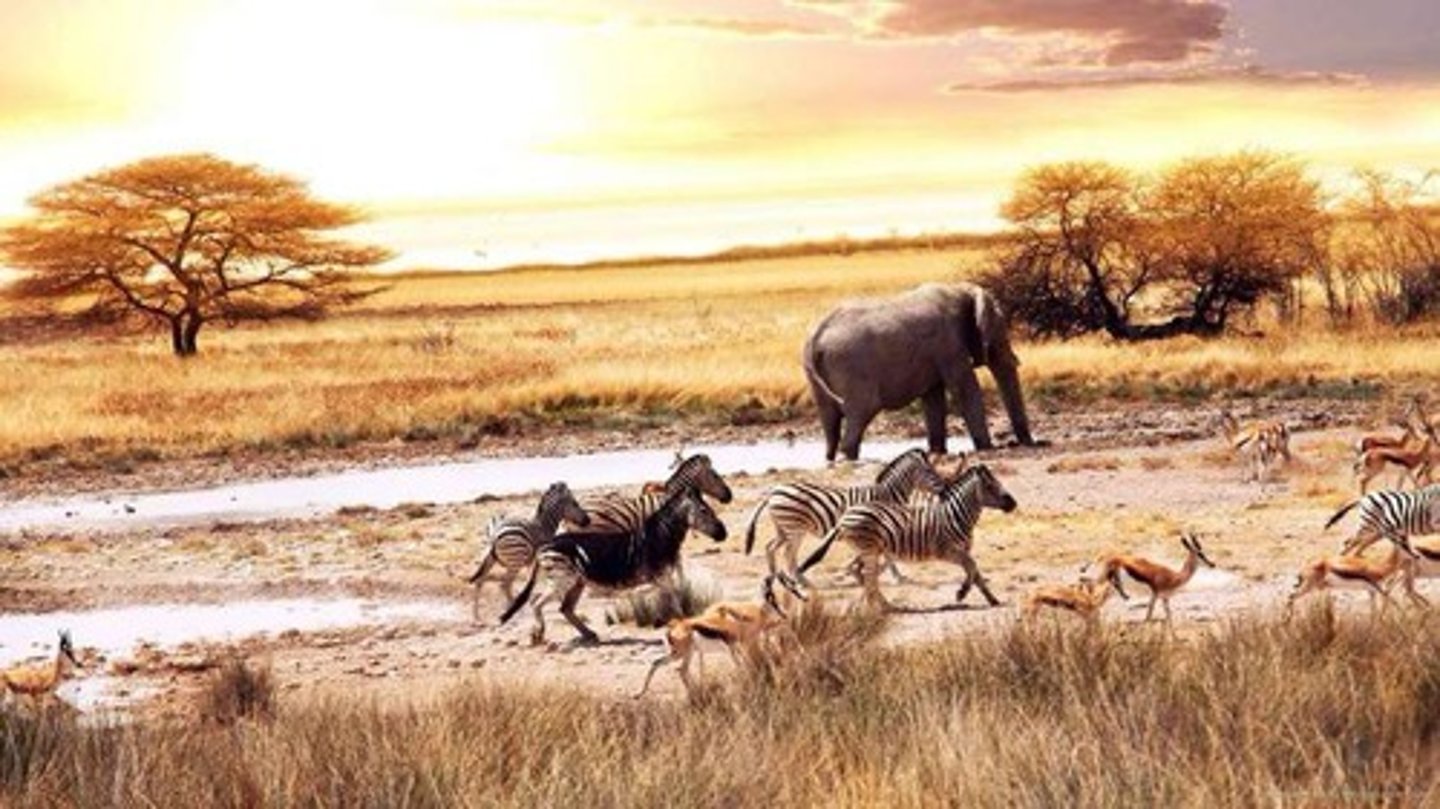
What is the climate pattern in a tropical savanna?
Temperature varies little with distinct wet and dry seasons, characterized by tree/grass codominance.
What is the significance of rainfall and temperature in determining biomes?
They help predict the type of biome in a given area, influencing the organisms that can thrive there.
What are the key drivers of global climate?
Sunlight, movement of the planet, and atmospheric and ocean circulation.
What is the difference between climate and weather?
Weather is the short-term state of the atmosphere, while climate is the long-term behavior of the atmosphere.
What is the Inter-Tropical Convergence Zone (ITCZ)?
A low-pressure area near the equator where air rises and cools, leading to high rainfall.
What are Hadley cells?
Circulations of air that occur between the equator and 30 degrees latitude, where warm air rises and cool air descends.
What is the Coriolis Effect?
The deflection of moving objects, including winds, caused by the rotation of the Earth.
How do ocean currents affect climate?
Ocean currents, driven by winds and the Coriolis effect, help distribute heat and moisture around the planet.
What is a microclimate?
A local zone where the climate differs from the surrounding area.
What are greenhouse gases?
Gases that absorb and emit infrared radiation, contributing to the greenhouse effect.
What is the greenhouse effect?
The warming of the Earth's surface due to greenhouse gases trapping heat in the atmosphere.
Name some examples of greenhouse gases.
Water vapor, carbon dioxide (CO2), methane (CH4), nitrous oxide (N2O), ozone (O3), and chlorofluorocarbons (CFCs).
What has been the impact of rising greenhouse gases since the pre-1760s?
Increased average temperatures, more extreme weather events, and changes in ocean acidity.
What is the significance of the Gulf Stream current?
It moderates temperatures and rainfall along the southeastern coast of the United States.
What are the two components of environments in ecology?
Abiotic (non-living) components and biotic (living) components.
What types of questions do ecologists ask?
Questions about biodiversity loss, species interactions, and ecological impacts on environments.
What levels of organization do ecologists study?
Organism, population, community, ecosystem, and biosphere.
What is ecology?
The scientific study of interactions between organisms and their environment.
What factors drive the distribution of organisms globally?
Light, temperature, and precipitation.
What is the role of landmasses in regional climate?
Landmasses heat faster than oceans, affecting local weather patterns like monsoons and land-sea breezes.
How do mountain ranges affect climate?
They can deflect winds and create rain gradients, influencing local climates.
What is the impact of climate change on polar regions?
Increased temperatures leading to loss of sea ice and changes in species survival, such as polar bears.
What is the significance of the scientific method in ecology?
It provides a systematic approach to studying ecological questions and testing hypotheses.
What is the expected outcome if the Earth's spin direction were reversed?
The direction of the trade winds would change, blowing from west to east.
What is the importance of studying ecological interactions?
Understanding how these interactions affect evolutionary processes and biodiversity.
What are the implications of increased ocean acidity?
It affects organisms with calcified shells and disrupts marine ecosystems.
What is the significance of the 25 of 28 hottest years statistic?
It highlights the trend of increasing global temperatures since 1996.
How does sunlight intensity vary with latitude?
Sunlight is more intense at tropical latitudes due to a steeper angle of incidence.
What happens to air as it rises and cools?
It loses moisture, leading to precipitation.
Tropical rainforest
most species, temperature varies litttle, rain present throughout yr, c3 photosynthesis, plants have drip tips/large thin leafs
desert
can be hot/cold, less rain, animals concentrate urine, thorny plants adapted to conserve water, C4 and CAM photosynthesis
Tundra
severe winters, almost no trees due to little rainfall, most plants low to the ground, produces anti-freeze proteins,
boreal forest
severe winters, lots of rain due to snow, poor soil, abundance of conifer trees
temperate forest
distinct winter season w/frost and snow, summer is usually moist, soils are fertile,
temperate grassland/shrubland
hot summers and cold winters, few trees, more grass, may become forests without disturbances when precipitation is high
tropical savanna/seasonal forest
temperature varies little, distinct wet/dry seasons, tree and grass codominance, often require disturbance to maintain
 Note
Note  Flashcards (24)